
REVIEW · OSAKA
Osaka: Castle History Walking Tour / Castle Tower Admission
Osaka Castle makes far more sense when you see it as a fighting machine, not just a pretty tower. This 90-minute walking tour traces the moats, gates, sharp wall angles, and trapped routes that once slowed an attacking army, then takes you into the tower for city views and castle exhibits.
I like two things here. First, the guide explains why each wall, turn, and entrance exists, so the grounds become a readable plan instead of a string of photo stops. Second, skip-the-line entry can save real time, especially later in the morning when lines for the tower and elevators grow.
The main consideration is that the castle museum floors are not guided one by one. You get the historical explanation outdoors and admission to the tower, then explore the museum on your own.
Key points to know before you book
- See the castle as a defense system: Triple moats, layered gates, and masugata entrances show how attackers were delayed and divided.
- Learn the story behind the stones: The tour visits Osaka Castle’s largest stone and explains how builders moved huge blocks in the 16th century.
- Reach the tower with less waiting: Separate entry and guided assistance help you avoid the main ticket line.
- Get history with a human voice: Guides including Mao, Spike, Kaz, Yuta, Saya, Ken, and Yu are praised for clear English, humor, patience, and useful answers.
- Finish with city views: The castle tower gives you a high view over Osaka after the walking portion.
- Allow time for your own museum visit: The guide does not lead you through every floor inside the tower.
Why Osaka Castle is better with a guide

Osaka Castle is easy enough to photograph without help. It is much harder to understand without help.
The golden tower draws your eye first, but the important military story is mostly at ground level. The outer moats, stone walls, gates, and changes in direction explain how the castle worked. A guide gives those features a purpose. Instead of seeing a large wall, you learn how its angle made climbing difficult. Instead of seeing a narrow entrance, you understand how it could trap an approaching force.
That change in viewpoint is the tour’s real value. You are not simply being led from one landmark to the next. You are shown how the castle’s designers used space, stone, water, confusion, and height to control movement.
The tour costs $33 per person and lasts about 90 minutes. That is a fair price if you want context, a smooth route, and tower admission in one package. It is less compelling if you mainly want to stroll at your own pace or spend a long time reading every museum display.
The guides also add a personal element. Recent tours have been led by Mao, Spike, Kaz, Yuta, Saya, Ken, Yu, Kat, Ami, and others. The strongest pattern is not a single personality, but a consistent focus on friendly explanations, questions, photographs, and group comfort. One guide adjusted the pace for an older visitor, while another waited for a group delayed by public transport. Those details matter when a historic site involves uneven walking, crowds, and a fixed meeting time.
More History Walking Tours in Japan
- Tokyo: Imperial Palace and Shogun Historical Walking Tour
★ 5.0 · 2,251 reviews - Kyoto Gion: 2-Hour Geisha Culture & History Walking Tour
★ 5.0 · 1,186 reviews - Tokyo: Imperial Palace Japanese History Walking Tour
★ 4.9 · 987 reviews
Meeting at Lawson S Otemae Rest House Store
The meeting point is in front of Lawson S Otemae Rest House Store. This is worth checking carefully before you leave, since several Lawson stores are located in the area. Use the supplied Google Maps point and look for the Local Guide Stars sign.
This is not the sort of meeting point where you want to wander around guessing. Give yourself enough time to identify the correct convenience store. Once the group is together, the guide begins the approach toward the castle and starts building the historical picture before you reach the tower.
Wear comfortable shoes. The tour covers historical grounds, moats, gates, stone walls, and paths, and the walking is a central part of the experience. Weather-appropriate clothing also matters because much of the explanation takes place outdoors.
Reading the moats and outer defenses
The opening section focuses on the castle’s outer defenses. Osaka Castle was designed to delay an enemy long before that enemy could reach the central tower.
You will see the triple moats and several layers of gates. Each obstacle bought time and broke up an attacking force. Water slowed movement, gates narrowed the approach, and walls forced soldiers into routes where defenders could watch and fire.
The guide also points out masugata entrances. These are not simple doorways leading straight through a wall. Their layout forced an approaching army to turn, gather in a confined space, and lose momentum before reaching the next gate.
This is where the tour earns its keep. On your own, you might notice that the route bends or that the entrance feels unusually tight. With an explanation, you can picture the practical result: attackers could not move forward in a clean line, and defenders had more time to respond.
The walking route includes zigzagging sections that once made an advance harder. Think of the castle as a sequence of controlled delays. You are constantly being redirected, separated, or exposed to another defensive position.
The discussion of military design suits anyone interested in architecture, strategy, or engineering. It also works for families, since the basic idea is easy to grasp: the castle made every step toward the center slower and more dangerous.
The largest stone and the work behind the walls
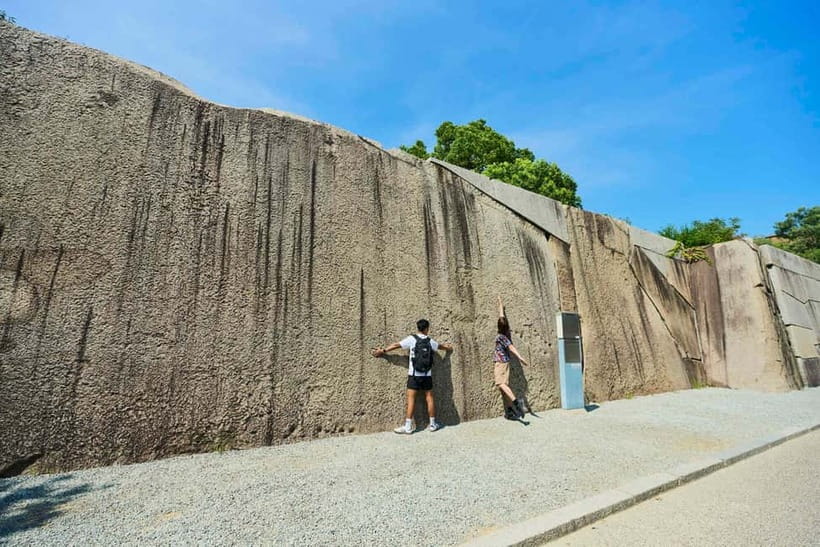
One of the most memorable stops is Osaka Castle’s largest stone. The guide explains how builders in the 16th century transported enormous blocks without modern machinery.
The point is not only the size of the stone. It is the human effort and planning behind it. Moving such a block required organization, labor, routes, and methods that are easy to overlook when you see only the finished wall.
You also look for marks left by master craftsmen. These hidden stone marks help explain how different teams identified or handled their work. They are small details, but they give the walls a more personal character. You stop seeing a single giant construction project and start noticing the individual crews behind it.
The stonework itself gets close attention. Wall angles were chosen to make climbing difficult, and the careful placement of stones added strength as well as visual impact. The guide helps you look at the wall from the point of view of someone trying to get over it, not someone taking a picture in front of it.
This part is especially useful for visitors who have already seen Japanese castles or fortifications elsewhere. It gives you a set of details to look for at other sites: the slope of a wall, the shape of an entrance, the position of a moat, or a symbol cut into a stone.
Same streets, a different route:
- Kyoto Geisha Walking Tour: Gion District & Hidden Gems
★ 4.7 · 3,273 reviews - Tokyo Tsukiji Fish Market Food and Culture Walking Tour
★ 5.0 · 3,184 reviews - Kyoto: Gion Magical Night Walking Tour with Geisha Trivia
★ 4.9 · 2,393 reviews - Kyoto: Gion Geisha District Walking Tour – Stories of Geisha
★ 4.7 · 2,187 reviews
Hokoku Shrine and the Toyotomi connection
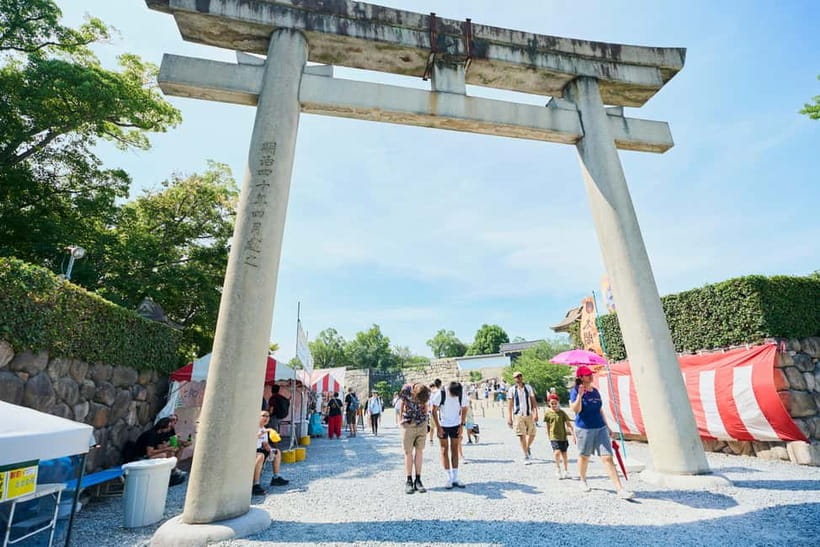
The route includes a guided visit to Hokoku Shrine. The shrine adds a different layer to the castle grounds, moving the story from military construction toward the people and political legacy tied to Osaka Castle.
The tour connects the site with Toyotomi Hideyoshi’s legacy and the later ambition of Tokugawa Ieyasu. This rivalry is central to understanding why Osaka Castle became more than a fortified residence. It was also a political symbol and a focus of power.
The guide explains how the fortress that appeared nearly impossible to defeat eventually fell during the conflicts of 1614 and 1615. That outcome gives the defensive design a sharp historical twist. The castle was built to slow and frustrate an enemy, yet design alone could not settle the political struggle around it.
Hokoku Shrine can also bring an unexpected cultural moment. One tour group happened to see a traditional Japanese wedding ceremony taking place during the visit. You should not count on that happening, but the shrine’s religious setting gives the walk a useful contrast with the castle’s walls, moats, and military purpose.
The shrine stop is relatively brief compared with the castle discussion, so it does not turn the experience into a full religious-site tour. Instead, it helps connect Osaka Castle to the people and events that shaped its meaning.
Entering the tower and looking for its defenses
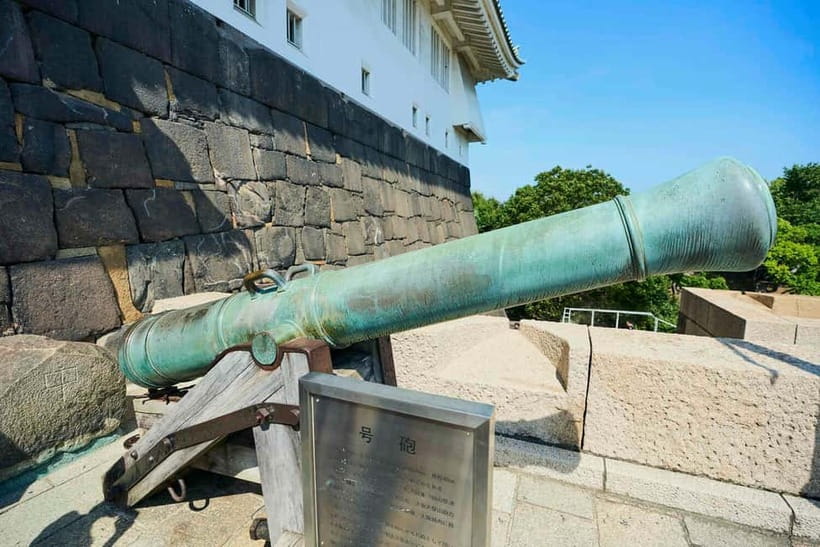
After the outdoor walk, you enter Osaka Castle Tower with admission included. The tower served as a command post and a final defensive position, and the guide points out features such as arrow slits and gun ports.
These openings are easy to miss when you are focused on the tower’s gold decoration and bright exterior. Their presence reminds you that the building had a practical military purpose, even as it projected wealth and authority.
Gold also played a psychological role. It was not merely decoration. The gleaming surfaces could signal power, impress allies, and intimidate enemies. The tour uses that contrast well: the castle needed to be strong, but it also needed to look strong.
You finish with views over Osaka from the top of the tower. The city view is a satisfying reward after the outdoor route because you can look back over the area from the position of the defenders. From above, the placement of the castle within the city becomes easier to understand.
Inside, you have time to visit the museum on your own. This point is important when you plan your day. The guide provides the main historical framework, but does not conduct a floor-by-floor museum tour. If you want to read every display or spend time with the exhibits, plan to continue independently after the guided portion.
Timing, crowds, and the value of skip-the-line entry
The tour advertises separate entrance access, which can be useful at a popular site such as Osaka Castle. A morning start may be a smart choice. One visitor on a 9 a.m. tour found that the lines had grown noticeably by the time the group left around 11 a.m.
The benefit is not only the ticket queue. Guided groups can also help you reach the right photo stops and move through the complex without repeatedly checking a map. The guide knows the sequence and can explain what you are seeing while you walk.
Crowds may still affect the pace. One guide warned a group that the castle could be busy and set realistic expectations about entering the tower. That is good tour practice. Skip-the-line access does not mean you have the entire castle to yourself, and the elevator or interior areas may still have waiting points.
The pace is generally manageable rather than rushed. The walk includes several stops, explanations, photographs, and time for questions. If you have an injured or older member in your group, mention the issue to the guide. Past guides have adjusted the pace and checked that people were comfortable, but the tour still involves walking through historic grounds.
Who will enjoy this experience most
I would choose this tour if you like history, architecture, military strategy, or places that become more interesting once someone explains the design.
It is also a good fit for families. One guide held the attention of a three-year-old for the full tour, and several guides have been praised for using clear explanations and humor. The subject matter is serious, but the format is active enough that you are not standing in one place listening for 90 minutes.
Small groups and solo visitors can benefit from the guide’s flexibility. On some dates, a guest received what was effectively a private tour because no one else joined. That cannot be promised, but a small group makes it easier to ask questions and pause for photographs.
The tour suits visitors who want an organized introduction before exploring more of Osaka. Guides have also offered suggestions for what to do after the castle, which can help you connect this stop with the rest of your day.
I would think twice if you prefer a slow, unstructured visit. The route has a set focus and a set length. You will have independent time in the tower, but most of the outdoor visit follows the guide’s pace.
Price, practical details, and final judgment
At $33, the package combines professional English guiding with Osaka Castle Tower admission. The value comes from the explanation of the grounds and the potential time saved at the entrance, not from having every museum room narrated.
The strongest part is the outdoor history. Triple moats, masugata gates, the largest stone, craftsmen’s marks, and wall angles are much easier to appreciate when someone points them out. The tower view then gives the visit a clear finish.
Book it if you want to understand how Osaka Castle worked and why it mattered. Skip it if you only need admission and photographs. For most first-time visitors, I would choose the tour, especially with an early start and a plan to explore the museum independently afterward.
FAQ
How long does the Osaka Castle tour last?
The activity is advertised as 90 minutes. It includes the guided walk around the castle grounds, Hokoku Shrine, and entry to Osaka Castle Tower.
What is included in the price?
The $33 price includes Osaka Castle Tower admission and a professional English-speaking guide.
Is the castle museum guided floor by floor?
No. The guide explains the castle’s history, defenses, and key features, but each floor of the museum is not guided. You can explore the tower exhibits on your own.
Where does the tour meet?
The meeting point is in front of Lawson S Otemae Rest House Store. Several Lawson stores are nearby, so confirm the location on Google Maps and look for the Local Guide Stars sign.
Is the tour in English?
Yes. The live tour guide speaks English.
Does the tour include skip-the-line access?
Yes. The activity includes access through a separate entrance, which can help you avoid the main ticket line.
What should I bring?
Wear comfortable shoes and clothing suited to the weather. The experience includes walking through outdoor historical sites.
More Castle and Palace Walks in Japan
- Tokyo Castle & Imperial PalaceーShogun Walking Tour
★ 4.7 · 1,068 reviews - Tokyo: Imperial Palace and Shogun Walking Tour
★ 4.9 · 935 reviews - Ultimate Osaka Walking Tour: Castle, Dotonbori & Hidden Gems
★ 5.0 · 862 reviews - Tokyo Castle & Imperial PalaceーShogun Walking Tour
★ 5.0 · 724 reviews
Just added around Japan
- Miyajima Half-day Trip Historical Walking Tour★ 5.0 · 284 reviews
- Hiroshima Walking Tour Why A Bomb was dropped to Hiroshima★ 5.0 · 347 reviews
- Tokyo: Asakusa & Sensoji ー Oldest Temple Walking Tour (2hrs)★ 5.0 · 213 reviews
- Asakusa Senso-ji Temple and Old Tokyo Walking Tour★ 5.0 · 560 reviews
- Asakusa Cultural Walk & Matcha Making Tour★ 5.0 · 245 reviews
- Tokyo: Tsukiji Market Walking Tour & Sushi Cooking Class★ 4.6 · 122 reviews
- Tokyo:Stroll in Old traditional culture towns~Yanaka & Nezu★ 4.9 · 186 reviews
- Tokyo: Shibuya Crossing & Hidden Streets Walking Tour★ 4.8 · 128 reviews
Castle and Palace Walking Tours, compared.

Edinburgh Castle: Guided Walking Tour with Entry Ticket
Read our review →
Doge’s Palace and St Mark’s Basilica Walking Tour
Read our review →
3-Hour Walking Tour of Old Town & Prague Castle
Read our review →Edinburgh Castle: Guided Walking Tour with Entry Ticket
Read our review →
Edinburgh Castle Guided Walking Tour in English
Read our review →


Walking Tour of Split and Diocletian’s Palace
Read our review →Browse the lists this tour appears in