
REVIEW · KYOTO
Kyoto: Gion Geisha District Walking Tour – Stories of Geisha
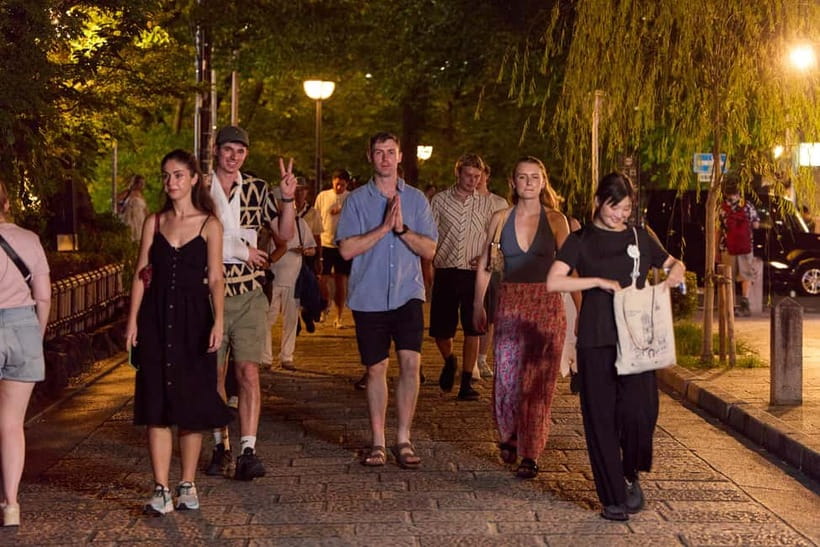
Kyoto’s geisha districts are best understood on foot, after sunset, when the old wooden teahouses begin receiving their evening appointments. This two-hour walk through Pontocho and Gion gives you the setting, the stories, and a chance to spot geiko or maiko on their way to work.
I like two things here: the price is a very reasonable $20 per person, and the guides make a difficult subject easier to understand. Yuki, Nami, Yukari, Deborah, Manuel, and several others are repeatedly praised for their warmth, clear explanations, and willingness to answer questions. The main drawback is that seeing a geiko or maiko is never guaranteed, and the tour finishes away from its starting point.
What makes this Gion walk worth your evening
- You visit two famous districts: Pontocho Alley and Gion each show a different side of Kyoto’s traditional entertainment world.
- The focus is cultural, not just photographic: You learn about training, clothing, customs, work, and the difference between geiko and maiko.
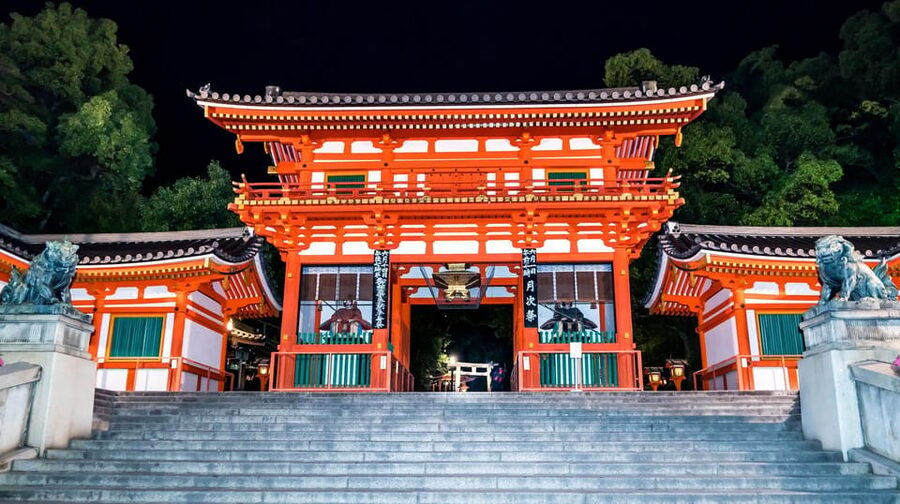
- The route includes major landmarks: Stops include the Izumo-no-Okuni statue, Yasaka Shrine, Gion Corner, and Hanamikoji Street.
- The pace leaves room for questions: The tour is broken into short stops, with time to listen, take photos, and ask about what you see.
- The evening setting matters: Narrow lanes, wooden teahouses, and softly lit streets give the districts their strongest atmosphere.
- You may see working geiko or maiko: The guide helps you spot them respectfully, but an encounter depends on timing and luck.
Starting near Shijo and getting oriented
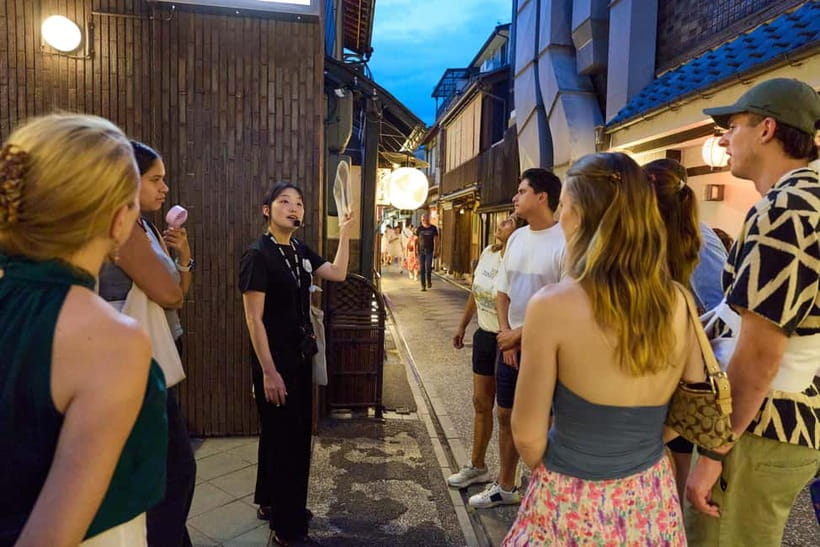
The meeting point is in front of Ben’s Cookies Kyoto Shijo. Look for the guide holding a sign board. This is a central starting point, but give yourself enough time to find the shop, especially if you are coming from another part of Kyoto.
The walk begins with about ten minutes of guided explanation near the meeting point. That opening matters. Geisha culture comes with unfamiliar names and assumptions, and a little groundwork helps you understand the rest of the evening.
In Kyoto, the terms geiko and geisha refer to trained professional entertainers. Maiko are apprentices, generally recognized by their more youthful styling and elaborate clothing. The tour explains how these roles developed and how training shapes their daily lives.
I like that the experience is built around explanation rather than a quick parade of photo stops. You are not simply pointed toward a pretty lane and sent on your way. The guide gives you a framework for understanding what the teahouses are for and why the districts still matter.
The activity is offered in English or Spanish. The guide names vary, but the strongest feedback repeatedly highlights Yuki, Nami, Yukari, Deborah, Manuel, Kenji, Shin, Adrian, Michael, and Akari. The important point is not any single guide assignment. It is that the tour depends heavily on the person leading it, and the available feedback points to guides who are friendly, well prepared, and comfortable with questions.
A few more walking tours around Kyoto worth a look
- Kyoto Geisha Walking Tour: Gion District & Hidden Gems
★ 4.7 · 3,273 reviews - Kyoto: Gion Magical Night Walking Tour with Geisha Trivia
★ 4.9 · 2,393 reviews - Night Walk in Gion: Kyoto’s Geisha District
★ 4.5 · 2,003 reviews
Pontocho Alley, Kyoto’s narrow evening corridor
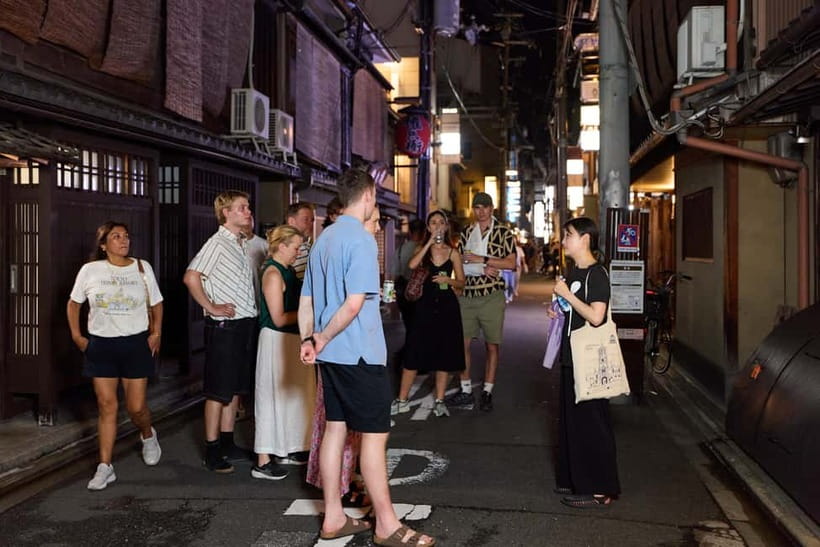
From the starting point, the group heads toward Pontocho Alley for about fifteen minutes of guided exploration. Pontocho is a narrow street lined with traditional eateries, teahouses, and elite clubs. It is one of the most atmospheric parts of the route, but it is also one of the busiest and tightest spaces.
You will notice how different the alley feels from a normal shopping street. The buildings are close together, and the older wooden façades give the lane a strong sense of continuity. The point is not to enter the private clubs. The value comes from learning how this kind of street functions and how its businesses connect with Kyoto’s traditional entertainment culture.
This is a place where a guide helps. On your own, you can walk the length of Pontocho in minutes and see attractive façades. With context, you begin to understand why the street is associated with formal hospitality, food, performance, and carefully maintained customs.
The narrow passage can make group movement awkward. You may need to pause to let people pass, and good photos can be difficult when the lane is crowded. Still, the short stop works well as an introduction to the evening.
The Izumo-no-Okuni statue and the story of kabuki
After Pontocho, the route crosses the river and pauses for about fifteen minutes at the statue of Izumo-no-Okuni. Here you learn about the woman associated with the creation of kabuki.
This stop broadens the story. The tour is not only about geiko and maiko. It also places Kyoto’s performance traditions in a wider setting, showing how entertainment, dance, costume, and public performance have shaped the city.
The statue gives the guide a fixed point for explaining this connection. It is also a useful breathing space between the two districts. You can listen without trying to walk through a tight alley, and you have a natural place to ask questions before moving into Gion.
Do not expect a large monument or a long sightseeing stop. The value is the story attached to it. If you already know a lot about kabuki, this section may feel brief. For most visitors, it adds useful background to the evening.
Entering Gion through traditional streets
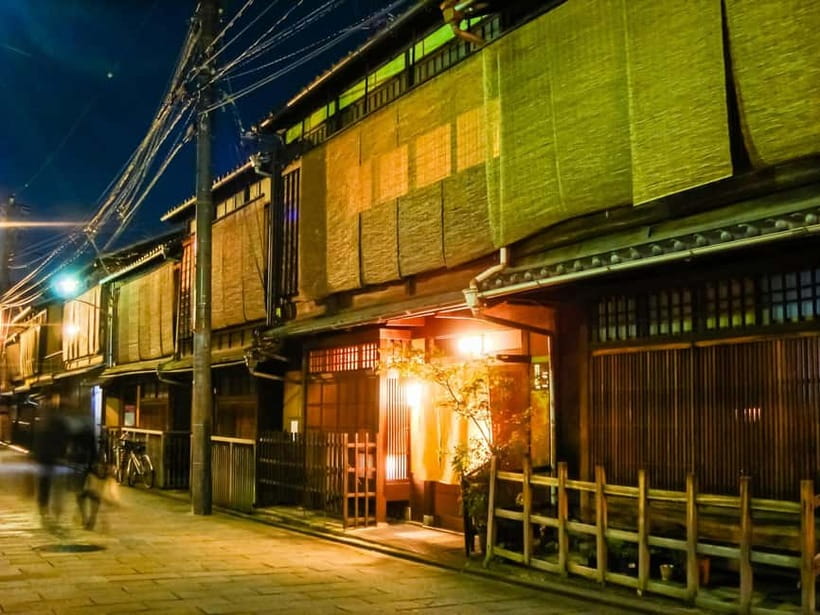
The tour then spends about thirty minutes exploring Gion. This is Kyoto’s best-known geisha district, with older wooden buildings, narrow lanes, and streets connected to teahouses and traditional restaurants.
Gion can be visually striking, but it is also a working neighborhood rather than a stage set. The guide’s job is to help you see the difference. You are learning about a living tradition, not simply walking through an old-fashioned movie scene.
The route is especially useful if you have only a short stay in Kyoto. One guide, Ann, was praised for adjusting her explanations for people who knew nothing about geisha culture as well as those who had already read about it. That flexibility is important in a mixed group.
Several guides also use photographs while explaining clothing and stages of training. This helps when you are trying to understand details that may be hard to see at night. You might hear about the lives of geiko and maiko, their preparation, and the importance of ceremony in Japanese culture.
The tour does not promise access to a teahouse or a private performance. That is a strength, not a weakness, for anyone hoping to understand the district without confusing a public walk with a paid cultural show. You see the setting and learn how the tradition works, but you remain on public streets.
Same streets, a different route:
- Best of Kyoto: Gion, Geisha, Pagodas & Cobblestones
★ 4.9 · 2,058 reviews - Kyoto Gion Geisha District Walking Tour – The Stories of Geisha
★ 5.0 · 1,441 reviews - Nishiki Market Brunch Walking Tour (7 Tastings + Brunch)
★ 5.0 · 1,355 reviews - Kyoto Arashiyama Walking Tour: Bamboo, Monkeys, Gardens & Secrets
★ 5.0 · 1,216 reviews
Yasaka Shrine after dark
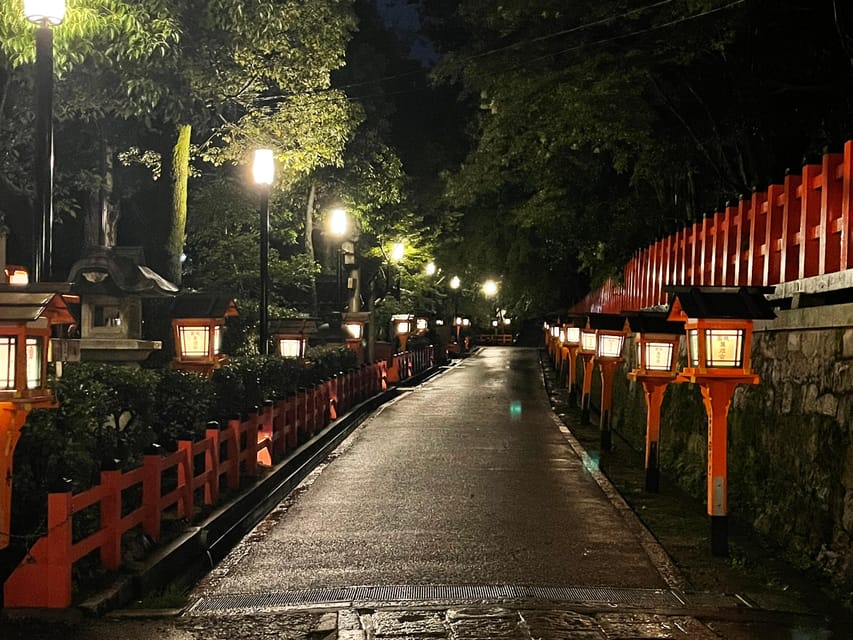
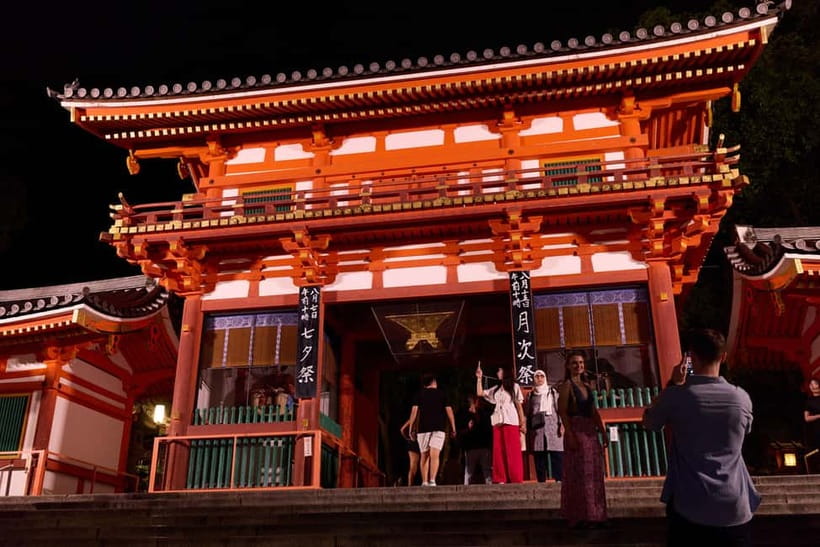
Yasaka Shrine receives about twenty-five minutes of guided attention. This is one of the most important religious sites in the area and gives the walk a change of pace from the commercial lanes.
The shrine helps explain that Gion is not only an entertainment district. Religious sites, festivals, neighborhood life, restaurants, teahouses, and tourism all overlap here. A visit at night also changes how you take in the architecture and open spaces.
This part may be less exciting for someone focused only on spotting geiko or maiko. I think it earns its place because it gives the evening some balance. Without it, the route could feel like a search for performers. With it, you get a clearer picture of the area around Gion.
The route includes about twenty-five minutes here, though the exact flow can depend on the guide and the group. If the weather turns poor, the guide may need to adjust where the group stops. One account specifically praised a guide for finding sheltered places during heavy rain.
Gion Corner and the meaning of performance
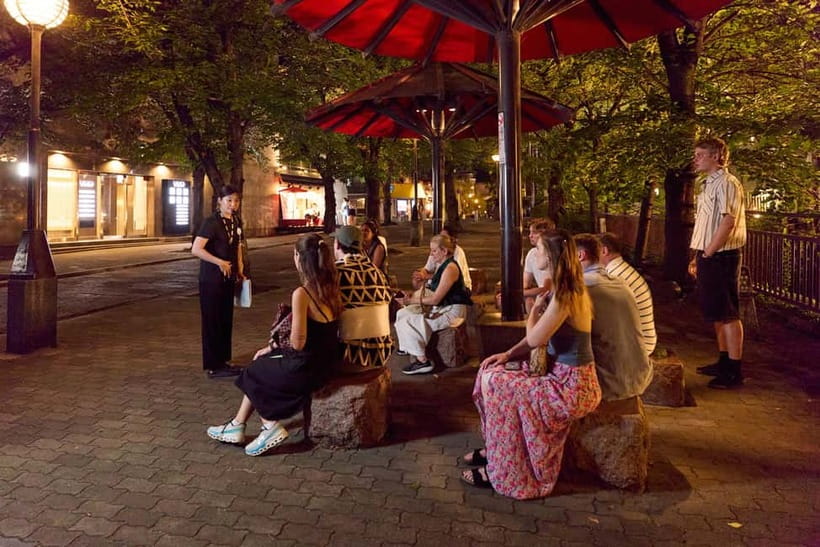
The next stop is Gion Corner, with about ten minutes of guided explanation. This is another chance to connect geiko and maiko culture with Kyoto’s performing arts.
You should think of this as a short interpretive stop, not a scheduled show. The tour does not include a formal performance or a geisha meal. Instead, the guide explains the role of performance and the traditions linked to the district.
That distinction is important when comparing this walk with more expensive Kyoto experiences. A private dinner or staged cultural program may offer direct entertainment, but it will cost far more. This tour gives you the background at a fraction of the price, then leaves you free to choose another cultural activity later.
Hanamikoji Street and the chance to see geiko or maiko
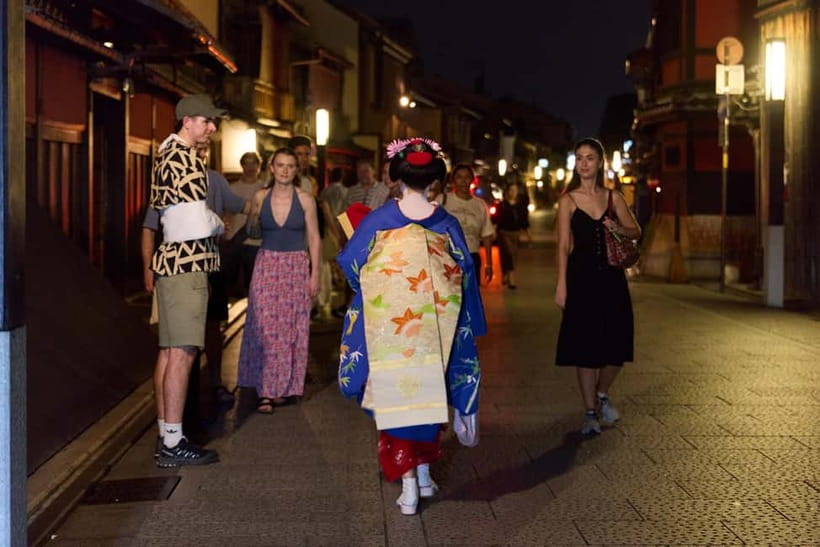
The route finishes on Hanamikoji Street, one of Gion’s most recognizable streets. The guide walks with you for about fifteen minutes and keeps an eye out for geiko and maiko heading to appointments.
This is likely the moment you are anticipating most. Some groups see a maiko, some see a geiko, and some see none. Several accounts describe the excitement of spotting one, including an encounter with a maiko and another with real geiko rather than maiko. Other feedback makes clear that sightings can be limited.
That unpredictability is worth stating plainly. You are not buying a guaranteed appearance. You are joining an evening walk through the district at a time when working performers may pass by.
If you do see someone, the guide’s role is especially valuable. You receive help identifying what you are seeing and understanding the difference between geiko and maiko. Just as important, you are reminded to treat the moment as part of someone’s workday, not as a staged meet-and-greet.
The street itself is worth seeing even without a sighting. The old façades and narrow lanes provide the visual setting that most people associate with Gion. But Hanamikoji can also be busy, and evening darkness limits architectural detail. If you want the best look at the buildings, consider returning in daylight on your own.
Guide quality shapes the whole experience
This tour is a classic example of a walking experience where the guide matters as much as the route. The stops are appealing, but the subject is too complex for a flat script.
Yuki receives especially warm praise for combining local pride with respect for Kyoto’s traditions. Nami is repeatedly described as friendly, clear, and attentive to the group’s pace. Yukari is praised for making the walk casual and fun while still explaining the subject well. Deborah is noted for strong storytelling, photographs, and skill in handling questions.
Other named guides, including Manuel, Kenji, Shin, Adrian, Michael, Akari, Ann, and Melanie, are also praised for making the subject accessible. You may not be able to choose your guide when booking, so I would judge the tour as a good format rather than book it solely for one person.
The group size can vary. One group had six people, while another had about thirteen. That is small enough for questions in many cases, but you should not assume every departure will feel private.
Pace, walking comfort, and practical details
The full activity lasts two hours and covers several districts and landmarks. It is a city walk rather than a strenuous hike, but you will be on your feet and moving through narrow streets. Wear comfortable shoes and bring water.
The evening timing works well for the subject. Pontocho and Gion are more atmospheric after dark, and the tour takes place when performers may be traveling to appointments. The tradeoff is that some buildings and shrine details are harder to see than they would be during the day.
The tour begins at Ben’s Cookies Kyoto Shijo and does not necessarily finish at the starting point. One person was surprised by this and had to work out the return route afterward. Before you set off, ask the guide where the walk ends and keep your phone map ready.
The activity is not suitable for children under ten. Alcohol and drugs are not allowed. English and Spanish departures are available, and cancellation is free up to twenty-four hours before the start time. You can also reserve now and pay later, which helps if your Kyoto schedule is still changing.
Is $20 a fair price?
Yes, provided you want explanation more than entertainment. At $20, you are paying for two hours of local guiding across two famous districts, with historical context and time for questions. That is strong value compared with a formal geisha performance, private meal, or paid cultural presentation.
The price does not include food, drinks, a show, entry to a private teahouse, or a guaranteed meeting with geiko or maiko. If you want direct contact or a performance, this is the wrong product.
For a first evening in Kyoto, I think the value is particularly good. The walk can give you enough background to make later visits to Gion more meaningful. It also helps you avoid treating the district as a simple photo stop.
Who should book this Gion tour?
I would recommend it to first-time Kyoto visitors, adults and older children, and anyone curious about Japanese performance traditions. It suits you especially well if you like asking questions and prefer a local explanation to reading signs as you walk.
It is also a good fit for a short Kyoto stay. Two hours is enough to cover the main areas without consuming an entire day. Several guides offer restaurant or sightseeing suggestions at the end, which can help you plan the rest of your visit.
I would think twice if you want guaranteed sightings, a private group, or an actual geisha performance. The route can also feel less satisfying in poor weather or if you have limited walking comfort. Still, the guides have shown they can adapt the pace and find shelter when needed.
FAQ
Where does the Gion geisha walking tour meet?
Meet in front of the Ben’s Cookies Kyoto Shijo shop. The guide will be holding a sign board.
How long does the tour last?
The tour lasts two hours.
What locations does the tour visit?
The route includes Pontocho Alley, the statue of Izumo-no-Okuni, Gion, Yasaka Shrine, Gion Corner, and Hanamikoji Street.
What languages are available?
The tour is available with a live guide in English or Spanish.
Does the tour guarantee that I will see a geiko or maiko?
No. The route gives you a chance to see geiko or maiko traveling to appointments, but sightings depend on timing.
Is the tour suitable for children?
The activity is not suitable for children under ten.
What should I bring?
Bring water. Comfortable walking shoes are also a sensible choice for a two-hour city walk.
Can I cancel the booking?
You can cancel up to twenty-four hours in advance for a full refund.
Can I reserve now and pay later?
Yes. The booking option allows you to reserve your place and pay later.
Should you book it?
Book this tour if you want a clear, affordable introduction to Kyoto’s geiko and maiko traditions, with an evening walk through Pontocho and Gion. The strongest reason to go is the guide: people such as Yuki, Nami, Yukari, and Deborah bring the subject to life with stories, photographs, local detail, and time for questions.
Go with realistic expectations. You may see a working geiko or maiko, but you may not. You will not enter a private teahouse or attend a formal performance. What you will get is a well-priced cultural walk that gives the streets meaning, and that is enough reason for me to recommend it.
Just added around Kyoto
- Kyoto: Meet the Geisha Maiko with Gion Walking Tour★ 4.8 · 371 reviews
- Cool Kyoto: 5-Hour Walking Tour with the Last Samurai★ 4.8 · 73 reviews
- Gion Walking Tour by Night★ 4.5 · 429 reviews
- Kyoto Sake Brewery & Tasting Walking Tour★ 5.0 · 623 reviews
- Kyoto Gion Night Walk & Geisha District Guided Tour★ 5.0 · 786 reviews
- Kyoto: Izakaya Bars Guided Walking Tour★ 4.9 · 815 reviews
- Kyoto Gion: 2-Hour Geisha Culture & History Walking Tour★ 5.0 · 1,186 reviews
- Kyoto Arashiyama Walking Tour: Bamboo, Monkeys, Gardens & Secrets★ 5.0 · 1,216 reviews
Walking Tours, compared.

Magical London: Harry Potter Guided Walking Tour
Read our review →
Reykjavik Food Walk – Local Foodie Adventure in Iceland
Read our review →
History and Hauntings of Salem Guided Walking Tour
Read our review →
New Orleans Premier Ghost, Voodoo and Vampire Walking Tour
Read our review →
Amsterdam Anne Frank: Small-Group Walking Tour & Local Guide
Read our review →

Edinburgh Castle: Guided Walking Tour with Entry Ticket
Read our review →
Anne Frank’s Story – Guided Walking Tour through Amsterdam
Read our review →Browse the lists this tour appears in