

REVIEW · SPLIT
Walking Tour of Split and Diocletian’s Palace
Diocletian’s Palace is not a fenced-off ruin. It is the heart of modern Split, with cafés, homes, shops, churches, and lanes tucked inside an ancient Roman plan. This 90-minute walking tour gives you a useful first look at the palace and the old city without asking you to spend half a day on your feet.
I like the route for two reasons: it connects the main Roman sights with later Venetian and Croatian landmarks, and it adds local history that you might miss on your own. Guides such as Antonella, Anton, Mario, and Marino have received especially warm praise for clear storytelling, humor, and genuine feeling for Split.
The main drawback is sound. Groups can reach 20 people, and several tours often gather in the same narrow spaces. Without headsets, a soft-spoken guide can be hard to hear, so try to stay close and choose a quieter tour time if your schedule allows.
Key Points to Know Before You Book
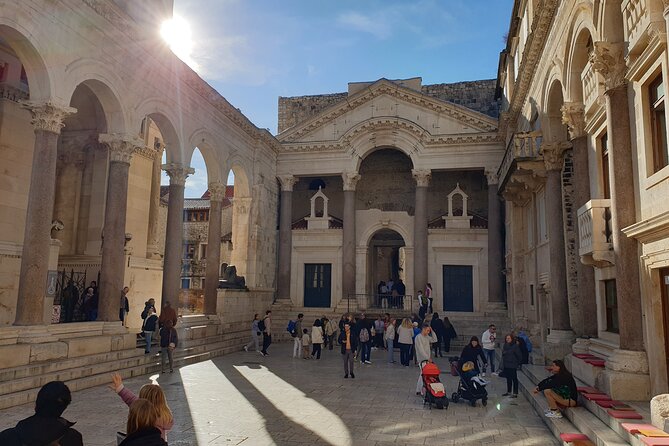
- The Peristyle is your starting point: This central square helps you understand how the palace connects to the rest of Split.
- The tour covers seven historic stops: You see the Peristyle, Vestibule, substructures, Golden Gate, Riva, Fruit’s Square, and the old synagogue.
- No entrance tickets are included: The walking portion covers exterior and public areas, while paid sections and the museum require separate admission.
- The group can reach 20 people: Small groups are advertised, but the actual experience may feel less intimate when the group is full.
- High and uneven steps matter: You should be comfortable with old stairs and irregular stone surfaces.
- It works best as your first Split activity: The route gives you a map in your head, making it easier to plan the rest of your visit.
Why This Walk Helps You Understand Split
The appeal of this tour is not simply seeing a Roman palace. It is learning how a palace became a city.
Emperor Diocletian built his retirement residence near the Roman settlement of Salona in the early fourth century. Centuries later, people moved into and around the abandoned complex, adapting its walls and rooms for daily life. That is why Split can feel unusual at first. The palace is not one complete monument waiting for inspection. It is a living center where ancient columns may sit beside a restaurant entrance and Roman stonework may support a modern apartment.
I like having a guide at the beginning because the layout can be confusing. The Peristyle, the four gates, the cellar level, the emperor’s quarters, and the waterfront all make more sense once someone explains how they fit together. You will also hear about later Venetian influence, Croatian cultural figures, and Split’s Jewish community, not only the emperor.
At $48.37 per person, the value depends on what you want. You are paying for an English-language guide and a structured introduction, not for entry into every paid monument. If you plan to explore the palace museum and other ticketed areas afterward, budget for those separately. If you have only one day in Split, the tour can save time by giving you a clear route and useful context at the start.
More Castle and Palace Walks in Split:
- Split: Old Town and Diocletian Palace Walking Tour
★ 4.9 · 4,727 reviews - Split & Diocletian’s Palace Walking Tour
★ 5.0 · 1,125 reviews - Split: Diocletian Palace & Old Town Guided Walking Tour
★ 4.7 · 882 reviews
Meeting at the Peristyle
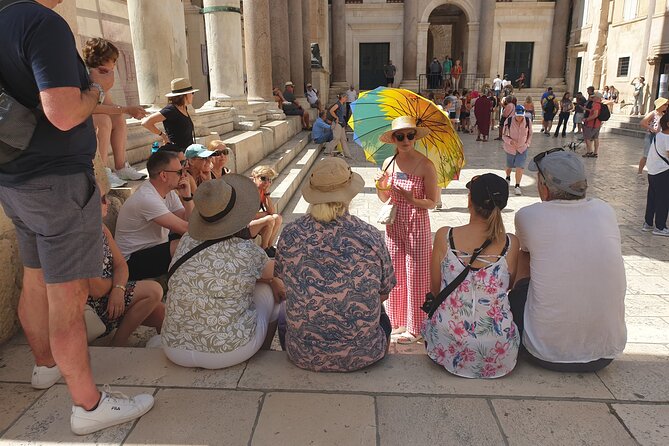
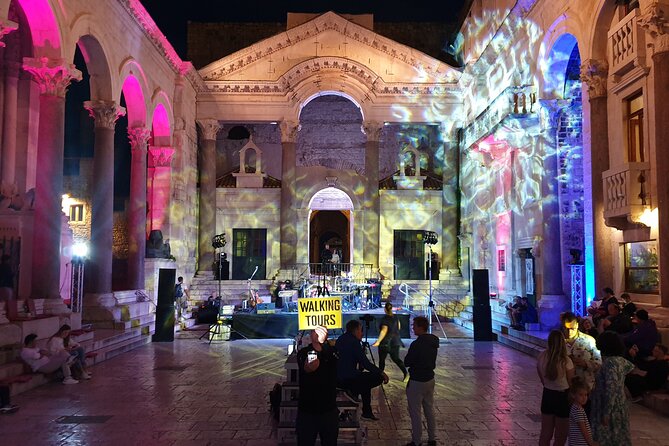
The tour begins on Peristil ulica, at the Peristyle, the palace’s grand central square. This is a sensible meeting point, but it can be difficult to locate if you are unfamiliar with Split’s lanes. Allow extra time and look for the open Roman square rather than relying only on a street address.
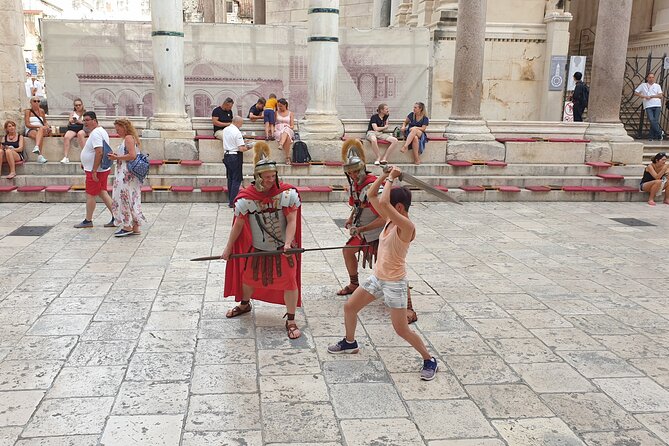
The Peristyle is the best place to begin because it acts as the palace’s main crossroads. From here, you can reach many of the complex’s important areas. The guide spends about 15 minutes explaining the square and its role in the palace plan.
Expect crowds, especially when several walking groups arrive at once. Stay near the guide from the start. This is also the spot where the size of your group becomes clear. A group of 10 or fewer should feel manageable, while the maximum of 20 can make it harder to hear in a busy square.
The Vestibule and the Sound of Dalmatian Song
From the Peristyle, you move to the Vestibule, the round entrance space leading toward the emperor’s private areas. The stop lasts about five minutes, but it can be memorable because of the shape and acoustics of the room.
The guide explains the Vestibule’s original purpose and its place in the palace. You might also hear traditional Dalmatian singing here. The sound carries well in the rounded chamber, although the experience depends on timing and who is present.
This is one of the places where staying close matters most. A guide with a strong voice can make the stop enjoyable for everyone. If your guide speaks softly, the echo can work against you. Do not be shy about moving nearer before the explanation begins.
Palace Substructures and What They Reveal
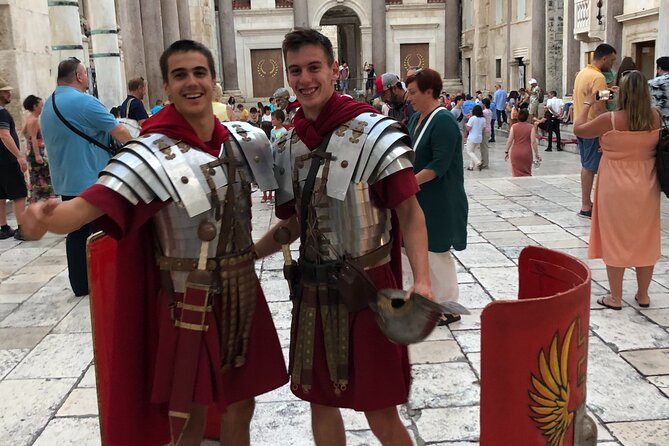
The substructures are among the most useful stops for understanding how Diocletian’s Palace was built. The lower level mirrors much of the structure above, which helps explain the palace’s original rooms and layout.
You spend about 10 minutes learning how the substructures were constructed and how their purpose changed over the centuries. This is not only an underground walk. It is a lesson in how later residents preserved the upper palace by using, filling, or adapting the lower spaces.
The tour does not include the museum section of the substructures, and no admission tickets are part of the package. You can visit the museum after the guided walk if you want a closer look at archaeological details. That arrangement keeps the tour price focused on guiding, but it also means you should not expect a full cellar visit during the 90 minutes.
Watch your footing here. The palace has old steps and uneven surfaces, and the experience is not a good match for anyone who has trouble with high steps. Comfortable shoes will help, though the most important preparation is simply moving carefully.
A few more walking tours around Split worth a look
- Krka Waterfalls tour with Trogir Walking tour and Krka panoramic boat cruise
★ 5.0 · 1,659 reviews - Walking Tour of Split with a ‘Magister’ of History
★ 5.0 · 1,122 reviews - Split Walking Tour with Professor of History
★ 5.0 · 926 reviews - From Split: Krka Waterfalls Cruise & Trogir Walking Tour
★ 4.7 · 681 reviews
The Golden Gate and Gregory of Nin
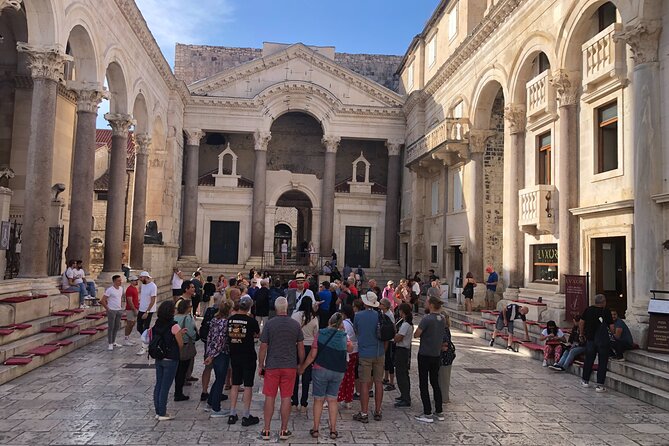
The Golden Gate is the palace’s main northern entrance and one of the clearest places to picture how people once entered the imperial complex. The guide explains the gate’s role and points out the statue of Gregory of Nin nearby.
Gregory of Nin was a medieval bishop linked to the use of the Croatian language in church services. His importance reaches beyond the statue itself, and the stop gives the guide a chance to connect Split’s medieval story with Croatian language and identity.
You will also hear the familiar local custom of touching the statue’s toe for good luck. That detail is not the main reason to visit, but it adds a simple, hands-on moment to a history walk. The Golden Gate is free to view, so you can return later on your own if the group is crowded during the first visit.
Riva Harbor and Split’s Waterfront

The route then opens out toward Riva Harbor, Split’s waterfront promenade. After the tight lanes and stone passages of the palace, the waterfront gives you room to pause and see the city from a broader angle.
A bronze model of Diocletian’s Palace helps you picture the full complex. This is especially useful if you have been trying to understand how the palace’s four gates, central square, and waterfront edge connect. The guide also explains the story of the Riva and its place in Split life.
I find this stop valuable for planning. You can begin to orient yourself toward the harbor, see how close the old city is to the water, and decide which parts deserve a later return. The stop takes about 15 minutes, making it one of the longer pauses on the route.
Fruit’s Square and Venetian Split
Fruit’s Square, officially Trg Braće Radić, introduces a different period of the city’s past. Here you learn about a 15th-century Venetian citadel and the role of Marko Marulić, often called the father of Croatian literature.
This is where the tour moves beyond the imperial palace most clearly. You see how Split continued to change long after Roman rule, with Venetian defenses and Croatian cultural life adding new layers to the old center.
The square is also a good place to listen for the guide’s storytelling style. Some guides, including Antonella and Anton, have been praised for mixing facts with humor. Others take a more classroom-like approach, with dates and political details. If you prefer lively stories, the guide assignment can make a real difference.
Passing the Old Split Synagogue
The final listed stop is the Split Synagogue, a 16th-century place of worship connected with the city’s Jewish community. The tour passes by the site and explains the history of Jewish life in Split.
This is a brief but worthwhile addition because it widens the tour’s focus. You are not only seeing Roman power and Venetian defenses. You are also learning about the communities that shaped the city over time.
Admission is not included, and the tour does not promise an interior visit. Treat this as a historical stop from the street rather than a synagogue tour. The explanation can help you notice a part of Split that is easy to overlook when your attention is fixed on the palace’s Roman remains.
Guide Style Can Shape the Experience
The strongest part of this activity is the guide. Names that have drawn particular praise include Antonella, Anton, Mario, Marino, Maggie, and Antonio. Their styles vary, but the best guides combine clear English, a sense of humor, and enthusiasm for Split.
Antonella is described as friendly, organized, funny, and easy to understand. Anton and Anthony are praised for energetic presentations that make the palace’s details easier to follow. Mario is noted for answering questions beyond the planned route, while Marino is described as a history teacher with strong passion for his city.
That last point also signals a possible weakness. A guide with a teaching background may offer a detailed history lesson, but a soft voice or less focused presentation can make the walk difficult. One experience ran much longer than the advertised duration, while another finished in less than an hour and a half. Most tours should be planned around the stated 90 minutes, but guide style and group conditions can affect the pace.
The company does not provide headsets according to the practical concerns raised about hearing the guide. In crowded palace spaces, position yourself close to the guide and ask politely if you cannot hear. This simple step may make a large difference.
Timing, Group Size, and Physical Demands
Several departure times are available, which helps if you are fitting Split between a cruise arrival, a meal, or another activity. Since the route is outdoors and through public spaces, the atmosphere can change greatly depending on how many other groups are in the palace at the same time.
The maximum group size is 20. That is not a private tour, and you should not book it expecting a one-on-one conversation. Still, a smaller group within that limit can give you chances to ask questions and stay near the guide.
The tour is near public transportation, service animals are allowed, and most people can take part. The main physical concern is the old architecture. High steps, uneven stones, and narrow passages are part of the setting. If stairs are difficult for you, this is not the easiest way to see Split.
Free cancellation is available up to 24 hours before the start time. Changes or cancellations inside that period are not accepted for a refund. The activity also requires a minimum number of participants, so a cancellation by the operator can result in another date or a full refund.
Who Should Book This Split Tour?
I would choose this tour if you are visiting Split for the first time, have only a day, or want the city’s Roman remains explained before exploring alone. It is also useful for families and couples who prefer a clear route instead of stopping constantly to read signs or guess what survives from the original palace.
The tour suits people who enjoy history but do not want a long museum lecture. You get Roman architecture, medieval Croatian culture, Venetian defenses, the waterfront, and local religious history in one compact walk.
I would hesitate if you want full access to the paid palace areas, a private guide, or a guaranteed quiet experience. You must pay separately for the substructure museum, and a full group can make hearing difficult. Anyone who dislikes stairs should also think twice.
Should You Book It?
Book it if you want a well-organized introduction to Split and value a guide who can connect the palace to the city around it. The high overall rating reflects how much the experience can depend on a strong guide, with Antonella, Anton, Mario, Marino, and others offering the kind of clear, lively instruction that makes old stones easier to understand.
Go in with realistic expectations. This is a guided overview, not an all-access palace ticket and not a private walk. Stay near the guide, arrive early at the Peristyle, wear supportive shoes, and plan extra time if you want to visit the paid substructures museum afterward. For a first look at Split, that is a fair trade for $48.37.
FAQ
Where does the walking tour begin?
The tour begins at Peristil ulica, at the Peristyle in Split’s historic center. It ends back at the meeting point.
How long does the tour last?
The listed duration is approximately 1 hour and 30 minutes. Actual timing can vary by guide and group.
Are entrance tickets included?
No. Admission tickets are not included. The museum section of the palace substructures is not part of the guided visit, but you can visit it afterward.
Is the tour offered in English?
Yes. The tour is offered in English and is led by a guide with knowledge of the palace and Split.
How many people can join the tour?
The maximum group size is 20 people. The experience may feel more personal when fewer people are booked.
Is the tour suitable for people with mobility issues?
Most people can participate, but the tour is not recommended for anyone who has difficulty with high steps. The route includes old and uneven surfaces.
Just added around Split
- Diocletian’s Palace and Old Town SMALL GROUP Walking Tour★ 5.0 · 502 reviews
- Split: City Walking Tour w/ Game of Thrones Locations★ 4.9 · 318 reviews
- Discover The Old Town Split 1.5h walking Small group tour★ 4.8 · 93 reviews
- SPLIT-PRIVATE Walking Tour of Diocletian’s Palace & Old Town★ 5.0 · 467 reviews
- Split: History and Heritage Walking Tour★ 4.9 · 650 reviews
- From Split: Krka Waterfalls Cruise & Trogir Walking Tour★ 4.7 · 681 reviews
- Split: Diocletian Palace & Old Town Guided Walking Tour★ 4.7 · 882 reviews
- Split Walking Tour with Professor of History★ 5.0 · 926 reviews
Castle and Palace Walking Tours, compared.

Edinburgh Castle: Guided Walking Tour with Entry Ticket
Read our review →
Doge’s Palace and St Mark’s Basilica Walking Tour
Read our review →
3-Hour Walking Tour of Old Town & Prague Castle
Read our review →Edinburgh Castle: Guided Walking Tour with Entry Ticket
Read our review →
Edinburgh Castle Guided Walking Tour in English
Read our review →


Grand Palace and Wat Phra Kaew Guided Walking Tour
Read our review →Browse the lists this tour appears in