REVIEW · BERLIN
Private Walking Tour Berlin Third Reich Hitler and World War II
Berlin’s Nazi past is scattered across the city, often beneath ordinary streets and office buildings. This private tour links those places into one serious, wide-ranging lesson, from the Soviet Memorial in Tiergarten to the site of the Führerbunker and the former Nazi government quarter.
I like the private format, which lets your guide adjust the pace and answer real questions rather than deliver a fixed speech. I also like the hotel pickup and drop-off, especially since the route covers a large part of central Berlin. The main drawback is that the schedule is packed: many stops receive only 10 or 15 minutes, and the tour can feel heavy after several hours of war, murder, and political terror.
Key points to know before booking
- The route covers 12 major sites, including the Holocaust Memorial, Bebelplatz, the Reichstag, and the German Resistance Memorial Center.
- Your hotel pickup and drop-off are included, making a broad city route easier to manage.
- Private guiding makes the day flexible, and guides such as Daniel, Jimmy, Georgia, Jasper, Simon, and Tobi have been praised for clear explanations and personal pacing.
- The tour is more about context than entry tickets, with most stops viewed from outside or visited briefly.
- The Topography of Terror and Holocaust Memorial deserve extra time, so plan to return on your own if you want a full museum visit.
- The experience is conducted in English, lasts about 3 to 4 hours, and costs $192.97 per person.
Why this private Berlin history tour works
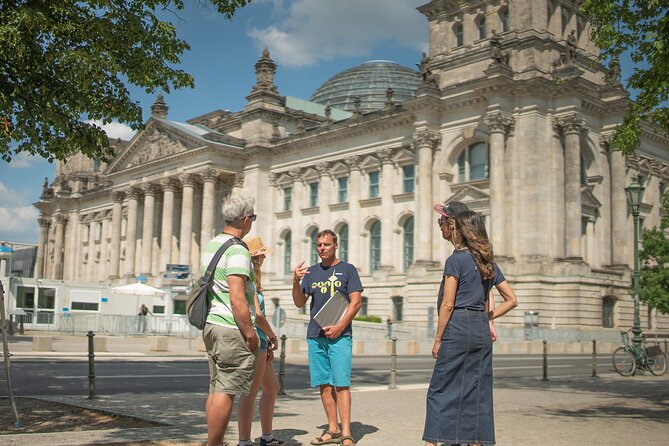
This is not a single museum visit. It is a citywide walk through the machinery, crimes, opposition, and final collapse of the Nazi regime.
You see where officials worked, where books were burned, where resistance was planned, where victims were deported, and where Hitler spent his final days. The guide’s job is to connect these sites. That matters in Berlin, where a plain building can carry more historical weight than its appearance suggests.
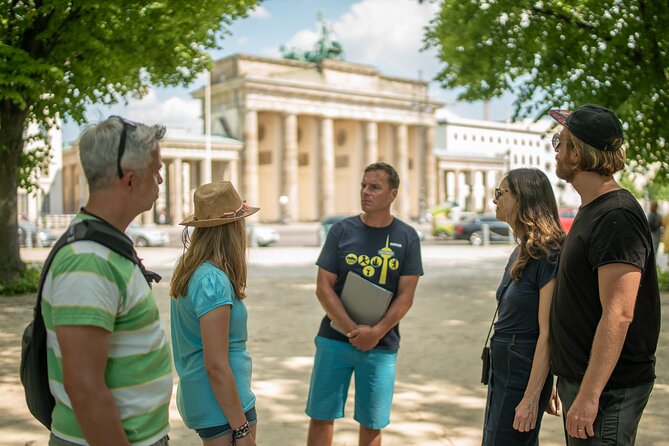
The private setup is the tour’s strongest feature. Your guide can ask what you already know, slow down for questions, or skip a subject you have covered elsewhere. Daniel, Jimmy, Georgia, Jasper, Simon, Tobi, Martin, and others have been praised for tailoring the route, keeping a good pace, and making difficult material understandable.
The price is $192.97 per person. That is a serious charge, but the value improves if you are traveling as a small family or group and want hotel service plus several hours with one guide. Group discounts are offered, so check the final price for your party rather than judging the per-person figure alone.
This is not the cheapest way to see Berlin’s wartime sites. You are paying for a private guide, flexibility, and the time saved by linking distant locations in one outing. Admission is not included, and the main value comes from interpretation rather than paid access to interiors.
More History Walking Tours in Berlin
- Berlin: Third Reich & Cold War Guided Walking Tour
★ 4.9 · 8,378 reviews - Berlin’s Best: 2 Hour Walking Tour Third Reich and the Cold War
★ 5.0 · 5,486 reviews - Third Reich Berlin: Hitler and WWII Walking Tour
★ 5.0 · 3,301 reviews
Tiergarten begins with Soviet victory and German defeat
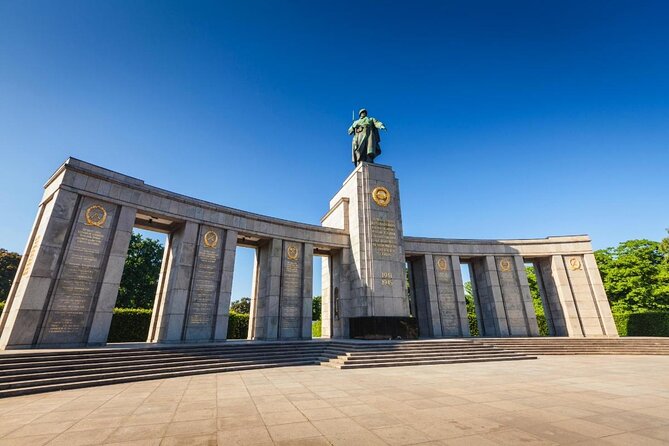
The Soviet Memorial Tiergarten gives the tour a strong opening. Built in 1949, it honors Soviet soldiers killed in the 1945 Battle of Berlin.
The memorial’s central statue shows a soldier holding a sword and shield. Your guide explains the symbolism, the Soviet role in defeating Nazi Germany, and the complicated place of the memorial in both Soviet and German memory.
You spend about 10 minutes here, so this is an introduction rather than a full study. I like the choice of starting point because it frames the war through the final defeat of the Nazi regime, not just through Hitler’s personal story.
Wilhelmstraße reveals how Nazi power operated
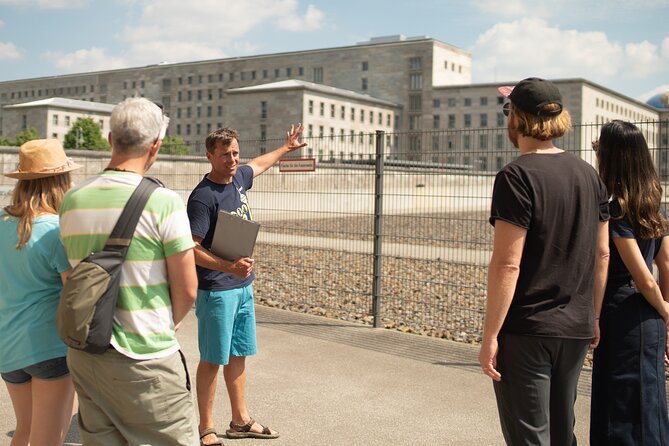
At the Detlev-Rohwedder-Haus on Wilhelmstraße, the tour shifts from battlefield history to government power. The building was first constructed as the Reichsbank headquarters and later housed the Ministry of Aviation under Hermann Göring.
This stop helps you see that dictatorship depended on offices, ministries, money, paperwork, and administrative decisions. The building later became the German Federal Treasury, a useful reminder that Berlin’s past is often built into ordinary working places.
The visit lasts about 10 minutes, followed by a longer walk along Wilhelmstraße. Once the center of Nazi government, the avenue held ministries and offices tied to military policy, propaganda, and rule. Your guide points out what occupied the area and explains how the street supported the regime’s operations.
Because much of this is viewed from outside, a strong guide matters. You are not simply looking at façades. You are learning what happened inside them and how political control took shape.
Topography of Terror puts repression at street level
The Topography of Terror occupies the former grounds of the SS and Gestapo headquarters. Its indoor and outdoor displays use photographs, documents, and personal accounts to explain political repression and state violence.
This is one of the most important stops on the route because it shifts attention away from Hitler alone. You learn how institutions targeted opponents, enforced fear, and helped turn Nazi policy into daily reality.
The scheduled visit is about 20 minutes. That is enough for an orientation, but not enough to read the exhibition in detail. I would treat this as a guided introduction and return later if the subject interests you. One useful advantage of the private tour is that your guide can explain what deserves a second visit.
More History Walking Tours in Germany
- Berlin: Third Reich, Hitler, and WWII Walking Tour
★ 4.9 · 1,757 reviews - Berlin: Cold War Walking Tour on Berlin Wall Route
★ 4.8 · 437 reviews - Berlin: Berlin Wall & East Side Gallery Walking Tour
★ 4.9 · 264 reviews - Cold War, Berlin Wall, Spies and the East Side Gallery
★ 4.8 · 254 reviews
Resistance gets a human face at Bendlerblock
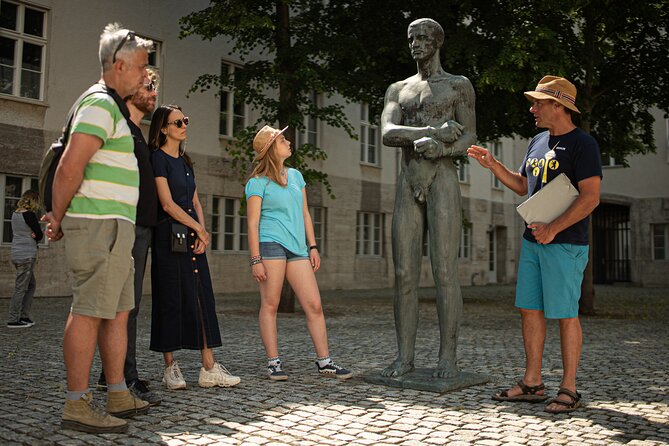
At the German Resistance Memorial Center, located in the Bendlerblock, you hear about Germans who opposed the Nazi regime. The focus includes Claus von Stauffenberg and the failed July 20, 1944 attempt to kill Hitler.
The value here is moral as well as historical. The stop shows that opposition existed, but it also makes clear how dangerous resistance was and how many people paid with their lives.
You have about 20 minutes. That is a tight visit for an exhibition covering different resistance groups and motives. Still, it gives families and students a useful counterpoint to the story of total obedience. Several guides have been praised for answering questions and connecting large political events with individual choices, which is especially helpful here.
Bebelplatz remembers the destruction of ideas
Bebelplatz is a short stop with a powerful subject. On May 10, 1933, Nazi supporters burned thousands of books considered politically or culturally unacceptable.
A memorial beneath the square shows empty bookshelves. From above, it can be easy to miss, but your guide points it out and explains its meaning. The nearby State Opera House and Humboldt University also help place the event in Berlin’s cultural and academic center.
You spend about 10 minutes here. That is enough to understand the event and the memorial, though not enough for a broad discussion of censorship. I like this stop because it reminds you that Nazi persecution began with ideas, propaganda, and attacks on freedom of expression, not only with the later violence of war.
The Reichstag connects dictatorship and democracy
The Reichstag Building offers one of the clearest links between the Nazi era and modern Germany. Completed in 1894, it was damaged during World War II and later restored as a symbol of democratic government.
Your guide explains the 1933 Reichstag Fire and how the Nazis used it to suppress opposition and consolidate power. The building’s importance is not just architectural. It shows how a political crisis can be turned into a tool for destroying civil rights.
The scheduled stop lasts about 15 minutes. Admission is not included, and this tour does not present itself as a full interior visit. If you want to see the building from inside, you will need to arrange that separately. Even from outside, the explanation gives the building a much sharper meaning.
The Holocaust Memorial demands quiet attention
The Memorial to the Murdered Jews of Europe consists of 2,711 concrete slabs arranged across a broad grid. The blocks vary in height, and walking among them can feel disorienting.
Your guide explains the memorial’s design and places it within the history of the Holocaust, including the Nazi persecution and murder of Europe’s Jewish population. The space is deliberately spare. It does not tell you everything, but it creates room for thought after the historical facts have been laid out.
The scheduled time is about 15 minutes. That may be enough for an introduction, but you should not expect a full visit to the underground information center or a long period of quiet reflection. I would return later if you want to spend more time here. The memorial is most effective when you are not rushing from one explanation to the next.
The Führerbunker is a site without a visible bunker
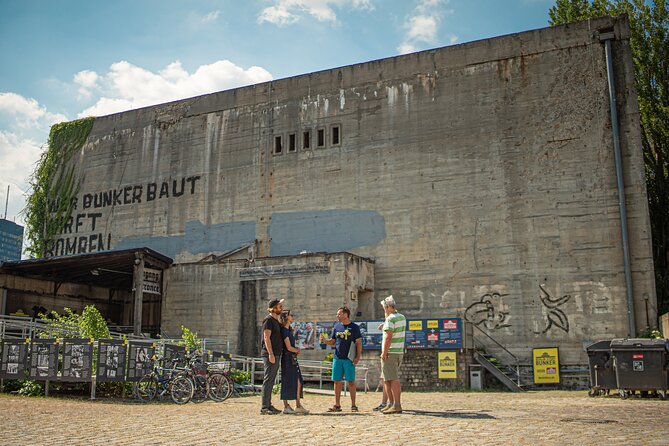
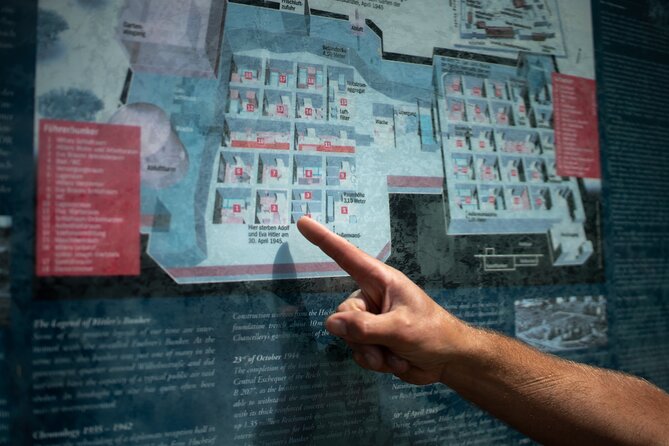
The tour takes you to the location above the Führerbunker, Hitler’s last headquarters during the final months of World War II. The original underground structure was largely destroyed after the war, and there is no dramatic bunker interior to enter.
That absence is part of the point. Your guide explains the bunker’s layout, the final decisions made there, and the collapse of the Nazi leadership as Soviet forces closed in on Berlin. You are looking at an ordinary urban setting while hearing about the regime’s final days below ground.
The stop lasts about 10 minutes. It is best understood as a historical location, not a cinematic attraction. I appreciate that the visit focuses on the consequences of dictatorship rather than turning Hitler’s final refuge into a shrine.
Anhalter Bahnhof tells the story of deportation
The remains of Anhalter Bahnhof once belonged to one of Berlin’s busiest railway stations. During the Nazi period, the station was connected with the deportation of Jewish people to concentration camps.
Here the scale of persecution becomes personal. Families passed through a functioning transport system, often separated from home and one another under state orders. Your guide discusses the station’s role and the memorials that remember those taken away.
Only about 10 minutes are scheduled. The surviving architecture can make the stop feel brief, but its importance is clear. This is not just a railway ruin. It helps you understand how the Holocaust depended on ordinary systems, including trains, stations, records, and official control.
The T4 Memorial confronts Nazi euthanasia
At Tiergartenstraße 4, the tour addresses the Nazi euthanasia program. The campaign targeted people with disabilities and mental illnesses, labeling them unworthy of life and killing them systematically.
The memorial explains the program and honors its victims. It also raises difficult questions about medical ethics, discrimination, state power, and the language used to strip people of their humanity.
This 10-minute stop is short, but it broadens the tour beyond the Holocaust and military history. You see another part of Nazi policy, one aimed at people within Germany itself. For many visitors, this is one of the less familiar subjects on the route, and a good guide can give it the attention it deserves.
Moltkebrücke marks the final battle for Berlin
The Moltkebrücke was a strategic crossing during the final battle in 1945. Soviet forces used the bridge while advancing into Berlin.
From here, your guide recounts the fighting around the bridge and explains how the Soviet advance changed the city’s future. The bridge gives you a physical point from which to picture the final phase of the war, rather than treating April 1945 as a date in a textbook.
The visit takes about 10 minutes. It works best as part of the larger sequence, linking the Soviet Memorial at the start with the collapse of Nazi control near the end of the war.
How the timing and transport shape the experience
The tour is advertised as a walking experience, but the broad route covers sites spread across central Berlin. One account of the experience describes using Berlin’s public transport system, so you should be ready for a mix of walking and city movement rather than a slow stroll in one small district.
Hotel pickup and drop-off make this much easier. You do not have to find an unfamiliar meeting point, and the guide can begin by learning what you want from the day. Some guides have started at the hotel, adjusted the route, and ended at another Berlin sight when that suited the group.
The pace is a key consideration. One family reported walking about 10,000 steps, while another praised a relaxed pace and well-timed stops. Wear comfortable shoes and dress for rain or cold. The tour operates in all weather, and several hours outside can feel long in winter.
The private format helps, but it cannot turn 12 stops into leisurely museum visits. You will get the best result if you tell the guide your priorities at the start. If the Holocaust Memorial, resistance, or military history matters most to you, ask for more explanation there and accept a shorter look elsewhere.
Which guide style suits your group
The company assigns different guides, so you should not book expecting one particular person unless the provider confirms it. Highly praised guides include Daniel, Jimmy, Georgia, Jasper, Simon, Callum, Oren, Tobi, Martin, Maria, Xavier, Artie, and others.
The common strength is a personal, teaching-focused approach. Daniel has been described as flexible and friendly, quickly building a route around a group’s interests. Jimmy has been praised for stories, energy, and his ability to engage children. Georgia adjusted a hotel start and shaped the day around the group. Simon was valued for clear explanations and practical suggestions for later visits.
A private tour also lets you ask for a wider historical frame. Some guides connect the Third Reich to World War I, the formation of Germany, or the Cold War. That can be useful, but it also means you should speak up if you want the day kept tightly on Hitler and World War II.
The experience is recommended by 99 percent of customers and carries a rating of 5 from 360 reviews. One less favorable account noted that the guide was helpful and informed but did not always follow the group’s preferred focus. That is a useful reminder to state your interests clearly at the beginning.
Who should book this tour
I would choose this tour if you have limited time in Berlin, want a private guide, or are traveling with children and need the pace adjusted. It also suits history lovers who want connections between sites rather than isolated facts.
Families may find the format especially useful. The subject is grim, but a skilled guide can explain it without turning the day into a lecture. The private setting also makes it easier to pause, ask questions, or change the emphasis.
I would not choose it if you want long museum visits or a quiet, unhurried walk. The schedule is broad, and several stops are brief. You will get an overview with strong site context, then need to return independently for deeper study.
Book it if hotel service, private attention, and a broad route matter more to you than keeping costs low. At $192.97 per person, it is a premium history tour, but the price can make sense for a small group that wants one thoughtful guide for a demanding subject.
Free cancellation is available up to 24 hours before the start time. Confirmation is normally immediate, though bookings made within two days may be confirmed within 48 hours, subject to availability.
FAQ
How long does the private Berlin Third Reich tour last?
The tour lasts approximately 3 to 4 hours.
Is hotel pickup included?
Yes. Hotel pickup and hotel drop-off are included.
Is the tour conducted in English?
Yes. The experience is offered in English.
Is this a private tour?
Yes. Only your group participates.
Are admission tickets included?
Most listed stops have no admission charge. Admission to the Reichstag is not included. The tour mainly focuses on exterior locations and brief visits to memorials and exhibitions.
Does the tour operate in bad weather?
Yes. It operates in all weather conditions, so you should dress appropriately.
Can I cancel for a full refund?
Yes. You can cancel at least 24 hours before the start time for a full refund. Cancellations or changes made less than 24 hours before the experience are not accepted for a refund.
Should you book it?
Book this private Berlin tour if you want the city’s Nazi and World War II sites explained as one connected story. The hotel service, flexible pacing, and strong guide roster make it a practical choice for families, first-time visitors, and anyone who wants more than a list of dates.
Skip it if you prefer to explore at your own pace or spend an hour inside each museum. For the right group, though, this is an efficient and serious introduction to Berlin’s hardest history, with enough personal attention to make the subject clear rather than merely grim.
More Private Walking Tours in Berlin
- Private Walking Grand Tour of Copenhagen
★ 5.0 · 3,953 reviews - Vienna: Private Walking Tour with a Local
★ 4.6 · 1,446 reviews - Barcelona Helicopter, Sailboat & Old Town Private Walking Tour
★ 5.0 · 1,395 reviews - Private Walking Tour of Hanoi City
★ 5.0 · 1,251 reviews
More Private Walking Tours in Germany
- Private Walking Tour: World War 2 and Cold War Sites in Berlin
★ 5.0 · 230 reviews - The History of Berlin: WWII PRIVATE Walking Tour With Locals
★ 5.0 · 209 reviews - Munich in the 3rd Reich and WW2 private walking tour
★ 5.0 · 148 reviews - Bamberg: Private Guided Walking Tour
★ 4.8 · 90 reviews
Just added around Berlin
- East Berlin and the Wall: Walking Tour★ 4.9 · 407 reviews
- Cold War, Berlin Wall, Spies and the East Side Gallery★ 4.8 · 254 reviews
- Berlin: walking tour about Charité★ 4.4 · 537 reviews
- Berlin: Walking Tour of the Top 10 Sightseeing Attractions★ 4.7 · 150 reviews
- Berlin: Sightseeing Walking Tour of the Top 20 Attractions★ 4.5 · 196 reviews
- Berlin: The Time of National Socialism Walking Tour★ 5.0 · 220 reviews
- Berlin: Kreuzberg Guided Walking Evening Tour★ 4.7 · 555 reviews
- Berlin : Must-see attractions Walking Tour★ 4.8 · 83 reviews
History Walking Tours, compared.

Berlin’s Best: 2 Hour Walking Tour Third Reich and the Cold War
Read our review →
Third Reich Berlin: Hitler and WWII Walking Tour
Read our review →
New Orleans Garden District History Walking Tour
Read our review →
Cartagena: Historic Center and Getsemaní Shared Walking Tour
Read our review →