
REVIEW · BERLIN
Berlin: Third Reich, Hitler, and WWII Walking Tour
Berlin’s Nazi past is easiest to grasp when you follow it on foot. This tour links the former ministries, Hitler’s bunker, the Reichstag, the Holocaust Memorial, and the Soviet War Memorial into one clear story of power, terror, war, and defeat. I like the way it connects ordinary city streets with events that changed Europe.
I also like the small-group option, the choice of English, German, or Spanish, and the guides’ habit of inviting questions rather than simply reciting dates. Guides including Maggie, Campbell, Emma, Nikolai, and JR have been praised for clear explanations, humor used with care, and the ability to keep young people interested. The main drawback is simple: three hours outdoors can feel long in cold, wet, or windy weather, so good shoes and proper clothing matter.
Key points to know before you book
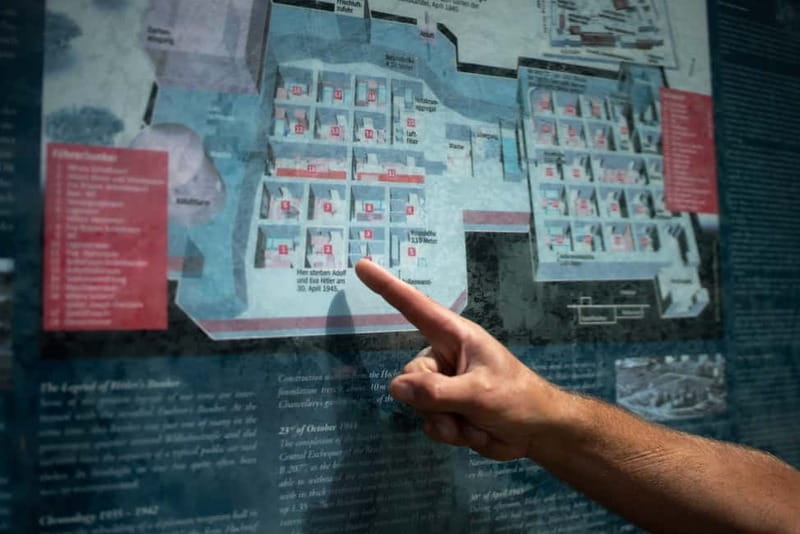
- Hitler’s bunker is now an unmarked site: You stand above the location and hear how the regime ended, but there is no bunker interior to visit.
- The tour follows Nazi power at street level: Former Luftwaffe, propaganda, SS, and Gestapo offices help explain how the dictatorship worked.
- The Reichstag and Brandenburg Gate add the final act: The route shows how Berlin became the last major battlefield of Nazi Germany.
- The Topography of Terror is a strong finish: The exhibition site focuses on the institutions behind Nazi persecution and repression.
- Expect a serious but approachable guide: The best guides explain difficult material plainly, invite questions, and use humor sparingly.
- The price is low for three hours: At $19 per person, this is a useful way to build a basic framework before visiting Berlin’s larger museums.
Why this Berlin walking tour works
Many Berlin sights connected with the Third Reich are easy to miss. A plain office building may once have housed a Nazi ministry. A patch of open ground may mark the location of Hitler’s bunker. A memorial may look like a simple monument until someone explains how it fits into the final days of the war.
This walk gives those places a shared story. You begin near Friedrichstraße and move through central Berlin toward the former centers of Nazi power. Along the way, the guide explains the rise of Hitler, the machinery of dictatorship, the war years, the destruction of Berlin, and the Soviet capture of the city.
I like this approach because the tour does not treat Adolf Hitler as an isolated figure. It places him inside a wider system involving the Luftwaffe, propaganda officials, the SS, the Gestapo, senior ministers, military planners, and ordinary institutions that helped the regime function.
The tone is serious, as it should be. Yet the strongest guides keep the experience clear rather than grim for three straight hours. Maggie has been praised for asking questions and bringing the group into the discussion. Emma and Rebecca are noted for explaining complex topics in simple terms, while guides such as Jamie G and Nikolai add personal stories and smaller details that help the larger events make sense.
More History Walking Tours in Berlin
- Berlin: Third Reich & Cold War Guided Walking Tour
★ 4.9 · 8,378 reviews - Berlin’s Best: 2 Hour Walking Tour Third Reich and the Cold War
★ 5.0 · 5,486 reviews - Third Reich Berlin: Hitler and WWII Walking Tour
★ 5.0 · 3,301 reviews
Starting at Friedrichstraße and the Palace of Tears
The meeting point is outside Friedrichstraße train station, on the square between the station and the Tränenpalast, also called the Palace of Tears. Look for guides wearing a blue lanyard and yellow name tag, often with yellow umbrellas.
This is a practical meeting point. Friedrichstraße is well connected, and the Palace of Tears gives you an immediate reminder that Berlin’s 20th-century story did not end in 1945. The building later became associated with the separation of East and West Berlin, adding another layer to the city’s political past.
The tour begins with a short guided stop in the Friedrichstraße area. Use this time to settle into the guide’s style and ask questions early. If you arrive by train, allow a few minutes to locate the correct square rather than waiting inside the station.
The Reichstag and the Soviet assault
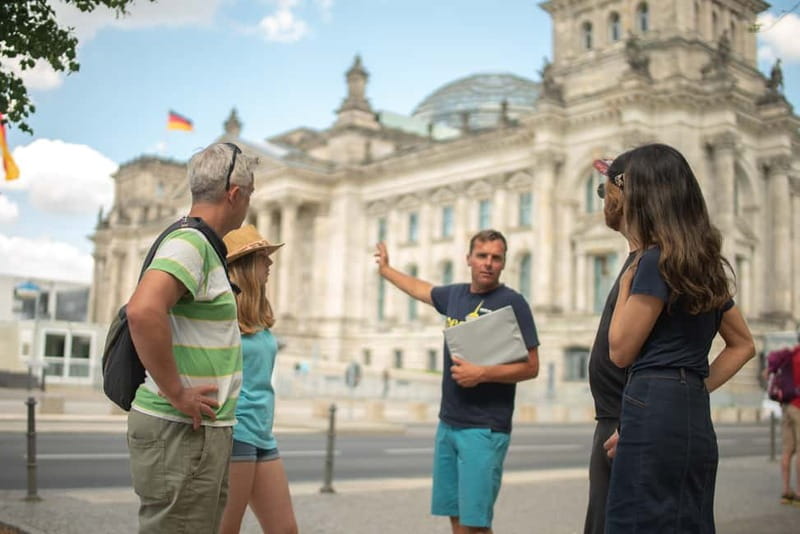
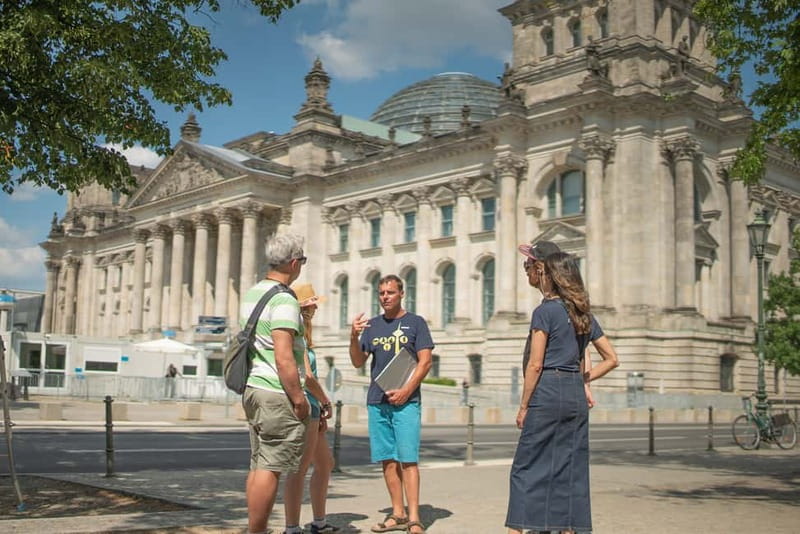
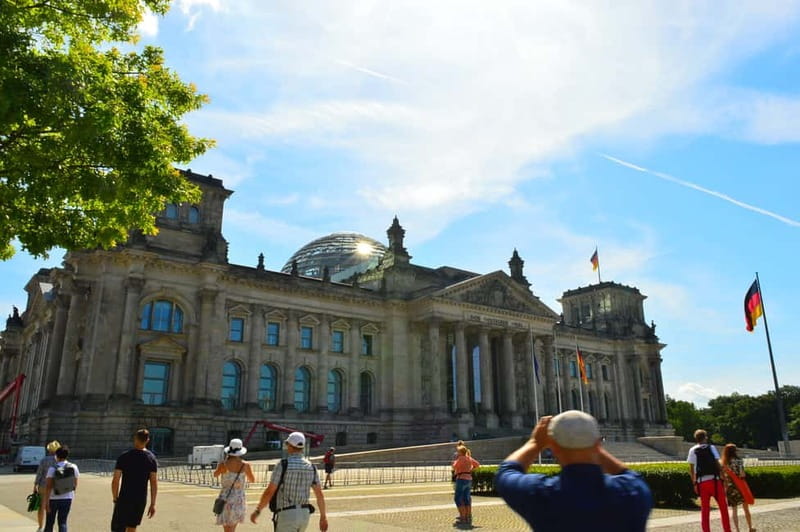
The Reichstag is one of Berlin’s essential landmarks, but this tour looks beyond its grand facade. The building became the symbolic and physical focus of the final Soviet assault on Nazi Germany. By the end of the war, Berlin was a battlefield, and the Reichstag represented the collapse of the regime.
Your guide explains how the fighting reached this central district and why the building became such a powerful symbol of defeat. The stop lasts about 15 minutes, enough for photographs and a focused explanation rather than an extended visit inside.
Do not expect admission to the Reichstag dome as part of this tour. The experience is outdoors and centers on the historical setting. If you want to visit the dome separately, you will need to arrange that on your own.
The Soviet War Memorial in Tiergarten
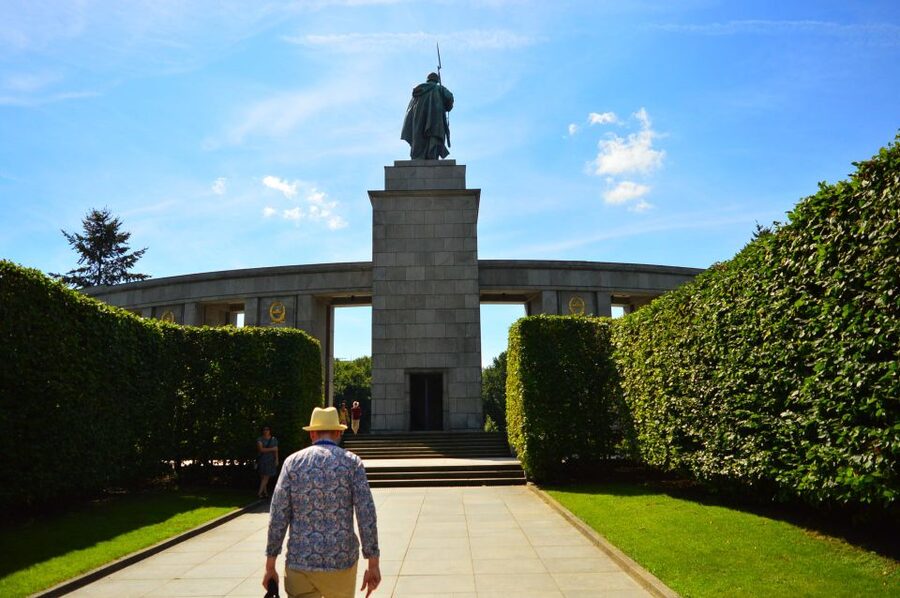
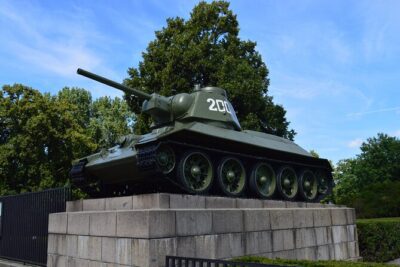
The route continues to the Soviet War Memorial in Tiergarten. T-34 tanks and Red Army howitzers flank the memorial, giving the site a strong physical presence. It is not just a place for a quick photograph. It helps you picture the military force that pushed into Berlin and the price paid during the final campaign.
This stop also adds balance to a tour that might otherwise focus only on Nazi leadership. The story shifts from Hitler’s plans and ministries to the Soviet advance and the defeat of the German state.
The memorial is outdoors, so weather matters here. A February tour in freezing wind or snow can be memorable for the wrong reason unless you wear warm layers, gloves, and shoes with good soles. Even in milder seasons, comfortable clothing is sensible because the tour operates rain or shine.
More History Walking Tours in Germany
- Berlin: Cold War Walking Tour on Berlin Wall Route
★ 4.8 · 437 reviews - Private Walking Tour Berlin Third Reich Hitler and World War II
★ 5.0 · 360 reviews - Berlin: Berlin Wall & East Side Gallery Walking Tour
★ 4.9 · 264 reviews - Cold War, Berlin Wall, Spies and the East Side Gallery
★ 4.8 · 254 reviews
The Holocaust Memorial and the meaning of remembrance
The Holocaust Memorial is another short stop on the route. The field of concrete stelae is a place for quiet attention, and the guide provides context about the victims of Nazi persecution.
This part of the tour is important because it keeps the focus from drifting toward military history alone. A discussion of armies, ministries, and leaders can become too abstract. The memorial brings the human cost back into view.
Expect the guide to explain the site rather than lead you through an indoor museum visit. The stop is listed as a photo stop and guided explanation, so allow extra time later if you want to explore the memorial on your own.
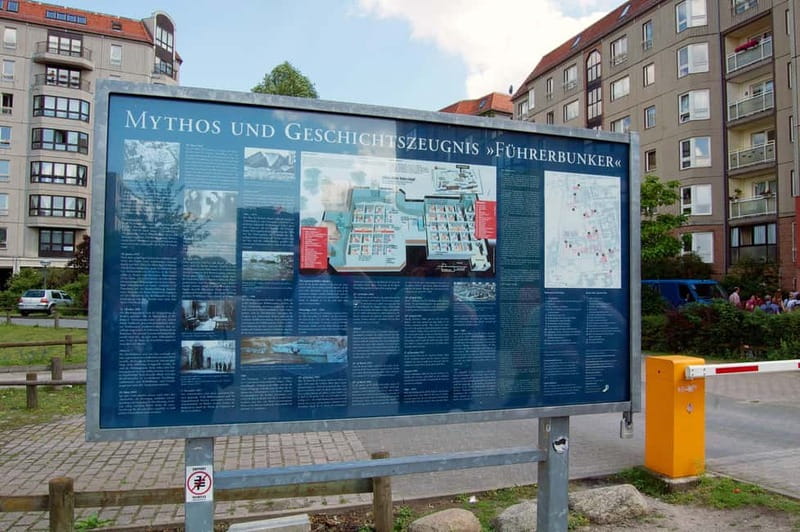
Standing above Hitler’s bunker
The bunker site is one of the tour’s most anticipated stops. You stand above the former Führer’s Bunker, where Hitler spent his final days and died by suicide as Soviet forces closed in on Berlin.
There is no dramatic entrance to see. The bunker is not open as a visitor attraction, and the location is marked in a deliberately restrained way. That can feel anticlimactic if you expect ruins or a preserved room. In practice, the absence of a grand memorial fits the subject. The guide supplies the missing context.
This is where the step-by-step account of Hitler’s last days becomes useful. You hear about the final decisions made underground, the collapse of the Nazi command structure, and what happened to Hitler’s remains afterward.
The stop also gives the guide a chance to explain Albert Speer’s planned Germania axis. That unrealized vision aimed to remake Berlin as a monumental capital of Nazi Europe. Seeing the modern street grid while hearing about those plans shows how much of the Nazi architectural program was designed to intimidate and control.
Detlev-Rohwedder-Haus and the former ministries
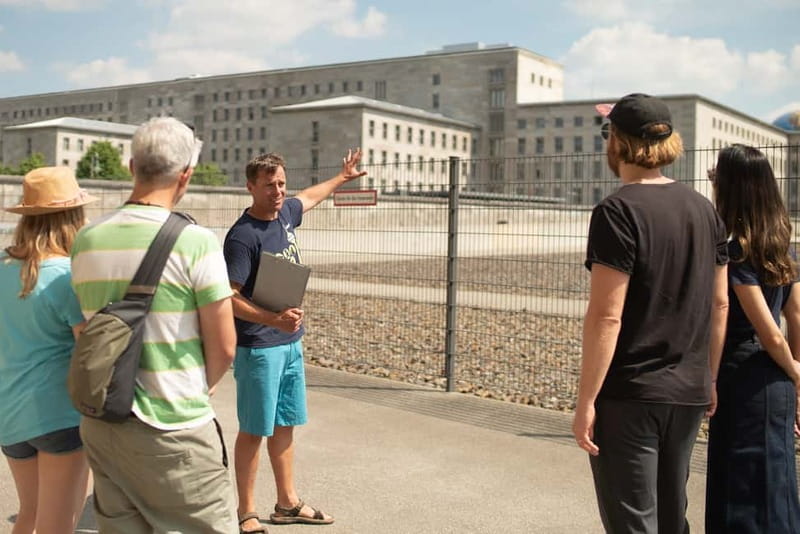
The Detlev-Rohwedder-Haus provides one of the clearest links between a present-day building and Nazi administration. The site was associated with Göring’s Air Ministry, where the Luftwaffe planned and directed aerial warfare, including the Blitz.
This is a good example of why a walking guide adds value. Without explanation, the building can look like another large government block. With context, it becomes part of the command structure that carried out the war.
The tour also points out the former locations of Joseph Goebbels’ Propaganda Ministry and Heinrich Himmler’s SS and Gestapo headquarters. These were not merely offices. They were centers for shaping public opinion, organizing terror, policing opponents, and enforcing Nazi rule.
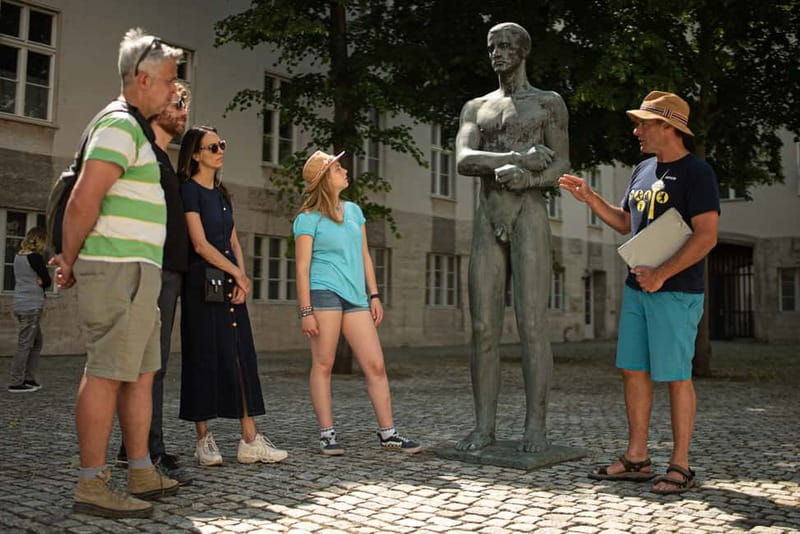
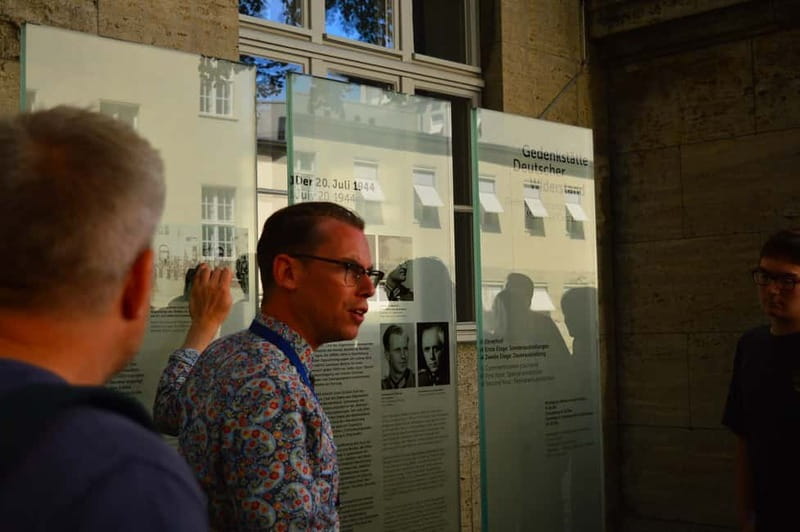
Some of the original buildings have disappeared, changed function, or survived in altered form. That means the experience depends heavily on the guide’s storytelling. A strong guide helps you read the city even when the original Nazi symbols and signs are gone.
The Topography of Terror at the end
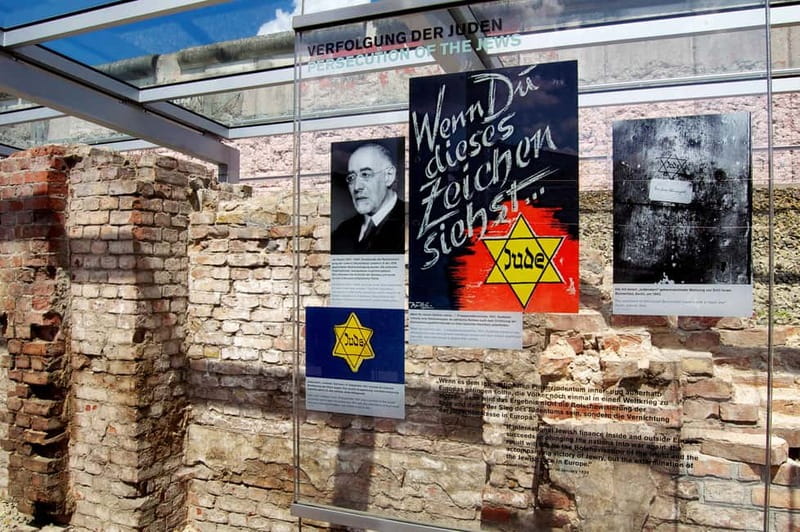
The tour finishes around the Topography of Terror, a documentation center built at the former site of major Nazi security institutions. The exhibition focuses on the SS, Gestapo, and police system that helped carry out persecution and mass murder.
Because the walking tour includes an outdoor guided stop rather than a full indoor museum visit, I would treat this as a useful introduction. If you have time, return to the documentation center afterward and give the exhibits more attention. The tour gives you the location and the basic structure. An independent visit lets you read the material at your own pace.
Ending here makes sense. You have moved from the visible symbols of Nazi power to the institutions that made repression possible. The last stop can leave you with a clearer sense of how the regime operated, not just how it looked.
The listed end point is the Dokumentationszentrum Topographie des Terrors area. Private options may include hotel pickup, but the standard meeting arrangement is at Friedrichstraße. Confirm the exact option you choose when booking.
How much walking and how hard is the pace?
The tour lasts about three hours and is conducted on foot. The route is broken into stops of roughly 15 minutes, which helps prevent the whole experience from becoming one long lecture while walking.
It is not a sightseeing bus tour. You need comfortable shoes and weather-appropriate clothing. Guides have continued through snow, freezing temperatures, wind, and rain, but that does not mean the conditions will be pleasant. In winter, plan for a genuinely outdoor experience.
A short refreshment break may be included after roughly two hours. One guide, Jasper, has been especially attentive to pointing out nearby cafés, bathrooms, and public buildings during this pause. Still, do not count on a full meal stop. Eat before you start or carry a small snack and water.
Families can manage the route if children are interested in the subject. A 13-year-old has been specifically reported as staying engaged, and pre-teens have also enjoyed the explanations. The material includes war, dictatorship, persecution, and suicide, so parents should decide if the subject suits their children.
Guide quality makes the biggest difference
The operator offers live guiding in English, German, and Spanish. Private and small-group formats are available, and the guide can shape the experience around questions more easily in a smaller group.
The strongest pattern among the guides is clarity. Campbell is described as informative, funny, and well organized. Hannah, Klaus, Paul, and Glen have been praised for explaining difficult material carefully and checking that everyone understands. Jamie G is particularly suited to visitors studying Nazi Germany because he links the locations to the wider historical picture.
Humor can be useful on a long walking tour, but it needs to be handled with care. The most effective guides use it to keep your attention between serious stops, never to make light of the victims or the crimes.
The experience also benefits from guides who acknowledge uncertainty or competing interpretations. One guide, Ru, has been praised for explaining theories without pushing the group toward one view. That kind of restraint is valuable with a subject full of myths and sensational claims.
Is $19 a fair price?
At $19 per person, this is strong value if you want a three-hour introduction to central Berlin’s Nazi history. You visit several major sites and get the connecting explanation that signs and buildings cannot provide on their own.
The price does not include museum admission, food, hotel pickup for standard group options, or indoor visits to the Reichstag. Think of it as a guided city walk, not a complete museum day.
The value is highest for a first visit to Berlin, for anyone studying the period, or for anyone who wants the city’s scattered sites arranged into a logical sequence. If you already know Berlin well and have spent time at the Topography of Terror and other museums, the tour may repeat some basic material, though the walking route and guide’s local details can still add something.
Free cancellation up to 24 hours before the start and the reserve-now, pay-later option make it easier to fit into a changing schedule. Check the available starting time before booking, especially if you want to pair it with another timed attraction.
Who should book this tour?
I would book this tour if you want a clear introduction to Berlin’s Nazi past without spending your first day inside museums. It suits history students, first-time visitors, families with older children, and anyone who learns better by seeing places in relation to one another.
I would also choose it early in a Berlin visit. The route gives you useful context for later visits to the Topography of Terror, the Holocaust Memorial, the Reichstag, and other museums.
I would think twice if you dislike walking outdoors, need a fully sheltered activity, or want to enter preserved Nazi interiors. The bunker is viewed from above, and several former ministry sites are explained from the street. The subject is also emotionally heavy, even though the guides work to keep the tone humane and manageable.
Final verdict: a smart first look at Nazi Berlin
At $19, this is an easy recommendation for most visitors who want to understand Berlin during the Third Reich and the Second World War. The route covers Hitler’s bunker, the former Nazi ministries, the Reichstag, the Holocaust Memorial, the Soviet War Memorial, and the Topography of Terror in one organized walk.
Book it if you value clear storytelling, direct access to historical sites, and the chance to ask questions. Bring warm clothes or rain gear when needed, wear proper shoes, and reserve the Topography of Terror for a separate visit if you want more time with its exhibits. The tour will not replace a museum day, but it can give that museum day a much stronger foundation.
FAQ
Where does the tour meet?
The standard meeting point is outside Friedrichstraße train station, on the square between the station and the Tränenpalast, or Palace of Tears.
How do I recognize the guide?
The guides wear a blue lanyard and yellow name tag. They may also be holding yellow umbrellas.
How long does the tour last?
The advertised duration is three hours. Some outings may run slightly longer, so avoid booking a tightly timed activity immediately afterward.
What languages are available?
Live guiding is available in English, German, and Spanish.
Is this a walking tour?
Yes. The experience is conducted on foot through central Berlin and includes several outdoor stops.
Does the tour enter Hitler’s bunker?
No. You stand above the former bunker location and hear about Hitler’s final days and the fate of his remains.
Does the tour include admission to the Topography of Terror?
The tour stops at the Topography of Terror and explains the site. Indoor museum admission is not listed as included.
Is hotel pickup available?
Pickup is available only with private options. For those bookings, wait in the hotel lobby five minutes before the scheduled time and look for a guide with a yellow name tag.
What should I wear?
Wear comfortable shoes, comfortable clothing, and clothing suited to the weather. The tour operates rain or shine.
Can I cancel for a full refund?
Yes. You can cancel up to 24 hours in advance for a full refund. A reserve-now, pay-later option is also available.
Just added around Berlin
- East Berlin and the Wall: Walking Tour★ 4.9 · 407 reviews
- Cold War, Berlin Wall, Spies and the East Side Gallery★ 4.8 · 254 reviews
- Berlin: walking tour about Charité★ 4.4 · 537 reviews
- Berlin: Walking Tour of the Top 10 Sightseeing Attractions★ 4.7 · 150 reviews
- Berlin: Sightseeing Walking Tour of the Top 20 Attractions★ 4.5 · 196 reviews
- Berlin: The Time of National Socialism Walking Tour★ 5.0 · 220 reviews
- Berlin: Kreuzberg Guided Walking Evening Tour★ 4.7 · 555 reviews
- Berlin : Must-see attractions Walking Tour★ 4.8 · 83 reviews
History Walking Tours, compared.

Berlin’s Best: 2 Hour Walking Tour Third Reich and the Cold War
Read our review →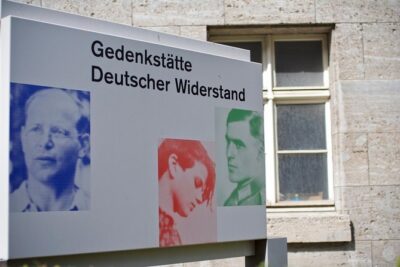
Third Reich Berlin: Hitler and WWII Walking Tour
Read our review →
New Orleans Garden District History Walking Tour
Read our review →
Cartagena: Historic Center and Getsemaní Shared Walking Tour
Read our review →
Imperial Palace and Shogun Historical Walking Tour
Read our review →Browse the lists this tour appears in