
REVIEW · BRUGES
Historical Walking Tour: Legends of Bruges
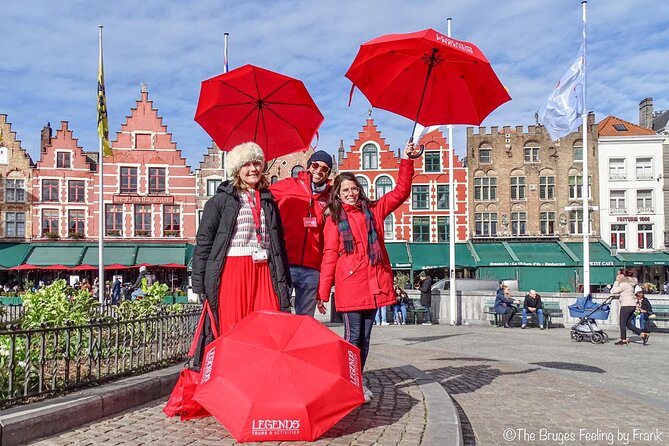
Bruges is easiest to understand on foot, and this tour gives you a useful sweep of the city in about 2 hours 15 minutes. You move from the medieval trading center at the Markt to quiet canals, the Beguinage, old hospitals, churches, and the political heart at Burg Square. The stories are not just dates: they cover beer monopolies, swans, rebellious citizens, French kings, and a pipeline running beneath the streets.
I like the route for two clear reasons. First, it packs Bruges’ main sights into one gentle introduction, which is a smart choice on a short stay. Second, the guides bring local color to the walk. Depending on the departure, you might meet Louis, Victoria, Martin, Sander, Wouter, Thomas, Celine, or Emiel, with several guides praised for humor, strong storytelling, and personal knowledge of Bruges.
The main consideration is the free-tour format. The price is only $3.62 per person, but tips are expected and important because the guide pays to conduct the tour. Also, it is a long outdoor walk with no guaranteed shelter, so cold or wet weather can make the experience less comfortable.
Key things to know before walking Bruges
- Eleven central stops: The route connects the Markt, Belfort, Gruuthusemuseum, St. John’s Hospital, Beguinage, De Halve Maan Brewery, Minnewater Lake, Our Lady’s Church, Groeningemuseum, Tanner’s Square, and Burg Square.
- A strong first-day tour: You get the city’s basic layout and plenty of ideas for places to revisit later.
- Stories with local character: Expect tales about Bruges’ nickname, its swans, beer trade, medieval power struggles, and the Dukes of Burgundy.
- Small enough to feel manageable: The maximum group size is 24, though some departures may be much smaller.
- Tips matter: The low booking price does not replace a guide gratuity.
- Good English delivery: The tour is offered in English, with guides such as Victoria, Martin, Sander, and Louis singled out for clear and engaging presentations.
Starting at the Markt and the Belfort
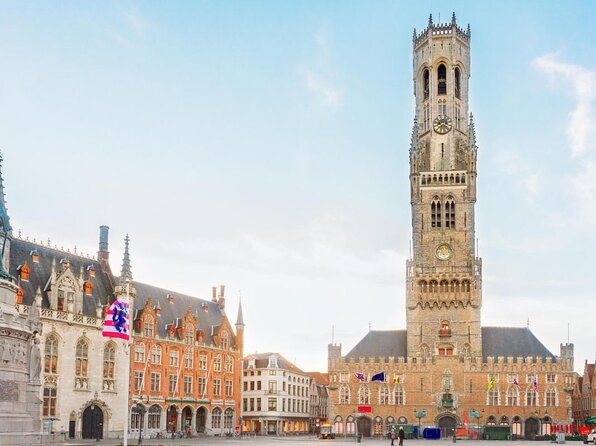
The meeting point is Pieter de Coninck en Jan Breydelmarkt, the broad central square better known simply as the Markt. This is an excellent place to begin because Bruges’ story starts here as a commercial city, not merely as a postcard of canals and brick houses.
Your guide explains how medieval Bruges became a trading hub and why its relationship with the French king was often tense. That political thread helps you read the city properly. Bruges grew wealthy through trade, but wealth brought demands from rulers who wanted control and taxes. The result was a city that could be proud, prosperous, and difficult to govern.
The next stop is the Belfort, where the tour visits the halls behind the belfry and explains the tower’s role during the Middle Ages. The walk does not include a climb up the tower, so you should treat this as a history stop rather than a ticketed tower visit.
If you want to climb the Belfort separately, plan ahead. One useful tip from the tour is to buy climbing tickets in the morning. The tower is one of Bruges’ most popular paid sights, and fitting it in later may be harder than expected.
More History Walking Tours in Belgium
- Historical Walking Tour: Legends of Antwerp
★ 5.0 · 1,837 reviews - Historical Walking Tour: Legends of Gent
★ 5.0 · 1,761 reviews - Brussels: Historical Walking Tour with Chocolate & Waffle Tasting
★ 5.0 · 1,165 reviews
Gruuthuse and St. John’s Hospital
At the Gruuthusemuseum, you hear about the city palace of a wealthy Bruges family. Their fortune came partly from a monopoly connected with the beer trade, a reminder that medieval power often rested on control of ordinary goods.
This stop is valuable because it moves beyond grand rulers and church towers. Beer was not simply a drink for celebration. Its production, sale, and taxation helped shape local wealth. The palace also gives you a glimpse of how an elite family displayed its influence in a city where trade made private fortunes possible.
The walk then reaches Sint-Janshospitaal, or St. John’s Hospital. It is described as one of the oldest surviving hospitals in the world and as a cornerstone of medieval society. You learn what such an institution meant in a period when care for the sick, poor, and injured was tied closely to religious and civic life.
The stop is relatively brief, about ten minutes, so do not expect a full museum visit. Instead, you get the setting and the reason it matters. If you later choose to return inside, you will already have a better sense of why the building occupies such an important place in Bruges.
The Beguinage and a quieter side of Bruges
The Princely Beguinage Ten Wijngaarde brings a change of pace. The tour leads you into a picturesque enclosed community where women have lived together for more than 800 years. It is described as the largest beguinage of its kind in the world.
For me, this is one of the route’s most useful contrasts. The Markt and Belfort tell the story of public power, commerce, and civic pride. The Beguinage shows a more private form of medieval life, shaped by community and religious purpose.
Keep your voice low here and expect the mood to become calmer. The tour spends about ten minutes in the area, enough to explain its purpose and show you why it differs from the rest of the city. It is also a good place to pause and notice Bruges’ quieter architectural details.
Beer, pipelines, and the tale of the Fools of Bruges
At De Halve Maan Brewery, the guide stops outside rather than taking the group on a brewery tour. You hear how the people of Bruges earned the nickname Fools of Bruges and see part of the beer pipeline that runs beneath the city.
This is exactly the sort of detail that makes a walking tour more memorable. You can read about medieval trade in a book, but a pipeline under the city connects that past to a real, physical feature beneath your feet.
The stop also adds humor to the route. Several guides are praised for balancing facts with jokes and personal flair, and this is a natural point for that approach. Do not come expecting a tasting or a full brewery visit as part of the $3.62 booking price. The value here is the story and the outside view.
Same streets, a different route:
- Bruges: Small Group Boat Cruise and Guided Walking Tour
★ 4.8 · 4,102 reviews - Brussels: Guided Walking Tour
★ 4.6 · 3,560 reviews - Bruges: Walking Tour, Canal Boat Trip w/Beer Tasting Option
★ 4.4 · 2,759 reviews - Brussels Walking and Tasting Tour (Beers,Chocolates&Fries/Waffle)
★ 5.0 · 929 reviews
Minnewater Lake and the city’s swans
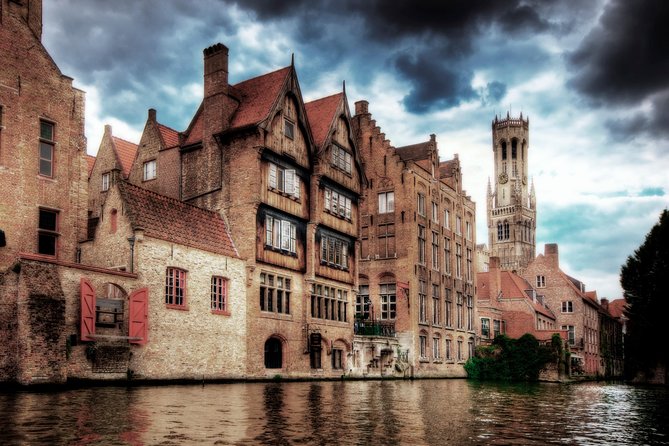
The walk continues to Minnewater Lake, often called the Lake of Love. Here, the guide explains why swans appear on Bruges’ canals and tells the story of the city’s conflict with Emperor Maximilian of Austria.
This stop gives the tour one of its most recognizable settings. The water and swans are beautiful, but the story keeps the scene from becoming a simple photo stop. Bruges’ symbols often have political or civic tales behind them, and this one connects a familiar image with a period of conflict.
The route is at its most atmospheric here, especially if the weather is kind. That said, the entire experience depends on outdoor conditions. The tour requires good weather, and poor conditions can lead to a new date or a full refund. On a cold day, you may want a warm layer even if the forecast looks mild. One family had to leave early because freezing weather was difficult with a toddler.
Our Lady’s Church and Flemish art
Onze-Lieve-Vrouwekerk, or the Church of Our Lady, is one of the tour’s major architectural stops. Its brick tower is described as the second tallest brick tower in the world, and the church contains a statue by Michelangelo as well as the tombs of the last Dukes of Burgundy.
The guide’s role here is to point out what you might miss if you simply walk past. Bruges can feel like one large historic scene, but each building has a different connection to trade, religion, art, or political power.
The tour then visits the garden of the Groeningemuseum. You do not get a full museum visit during the walk, but the guide introduces the setting and points to work associated with major Flemish masters.
This is an important limit to understand. If you want to study the paintings, you will need to return on your own and allow proper museum time. The tour gives you an orientation, not a substitute for the galleries.
Tanner’s Square and the old working city

Huidenvettersplein, or Tanner’s Square, shows a less polished side of Bruges. This was where skins were greased and turned into leather, a smelly but essential trade.
I like this stop because it keeps the tour from treating Bruges as a city built only for nobles, artists, and church visitors. Medieval cities depended on hard, dirty work. Tanner’s Square helps you picture the workers and trades that supported the elegant buildings elsewhere.
The stop also gives you a practical way to read old city centers. Names often preserve the work once done there. You may pass through a pretty square today, but the name can point to a very different past.
Finishing in Burg Square
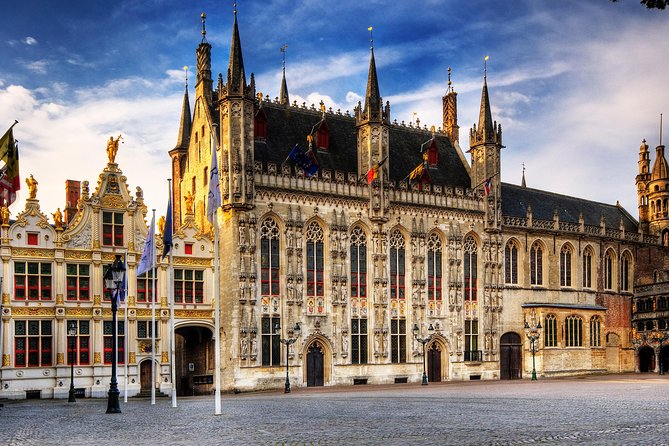
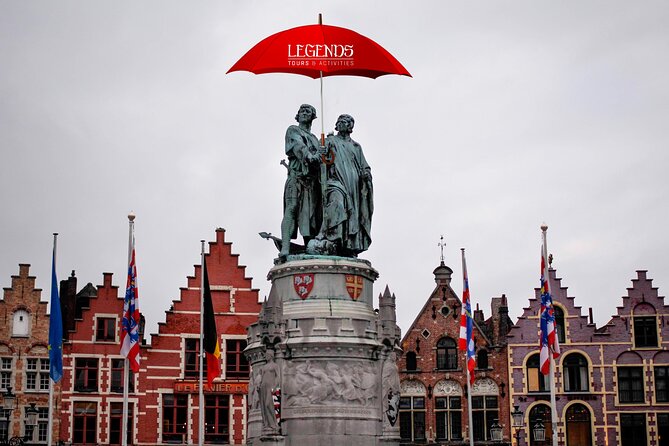
The final stop is Burg Square, reached after passing the old Fishmarket. Burg is the political heart and birthplace of Bruges, making it a fitting place to finish.
By this point, the route has linked commerce, religion, art, industry, and civic power. You should leave with a basic map in your head and several places worth revisiting. The end point is De Burg, Burg 15, so you finish in a central area rather than being left far from the sights.
This is also a useful moment to ask your guide practical questions. Several guides have offered suggestions for restaurants, chocolate shops, and other things to do. The value of those tips depends on the individual guide, but local advice can help you use the rest of your day more wisely.
What the guides add to the walk
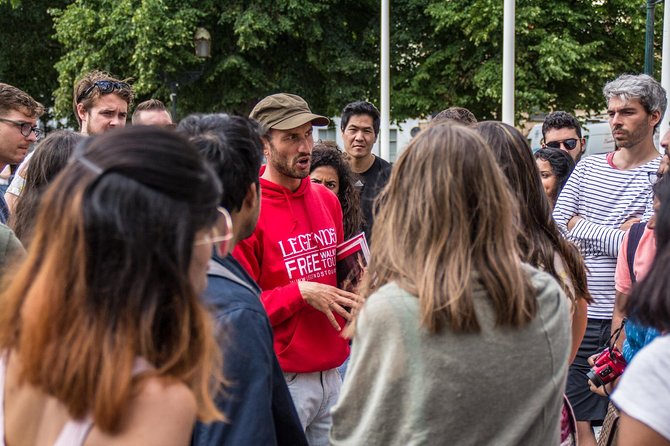
The strongest feature of this experience is the human delivery. Louis is described as a Bruges native with a clear love for the city. Victoria is praised for charisma, humor, historical detail, and excellent English. Martin is known for an entertaining and in-depth presentation, while Sander is described as friendly, funny, and good at answering questions.
Other named guides include Wilium, Wouter, Thomas, Erik, Emiel, Patrick, Nicholas, Celine, and Willem. Their styles may differ, but the repeated strengths are easy to identify: storytelling, local tips, humor, and an ability to explain buildings without making the walk feel like a lecture.
A small group can improve the experience. One departure had only four people, which made it easy to ask questions. The official maximum is 24, so group size can vary. If you prefer a quiet, private walk, this is not the same as booking a private guide. If you like meeting other people and want a low-cost introduction, the format works well.
Some guides also add a small chocolate touch, such as a complimentary truffle. Do not treat that as the main reason to book, since it may depend on the guide and departure. It is simply a pleasant extra.
Price, pace, and practical comfort
At $3.62 per person, this is an unusually inexpensive way to get a structured introduction to Bruges. All fees and taxes are included, but you should budget for a tip. In a free-tour model, that gratuity is a core part of the guide’s earnings, not an optional afterthought.
The tour lasts about 2 hours 15 minutes and visits eleven stops. That means the pace is steady, with some stops lasting five minutes and others around fifteen. You will see a lot, but you will not have time to explore each building inside.
Wear comfortable shoes. The walk is on foot, with regular stops that give you chances to rest, but it is still a substantial outdoor outing. Most people can participate, and service animals are allowed. The meeting point is near public transportation, which makes arrival simple.
Confirmation is provided at booking. You can cancel for a full refund up to 24 hours before the start time. Inside that window, changes and refunds are not accepted. If poor weather or too few bookings causes cancellation, you are offered another date or experience, or a full refund.
Who should book Legends of Bruges
I would choose this tour early in a Bruges visit, especially if you have only one day. It gives you the city’s basic shape, explains the famous sights, and helps you decide where to spend more time afterward.
It is also a good fit for:
- First-time visitors who want the main landmarks in one walk
- Couples and families seeking a low-cost introduction
- History fans who enjoy stories about power, trade, and medieval life
- People who want local suggestions for food, chocolate, and further sightseeing
- Short-stay visitors who need an efficient route through central Bruges
I would think twice if you want long interior visits, a formal art lecture, or a slow photography walk. The route is broad rather than exhaustive. Its purpose is to connect the city’s major places and make them easier to understand.
Should you book this Bruges walking tour?
Yes, if you want an affordable first look at Bruges with a guide who can turn streets and squares into a sequence of memorable stories. The route is well chosen, the price is hard to beat, and the best guides add humor and local feeling without losing the historical thread.
Book it early in your stay, bring good shoes and weather protection, and plan to tip. If possible, leave time afterward to return to the Belfort, Groeningemuseum, St. John’s Hospital, or another sight that catches your interest. That is where this tour works best: not as your entire Bruges visit, but as a smart opening chapter.
FAQ
Where does the Historical Walking Tour: Legends of Bruges begin?
It begins at Pieter de Coninck en Jan Breydelmarkt, 8000 Brugge, Belgium.
Where does the tour finish?
The tour ends at De Burg, Burg 15, 8000 Brugge, Belgium.
How long does the tour last?
It lasts approximately 2 hours and 15 minutes.
What language is the tour offered in?
The tour is offered in English.
How much does the tour cost?
The listed price is $3.62 per person. All fees and taxes are included, and tips are recommended.
How large can the group be?
The maximum group size is 24 people. The actual group may be smaller.
Can I cancel for a full refund?
Yes. You must cancel at least 24 hours before the experience start time for a full refund. Cancellations or changes made less than 24 hours before the start time are not refunded.
Just added around Belgium
- Brussels: Guided Walking Tour with Optional Beer Tasting★ 4.2 · 89 reviews
- Brussels: Private Walking Tour with a Local★ 4.4 · 102 reviews
- Brussels Highlights: Walking & Bus Tour with Waffle Tasting★ 4.2 · 233 reviews
- Brussels: Chocolate Appreciation and Tasting Walking Tour★ 4.8 · 178 reviews
- Brussels: Chocolate Workshop and Guided Walking Tour★ 4.6 · 263 reviews
- Brussels: Walking Food Tour with Chocolate, Beer, & Waffles★ 4.7 · 318 reviews
- Brussels: City Highlights Walking and Tasting Tour★ 4.9 · 505 reviews
- Bruges: Nightly Tales and Untold History Walking Tour★ 4.9 · 154 reviews
History Walking Tours, compared.

Berlin’s Best: 2 Hour Walking Tour Third Reich and the Cold War
Read our review →
Third Reich Berlin: Hitler and WWII Walking Tour
Read our review →
New Orleans Garden District History Walking Tour
Read our review →
Cartagena: Historic Center and Getsemaní Shared Walking Tour
Read our review →
Imperial Palace and Shogun Historical Walking Tour
Read our review →
Leipzig: 1.5-Hour Historical Walking Tour in German
Read our review →Browse the lists this tour appears in