REVIEW · BERLIN
Private Walking Tour: World War 2 and Cold War Sites in Berlin
Berlin’s hardest stories are written into ordinary streets, office buildings, train stations, and empty spaces. This private walking tour connects those pieces, from the former Nazi government district and Hitler’s bunker site to Checkpoint Charlie and the Berlin Wall. The most useful part is not simply seeing the sights. It is having someone explain what happened where you are standing.
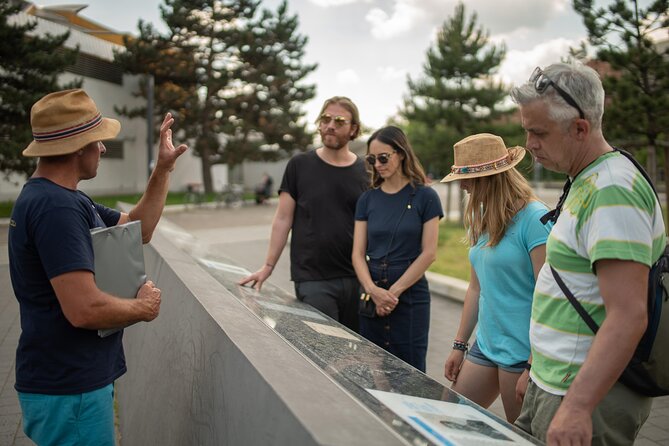
I like two things in particular: the route can be tailored to World War II, the Cold War, or both, and you get a private guide rather than a fixed group tour. Guides such as Daniel, Glen, Maria, Jamie, Ariel, Joerg, and Klaus have been praised for answering questions, adjusting the pace, and bringing photographs or extra context.
The main drawback is distance. A three to four-hour walk cannot give every listed stop equal time, especially if you want both central Nazi sites and farther locations such as Tempelhofer Feld, Bernauer Strasse, and East Side Gallery. Tell the operator your priorities before the tour, and be ready for a brisk walk with little time for food or rest.
Key points to know before booking
- Private route planning: Choose a World War II focus, a Cold War focus, or a combination of both.
- Important central sites: The Brandenburg Gate, Reichstag, Holocaust Memorial, Hitler’s bunker site, Checkpoint Charlie, and the former Air Ministry can fit naturally into a central route.
- Personal guide attention: Your guide can adjust the pace, answer questions, and add sites based on what you have already seen.
- Long-distance tradeoff: Bernauer Strasse, Tempelhofer Feld, Prenzlauer Berg, and East Side Gallery may require careful planning within the four-hour limit.
- Good first-day option: The tour gives you a useful map of Berlin’s recent past and can help you plan the rest of your stay.
- Price and format: At $192.97 per person, it makes the most sense for couples, families, or small groups who value a private, tailored experience.
Why this private Berlin tour works best as an introduction
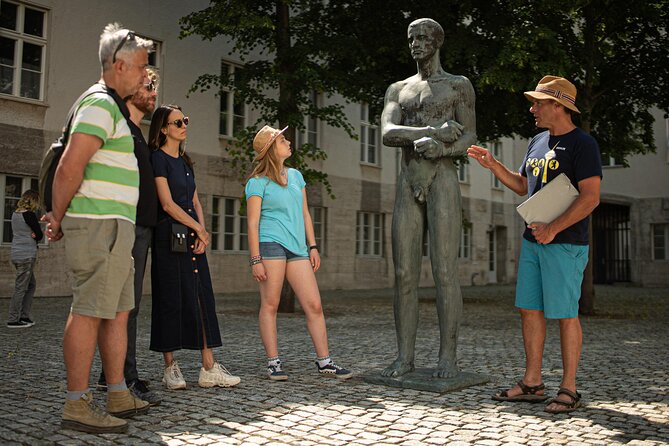
Berlin is not a city where the biggest historical sights always explain themselves. A vacant lot may mark the location of Hitler’s bunker. A plain government building may have housed one of the Nazi regime’s most important ministries. A modern train station may recall years of painful family separations.
That is why a private guide can be useful here. You are not just walking past monuments. You are asking how the Nazi dictatorship took power, how Berlin was divided after the war, and how the Wall shaped daily life. The guide can connect those subjects instead of treating each stop as an isolated photo opportunity.
The tour lasts about three to four hours and is offered in English. You meet in the lobby of a central Berlin hotel, with morning or afternoon departure times available. Hotel pickup and drop-off are included, although you should confirm the exact arrangements when booking.
The private format is especially helpful if your group has different interests. One person may want military history, another may care more about escape attempts and family life in East Berlin, and someone else may want to understand how Berlin handles its Nazi past today. A good guide can balance those needs far better than a set group itinerary.
More History Walking Tours in Berlin
- Berlin: Third Reich & Cold War Guided Walking Tour
★ 4.9 · 8,378 reviews - Berlin’s Best: 2 Hour Walking Tour Third Reich and the Cold War
★ 5.0 · 5,486 reviews - Third Reich Berlin: Hitler and WWII Walking Tour
★ 5.0 · 3,301 reviews
The Reichstag and Brandenburg Gate begin the story
The Reichstag is a natural opening point. Today it is the home of Germany’s federal Parliament, but the building also places you near the center of Berlin’s political history. From here, your guide can explain the struggle from Stalingrad through the Battle of Berlin and the fall of the Third Reich’s capital.
The nearby Brandenburg Gate gives the tour a different frame. Once a royal city gate, it became one of the clearest symbols of Berlin’s division during the Cold War. The Gate faced the political border between East and West Berlin, and images of it helped define the divided city for people around the world.
Today it represents peace and German unity. That change in meaning is worth hearing in person because the monument has not changed as much as the events around it have. You can look at the same columns through several periods of German history.
If your interest leans toward World War II, the area also opens discussion of Albert Speer’s plans for Germania, the monumental rebuilding scheme intended for Nazi Berlin, and the memorials to people who opposed the regime, including Claus von Stauffenberg. The exact amount of time spent on these subjects depends on your guide and your chosen emphasis.
The Holocaust Memorial requires a slower pace
The Memorial to the Murdered Jews of Europe is one of Berlin’s most important places of remembrance. Its 2,711 concrete slabs form a grid close to the Brandenburg Gate. Their changing heights create a stark, uneasy setting that feels different as you walk through it.
This is not a site to rush through for a quick photograph. The physical design offers no simple message, and the shifting ground lines and narrow passages can feel disorienting. Your guide can provide the historical context, but you should also allow yourself a quiet moment without commentary.
An underground information center beneath the memorial presents personal accounts and information about Jewish families murdered during the Holocaust. The tour stop is listed as about 15 minutes, so ask in advance if you want substantial time inside the information center. A short stop can introduce the memorial, but it cannot replace a longer visit.
I appreciate that the memorial is treated as part of the city rather than as a separate museum appointment. You see how remembrance exists beside government buildings, embassies, hotels, and busy streets. That contrast is central to understanding modern Berlin.
Hitler’s bunker site and the former Air Ministry
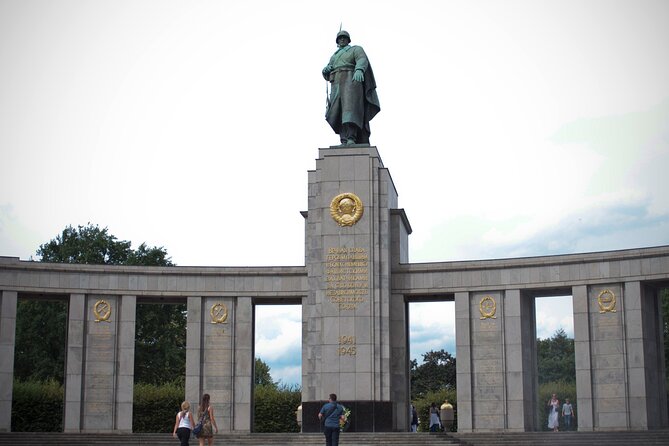
The Führerbunker site is intentionally understated. There is no dramatic preserved chamber to enter. The location is associated with the final days of Hitler and the Nazi leadership, but the site itself is now marked in a low-key way.
That restraint matters. Your guide can explain the bunker’s role and the final collapse of the regime without turning the place into a shrine. If you have watched documentaries or read about the end of the war, this stop helps place those events on an actual Berlin street.
The former Reich Air Ministry offers another useful lesson. Completed in 1936, the huge building was tied to Hermann Göring and the Luftwaffe. Its design was meant to project the power of the Nazi state. Though damaged in the war, the building survived and was later used by East Germany as its Ministry of Transport.
This is one of the few surviving major Nazi-era structures in Berlin. Its later use also shows how one building can carry several layers of political history. You are not looking at a museum set. You are looking at a working structure that passed from Nazi rule to East German government and into modern Berlin.
More History Walking Tours in Germany
- Berlin: Third Reich, Hitler, and WWII Walking Tour
★ 4.9 · 1,757 reviews - Berlin: Cold War Walking Tour on Berlin Wall Route
★ 4.8 · 437 reviews - Private Walking Tour Berlin Third Reich Hitler and World War II
★ 5.0 · 360 reviews - Berlin: Berlin Wall & East Side Gallery Walking Tour
★ 4.9 · 264 reviews
Topography of Terror puts the perpetrators in focus
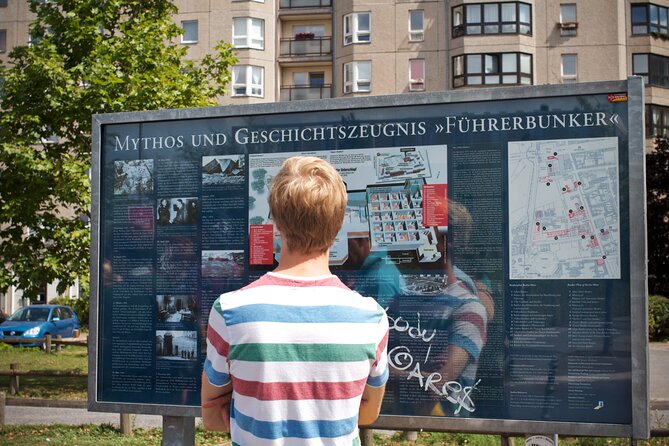
The Topography of Terror occupies the former headquarters area of the SS, Gestapo, and Security Service. Its exhibitions focus on the people and institutions that carried out Nazi persecution.
This is an important contrast with the Holocaust Memorial. The memorial emphasizes the murdered Jews of Europe and the act of remembrance. Topography of Terror concentrates on the machinery of repression and the officials who operated it.
The tour stop is scheduled for about 15 minutes, which works as an introduction but may feel brief if you want to study the displays. If your group has a strong interest in Nazi administration, policing, or political violence, ask the guide whether more time can be devoted to this site.
The tour’s best guides are likely to be most useful here because the facts can become dense. Guides such as Ariel, Hannah, Maggie, and Callum have been praised for explaining complicated subjects clearly and responding to questions. Still, the experience will depend on the individual guide assigned to your booking.
Checkpoint Charlie explains the Cold War in human terms
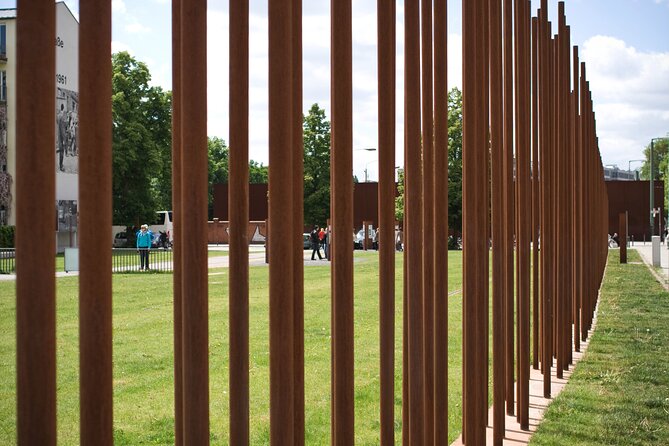
Checkpoint Charlie is one of Berlin’s most famous Cold War locations. It was the best-known crossing point between East and West Berlin and became a symbol of the city’s division.
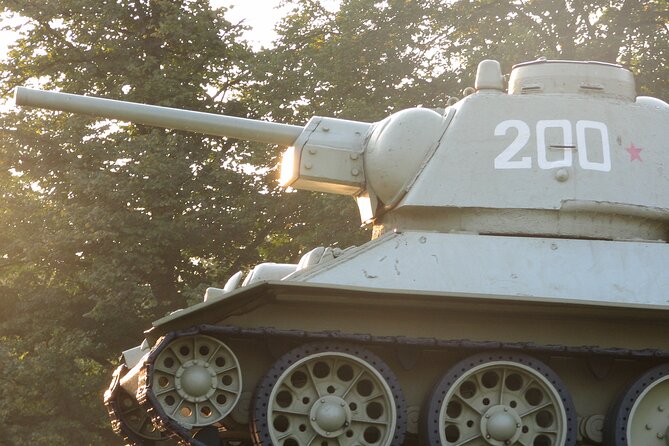
The 1961 confrontation between American and Soviet tanks gives the site its most dramatic episode. That standoff brought the Cold War close to open conflict, but the area’s daily human stories are just as important. Families and friends were separated. Escape attempts carried enormous risks. Travel rules shaped where people could work, study, and live.
The modern checkpoint area can feel commercial and crowded compared with the history it represents. That is a reason to have a guide. You need someone to separate the authentic historical setting from the later displays and explain what the crossing meant during the years of division.
The stop is listed at about 15 minutes. That is enough for a clear explanation, but not enough to explore every Cold War detail. If the Wall and divided-city history are your main reason for booking, tell the operator so the itinerary gives this subject enough weight.
The Palace of Tears shows the cost of separation
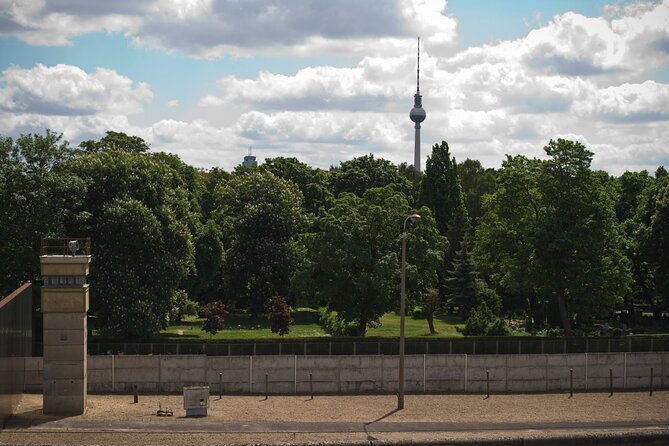
At Friedrichstrasse Station, the Palace of Tears recalls the departure hall used by East Germans crossing into West Berlin between 1961 and 1989. The name comes from the painful farewells that took place there.
This stop adds something that a tank standoff or political speech cannot. It shows the emotional cost of the border. People did not experience the Cold War only through headlines. They experienced it through restricted travel, sudden goodbyes, and the fear that a visit might be the last time they saw someone.
A museum inside the building presents the history of the border and personal accounts from the period. The tour allows about 20 minutes here. That is a useful amount of time for an introduction, though you may want to return on your own if the subject catches your attention.
The Palace of Tears is also a reminder that Berlin’s Cold War story is not confined to the Wall itself. Transport stations, apartment blocks, workplaces, and family routines all carried the effects of division.
Bernauer Strasse preserves the Wall as a real border
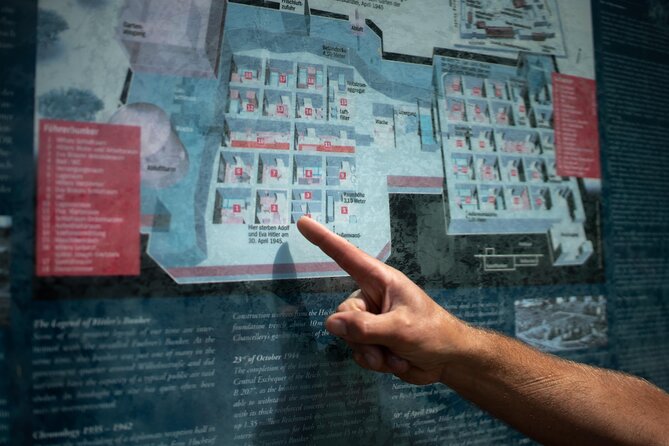
The Berlin Wall Memorial on Bernauer Strasse is among the most informative Wall sites in the city. When the Wall went up in 1961, it cut directly through the street and separated neighbors. Some East Berlin residents were trapped on one side while people in the West watched from nearby buildings.
The memorial preserves sections of the Wall, a watchtower, and a documentation center. It also explains escape attempts, including Tunnel 29, through which 29 people escaped in 1962, and Tunnel 57, used by 57 people in 1970.
This area helps you understand the Wall as a system, not just a concrete barrier. There were barriers, patrols, observation points, buildings, and open spaces between the eastern and western sides. The human stories make the political division easier to grasp.
The scheduled stop is about 25 minutes, longer than several central locations. That is sensible, but it still may not be enough for the documentation center and all outdoor sections. If you want a serious look at the Wall, make Bernauer Strasse one of your main priorities rather than trying to add every possible stop.
East Side Gallery and Tempelhofer Feld require route choices
The East Side Gallery is the longest remaining section of the Berlin Wall and an open-air collection of murals. The artwork promotes freedom, justice, and political change. It gives the Wall a very different mood from Bernauer Strasse, where the emphasis is on division, surveillance, and escape.
The Gallery is visually striking, but it lies away from the central Nazi-era cluster. Reaching it can affect how much time remains for other stops. The listed visit is about 15 minutes, which lets you see a portion of the paintings but not study the full stretch at leisure.
Tempelhofer Feld presents yet another side of Berlin’s past. The former Nazi airport later played a role in the Allied airlift of 1948 and 1949. The airport no longer operates, and the site is now an immense public recreation area.
The open space is impressive, but it is not a compact historic stop. If you want both Tempelhofer Feld and the central government district, ask how transportation and timing will work. A walking tour covering every location named in the route would require firm choices, not just enthusiasm.
Prenzlauer Berg adds the Soviet and East German period
The Prenzlauer Berg stop focuses on an old NKVD prison, later used by East Germany’s secret police, the Stasi. The site helps explain how political control continued after Nazi rule ended.
You can learn about interrogation methods used against prisoners and how the location is treated today. That last point matters. Berlin’s modern historical culture is not only about preserving buildings. It also asks how Germany should remember, explain, and take responsibility for destructive political systems.
This stop is best for people who want the Cold War story to include ordinary fear and state surveillance, not only famous leaders and border crossings. It also shows why the tour can feel much broader than a standard list of monuments.
How the $192.97 price measures up
At $192.97 per person, this is expensive compared with a large group walking tour. The value comes from the private format, not from admission tickets, since the listed stops have no admission charge and food and drinks are not included.
For two people, the total cost is substantial. For a family or small group, the per-person price may feel easier to justify because the guide can adapt the route and pace to your interests. You are also paying for the chance to ask questions without competing with a large group.
The strongest value appears when you prepare. Tell the operator what you have already seen, which period matters most, and which sites you consider essential. Several guides, including Jamie, Rohan, Joerg, Glen, and Maria, have been praised for changing the agenda around those details.
This is a poor value if you expect every listed location in one uninterrupted four-hour walk. The route covers a wide area, and the tour may need to favor central sites or use public transportation between distant areas. Ask for a proposed route before the day begins.
Practical details that affect your day
Wear comfortable shoes. The experience is built around walking, and the route may include long stretches between sites. One guide has been praised for adjusting the pace for older participants, while another tour continued despite rain and cold, so check the forecast and dress for Berlin’s conditions.
There is no food or drink included. Plan to eat before the tour or after it, since the schedule is focused on movement and explanation. The tour is offered in the morning or afternoon, and an early booking can make sense if you want to use the guide’s suggestions for the rest of your visit.
Hotel pickup and drop-off are included. The activity is private, and only your group takes part. Service animals are allowed, most people can participate, and the route is near public transportation.
Free cancellation is available up to 24 hours before the start time. Changes or cancellations made later are not accepted for a refund.
Who should book this private walk?
I would choose this tour if you want a clear framework for Berlin’s Nazi and Cold War past, especially on your first full day. It can help you understand the city’s layout, learn how to use the U-Bahn and S-Bahn, and decide which museums or memorials deserve a longer return visit.
It also suits families and small groups with specific questions. The private guide can explain the difference between fascism and communism, discuss Berlin culture, or follow a particular interest in escape stories, military history, Nazi architecture, or life in East Germany.
I would hesitate if you dislike long walks, want extensive indoor museum time, or expect a fixed list of every advertised location. The tour succeeds through conversation and flexibility, so you should communicate clearly before booking.
Should you book it?
Book this private Berlin tour if you want history explained on the streets where it happened and you are willing to choose priorities. The strongest version combines a central route with the Holocaust Memorial, Hitler’s bunker site, Topography of Terror, Checkpoint Charlie, and the Brandenburg Gate, then adds either Bernauer Strasse or East Side Gallery.
If the Berlin Wall is your main interest, request Bernauer Strasse and East Side Gallery specifically. If World War II matters most, ask for the Reichstag, former Air Ministry, Topography of Terror, and Nazi resistance sites. At this price, the tour should be shaped around your questions, not treated as a generic walk.
FAQ
How long does the private walking tour last?
The tour lasts approximately three to four hours. The exact length and route can depend on your chosen focus and the sites you request.
Can I choose between World War II and Cold War history?
Yes. You can focus on World War II, focus on the Cold War, or request a combination of both.
Is hotel pickup and drop-off included?
Yes. The tour includes hotel pickup and drop-off, with a central Berlin hotel lobby used for the meet and greet.
Is the tour conducted in English?
Yes. The experience is offered in English.
Are entrance tickets included?
The listed stops show free admission. Food and drinks are not included.
Is this a private tour?
Yes. Only your group participates, and the guide can adjust the route, pace, and subjects to your interests.
More Private Walking Tours in Berlin
- Private Walking Grand Tour of Copenhagen
★ 5.0 · 3,953 reviews - Vienna: Private Walking Tour with a Local
★ 4.6 · 1,446 reviews - Barcelona Helicopter, Sailboat & Old Town Private Walking Tour
★ 5.0 · 1,395 reviews - Private Walking Tour of Hanoi City
★ 5.0 · 1,251 reviews
More Private Walking Tours in Germany
- The History of Berlin: WWII PRIVATE Walking Tour With Locals
★ 5.0 · 209 reviews - Munich in the 3rd Reich and WW2 private walking tour
★ 5.0 · 148 reviews - Bamberg: Private Guided Walking Tour
★ 4.8 · 90 reviews - Dresden: Private Guided Walking Tour
★ 4.5 · 81 reviews
Just added around Berlin
- East Berlin and the Wall: Walking Tour★ 4.9 · 407 reviews
- Cold War, Berlin Wall, Spies and the East Side Gallery★ 4.8 · 254 reviews
- Berlin: walking tour about Charité★ 4.4 · 537 reviews
- Berlin: Walking Tour of the Top 10 Sightseeing Attractions★ 4.7 · 150 reviews
- Berlin: Sightseeing Walking Tour of the Top 20 Attractions★ 4.5 · 196 reviews
- Berlin: The Time of National Socialism Walking Tour★ 5.0 · 220 reviews
- Berlin : Must-see attractions Walking Tour★ 4.8 · 83 reviews
- Berlin: Kreuzberg Guided Walking Evening Tour★ 4.7 · 555 reviews
History Walking Tours, compared.
Berlin’s Best: 2 Hour Walking Tour Third Reich and the Cold War
Read our review →
Third Reich Berlin: Hitler and WWII Walking Tour
Read our review →
New Orleans Garden District History Walking Tour
Read our review →
Cartagena: Historic Center and Getsemaní Shared Walking Tour
Read our review →