
REVIEW · BERLIN
Berlin’s Best: 2 Hour Walking Tour Third Reich and the Cold War
Berlin’s most difficult stories are packed into this two-hour walk. You move from the Brandenburg Gate and Reichstag through Nazi government sites, the Holocaust Memorial, Hitler’s bunker location, and the Berlin Wall before ending at Checkpoint Charlie. It is a brisk route, but it covers ground that a bus tour cannot reach.
I like the clear start-to-finish story, from the rise of Nazism to German reunification. I also like the guides’ practical teaching style. Names praised by guests include Glen, Maggie, Mikey, James, Peter F., and Mikhail, with several guides using old photographs to show how each place once looked. The main drawback is simple: two hours leaves little time to linger, and much of the route is outdoors, so winter visitors need warm clothes and sensible shoes.
Key points to know before you book
- A compact route through Berlin’s darkest chapters: The walk links Nazi power sites, wartime memorials, Cold War landmarks, and reunification in one steady timeline.
- Starts at Brandenburg Gate and ends at Checkpoint Charlie: Both locations are central and easy to connect with public transportation.
- Mostly exterior history: You see important buildings and sites from the street, but admission to indoor museums is not part of the tour.
- Strong guide-led storytelling: Guides such as Glen, Mikhail, Maggie, Mikey, and James are praised for clear explanations, humor, and respectful handling of painful subjects.
- Maximum group size of 30: Large enough to feel social, but possibly less personal than a small private walk.
- Good value at $24.07: For two hours of guided sightseeing in central Berlin, the price is modest, especially if you are new to the city.
A fast route through Berlin’s 20th-century story
This is not a general introduction to every side of Berlin. It focuses on the city’s Nazi and Cold War past, with a short look at reunification at the end.
That focus gives the walk a useful shape. You begin with symbols of modern Germany, move into the machinery of dictatorship and war, then follow the division between East and West. By the final stop, the Berlin Wall is gone, but the questions raised by the route are still very much alive.
The guide supplies the connective tissue. The buildings can look ordinary at first glance, especially in a city rebuilt and changed so often. A good explanation helps you see what happened on the ground beneath your feet.
The pace is brisk. The listed stops add up to roughly an hour and a half of guided time, leaving the rest for walking between locations, questions, and transitions. You should expect short talks rather than long visits at each site.
More History Walking Tours in Berlin
- Berlin: Third Reich & Cold War Guided Walking Tour
★ 4.9 · 8,378 reviews - Third Reich Berlin: Hitler and WWII Walking Tour
★ 5.0 · 3,301 reviews - Berlin: Third Reich, Hitler, and WWII Walking Tour
★ 4.9 · 1,757 reviews
Meeting at Brandenburg Gate
Meet 15 minutes before departure in front of the Tourist Information office on the Pariser Platz side of Brandenburg Gate. Look for the guide carrying a pink umbrella. That detail matters in a busy public square, particularly when several groups gather near the monument.
The gate is a strong place to begin. It once marked one of Berlin’s old city entrances, but today it is best known as a symbol of a divided city becoming one again. Your guide explains why it carries such weight in modern Germany and how it came to represent reunification.
You spend about 15 minutes here, and there is no admission charge. This opening also gives you a useful orientation to central Berlin. If you arrive early, you can take in the gate, Pariser Platz, and the surrounding government quarter before the walk begins.
The Reichstag and the collapse of democracy
The Reichstag Building comes next. You spend about 10 minutes hearing how this parliament building reflects the upheavals of the last century.
The key story is the Reichstag fire of 1933 and the way Adolf Hitler used the event to help destroy Germany’s democratic system. The building is not simply an impressive government landmark. It is a place where political power, public fear, and dictatorship collided.
You view the building from outside on this tour. The glass dome and interior parliament spaces are not included, so book this walk for the history and setting rather than an inside visit.
I find this stop useful because it gives the Nazi period a political starting point. Instead of treating the Second World War as an isolated event, the guide explains how the dictatorship gained control and used state institutions.
Soviet tanks in the Tiergarten
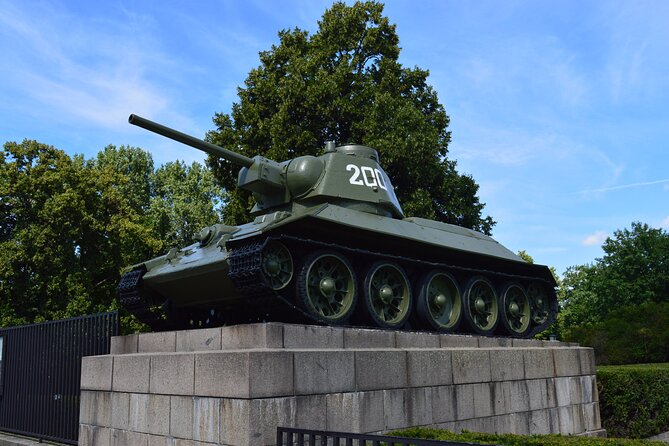
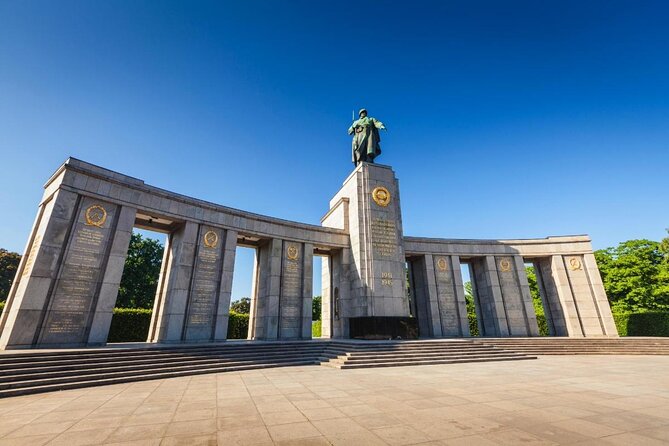
The Soviet Memorial in the Tiergarten adds a physical reminder of the Second World War. The stop lasts about seven minutes and includes views of Soviet T-34/76 tanks and field artillery.
The memorial can be striking because the military equipment is displayed in an open public setting. It connects the final battles for Berlin with the Soviet victory and the occupation that followed.
This is a short stop, so expect a focused explanation rather than a full memorial visit. It works best as part of the wider story. The tour is showing you how Berlin moved from Nazi rule into a postwar city controlled by competing powers.
The route also includes the Victory Column. Your guide explains why Albert Speer moved it from its original location and discusses the Nazi plan for Germania, a proposed new capital intended to replace Berlin if Germany had won the war.
That section helps explain the scale of Nazi ambition. You are not just hearing about military events. You are hearing about an attempt to reshape the capital and project power through architecture.
More History Walking Tours in Germany
- Berlin: Cold War Walking Tour on Berlin Wall Route
★ 4.8 · 437 reviews - Private Walking Tour Berlin Third Reich Hitler and World War II
★ 5.0 · 360 reviews - Berlin: Berlin Wall & East Side Gallery Walking Tour
★ 4.9 · 264 reviews - Cold War, Berlin Wall, Spies and the East Side Gallery
★ 4.8 · 254 reviews
The Holocaust Memorial and an uncomfortable pause
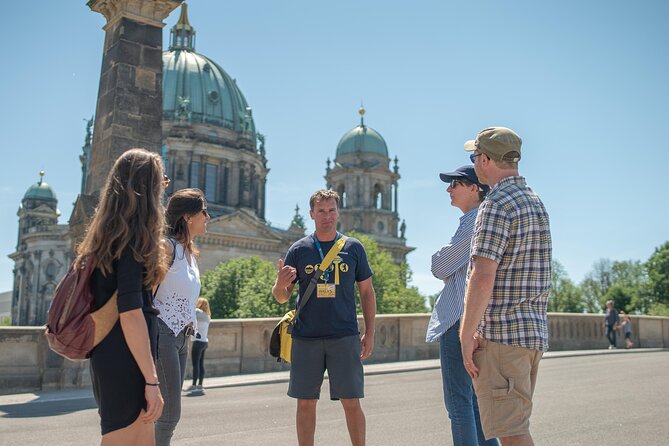
The Memorial to the Murdered Jews of Europe is one of the tour’s most important stops. You walk through the field of concrete blocks for about 10 minutes.
There is no admission ticket, but this is not a casual sightseeing spot. The memorial is designed to make you feel disoriented as the ground and blocks change around you. Your guide provides context about the murder of Europe’s Jews and explains how Germany presents this past today.
Give yourself room to think here. The stop is short, and the group will eventually move on, but you do not need to treat the memorial like a quick photo stop. Listen carefully, keep your voice low, and remember that the site is dedicated to people who were murdered.
This is also one point where a guide’s tone matters. Several guides are praised for handling difficult subjects with care while keeping the explanation accessible. The best moments of the walk come when the guide avoids both a dry lecture and misplaced humor.
Standing above Hitler’s bunker
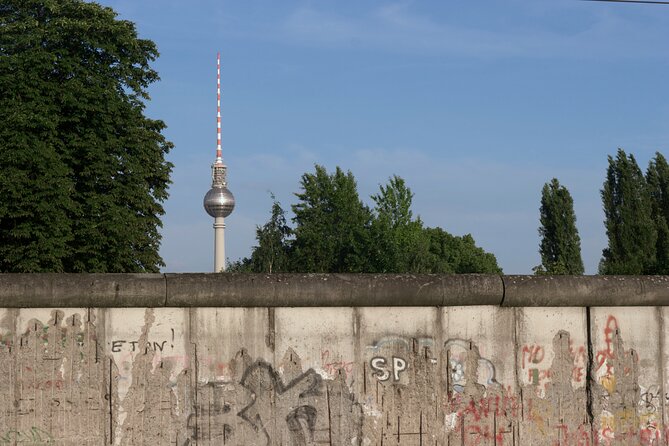
The Fuhrerbunker stop is brief, about 10 minutes, but it often leaves the strongest impression. You stand above the former bunker site and hear about Hitler’s final days, including his suicide on April 30, 1945.
There is no dramatic entrance to see. The bunker itself is not open as a tourist attraction, and the location is marked in a deliberately restrained way. That plainness is part of the point. Your guide explains what happened below ground and how Germany has dealt with the site without turning it into a shrine.
This stop can feel strange because the location is now part of an ordinary urban setting. The tour helps you understand why the site is treated with caution and why little is done to make it visually spectacular.
For me, this is where the walk shifts from major landmarks to the value of knowing what lies behind an unremarkable place. The historical meaning is not obvious without explanation.
The Aviation Ministry and Nazi power
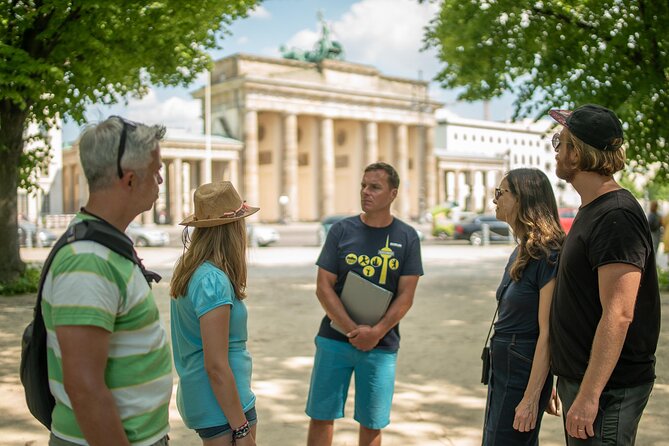
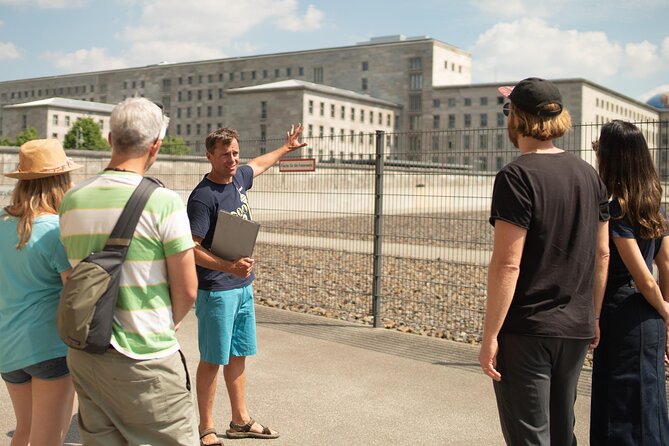
The former Aviation Ministry gives you another look at the Nazi state. You walk along the length of Hermann Göring’s former Air Ministry, spending about five minutes on the stop.
The building also played a role after the war. It was the location where East Germany, or the GDR, was proclaimed in 1949. That one building therefore connects Nazi government, postwar occupation, and the creation of a divided German state.
This is a useful example of Berlin’s layered past. The city does not offer a clean line between one era and the next. The same streets and structures were used by different governments, often for sharply different purposes.
You see the building from the outside. The value lies in the guide’s explanation and in noticing how a surviving structure fits into the modern city.
Topography of Terror and Nazi institutions
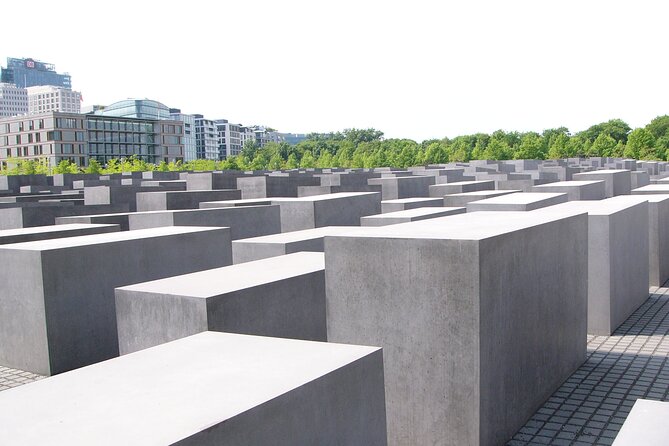
At the Topography of Terror, you spend about 15 minutes near the former headquarters of the SS, Gestapo, and SD. These institutions helped organize persecution, repression, and terror under the Nazi regime.
The site now houses an exhibition about those crimes. The walking tour points out the location and explains why it matters. It does not replace a full visit to the exhibition, so you may want to return later if you have time for a more detailed museum experience.
This stop gives the route some documentary weight. Earlier sites show political power and wartime destruction. Here, you focus on the institutions that turned ideology into arrests, torture, deportation, and murder.
If you have already visited the Topography of Terror, the stop still helps place it within the route. If you have not, make a note to come back. The tour gives you a reason to do so, but not the time for a full museum visit.
The Berlin Wall at Niederkirchnerstraße
The walk then reaches Niederkirchnerstraße, where you see a large surviving section of the Berlin Wall. The stop lasts about seven minutes.
Your guide explains how the Wall divided East and West Berlin, what daily life was like on each side, and what happened to people who tried to escape. The stories of failed escapes make the concrete barrier feel less like an old political symbol and more like a dangerous border that shaped real lives.
This is another place where old photographs can help. Guides such as Mikhail and Glen are praised for using historic images to show how locations looked before the Wall fell. Comparing the past with the present can make the changes easier to grasp.
The stop is short, so do not expect a long explanation of every stage of the Wall’s construction. You get a focused account of division, escape, and the human cost of the border.
Checkpoint Charlie and the road to reunification
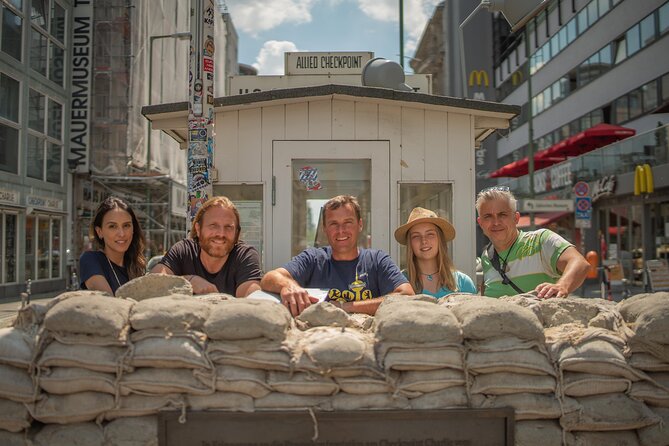
Checkpoint Charlie is the final stop. You spend about 15 minutes hearing about the famous checkpoint, the Soviet and American tank confrontation in 1961, and the fall of the Berlin Wall on November 9, 1989.
The ending works well because the route has been moving toward this moment. You began at a symbol of unified Germany, then traced the political forces that led to dictatorship, war, occupation, division, and finally reunification.
Checkpoint Charlie itself can feel commercial and crowded. The tourist displays and surrounding businesses do not always match the seriousness of the history. That is exactly why a guide helps. You can separate the real Cold War story from the modern souvenir setting.
The tour finishes by considering how successful German reunification has been during the more than 30 years since the Wall came down. It does not pretend that reunification erased every difference overnight. Instead, it gives you a starting point for thinking about Berlin as a city still shaped by its divided past.
What the $24.07 price gets you
At $24.07 per person, this is a strong value if you want a guided introduction to central Berlin’s Nazi and Cold War sites.
You are paying for an English-speaking local guide, a structured route, and the ability to connect places that might otherwise seem unrelated. There are no major admission fees hidden inside the experience because the tour visits these locations from the street.
The value drops if you want long museum visits or time for detailed photography. This is a walking overview, not a series of interior tours. You may still choose to return to the Topography of Terror or another museum after the walk.
A maximum of 30 people keeps the cost low, but it can affect how easily you hear and ask questions. The guide names associated with especially strong sessions include Glen, Ben, Maggie, Rebecca, Tom, Joachim, Peter F., Simon, Mikey, Georgia, James, Mikhail, Eyan, Xavier, Ronja, and Jamie S. Your assigned guide may be different, but the repeated strengths are clear: clear answers, a friendly manner, careful handling of painful material, and a knack for keeping the group moving.
Timing, footwear, and weather
Wear sensible shoes. You will be outside for about two hours, and the route includes several stretches between stops.
Winter requires extra planning. Bring gloves and warm layers, and use the restroom before meeting the group. There may be a restroom break if needed, but the walk is designed to keep moving.
The tour is offered in English only. Most people can take part, and service animals are allowed. It is near public transportation, with the start and finish both in central Berlin.
Free cancellation is available if you cancel at least 24 hours before the start time. Inside that window, the payment is not refunded, and changes are not accepted.
Who should book this Berlin walk?
I would choose this tour if you are visiting Berlin for the first time and want a clear framework for the city’s 20th-century past. It is also a good fit if you have only a short stay and want to cover several major sites without spending half a day in one museum.
Families can make good use of it. Guides have handled questions from children and teenagers, and the subject matter can prompt useful conversations. The material is serious, but the guiding style is not designed to shut younger people out.
You should think twice if you dislike group walks, need a slow pace, or want detailed time at each memorial. The two-hour format favors breadth over quiet reflection.
Should you book Berlin’s Best?
Book it if you want a well-organized historical route at a modest price, especially early in your Berlin stay. The tour gives you a useful map of the city’s Nazi and Cold War sites, and the ending at Checkpoint Charlie leaves you well placed to continue exploring.
Do not book it expecting museum entry, a private guide, or long stops. You will see many significant places from outside and rely on the guide to explain what happened there.
For most first-time visitors with two free hours, I think the balance is right. You get a serious introduction, a central route, and enough pointers to plan what to visit next on your own.
FAQ
How long is the tour?
The walking tour lasts approximately two hours.
Where does the tour begin?
It begins at Brandenburg Gate, at Pariser Platz in Berlin. Meet in front of the Tourist Information office on the Pariser Platz side 15 minutes before departure.
How do I find the guide?
Look for the guide with the pink umbrella.
Where does the tour end?
The tour ends at Checkpoint Charlie, at Friedrichstraße 43-45.
Is the tour offered in English?
Yes. The tour is offered in English only and includes an English-speaking local guide.
What sites are included?
The route includes Brandenburg Gate, the Reichstag Building, the Soviet Memorial in the Tiergarten, the Victory Column, the Holocaust Memorial, the former Fuhrerbunker site, the former Aviation Ministry, the Topography of Terror, a section of the Berlin Wall at Niederkirchnerstraße, and Checkpoint Charlie.
Can I cancel for a full refund?
Yes. You can receive a full refund if you cancel at least 24 hours before the experience begins. Cancellations or changes made less than 24 hours before the start time are not accepted for a refund.
More Two-Hour Tours in Berlin
- Budapest City Landmarks Walking Tour in 2 Hours
★ 5.0 · 2,048 reviews - Leipzig: 2-Hour Guided Walking Tour in German
★ 4.8 · 1,612 reviews - Lucca: 2-Hour City Center Walking Tour
★ 4.7 · 1,314 reviews - 2-Hour Bonaventure Cemetery Walking Tour
★ 5.0 · 1,270 reviews
Just added around Berlin
- East Berlin and the Wall: Walking Tour★ 4.9 · 407 reviews
- Cold War, Berlin Wall, Spies and the East Side Gallery★ 4.8 · 254 reviews
- Berlin: walking tour about Charité★ 4.4 · 537 reviews
- Berlin: Walking Tour of the Top 10 Sightseeing Attractions★ 4.7 · 150 reviews
- Berlin: Sightseeing Walking Tour of the Top 20 Attractions★ 4.5 · 196 reviews
- Berlin: The Time of National Socialism Walking Tour★ 5.0 · 220 reviews
- Berlin: Kreuzberg Guided Walking Evening Tour★ 4.7 · 555 reviews
- Berlin : Must-see attractions Walking Tour★ 4.8 · 83 reviews
History Walking Tours, compared.

Third Reich Berlin: Hitler and WWII Walking Tour
Read our review →
New Orleans Garden District History Walking Tour
Read our review →
Cartagena: Historic Center and Getsemaní Shared Walking Tour
Read our review →
Imperial Palace and Shogun Historical Walking Tour
Read our review →
Leipzig: 1.5-Hour Historical Walking Tour in German
Read our review →Browse the lists this tour appears in