
REVIEW · BERLIN
Berlin History Walking Tour with a French-Speaking Guide
Berlin’s past comes at you quickly on this three-hour French-language walking tour, from the Cold War checkpoint to the site of Hitler’s last days and the memorial to Europe’s murdered Jews. It gives you a useful first map of central Berlin without burying you in museum rooms or long transfers.
I like the strong route of major landmarks and the chance to hear the difficult parts of the city’s story explained in French. I also like the human touch: guides named Anouk, Martin, Arthur, Paul, and Céline are praised for clear explanations, humor, good pacing, and practical advice about other places to see and eat.
The main caution is simple: this is a full walking tour, not a bus ride. The group can reach 25 people, there are no audio devices, and one visitor found some historical details imprecise. Bring good shoes, pay attention, and ask questions.
Key points at a glance
- A 10 a.m. start at Potsdamer Platz: You can cover Berlin’s central landmarks and still finish near Museum Island in time for lunch.
- A serious route with real historical weight: Checkpoint Charlie, Hitler’s Bunker, and the Holocaust Memorial focus the tour on Nazism, war, division, and reunification.
- French-speaking guidance throughout: The experience is designed for French speakers, with guides including Anouk, Martin, Arthur, Paul, and Céline.
- Mostly a continuous walk: Transportation between stops is not provided, so expect several hours on foot.
- A useful first visit to Berlin: The route links famous sights with enough context to help you plan the rest of your stay.
- Good value at $27.81: For a small fee, you get a local guide, a structured route, and access to several central sites without paying for a large museum admission.
Why this Berlin walk works well as a first outing
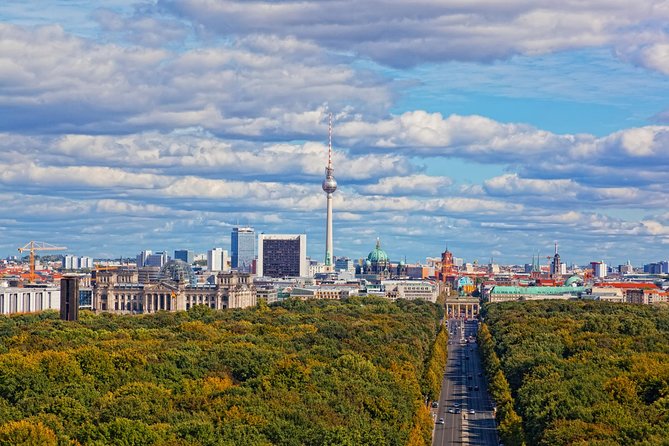
Berlin can feel scattered at first. Its important sites are spread through broad avenues and open spaces, and the city’s story is split between Prussian power, Nazi terror, Cold War division, and reunification. A guide helps you connect those pieces while you walk.
This tour keeps the focus on central Berlin. You start in the modern Potsdamer Platz area, move through sites tied to the Cold War and the Nazi period, then continue along Unter den Linden toward Museum Island and the Brandenburg Gate. The route gives you landmarks, dates, and visual clues without asking you to spend half a day inside one museum.
I especially like the morning timing. Meeting at 10 a.m. gives you time to reach Potsdamer Platz without an early alarm, while the finish near Museum Island leaves the afternoon open. You can have lunch afterward, visit a museum, explore Alexanderplatz, or continue walking through the historic center.
The tour is priced at $27.81 per person. That is fair value if you want orientation and explanation rather than simply collecting photographs. You are paying for the guide and the structure of the morning, not for a meal or a private vehicle. Since the stops are viewed from the city streets, the price remains lower than a tour built around several formal museum admissions.
More History Walking Tours in Berlin
- Berlin: Third Reich & Cold War Guided Walking Tour
★ 4.9 · 8,378 reviews - Berlin’s Best: 2 Hour Walking Tour Third Reich and the Cold War
★ 5.0 · 5,486 reviews - Third Reich Berlin: Hitler and WWII Walking Tour
★ 5.0 · 3,301 reviews
Potsdamer Platz sets the modern tone
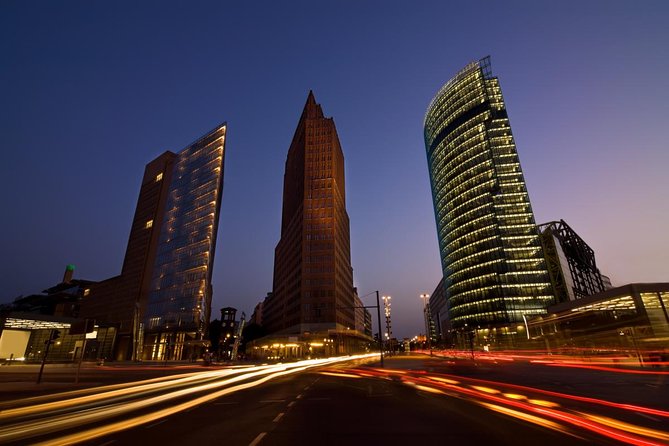
The meeting point is Potsdamer Platz 10, at the corner of Gabriele-Tergit-Promenade. This is a useful place to begin because the area shows how dramatically Berlin has changed.
Potsdamer Platz was once divided by the Berlin Wall and later rebuilt as a major modern district. The tour uses the area as a starting point for discussing the city’s postwar transformation, including the Sony Center and the surrounding contemporary architecture.
You have about 10 minutes here. That is enough for an introduction and a quick look around, but not a detailed architectural visit. Arrive ready to walk rather than expecting a long stop with time for shopping or extensive photographs.
The modern buildings at Potsdamer Platz also prepare you for one of Berlin’s recurring themes: old wounds beside new construction. The city often places sleek offices, open squares, and rebuilt structures directly beside reminders of destruction and division.
Checkpoint Charlie explains a divided city
The group continues to Checkpoint Charlie, one of the best-known symbols of the Cold War. The stop lasts about 10 minutes, and admission is free.
This was a crossing point between East and West Berlin during the years when the city was divided. The value of stopping here is not the checkpoint booth alone. Your guide can explain what the crossing represented, how the two sides confronted each other, and why this corner became so famous around the world.
Checkpoint Charlie is also a place where expectations matter. The site is highly popular and visually simple, so it can feel less dramatic than its political importance suggests. The explanation is what gives the stop weight. Without context, you see a sign and a guardhouse. With context, you understand the fear, tension, and propaganda attached to the location.
Use this stop to ask questions. The guides are praised for answering individual questions and adjusting to the group. That matters at a place where a short explanation can easily become either too shallow or too technical.
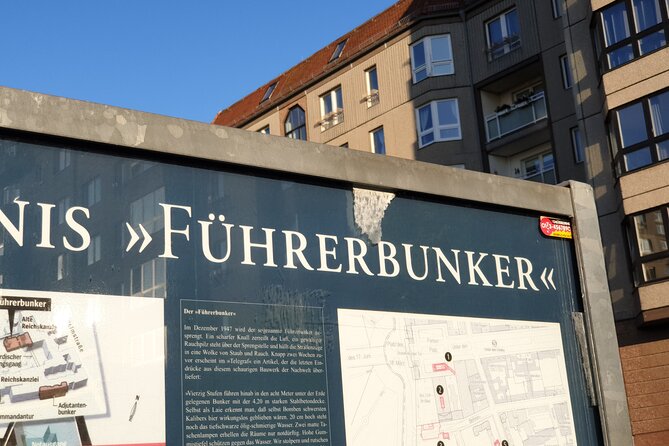
Hitler’s Bunker is about the site, not a theatrical attraction
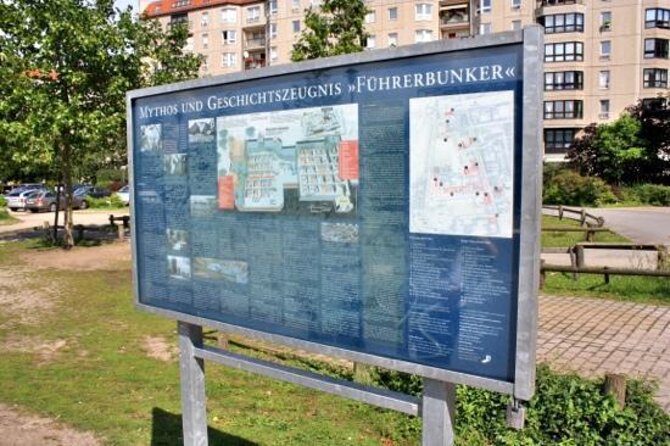
The next stop concerns the Führerbunker, where Hitler spent his final days. The tour does not present it as a preserved underground attraction. Instead, the guide explains the location, what happened there, and why the present-day site looks the way it does.
That distinction is important. The site has a grim pull for many people, but Berlin has deliberately avoided turning it into a monument to Hitler. Understanding the absence of a dramatic entrance or visible bunker structure is part of understanding how Germany handles this past.
You have about 10 minutes here. The stop is brief, but the subject is serious. A good guide must explain the historical importance without sensationalism, and the strongest guide comments describe clear, well-documented storytelling throughout the morning.
The tour summary includes admission to Hitler’s Bunker and the Holocaust Memorial. In practical terms, you should expect guided interpretation at the bunker location rather than a standard underground visit.
More History Walking Tours in Germany
- Berlin: Third Reich, Hitler, and WWII Walking Tour
★ 4.9 · 1,757 reviews - Berlin: Cold War Walking Tour on Berlin Wall Route
★ 4.8 · 437 reviews - Private Walking Tour Berlin Third Reich Hitler and World War II
★ 5.0 · 360 reviews - Berlin: Berlin Wall & East Side Gallery Walking Tour
★ 4.9 · 264 reviews
The Holocaust Memorial asks you to slow down
The Memorial to the Murdered Jews of Europe is one of the most affecting stops. The tour allows about 15 minutes here, where you hear the story behind the memorial and the crime it commemorates.
The field of concrete slabs is open to the public, and its design changes as you move through it. The experience is physical and quiet rather than built around a long written explanation. Your guide’s role is to provide historical context and help you approach the place with the seriousness it demands.
This is not a stop to rush through for a photograph. Take a moment to look, listen, and notice how the memorial changes as the ground shifts. The guide’s explanation can help you understand why the memorial is deliberately abstract and why the city places it near major central landmarks.
The memorial is one reason this tour is better suited to people who want history rather than a light sightseeing stroll. The route deals directly with state violence, genocide, war, and memory. Those subjects are handled as part of the city’s story, not pushed aside for easier sightseeing.
Unter den Linden links imperial Berlin to the present
From the memorial, the walk reaches Unter den Linden, Berlin’s grand central avenue. The group spends about 20 minutes here, making it one of the longer stops.
The avenue once led toward the emperor’s palace and still carries traces of different periods of German history. Your guide points out changes in architecture and the marks left by war. This is where the walk begins to feel less like a series of isolated monuments and more like a lesson in how Berlin was built, damaged, rebuilt, and changed.
Look up as you walk. The important details are not limited to the famous buildings. The avenue helps you see how royal ambition, war damage, socialist-era rebuilding, and modern restoration overlap in one part of the city.
The walking pace is a strength here. You are not being driven past the buildings at speed. You have time to see how the avenue fits together, though the group must keep moving to complete the route.
Bebelplatz brings Nazi censorship into view
Bebelplatz receives a shorter stop of about 10 minutes, but its story is powerful. This was the site of the Nazi book burning in 1933, when works by Jewish, socialist, pacifist, and other writers were targeted.
The square also includes Humboldt University and the Catholic Cathedral, which creates a striking contrast. A place associated with learning and religious tradition became a stage for political censorship and intimidation.
Your guide can point out the memorial beneath the square, a reminder of empty bookshelves. Even if you have read about the book burning before, seeing the memorial in its setting helps connect the event to the city around it.
This is another place where the guide’s ability to explain clearly matters. Ten minutes is not enough for a full study of Nazi cultural policy, but it is enough to understand why Bebelplatz belongs on a first tour of Berlin.
Museum Island provides a strong finish
The route concludes near Museum Island, close to Alexanderplatz. The area includes the Berliner Dom and the reconstructed Humboldt Forum, giving you a look at Berlin’s architectural heritage and its ongoing arguments about rebuilding and memory.
The end point is useful because it leaves you in one of the city’s best areas for an afternoon. You can remain on Museum Island, visit a museum, walk toward Alexanderplatz, or stop for lunch nearby.
The tour allows about 15 minutes here. That does not provide time to tour the museums inside, and museum admission is not included as part of this walking experience. Think of the stop as an introduction and a practical handoff to the rest of your day.
If you plan to visit one of Museum Island’s museums afterward, check opening times separately. The tour itself ends outside, near the island, rather than turning into an indoor museum visit.
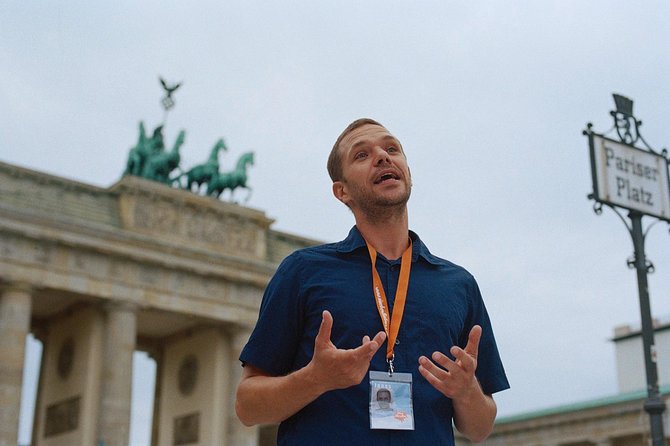
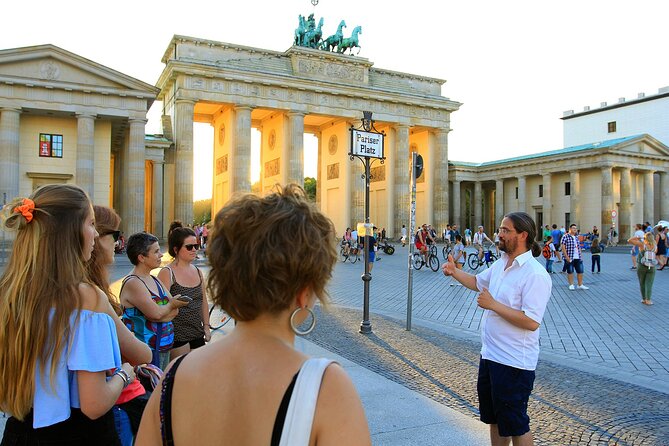
The Brandenburg Gate gives the walk a clear ending
The Brandenburg Gate is Berlin’s most recognizable gateway and one of the main photo stops in the city. The guide explains how it moved from a symbol of royal authority to a Cold War landmark and finally to an image of German reunification.
Its meaning changed as Berlin changed. That makes it an effective final landmark for a tour covering monarchy, dictatorship, division, and reunification.
The stop is listed at about 10 minutes. You will have time for photographs and a concise explanation, but this is not a private photo session. The area can be busy, so stay close enough to hear the guide.
The gate also helps tie together the earlier stops. Potsdamer Platz showed the rebuilt modern city. Checkpoint Charlie represented division. The memorials addressed Nazi crimes. Here, the story moves toward a reunited Germany, though the city’s past remains visible everywhere.
What the guide adds to the morning
The most praised feature of this experience is the quality of the French-speaking guides. Anouk is described as precise and attentive to questions. Martin is praised for passion and a well-paced walk. Arthur is noted for clear explanations, humor, and a strong grasp of Berlin’s past and present.
Paul is described as friendly and competent, while Céline is credited with making the city’s story feel more immediate than reading about it alone. These names give you a sense of the guiding style to expect, though the specific guide assigned to your departure may vary.
The best part of a live guide is the ability to ask about what you are seeing. You can request clarification, ask how Berliners deal with the past, or ask for ideas beyond the main route. Practical advice about other sights and restaurants is also mentioned as part of the experience.
There is one limitation. The tour does not provide audio receivers. In a group of up to 25 people, hearing every sentence can be harder, especially near roads or in crowded public spaces. Stay close to the guide and speak up if you miss something.
Walking conditions, group size, and value
The tour lasts about three hours, although one departure ran for roughly three and a half hours. Plan your morning around a flexible finish rather than scheduling a tight appointment immediately afterward.
Transportation to and from the attractions is not included. The route is meant to be completed on foot, and you should have a moderate level of physical fitness. Wear comfortable shoes and dress for the weather, since the experience operates in rain or shine.
A maximum of 25 people keeps the cost low while still allowing a group format. It is not the intimacy of a private tour, but it is small enough to follow a guide more easily than on a large coach excursion.
At $27.81, I see this as a strong first-day purchase for a French-speaking visitor. You get a central route, local interpretation, and a useful overview without spending money on transport between each landmark. The value drops if you already know Berlin well or want long visits inside museums, since this tour stays focused on the streets and exterior sites.
The experience is also suitable for solo visitors. The route gives you a clear plan, and the guide creates opportunities for questions even if you arrive alone.
Who should book this Berlin history tour
I would choose this tour if you are visiting Berlin for the first time, prefer French, and want to understand the city before exploring it on your own. It is especially useful if you want to cover the major central sights in one morning.
It also suits anyone who likes historical context more than shopping or entertainment. The subjects are difficult, and the tone is serious, but the guides add warmth, humor, and practical help where appropriate.
I would think twice if you dislike walking, need a fully seated experience, or want extended time at each monument. The stops are deliberately short, and the route covers a lot of ground. You will gain breadth, not a detailed study of every site.
The experience allows service animals and is near public transportation. Confirmation arrives at booking, and free cancellation is available if you cancel at least 24 hours before the 10 a.m. start time. Changes or cancellations made later are not accepted for a refund.
Should you book it?
Book this tour if you want a clear French-language introduction to central Berlin, with serious history, major landmarks, and a finish near Museum Island. The mix of Checkpoint Charlie, the bunker site, the Holocaust Memorial, Bebelplatz, and the Brandenburg Gate gives you a strong sense of how the city’s past shapes its present.
Before booking, be honest about the walking. Bring weather-ready clothing, comfortable shoes, and a willingness to stay near the guide because there are no audio devices. If those conditions suit you, the $27.81 price is a sensible way to get your bearings and decide what deserves more time later.
FAQ
Where does the Berlin history walking tour start?
The tour starts at Potsdamer Platz 10, 10785 Berlin, at the corner of Gabriele-Tergit-Promenade.
What time does the tour begin?
The tour starts at 10 a.m.
How long does the experience last?
The scheduled duration is approximately three hours. One departure lasted about three and a half hours.
Where does the tour end?
The tour ends next to Museum Island, near Alexanderplatz, at Museumsinsel, 10178 Berlin.
Is the tour conducted in French?
Yes. The experience operates in French with a professional French-speaking guide.
Is transportation between the stops included?
No. Transportation to and from the attractions is not included. The route is completed on foot.
What landmarks are included?
The route includes Potsdamer Platz, Checkpoint Charlie, the Führerbunker site, the Holocaust Memorial, Unter den Linden, Bebelplatz, Museum Island, and the Brandenburg Gate.
What is the maximum group size?
The tour can have a maximum of 25 participants.
Can I cancel for a full refund?
Yes. You can cancel at least 24 hours before the local start time for a full refund. Cancellations or changes made less than 24 hours before the tour are not refunded or accepted.
Just added around Berlin
- Berlin Walking Tour★ 4.5 · 378 reviews
- East Meets West: Berlin Food Culture & Street Art★ 5.0 · 157 reviews
- Berlin Highlights Private Guided Walking Tour★ 4.5 · 89 reviews
- Small Group Walking Tour of East Berlin with a French Guide★ 5.0 · 176 reviews
- Berlin Street Art Walking Tour – Off The Grid★ 5.0 · 270 reviews
- Gruseltour Berlin Haunted Ghost Walk 90-minute at Berlin Mitte city center★ 5.0 · 75 reviews
- Berlin Private Complete History All Day Walking Tour★ 5.0 · 474 reviews
- Private Berlin: Iconic Sights and Hidden Gems Walking Tour★ 5.0 · 292 reviews
History Walking Tours, compared.

Berlin’s Best: 2 Hour Walking Tour Third Reich and the Cold War
Read our review →
Third Reich Berlin: Hitler and WWII Walking Tour
Read our review →
New Orleans Garden District History Walking Tour
Read our review →
Cartagena: Historic Center and Getsemaní Shared Walking Tour
Read our review →
Imperial Palace and Shogun Historical Walking Tour
Read our review →Browse the lists this tour appears in