
REVIEW · LISBON
Lisbon: Belem Walking Tour with Jeronimos Monastery Entry
The best part of this Belem walking tour is that it gives the district a clear story. You begin inside Jerónimos Monastery, then connect its carvings, royal tombs, and Manueline style to Portugal’s Age of Discovery. The original Pastel de Belém is a tasty pause, not just a sugar stop.
I like the pre-purchased monastery ticket, especially for a 9:30 morning entry when queues can grow quickly. I also like the guides’ practical, human approach. Luis, Leonardo, Leo, and Federico are repeatedly praised for clear English, humor, good pacing, and answers to odd questions. The main drawback is that Belem Tower is currently closed for restoration, so you see it from outside rather than entering.
Key points to know before booking
- Jerónimos Monastery is the main event: Allow about 90 minutes for the cloisters, church, tombs, and architectural details.
- The separate entrance saves time: Your guide has tickets ready and meets you near the monastery queue.
- The Pastel de Belém is included: You stop at the historic bakery for the pastry made from the monastery’s old recipe.
- The walk connects major sights: Empire Square Garden, the Discoveries Monument, and Belem Tower follow the monastery visit.
- Belem Tower cannot currently be entered: Restoration work limits this stop to exterior viewing and explanation.
- Come ready to walk: Comfortable shoes, sun protection, and an umbrella matter because the tour runs in rain or shine.
Why Jerónimos Monastery deserves the first 90 minutes
Jerónimos Monastery is not a quick photo stop. Its Upper Cloister gives you the first proper look at the building’s decorative stonework, arches, columns, and carved details. Starting here is smart because the monastery supplies the historical key for everything that follows.
Your guide explains Manueline architecture, the Portuguese style that grew from late Gothic forms with Renaissance touches in the early 16th century. You will see how the design carries maritime ideas and symbols connected with Portugal’s seafaring power. The point is not simply to admire pretty stone. You begin to understand what the monastery represented to the kingdom and to the wider society of its time.
The Upper Cloister is also the best place to pause and take in the building as a whole. The tour description promises broad views of the architectural details, and the guide’s commentary gives those details a purpose. Without explanation, a carved armillary sphere or nautical motif can become visual clutter. With context, it becomes part of a story about royal ambition, religion, trade, and navigation.
You then move down to the lower part of the cloister. Important rooms include the Chapter Room and the old Refectory. These spaces help you picture the monastery as a working religious complex, not only as a grand monument built for modern sightseeing.
The tour also points out the tomb of Fernando Pessoa, which was moved to this site in the 20th century. That creates an interesting link between Portugal’s older royal and religious traditions and one of its best-known literary figures.
A few more walking tours around Lisbon worth a look
- Lisbon: History, Stories and Lifestyle Walking Tour
★ 4.8 · 10,902 reviews - Best of Lisbon Small-Group Guided Walking Tour
★ 5.0 · 4,869 reviews - Lisbon: Food and Wine Small Group Walking Tour
★ 4.9 · 4,082 reviews
A church filled with Portugal’s famous names
The church, Santa Maria de Belém, is a major part of the visit. Its scale and height give you a different view of Manueline design from the cloister. Here, the architecture feels more ceremonial and public, with the interior tied to royal power and national memory.
The church contains the tombs of King Manuel I and his son, João III, both connected with the Avis dynasty. You will also see the tomb of Vasco da Gama, the navigator whose voyage to India helped define Portugal’s overseas ambitions. Luiz Vaz de Camões, the poet associated with The Lusiads, is also buried here.
This is where a guide earns the admission price. Signs inside the church and monastery are limited, so it can be hard to understand who built each section, what the carvings mean, and why particular people are buried there. A good guide turns the church from a grand room into a place with personalities and competing ideas.
The most consistently praised guides on this tour include Luis, Leonardo, Leo, Federico, and Renan Stein. Names can vary by date, but the useful pattern is clear: the guide is expected to do more than recite dates. Luis has been praised for answering questions and explaining Portugal’s past in an easy-to-follow way. Leo is especially noted for his enthusiasm and ability to make the stories feel alive. Federico is often described as energetic and good at connecting the monastery with the tower and the wider history of Portugal.
One caution: the amount of information can feel heavy if you prefer a light sightseeing walk. One assessment described the tour as almost too informative to follow at times. If you enjoy history, that is likely a benefit. If you want only photographs and a few facts, this may feel more like a lesson than a casual stroll.
The Pastel de Belém stop is more than a snack
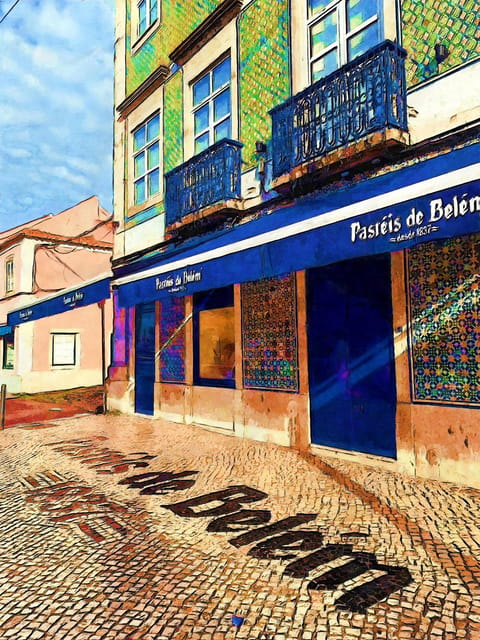
After the monastery and church, you walk to Pastéis de Belém for the included custard tart. This is the original Pastel de Belém, made from a recipe associated with the monks of Jerónimos Monastery and sold at the same establishment since the mid-19th century.
That connection makes the stop useful. You are not simply being handed a generic pastry because it is popular in Lisbon. The tart is tied directly to the building you have just explored. The food break also gives your group a change of pace after a concentrated indoor visit.
The pastry itself is called a Pastel de Belém at this bakery. Elsewhere in Portugal, you will often see the term pastel de nata. The tour includes one tart, while lunch and other food are not included. Several people found this pastry among the best Portuguese custard tarts they tried during their time in Portugal, but your experience will depend on your own taste and how busy the shop is.
Give this stop its full 30 minutes rather than treating it as a rushed bite. It is one of the tour’s more authentic touches because the recipe is linked to the monastery’s past. It also gives you a chance to ask your guide about the relationship between religious houses, food production, and Lisbon’s commercial traditions.
Empire Square Garden and the walk toward the river
The route continues through Empire Square Garden, with about 15 minutes of walking. This section helps you shift from the monastery’s enclosed spaces to the broad public setting of Belem.
Do not expect a long garden tour. The square works as a connecting point between the monastery and the monuments along the riverfront. It also offers a break from standing inside the church and cloisters. On a sunny day, you will appreciate the open air, though there is less shade than inside the monastery.
The walking portion is manageable for people comfortable with a three-hour city tour, but it is not suitable for wheelchair users or people with mobility impairments according to the activity information. Wear shoes that can handle pavement and bring water, sunscreen, and a hat. The tour runs rain or shine, so an umbrella is sensible in unsettled weather.
The timing matters. A morning start lets you visit the monastery early, then spend the later part of the tour outdoors. Lisbon can become hot, and one group completed the walk on a particularly warm morning. The walk is also exposed in places, so do not judge the weather only by what it feels like when you leave your hotel.
Same streets, a different route:
- Best of Lisbon Walking Tour: Rossio, Chiado & Alfama
★ 4.9 · 2,700 reviews - Age of Discoveries Walking Tour in Belém
★ 5.0 · 1,513 reviews - Lisbon Food Tour with 10+ Tastings of Local Delicacies & Wines
★ 5.0 · 1,339 reviews - Sintra & Cascais Day Tour with Pena Palace Entry and Gardens Walk
★ 5.0 · 962 reviews
The Discoveries Monument and Portugal’s seafaring story
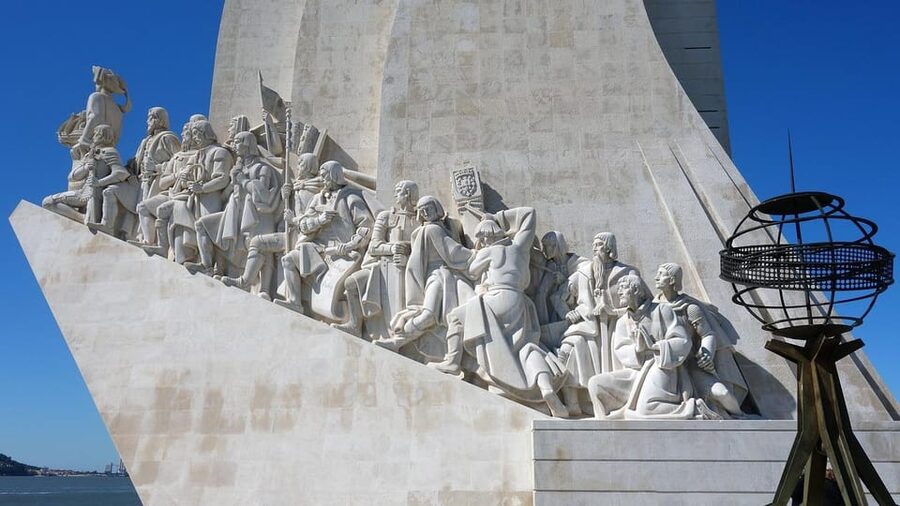
The Monument to the Discoveries is the next major stop. Built in 1960 to mark the 500th anniversary of the death of Infante D. Henrique, it presents a group of figures linked with Portuguese navigation and overseas expansion.
The guide gives the monument meaning within the wider story of the 15th and 16th centuries. Infante D. Henrique is presented as a central figure, while other people connected with navigation and Portuguese expansion appear alongside him. A guided explanation matters here because the monument’s message is easier to understand when you know who the figures represent and why the monument was created in the 20th century.
You spend about 20 minutes at this stop. That is enough for an explanation and exterior sightseeing, but not a long museum visit. The tour is focused on the monument’s historical role and its place in Belem, not on extended indoor exhibits.
There is also room for perspective. The monument commemorates Portuguese expansion, so it naturally presents a proud national story. A thoughtful guide can help you understand the period and its importance without reducing the past to a simple heroic tale. The supplied tour information emphasizes the expansion of Portuguese culture around the world, while your guide may also help you see how much political and religious power sat behind those voyages.
Belem Tower, with an important current limitation
From the Discoveries Monument, you walk about 15 minutes to Belem Tower. Together with Jerónimos Monastery, the tower has UNESCO World Heritage status and is another strong example of Manueline architecture.
The tower was built as a defensive point against invaders trying to reach Lisbon. Its location by the water makes that purpose easy to grasp. After the monastery’s grand religious and royal architecture, the tower gives you a more practical side of the same period: protection, control of the river, and the defense of the capital.
At present, restoration work means you cannot visit the inside of Belem Tower. The guide takes you to the exterior and explains its role and design. This is the tour’s clearest limitation, especially if you are paying partly because you expect three major monuments with interior access.
Still, the tower is not a wasted stop. You see its outside, hear how it functioned, and complete the visual connection between the monastery and the river. Just book with the correct expectation: this is an exterior visit until restoration ends.
The guide makes the difference
The tour lasts about three to three and a half hours, and its success depends heavily on the person leading it. The strongest reports focus on clear English, enthusiasm, humor, and the ability to answer questions without losing the group.
Luis is repeatedly described as friendly, prompt, and good at explaining complex subjects in a digestible way. Leonardo and Leo are praised for making history engaging, while Federico is noted for connecting the architecture to Portuguese monarchy and navigation. Renan Stein is also described as passionate and generous with stories.
Headsets may be provided, as one group noted, which helps inside the monastery when several groups are nearby. Group size can vary, and private groups are available. A small group can make it easier to ask questions and keep the pace suited to your interests, though the standard booking does not promise a particular guide or group size.
Arrive early at the meeting point. Your guide waits in front of Jerónimos Monastery near the south entrance to the church, where the access queues form. The exact location can be confusing, so study the meeting-point image carefully and allow extra time for traffic. One group nearly arrived late after a delayed ride and heavy traffic.
Is $70 a fair price?
At $70 per person, this is not the cheapest way to see Belem. You are paying for the monastery entrance, the included Pastel de Belém, a live English-speaking guide, and time saved by using a separate entrance. Transportation, lunch, and entry to Belem Tower are not included.
The value is strongest if you would otherwise stand in a long queue or walk through the monastery without much explanation. Jerónimos Monastery is the heart of the experience, and the guided context fills a real gap because there are few signs inside the complex. You also get a structured route through the major Belem sights instead of having to organize the order yourself.
The price is less appealing if you mainly want to photograph the monuments, already know Portuguese history, or do not mind waiting for tickets. It is also worth remembering that the tower is closed for restoration, so you are not receiving access to every landmark named in the route.
Free cancellation up to 24 hours before the start and the reserve-now, pay-later option reduce the risk of booking. The tour can be canceled if the minimum number of participants is not reached, so check the final booking details before you build an entire day around it.
Who should book this Belem tour?
I would choose this experience if you are visiting Lisbon for the first time, care about architecture or history, and want the major Belem sights explained in one morning. It suits couples, families with older children, and anyone who prefers a guide to a self-led visit.
It is also a good fit if you dislike queues. The early monastery entry is the practical prize, especially during busy periods. You will also benefit if the names Manuel I, Vasco da Gama, and Camões are familiar but their connection to Belem is not.
I would look elsewhere if you need step-free access, cannot manage several walking sections, or want to enter Belem Tower. The tour is not suitable for wheelchair users or people with mobility impairments. It is also not ideal for anyone seeking a quiet, unstructured morning, since the guide provides a steady stream of historical detail.
Should you book it?
Book this tour if Jerónimos Monastery is high on your Lisbon list and you want more than a quick look at the cloisters. The separate queue, strong English-language guiding, included pastry, and well-linked route make the $70 easier to justify.
Go in knowing the limits: Belem Tower is currently exterior-only, lunch and transportation are separate, and the walk runs in all weather. Bring comfortable shoes, sunscreen, a hat, and an umbrella. Arrive early at the monastery, then let the guide connect the stonework, royal tombs, pastry, monuments, and river defenses into one readable morning.
FAQ
Where does the tour start?
It starts in front of Jerónimos Monastery, near the south entrance to the church and the queues for access. Check the meeting-point photo carefully so you can identify the guide.
How long does the tour last?
The tour lasts about three to three and a half hours. The guided visit inside Jerónimos Monastery takes about 90 minutes.
Is entry to Jerónimos Monastery included?
Yes. The entrance ticket is included, and the guide has the tickets purchased in advance. The tour uses a separate entrance to help you avoid the main waiting line.
Is the Pastel de Belém included?
Yes. One original custard tart from Pastéis de Belém is included. Lunch and other food are not included.
Can I enter Belem Tower?
No. Belem Tower is currently undergoing restoration and cannot be visited inside. The tour includes exterior sightseeing and an explanation from the guide.
Is the tour suitable for wheelchair users?
No. The activity is not suitable for wheelchair users or people with mobility impairments. Comfortable shoes are recommended, and you should bring sun protection and an umbrella because the tour runs in rain or shine.
Just added around Lisbon
- Small Group Walking Tour of Belém★ 4.9 · 80 reviews
- Lisbon Through the Eyes of a Local – Food and Walking Tour★ 4.9 · 141 reviews
- Lisbon: Jewish Walking Tour★ 4.9 · 96 reviews
- Lisbon: Private Boat Trip, Guided Walking Tour, Bike & Tram★ 4.8 · 116 reviews
- Lisbon: Food and Culture 3-Hour Walking Tour★ 4.7 · 95 reviews
- Lisbon: Street Art Walk★ 5.0 · 79 reviews
- Lisbon: Helicopter Ride, Boat Trip, & Old Town Walking Tour★ 4.7 · 480 reviews
- Lisbon: Food & Wine Walking Tour Through Baixa★ 4.9 · 287 reviews
Walking Tours, compared.

Magical London: Harry Potter Guided Walking Tour
Read our review →
Reykjavik Food Walk – Local Foodie Adventure in Iceland
Read our review →
History and Hauntings of Salem Guided Walking Tour
Read our review →
New Orleans Premier Ghost, Voodoo and Vampire Walking Tour
Read our review →
Amsterdam Anne Frank: Small-Group Walking Tour & Local Guide
Read our review →

Edinburgh Castle: Guided Walking Tour with Entry Ticket
Read our review →
Anne Frank’s Story – Guided Walking Tour through Amsterdam
Read our review →Browse the lists this tour appears in