
REVIEW · LISBON
Age of Discoveries Walking Tour in Belém
Belém’s story comes alive when you walk it in sequence, from the square named for Afonso de Albuquerque to the riverfront where Portuguese ships once set out across the world. This 2.5-hour route links monuments, gardens, a famous bakery, and the Tagus in one easy-to-follow outing.
I like two things here. First, the price is hard to beat: you pay a small reservation fee of $3.62, then decide what the guide’s work was worth. Second, the stop at Pastéis de Belém gives the tour a welcome taste of everyday Lisbon, not just grand stone monuments.
The main drawback is pace. You cover eleven stops, and some guides move quickly or speak too softly when the area is crowded. If you want to enter Jerónimos Monastery, the Discoveries Monument, or Belém Tower, plan a separate visit after the walk.
Key points at a glance

- The route connects 11 major sights: Walk from Afonso de Albuquerque Square to Belém Tower without arranging private transport.
- The original pastel bakery is included as a stop: You have time to buy the famous custard tart, though food is not included in the price.
- The tour stays outside most monuments: The church at Jerónimos is visited, but the monastery cloisters and other paid interiors are not part of the walk.
- The guide shapes the experience: Guides such as Fernanda, Katerina, João, Elena, Sara, and Claudia have been praised for clear storytelling and strong personality.
- The group can reach 25 people: That keeps the cost low, but you may need to stay close to hear every explanation.
- The price is a reservation fee, not the full guide payment: A tip is expected if you find the walk useful.
Why Belém works so well on foot
Belém is Lisbon’s district of ships, royal ambition, religious wealth, and national memory. Its sights are spread along the river and through open gardens, so a walking tour helps you understand how they fit together.
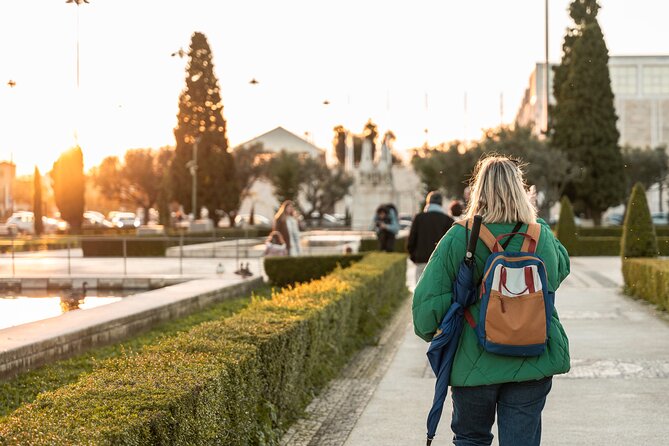
You begin at the Garden of Afonso de Albuquerque, near the riverfront. The route then moves past the Thai Pavilion, the pastry shop, Jerónimos Monastery, the Praça do Império, the Compass Rose, and the Discoveries Monument before ending at Belém Tower.
That order matters. You start with the people who helped direct Portugal’s overseas expansion, then see the religious and civic buildings funded by that era. At the river, the story shifts from royal power to navigation, exploration, and the modern memory Portugal has built around its maritime past.
The walk lasts about two and a half hours. It is not a strenuous mountain hike, but you should be ready to remain outdoors and walk between stops for most of the morning or afternoon. The tour requires good weather, and the open riverside section can feel exposed in poor conditions.
A few more walking tours around Lisbon worth a look
- Lisbon: History, Stories and Lifestyle Walking Tour
★ 4.8 · 10,902 reviews - Best of Lisbon Small-Group Guided Walking Tour
★ 5.0 · 4,869 reviews - Lisbon: Food and Wine Small Group Walking Tour
★ 4.9 · 4,082 reviews
Afonso de Albuquerque Square and the Thai Pavilion
The first stop is the Statue of Afonso de Albuquerque, in a formal square and garden. Albuquerque served as Portugal’s viceroy in the East and helped expand the country’s trading and military reach. The guide uses the statue and surrounding sculptures to explain the ambitions behind Portugal’s overseas empire.
This is a useful opening because it puts a human face on a period often reduced to dates and ship routes. You hear about the decisions, rivalries, and power structures that shaped Portuguese expansion rather than simply looking at another monument.
After about 15 minutes, the group walks to the Sala Thai, or Thai Pavilion. The small structure recalls Portugal’s links with India, Thailand, and Sri Lanka. It also offers a chance to discuss how goods, customs, and ideas moved along the same routes as Portuguese ships.
The connection to tea and Lady Catarina of Bragança adds a memorable personal detail. Catarina’s marriage to Charles II helped bring tea drinking into fashion in Britain. This stop is brief, at about 10 minutes, but it gives the wider story a useful cross-cultural angle.
Pastéis de Belém: the sweetest stop
The pastry stop is one of the most practical parts of the walk. Pastéis de Belém claims the original recipe for the custard tart now known around Portugal as pastel de nata. The recipe is linked to the monks of nearby Jerónimos Monastery, and the bakery has made the pastry a symbol of the neighborhood.
You have time to buy a tart during the stop. Food is not included, so bring a little cash or a payment card if you want to try one. This is not a full food tour, and the stop is listed at about 10 minutes, so you should not expect a long meal or a detailed pastry demonstration.
Still, the timing is smart. A warm custard tart breaks up the history and gives you something concrete to remember from the walk. Some guides have also helped groups avoid the longest line, though the exact handling can depend on the guide and the crowd.
If you are sensitive to noise or prefer a quiet bakery visit, consider returning later on your own. The short stop is convenient, but it may feel rushed if you want to sit down or order several pastries.
Chão Salgado and the Marquis of Pombal
The next stop, near Chão Salgado Alley, shifts the subject from overseas expansion to Lisbon’s political past. The guide connects the site with the Marquis of Pombal, the powerful minister who helped rebuild Lisbon after the 1755 earthquake and pushed through major changes in government and urban planning.
Pombal’s record was not gentle. The discussion includes the Távora Massacre, a brutal episode linked to his rule. That contrast makes this a worthwhile pause: Portugal’s story is not only one of daring voyages and beautiful buildings. It also includes harsh authority, political punishment, and the costs of modernization.
The stop lasts roughly 10 minutes. Because the site itself is modest, much of its value comes from the explanation. If your guide is a strong storyteller, this can be one of the sharper historical moments. If the delivery is hurried, it may feel less memorable than the larger monuments.
Same streets, a different route:
- Best of Lisbon Walking Tour: Rossio, Chiado & Alfama
★ 4.9 · 2,700 reviews - Lisbon Food Tour with 10+ Tastings of Local Delicacies & Wines
★ 5.0 · 1,339 reviews - Sintra & Cascais Day Tour with Pena Palace Entry and Gardens Walk
★ 5.0 · 962 reviews - Lisbon Roots – Small group Food & Culture Walking Tour w/tastings
★ 5.0 · 910 reviews
Jerónimos Monastery and the church visit
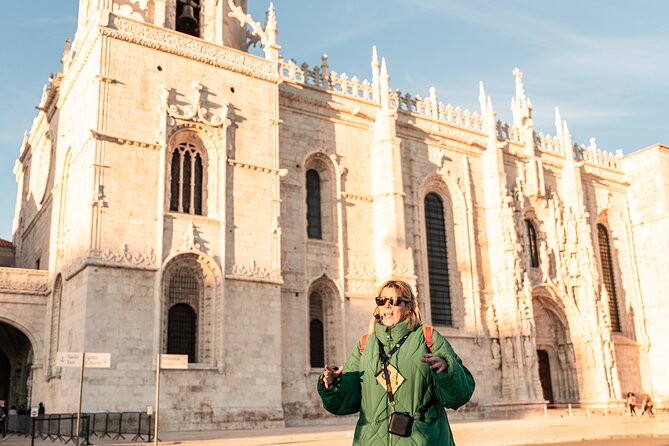
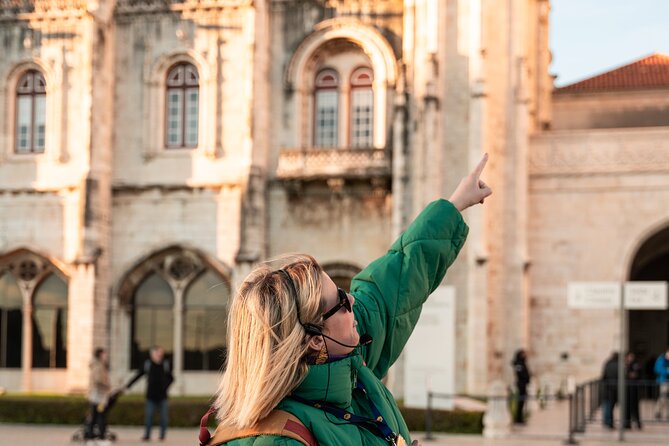
Jerónimos Monastery is the architectural centerpiece of the route. Its Manueline design uses carved stone, maritime details, Christian symbols, and references to Portugal’s overseas ambitions. The building was created during the era of exploration, when the country had the money and confidence to express its power in elaborate form.
The tour does not include a full visit to the monastery. You visit the church, while the cloisters and other interior areas are left for a separate visit. Admission to the tour’s listed stops is free, but that does not mean every monument interior is included.
Allow about 20 minutes here. Listen for the connection between the building’s carvings and the sea. The stonework is not decoration added at random. It reflects a period when navigation, faith, royal power, and trade were closely tied together.
If Jerónimos is high on your Lisbon list, return after the tour with enough time for the full interior. The walk gives you context, but it does not replace an independent visit to the cloisters.
Praça do Império and the Compass Rose
The route continues through the Jardim da Praça do Império, a broad formal garden created for the 1940 New State World exhibition. The exhibition celebrated Portugal’s long national story, including its founding in 1140 and independence from Spain in 1640.
This stop gives the guide room to explain how governments use public spaces to shape national identity. The gardens and fountain are attractive, but the historical point is more complicated than the polished setting suggests. The 1940 exhibition presented a carefully chosen image of Portugal and its past.
Next comes the Rosa dos Ventos, or Compass Rose, with its large Mappa Mundi mosaic. The design marks routes taken by Portuguese navigators and presents the country’s role in global exploration. At about 10 minutes, this is a quick stop, but it is also one of the best places to see the story laid out visually beneath your feet.
I like this section because it links memory to geography. You are not only hearing names and dates. You can look at the map and see how Portugal imagined its place in the world.
The Discoveries Monument and the Tagus
The Padrão dos Descobrimentos rises beside the Tagus as a dramatic stone tribute to Portugal’s explorers. Prince Henry the Navigator leads the figures toward the river, followed by sailors, cartographers, missionaries, and other figures connected with the country’s maritime expansion.
The tour stops outside the monument and does not include the interior or viewing platform. You get around 15 minutes for the exterior and the surrounding area. That is enough to hear the story and take photographs, but not enough for a full museum visit.
This is also the point where the tour’s national pride deserves a little balance. The monument celebrates exploration, yet those voyages were tied to conquest, trade monopolies, forced labor, and colonial rule. A good guide can explain both the achievement and the human cost. Guides such as Claudia have been praised for offering direct, personal interpretations rather than simply repeating a standard script.
From here, the route follows the Tagus. The riverbank opens up the view toward the 25 de Abril Bridge and the Cristo Rei statue. The guide also discusses Gago Coutinho, the aviation pioneer whose transatlantic flight connected Portugal to Brazil by air.
This riverside stretch can be the most relaxing part of the walk. After several monuments and historical explanations, you have room to look outward and understand why Lisbon’s river mattered so much.
Belém Gardens and the final tower

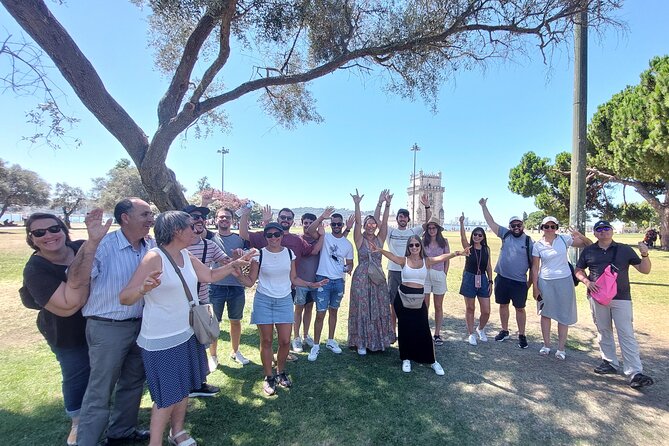
The final section passes through the gardens near Belém Lighthouse and the Tower of Belém. The gardens frame the tower and provide a quieter place to pause before the tour ends.
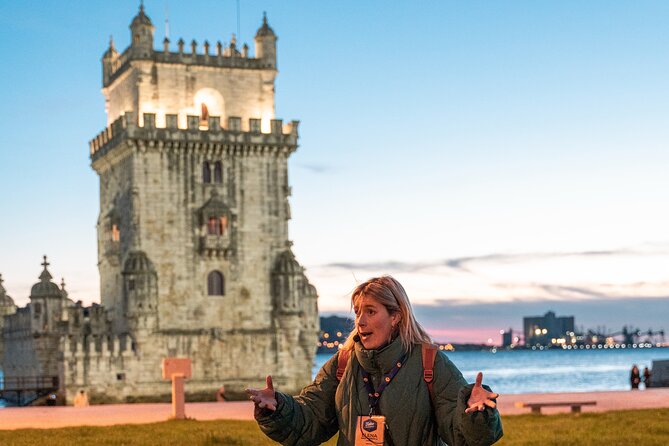
Belém Tower was built to guard the entrance to Lisbon and is one of the clearest examples of Manueline architecture in the area. Its decorative stonework reflects the same seafaring age seen at Jerónimos, but its original role was defensive rather than religious.
The tour ends beside the tower after about 15 minutes in the gardens and 20 minutes at the tower itself. You do not go inside. That is important when planning your day, since the tower’s interior has narrow spaces and a different feel from the open riverfront.
The ending is well chosen. You finish at one of Lisbon’s most recognizable sights, with the Tagus behind it and the city’s maritime story gathered into one final image. If you still have energy, this is the place to continue exploring independently.
Guides, group size, and tour style
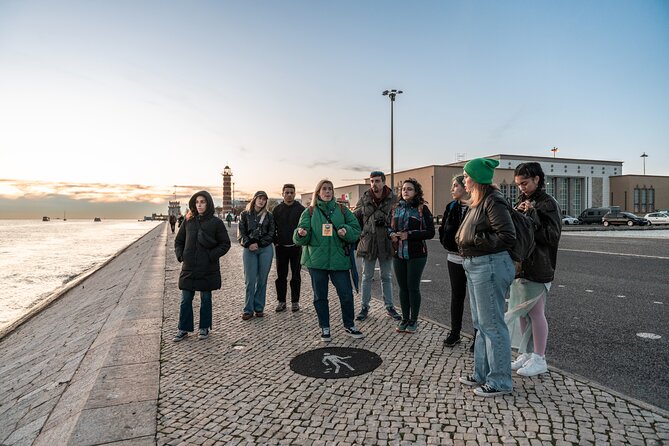
The tour is offered in English and can include up to 25 people. That is a reasonable ceiling for a low-cost walk, though the experience will depend strongly on where you stand and how clearly the guide speaks.
Several guides have earned especially warm praise. Fernanda is described as welcoming and helpful with suggestions for food and sightseeing. Katerina has been praised for explaining the age of exploration with energy, while João is noted for his passion and command of Portuguese history. Claudia is known for a more outspoken style and unusual angles on the past. Elena and Sara have also been singled out for charisma and clear explanations.
That variety is worth keeping in mind. One guide may turn the walk into a lively conversation, while another may deliver the material in a flatter or faster way. Some people have found the pace slow, while others have felt that important details were skipped. A participant also wished one guide had spoken louder in crowded areas.
Stay near the guide, especially at the riverside and around the major monuments. If you cannot hear, move forward rather than waiting for the group to spread out.
Is $3.62 really good value?
At $3.62 per person, this is an unusually inexpensive way to get an introduction to Belém. The fee functions as a reservation charge, and the guide generally works for tips. You should budget for a gratuity if the walk helps you understand the district or plan the rest of your day.
The value comes from the route and the organization. You do not need private transport, and you cover a large portion of Belém without having to connect the sights yourself. You also get historical context that would be easy to miss if you simply photographed each monument and moved on.
The price does not cover pastries, paid monument interiors, or transportation to the starting point. It also does not guarantee a particular guide. Think of it as a low-cost orientation walk, not a complete Belém sightseeing package.
The experience has a 4.9 rating from 1,514 ratings, with 99 percent of participants recommending it. That is a strong record, but the less positive experiences point to the practical risks: guide style, sound level, weather, and pacing.
Getting there and planning the rest of your day
The meeting point is the Garden of Afonso de Albuquerque at Praça Afonso de Albuquerque. The tour ends beside Belém Tower on Avenida Brasília, so you finish in a useful location rather than returning to the starting square.
Public transportation is nearby, and private transportation is not included. One useful planning note is to check your route to Belém before the day begins, especially if you are relying on a train or other public transport. The experience is not designed around parking.
Book ahead if your Lisbon schedule is tight. It is often reserved about 24 days in advance. Confirmation arrives at booking, and free cancellation is available up to 24 hours before the start time. Changes or cancellations inside that window are not refunded.
The tour requires a minimum number of participants and suitable weather. If the operator cancels for either reason, you are offered another date or experience, or a full refund.
Who should book this Belém walk?
I would recommend it to first-time Lisbon visitors who want a clear introduction to Belém without paying for a private guide. It also suits budget-minded visitors, history fans, and anyone who likes to combine famous sights with one simple local food stop.
Families can participate, since most people can take part and service animals are allowed. Still, the two-and-a-half-hour duration may feel long if younger children prefer a faster visit to the main monuments.
You should think twice if you want extensive interior visits, a small private group, or a tightly controlled schedule. You may also prefer an independent visit if you already know Portugal’s maritime history and only want to see the tower and monastery quickly.
Final verdict
Book this tour if you want the big Belém sights explained in a sensible order, with a famous pastel and river views along the way. The low fee, strong overall rating, and broad route make it one of the better budget introductions to the district.
Just arrive ready to walk, stay close enough to hear, and treat the tour as an orientation rather than the final word on Belém. Save extra time for Jerónimos Monastery, the Discoveries Monument, or Belém Tower if you want to go inside.
FAQ
How long does the Age of Discoveries Walking Tour in Belém last?
The tour lasts approximately 2 hours and 30 minutes.
Where does the tour begin and end?
It begins at the Garden of Afonso de Albuquerque at Praça Afonso de Albuquerque and ends beside Belém Tower on Avenida Brasília.
Is the tour offered in English?
Yes. The experience is offered in English and includes an English-speaking guide.
Does the tour include entry to Jerónimos Monastery and Belém Tower?
No. The route includes the church at Jerónimos, but not the full monastery. You do not enter Belém Tower or the Discoveries Monument.
Are food and drinks included?
No. The stop at Pastéis de Belém gives you time to buy the famous custard tarts, but food is not included in the tour price.
Can I cancel for a full refund?
Yes. You can cancel at least 24 hours before the start time for a full refund. Cancellations or changes made less than 24 hours before the tour are not refunded.
Just added around Lisbon
- Fado: Musical Walking Tour with Food & Live Show★ 5.0 · 121 reviews
- Eat & Walk Through Lisbon: A Local Food & Wine Experience★ 4.9 · 458 reviews
- Best of Lisbon Private Walking Tour★ 5.0 · 370 reviews
- Lisbon: Private Dark History Walking Tour with Drinks★ 4.8 · 387 reviews
- Lisbon: Award-Winning Guided Walking Food Tour with Local Drinks★ 5.0 · 374 reviews
- Lisbon: Best of City Private Walking Tour★ 4.9 · 601 reviews
- Lisbon: Belém Walking Tour with Jerónimos Monastery Ticket★ 4.9 · 637 reviews
- Lisbon: Kickstart Street Art Walking Tour★ 4.9 · 717 reviews
Walking Tours, compared.

Magical London: Harry Potter Guided Walking Tour
Read our review →
Reykjavik Food Walk – Local Foodie Adventure in Iceland
Read our review →
History and Hauntings of Salem Guided Walking Tour
Read our review →
New Orleans Premier Ghost, Voodoo and Vampire Walking Tour
Read our review →
Amsterdam Anne Frank: Small-Group Walking Tour & Local Guide
Read our review →

Edinburgh Castle: Guided Walking Tour with Entry Ticket
Read our review →
Anne Frank’s Story – Guided Walking Tour through Amsterdam
Read our review →Browse the lists this tour appears in