
REVIEW · BUCHAREST
Bucharest Highlights Walking Tour
Bucharest reveals itself in layers on this tour: old caravan inns, Orthodox courtyards, grand banks, royal buildings, Stalin-era architecture, and the vast Palace of Parliament. You begin in the old center and finish at the seat of Romania’s communist-era power, so the route gives you a useful story of how the city changed.
I especially like the strong first-time orientation and the way the walk links architecture to politics, trade, religion, and daily life. Guides including Ed, Dan, Andrei, and Lucia are praised for clear explanations, humor, patience, and good answers to questions.
The main drawback is simple: this is an outdoor walk, and winter can be very cold. You will also see several major buildings from outside, with entry fees not included at Palatul CEC, the Royal Palace, and the Palace of Parliament.
Key points to know before you book
- Start among Bucharest’s oldest trading buildings: Manuc’s Inn and Hanul Gabroveni introduce the city’s commercial beginnings.
- Follow the city’s power centers: The route moves from caravan inns to banks, the royal palace, communist architecture, and Parliament.
- Expect a guide-led history lesson: Ed, Dan, Andrei, Lucia, and Dan are noted for lively commentary and thoughtful answers.
- Finish at the enormous Parliament building: The walk ends in Constitution Square, directly in front of the Palace of Parliament.
- Plan for 2.5 hours outside: Wear comfortable shoes and bring extra layers in cool weather.
- Pay $21.77 for orientation, not admission: The price is reasonable if you want context and a clear city introduction, but it does not cover entry fees.
Why this route works so well for a first look at Bucharest
Bucharest can be hard to read at street level. A pretty nineteenth-century facade may sit beside a communist block, a restored church, or a half-renovated building. Without some context, the city can feel like a collection of unrelated parts.
This walk gives those parts a sequence. You begin with trade and the medieval roots of Bucharest, move through the city’s financial center, then reach the royal and communist chapters. By the time you arrive at Parliament, you have a better sense of why Bucharest contains such sharp contrasts.
The route is also practical. It starts at Piața Sfântul Anton 64 in the old center and ends at Piața Constituției, in front of Parliament. You do not return to the starting point, so think of it as a one-way introduction rather than a loop. That can work nicely if you plan to continue sightseeing near Parliament afterward.
The group can include up to 25 people. That is not an intimate private walk, but it is still small enough for a guide to keep the group together and take questions. The guides are repeatedly praised for checking that everyone is present before moving on, which matters on city streets.
More City Highlights Walks in the world:
- Berlin City walk Government District and Places of Democracy
★ 4.7 · 8,467 reviews - Historic Charleston Guided Sightseeing Walking Tour
★ 5.0 · 6,216 reviews - Quebec City Walking Tour
★ 5.0 · 4,716 reviews
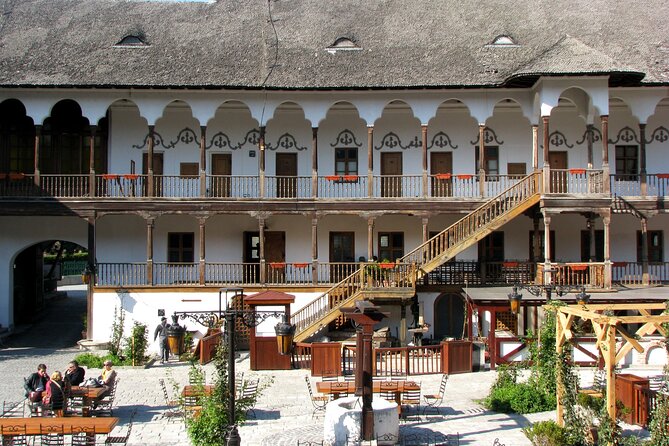
Manuc’s Inn: Bucharest starts with trade
The first stop, Manuc’s Inn, is one of the best places to begin a Bucharest walk. Known in Romanian as Hanul lui Manuc, it introduces the city’s early role as a meeting point for merchants and goods.
You spend about 20 minutes here, with no admission fee. The focus is not simply on an old building. It is on the way Bucharest grew through movement, trade, and connections between different parts of the region.
This makes a useful correction to the idea that Bucharest began as a grand capital. Its early identity was more commercial and practical. An inn such as this offered a place for merchants to stop, trade, eat, and sleep.
I like starting here because it gives the rest of the walk a foundation. Later banks and royal buildings make more sense once you have seen the older commercial side of the city.
Hanul Gabroveni and the city’s caravan inns
The next 20-minute stop is Hanul Gabroveni. The guide explains Bucharest’s caravan-serai tradition, a reminder that the old center once had many trading inns.
The tour points out that, two centuries ago, around one in four buildings in the old city center was a caravan-serai. Only three remain today, and Hanul Gabroveni is one of them. That fact helps you picture a city built around commerce rather than monumental government.
This is one of the more distinctive parts of the route. Many city walks hurry past old buildings and focus only on famous monuments. Here, you get a look at the working city behind the grand facades.
The two inn stops also give your guide a chance to explain Bucharest’s beginnings before the walk moves into later periods. If you enjoy architecture and urban development, pay close attention to how the guide connects these buildings to the street plan and the city’s changing fortunes.
The National Bank and Bucharest’s former financial district
The walk then reaches the BNR Palace, the home of Romania’s National Bank. You spend about 10 minutes in an area that was once Bucharest’s financial district.
The National Bank, former Stock Exchange, Palace of Trading and Commerce, and other state and private banks gather around this part of the city. Together, they show how Bucharest developed into a modern capital with growing financial ambitions.
This stop is brief, but it adds useful balance. The tour is not only about medieval beginnings, royal politics, or communism. It also shows the commercial confidence of the late nineteenth and early twentieth centuries.
You should expect exterior viewing rather than a bank visit. The value is in seeing the buildings together and hearing how the district functioned. A guide can point out architectural details that are easy to miss when you are simply walking through the old center on your own.
A few more walking tours around the world worth a look
- Magical London: Harry Potter Guided Walking Tour
★ 4.7 · 22,044 reviews - Reykjavik Food Walk – Local Foodie Adventure in Iceland
★ 5.0 · 18,952 reviews - History and Hauntings of Salem Guided Walking Tour
★ 5.0 · 14,564 reviews - New Orleans Premier Ghost, Voodoo and Vampire Walking Tour
★ 4.5 · 12,856 reviews
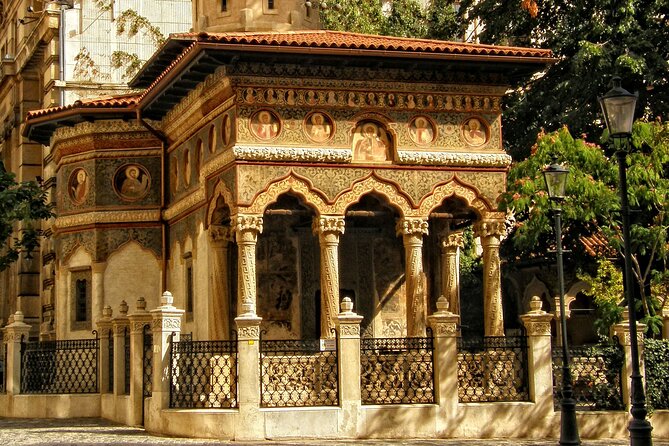
Stavropoleos Monastery: a quiet Orthodox pause
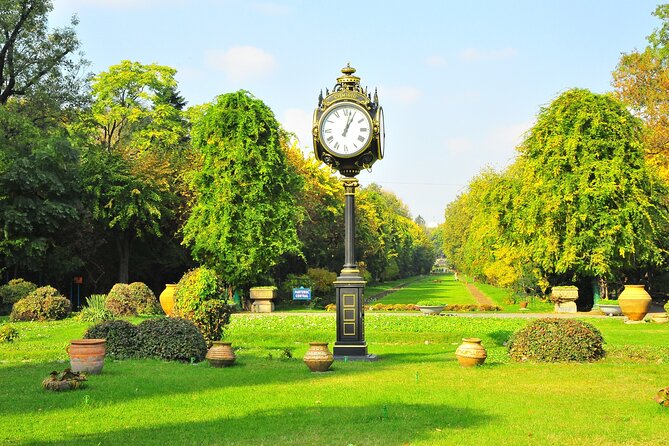
Stavropoleos Monastery is one of the walk’s most memorable changes of mood. After the financial district, you reach a smaller and more intimate Orthodox landmark.
About 90 percent of Romania’s population is Christian Orthodox, and the monastery gives you a direct look at that religious tradition. The building is important not only as a place of worship but also as an example of Orthodox design and decoration.
You spend about 10 minutes here, with no admission fee listed. The stop is short, so do not expect an extended religious tour. Instead, it works as a focused introduction to the role of Orthodox Christianity in Romanian culture.
I find this kind of pause valuable on a city walk. You move from money and trade to belief and community, then continue toward the grand civic buildings. The contrast helps Bucharest feel like a lived-in city rather than a line of monuments.
Palatul CEC and the city’s changing face
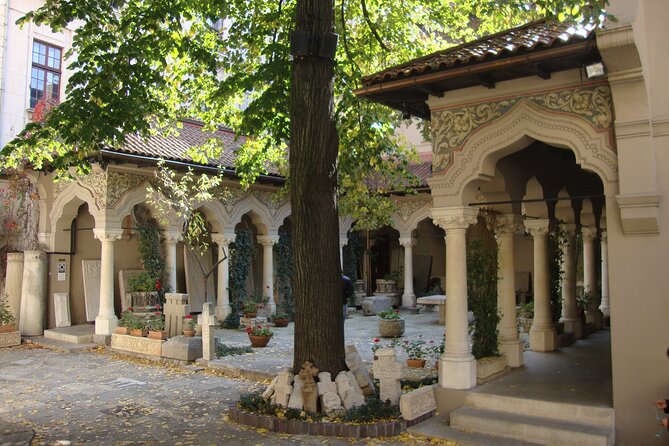
Palatul CEC is one of the most striking exterior views on the route. The tour presents it as perhaps the finest example of old architecture in Bucharest and uses the building to explain why much of the city’s historic-looking architecture is not as old as you might expect.
You spend roughly 10 minutes here. The guide places the building within Bucharest’s six centuries of development and explains how the city was remodeled and shaped over time.
That point is important. Bucharest has old roots, but its grandest surviving buildings often belong to more recent periods. The mix of French-influenced, neoclassical, eclectic, and other architectural styles reflects repeated efforts to remake the capital.
Admission is not included at Palatul CEC. The tour data does not promise an interior visit, so plan on seeing and discussing the building from the outside. For a short orientation walk, that is a sensible use of time, but you should not book this experience expecting detailed indoor access to every landmark.
Macca-Villacrosse Passage and old-city spending
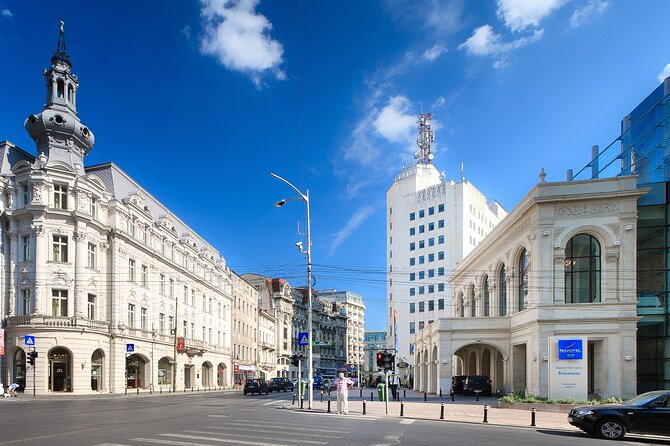
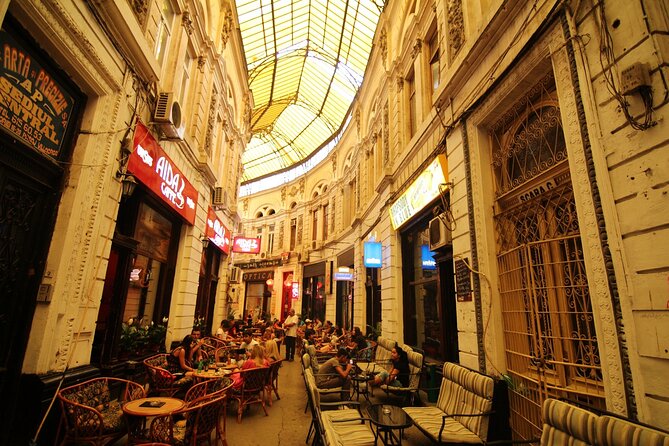
The five-minute stop at Macca-Villacrosse Passage is brief but atmospheric. Still within the former financial district, the passage shows the consumer side of a wealthy commercial center.
The guide frames it simply: where money gathers, spending follows. The galleries once represented the highest standard of shopping and leisure in Bucharest.
This stop is less about a long historical lecture and more about seeing how the city’s financial life shaped its social life. It also breaks up the larger monuments with a smaller urban space.
Because you spend only five minutes here, take a quick look at the covered passage, surrounding facades, and the way the narrow space differs from the broad avenues ahead. It is a small stop, but it helps show that Bucharest’s character is found in passages and courtyards as much as in official buildings.
The Royal Palace and the shift from monarchy to communism
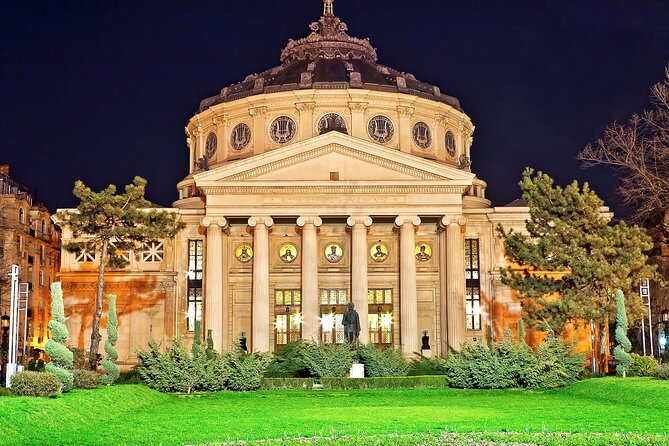
At the Royal Palace, the route moves into Romania’s modern political story. The building connects the monarchy, communist rule, and the later democratic period.
You spend about 10 minutes here, with admission not included. The guide’s job is to tie the building to the political changes around it, not simply identify the facade.
This is where the walk becomes especially useful for understanding twentieth-century Romania. The same central area carried different meanings under different systems of government. The monarchy, communist state, and democracy all left marks on this part of Bucharest.
You may find that this section raises more questions than it answers. That is a good sign for an orientation walk. Write down the names and events that catch your interest, then return later to a museum or historic building if you want a fuller account.
Sala Palatului and the Stalin-era city
The stop at Sala Palatului lasts about 10 minutes and shifts the architectural mood again. Here, you see the influence of the Stalin era.
The building offers a clear visual lesson in how architecture can express political power. The route does not treat Bucharest as a city of one single style. Instead, it shows how each period added its own scale, materials, and ideals.
This section is particularly helpful if you are trying to understand the relationship between Bucharest’s elegant older buildings and its more imposing twentieth-century structures. You can compare the two directly rather than seeing them on separate parts of your trip.
The guide commentary matters here. A large government or cultural building can be difficult to interpret without context. The guides are praised for explaining architectural facts in plain English and keeping the tone lively with stories and occasional jokes.
Cismigiu Park: a breath of green in the city center
Cismigiu Park is the route’s calmest stop. At about 10 minutes, it is not a long park visit, but it gives you a chance to experience Bucharest’s oldest park.
After several urban and political landmarks, the park offers a different view of city life. It shows the capital as a place for walking, rest, and ordinary local routines, not only a setting for banks and government buildings.
Do not expect a full circuit of the park during this tour. The stop is short and the route still has one major destination ahead. Still, it is a welcome change of pace, especially if the earlier sections have involved standing outside buildings in cold weather.
Some guides have added short breaks for coffee, hot chocolate, or restroom needs when conditions called for it. That is not a guaranteed feature, but it reflects the flexible approach described by people who took the walk. The tour has also sometimes run beyond 2.5 hours when the group needed more time.
The Palace of Parliament: a huge and complicated finish
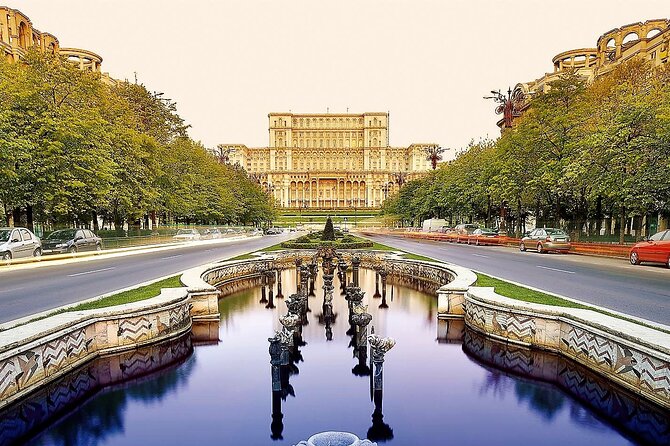
The final stop is the Palace of Parliament, and it is hard to imagine a more dramatic ending. The building is the second-largest administrative building in the world after the Pentagon, yet it is heavier.
You spend about 20 minutes here and finish in Piața Constituției, directly in front of the building. Admission is not included, so this experience is about the exterior and the guide’s explanation rather than an included interior tour.
The building gives the tour’s political story a powerful final image. After hearing about trade, banking, monarchy, and Stalin-era design, you reach the monument most closely linked with Nicolae Ceaușescu’s communist regime and the reshaping of Bucharest on a massive scale.
The scale can be difficult to grasp without someone pointing out the relationships between the building, the square, and the surrounding city. That is where the tour earns much of its value. You are not simply taking a photograph of an enormous facade. You are hearing why it was built, what it represented, and how it fits into Romania’s recent past.
You should also be clear about what this tour is not. It is not a Parliament interior visit, and it is not a detailed architectural inspection of every wing. It is a strong exterior introduction at the end of a city walk.
The guides make the difference
The guide is the main reason to choose a walking tour over a self-guided route. Names associated with this experience include Ed, Dan, Andrei, and Lucia.
Ed is repeatedly described as engaging, friendly, funny, and highly informed about Bucharest’s architecture and past. Dan is praised for answering questions, sharing Romanian music and songs, and adjusting the pace with breaks when the weather was rough. Andrei is noted for relaxed commentary and useful suggestions for food and places to visit. Lucia is described as informative and humorous.
You can expect the guide to explain more than dates. The strongest parts of the commentary connect buildings to one another and place Romanian history within the city you are walking through.
The tour also works well for solo visitors. The guide keeps the group together, allows questions, and creates a social setting without requiring you to arrive with a companion. A private departure may be customized more closely, as one account of the experience describes, but the standard group can include up to 25 people.
Is $21.77 a fair price?
At $21.77 per person, this is a reasonable price for a 2.5-hour guided introduction, especially if Bucharest is new to you. You are paying for a local English-speaking guide, a carefully arranged route, and the context that turns a series of buildings into a story.
The price is less attractive if you want paid interior visits. Fees and taxes are not included, and admission is specifically not included at Palatul CEC, the Royal Palace, and the Palace of Parliament. You should treat this as an orientation walk, not an all-inclusive sightseeing pass.
I would book it early in a short Bucharest stay. It is booked on average about 20 days ahead, and a morning walk can help you decide which areas deserve more time later. The tour can also be booked close to departure when space remains, but early planning is sensible if your dates are fixed.
Practical advice for the walk
Wear shoes suited to about two and a half hours on city streets. The walk is described as manageable rather than punishing, but you will spend time standing outside while the guide speaks.
Bring extra layers from late autumn through winter. Cold weather is the one clear recurring concern, and Bucharest’s open squares can feel much colder than expected. A hat, gloves, and a warm drink can make a real difference.
The meeting point is Piața Sfântul Anton 64, near public transportation. The tour ends at Piața Constituției, in front of Parliament, so plan your next stop from there rather than assuming you will return to the old center.
Confirmation is provided at booking. Most people can take part, and the group limit is 25. The experience depends on good weather and a minimum number of participants. If poor weather or low enrollment cancels the walk, you are offered another date, another experience, or a full refund. You can cancel for a full refund up to 24 hours before the start time.
Who should book this Bucharest walk?
I would choose this tour if you are visiting Bucharest for the first time, have only a day or two, or want help understanding the city before exploring alone. It is also useful if architecture, political history, and urban change interest you more than shopping or nightlife.
It suits visitors who enjoy asking questions and listening to a guide rather than rushing from one ticketed attraction to the next. The route gives you a broad framework, with enough detail to make later visits more rewarding.
I would look elsewhere if you want long indoor visits, a fully accessible transport-based tour, or a route devoted to one period of history. Several stops are short, and some important buildings are viewed from outside.
Should you book the Bucharest Highlights Walking Tour?
Yes, if you want a clear first chapter to your Bucharest visit. The route covers old trade, Orthodox culture, finance, monarchy, communism, parks, and Parliament in one manageable walk, and the guides add the stories that make the contrasts easier to understand.
Book it with comfortable shoes, warm layers in cool weather, and realistic expectations about exterior sightseeing. At $21.77, it offers good value for orientation and local context, especially when your time in Bucharest is limited.
FAQ
How long does the Bucharest Highlights Walking Tour last?
The tour lasts approximately 2 hours and 30 minutes. It can sometimes run longer when the guide allows extra questions or weather-related breaks.
What language is the tour offered in?
The tour is offered in English.
Where does the tour begin?
It begins at Piața Sfântul Anton 64, București 030167, Romania.
Where does the tour end?
It ends at Piața Constituției, directly in front of the Palace of Parliament.
What places are included on the route?
The route includes Manuc’s Inn, Hanul Gabroveni, the BNR Palace, Stavropoleos Monastery, Palatul CEC, Macca-Villacrosse Passage, the Royal Palace, Sala Palatului, Cismigiu Park, and the Palace of Parliament.
Is admission to the attractions included?
All fees and taxes are not included. Admission is specifically listed as not included at Palatul CEC, the Royal Palace, and the Palace of Parliament.
How many people can join the tour?
The tour has a maximum group size of 25 people.
Is the tour suitable for most people?
Most people can participate, and the meeting point is near public transportation. The experience is an outdoor walking tour, so you should be prepared to walk and stand outside.
What should I wear?
Wear comfortable walking shoes. Bring warm extra layers in cold weather, as several parts of the tour take place outdoors.
Can I cancel the booking?
You can cancel up to 24 hours before the start time for a full refund. Cancellations or changes made less than 24 hours before the start time are not accepted for a refund.
Just added around the world
- Fira: Guided Foodie Walking Tour with Tastings★ 4.9 · 474 reviews
- Fez: Guided Walking Tour of the Historic Medina★ 5.0 · 359 reviews
- Fez: Walking Tour in the Ancient City of Fez★ 4.8 · 73 reviews
- Faro: Old Town Guided Walking Food Tour★ 4.9 · 94 reviews
- Feel like a local – Walking Tour in Mykonos Town 2hours★ 4.4 · 77 reviews
- Fes: A Guided Walking Tour Through the Historic Medina★ 4.4 · 97 reviews
- Fez: Half-Day City Private Walking Tour with a Guide★ 4.6 · 114 reviews
- Fanal / Assobiadores – Levada Walk★ 4.6 · 93 reviews
City Highlights Walking Tours, compared.
Berlin City walk Government District and Places of Democracy
Read our review →
Historic Charleston Guided Sightseeing Walking Tour
Read our review →
Oxford: University and City Walking Tour with Alumni Guide
Read our review →
City Highlights Temple and Market Walking Tour
Read our review →
A History of Terror – Belfast City Centre Walking Tour
Read our review →Browse the lists this tour appears in