
REVIEW · BUCHAREST
Bucharest Under Communism: Life, Terror & Hope
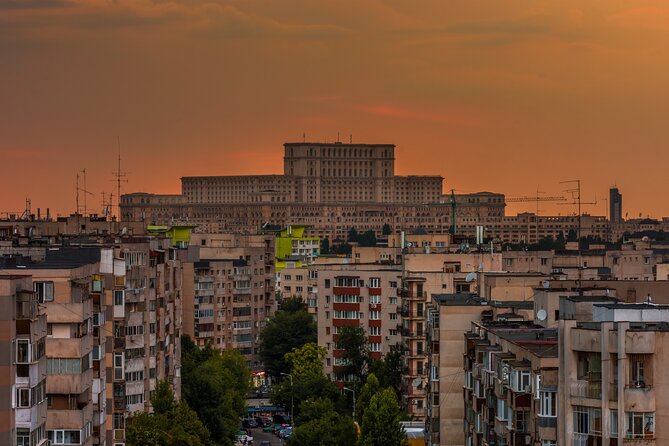
The most striking part of this Bucharest walking tour is the way it turns huge monuments into human stories. At the Palace of Parliament, you learn not only about the building’s size, but also about the shortages, forced labor, demolished neighborhoods, and political ambition behind it. At Revolution Square, the focus shifts from architecture to fear, protest, and the sudden collapse of Nicolae Ceaușescu’s regime.
I like the clear route through major communist-era landmarks, and I like the way guides such as Laura and Tamar use photographs, anecdotes, and personal stories to make the past easier to grasp. The main consideration is the length: at about three and a half hours, this is a serious walking tour, not a quick introduction. The Palace of Parliament is viewed from outside, and admission inside is not included.
Key points to know before you book
- The route connects Unirii Square with the 1989 Revolution: You follow Ceaușescu’s grand boulevard from the fountains toward the Palace of Parliament, then finish at the sites of the uprising.
- The Palace of Parliament is an outside visit: You hear the building’s story and view it from different angles, but the admission ticket is not included.
- Laura and Tamar are praised for clear, lively guiding: Their approach combines historical explanation with old photographs, personal anecdotes, and plenty of time for questions.
- Mihai Voda Monastery adds a surprising religious story: This medieval church survived a period when other churches and neighborhoods were destroyed or moved.
- The group is limited to 15 people: That is small enough for questions without promising a fully exclusive walk.
- The tour ends near Bucharest’s Old Town: Revolution Square is about five minutes from the Old Town, making it easy to continue your evening afterward.
Why communist Bucharest is best understood on foot
Bucharest’s communist past can be hard to read from a map. One building may represent state power, another forced modernization, and a quiet church may reveal how much of the old city disappeared.
This route helps connect those pieces. You begin at Piața Sfântul Anton 64, near the center, and move through Unirii Square, the area around the Palace of Parliament, Mihai Voda Monastery, Revolution Square, and University Square. The walk covers the final phase of communist planning as well as the 1989 uprising that ended the regime.
I find the subject especially useful for a first visit because it explains why Bucharest can feel architecturally uneven. Grand avenues and giant government buildings sit beside older churches and surviving fragments of the pre-communist city. The tour gives you a way to read that contrast instead of simply photographing it.
The guide-led format matters here. A building like the Palace of Parliament can seem impressive at first glance, but the important questions are less obvious. Why was it built? What was removed to make room for it? How did ordinary people experience the economic cost? What happened to the political system that created it?
A good guide can answer those questions while keeping the walk moving. The strongest feedback about this experience centers on guides who explain clearly, handle questions patiently, and keep the history from becoming a list of dates.
More History Walking Tours in Bucharest:
- Bucharest: Communism and History Guided City Walking Tour
★ 4.9 · 918 reviews - Bucharest: Relics of Communism 3-Hour Walking Tour
★ 4.9 · 77 reviews - Berlin: Third Reich & Cold War Guided Walking Tour
★ 4.9 · 8,378 reviews
Unirii Square and the boulevard of power
The first major stop is Piața Unirii, or Unirii Square. This broad central space was shaped during the last phase of communism and is known for its fountains and its connection to the former Victory of Socialism Boulevard.
This is where the tour introduces Ceaușescu’s vision for Bucharest. The boulevard was designed to create a dramatic approach toward the seat of power. Its scale tells you something about the regime’s need for control and spectacle. From here, the city was not meant to feel modest or intimate. It was meant to frame the state and its leader.
I like beginning here because you can see the plan before hearing the full story. The broad roadway, open space, and monumental direction make more sense once the guide explains what Ceaușescu wanted the capital to represent.
The fountains also give the stop a lighter visual detail, though the subject itself is not light. You are looking at a public space created during a period when Romania faced severe shortages. That contrast between grand urban design and restricted daily life becomes one of the tour’s central themes.
Allow around 30 minutes here. You will want comfortable shoes, since the value comes from walking the space and taking in the proportions rather than simply pausing for one photograph.
The Palace of Parliament and the price of grandeur
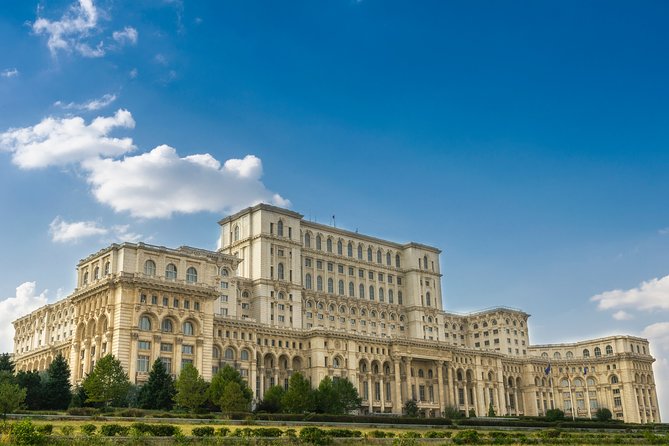
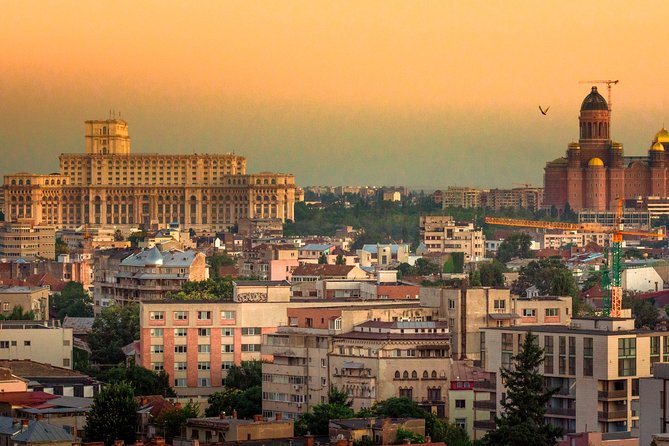
The Palace of Parliament is the tour’s largest visual stop. It is described as the second-largest building in the world after the Pentagon and as the most expensive administrative building. Its scale is difficult to miss, but the story behind it matters more than the size.
The building was created during the 1980s, when the Romanian population faced shortages of food, fuel, electricity, and other basic goods. The tour explains how vast amounts of material, money, and work effort were directed toward the project while daily life became harder.
You view the palace from different angles and hear how people in Bucharest see it today. That last point is useful. The building is not simply a relic of dictatorship. It remains part of the city, part government complex, part tourist sight, and part reminder of what the regime demanded from the country.
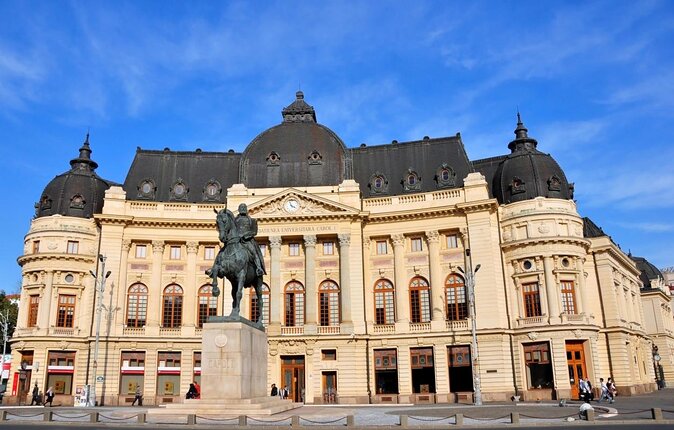
Across from the palace is the Academia Romana building, another large construction connected with the dictator’s ambitions. It was intended for Elena Ceausescu, Nicolae’s wife. The pairing helps show how personal and political power shaped the urban plan.
A key practical point: admission to the Palace of Parliament is not included. This tour is about the exterior and the surrounding story. If you want to tour the interior separately, you will need to arrange that on your own, subject to the building’s own entry rules and availability.
The stop is scheduled for about an hour. That gives the guide time to explain the construction, the demolition required to clear the area, and the building’s place in present-day Bucharest. It also gives you time to see how the palace dominates the surrounding streets.
I consider this excellent value even without interior entry, provided you understand what you are buying. The building is the visual centerpiece, but the interpretation is the real service.
Mihai Voda Monastery and the city that survived
Mihai Voda Monastery changes the mood of the walk. After the immense government buildings, you reach a medieval religious site that survived the destruction and reshaping of central Bucharest.
The guide explains how some churches were demolished during the communist period while others were saved in unusual ways. Some churches were hidden behind utilitarian apartment blocks and other structures. That odd arrangement is more than an architectural curiosity. It shows how the authorities treated religion and older parts of the city.
Mihai Voda Church offers a glimpse of what Bucharest looked like before the monumental rebuilding campaigns. Its survival gives you a physical connection to the older capital, rather than only an account of what disappeared.
This half-hour stop is one of the most valuable parts of the route for anyone interested in architecture. The Palace of Parliament tells you what the regime wanted to create. Mihai Voda shows you what it pushed aside but did not completely erase.
It also keeps the tour from becoming too focused on Ceaușescu himself. The story includes churches, neighborhoods, public space, and the long history of the city. You see how political decisions affected places that were not built for power at all.
Same streets, a different route:
- Bucharest: City Highlights Guided Walking Tour
★ 4.9 · 1,482 reviews - Bucharest Highlights Walking Tour
★ 5.0 · 469 reviews - Bucharest: Hidden Markets Walking Tour with Tastings
★ 4.9 · 329 reviews - Bucharest: Ghost Stories & Romanian Mythology Walking Tour
★ 4.9 · 287 reviews
Revolution Square and Ceaușescu’s final speech
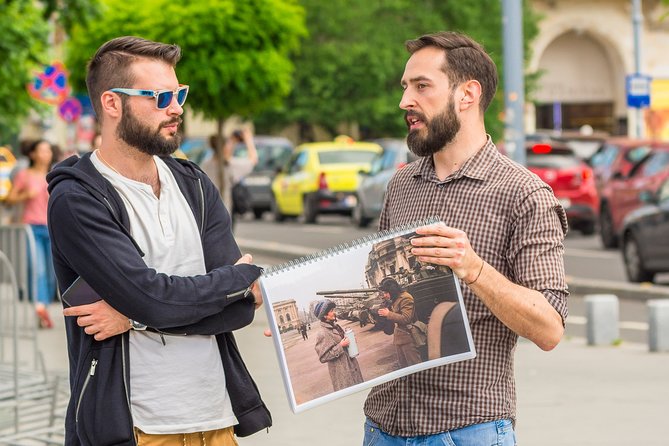
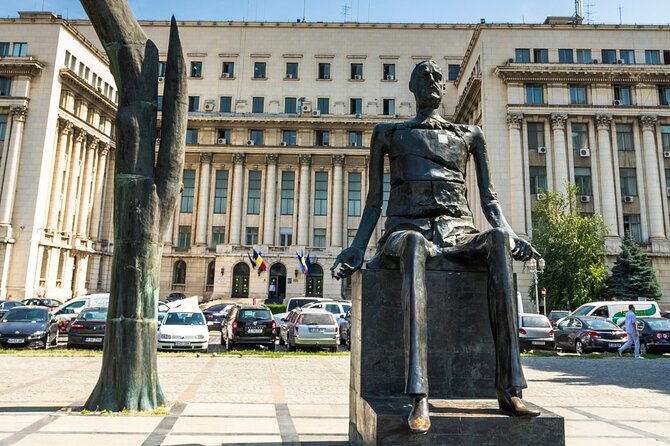
Revolution Square is the emotional center of the walk. This is where the communist regime began to collapse in December 1989 and where the public protests became a direct challenge to Ceaușescu.
You see the building that housed his office, the balcony where he gave his last speech, and the places connected with the first mass demonstration in Bucharest. The guide explains what happened to people who protested against the regime, along with the story behind the monument dedicated to those who died.
This stop needs careful explanation because the revolution was not a simple, tidy change from dictatorship to democracy. The tour addresses the violence of the protests and what followed after Ceaușescu lost power. You get the political story, but also the human cost.
I would set aside the full hour listed for this stop. The square contains several important locations close together, and the guide’s historic photographs are particularly useful here. They help you compare the present-day buildings with the scenes of crowds, speeches, and unrest in 1989.
The guide’s style matters most at this point. Laura is repeatedly praised for her strong English, patience, humor, and ability to answer detailed questions. Tamar is also noted for mixing facts with anecdotes and keeping the pace lively. The specific guide may vary, but the tour appears designed for conversation rather than a memorized speech.
University Square and the final chapter of protest
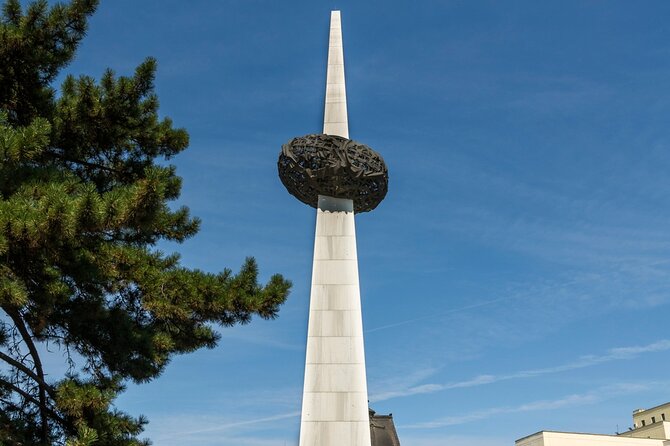
The final stop is University Square, another key site of opposition to communism. It became a central place for protests in 1989, and the tour discusses the people who were killed while calling for a free society.
Ending here gives the walk a clear direction. You begin with the physical expression of communist power and finish with ordinary people confronting that power in public. The route is not only about what Ceaușescu built. It is also about what people were willing to risk to change the country.
The stop lasts about 30 minutes and is included in the tour. From here, you finish at Revolution Square, which is about five minutes from the Old Town. That makes the ending practical. You can continue into the historic center for dinner, drinks, or another walk without arranging transport back to your hotel.
What the guides add to the experience
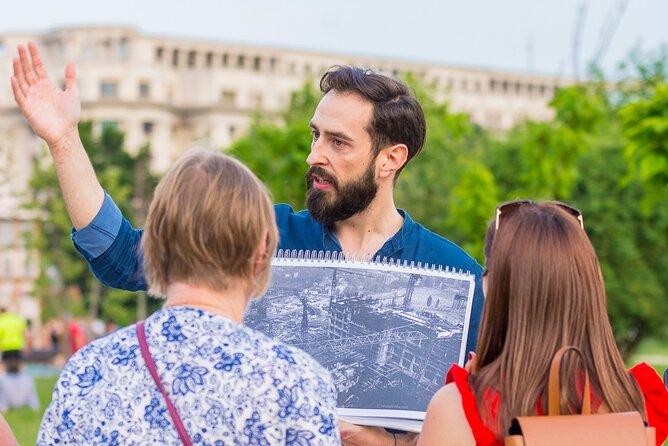
The strongest part of this tour is likely to be the person leading it. Laura appears frequently in the feedback and is described as a history graduate who brings photographs, detailed explanations, and personal stories about the communist period. Tamar is also praised for answering questions and combining historic facts with anecdotes.
That does not mean every guide will have the same style. Still, you can expect a personal, conversational approach rather than a silent walk between landmarks. The group size is capped at 15, which should make it easier to hear the guide and ask questions.
I especially like the use of historic photographs. Communist Bucharest has changed, and some places are easier to understand when you can see what they looked like during the protests or before large-scale rebuilding. Ask questions if you have family connections to Romania or want to understand the transition from monarchy to communism and then to democracy.
The tour also includes some lighter moments. One account mentions a break at Bucharest’s oldest cake store, though this should not be treated as a guaranteed feature unless confirmed at booking. It is a reminder that the walk can include local color as well as political history.
Price, timing, and physical demands
At $23.22 per person, this is a strong price for a guided walk lasting about three and a half hours. You are paying for a long route, a guide, historical interpretation, and access to several major sites without a separate vehicle transfer.
The value is best for someone who wants context. If you only want quick photographs of the Palace of Parliament, you can visit the area independently. If you want to understand why the palace exists, how the city was reshaped, and how the 1989 protests unfolded, the guide adds much more.
The listed start time is 4:00 pm. Since the route is outdoors and requires walking between sites, weather can affect the experience. Poor weather may lead to a new date or a full refund.
Wear comfortable shoes and allow the full time. The route includes several stops, broad public spaces, and historic sites. Most people can participate, and service animals are allowed. The meeting point is near public transportation, and the walk finishes near the Old Town.
The experience is described as private, but the stated maximum is 15 people. I would read that as a guide-led experience with a small group limit, not necessarily a one-party private tour unless your booking specifically confirms exclusive use.
Who should book this Bucharest walking tour?
I would choose this tour if you are visiting Bucharest for the first time and want a framework for the city. It is also a good fit if you already know the basic story but want the physical locations, photographs, and local explanations to connect the pieces.
History students, architecture fans, and visitors interested in the Cold War should get plenty from it. So should anyone who finds that large monuments make more sense when a guide explains the people who paid for them.
You may want to skip it if you dislike long walks, outdoor touring in uncertain weather, or serious political subjects. It is not a casual sightseeing loop. The story includes shortages, demolition, imprisonment, protest, and deaths. The guides aim to keep the experience engaging, but the subject remains heavy.
Should you book it?
Yes, if you want to understand Bucharest beyond its Old Town and grand buildings. The route covers the city’s most important communist-era sights, and the final stops at Revolution Square and University Square give the history a strong human focus.
Book it early in your stay if possible. The tour can help you read the rest of Bucharest with better eyes, especially the contrast between old churches, communist planning, and modern democratic life. Just remember that the Palace of Parliament is viewed from outside and that you should allow about three and a half hours for the complete walk.
FAQ
Where does the tour start?
The meeting point is Piața Sfântul Anton 64 in Bucharest, Romania. The listed start time is 4:00 pm.
Where does the tour finish?
The tour ends at Revolution Square, or Piața Revoluției. The square is about five minutes from Bucharest’s Old Town.
How long does the experience last?
The advertised duration is approximately three hours and 30 minutes. The planned stops total about three and a half hours.
Is admission to the Palace of Parliament included?
No. Admission to the Palace of Parliament is not included. The tour views the building from different angles and explains its construction and history.
Is this a private tour?
The experience is described as private and has a maximum of 15 participants. Confirm the exact group arrangement when booking if you require an exclusive tour for your party.
Which landmarks are visited?
The route includes Unirii Square, the Palace of Parliament, Mihai Voda Monastery, Revolution Square, and University Square.
Can most people take part?
Yes. Most people can participate, and the tour is near public transportation. Service animals are allowed.
What is the cancellation policy?
You can cancel up to 24 hours before the start time for a full refund. Changes or cancellations made less than 24 hours before the start time are not accepted for a refund. If poor weather cancels the experience, you will be offered another date or a full refund.
Just added around Bucharest
- Guided Walking Tour of Historical Bucharest★ 5.0 · 84 reviews
- Walking Tour- Delightful Bucharest (Highlights, Stories, Sights)★ 5.0 · 145 reviews
- Bucharest 3-hours Walking Tour (Small Groups)★ 5.0 · 85 reviews
- 4h Bucharest Private Tour (2h by Car and 2h Walking in Old Town)★ 5.0 · 90 reviews
- Best of Bucharest | Private Walking Tour★ 5.0 · 199 reviews
- Bucharest: Relics of Communism 3-Hour Walking Tour★ 4.9 · 77 reviews
- Bucharest: Guided Walking Tour with Romanian Snack★ 4.9 · 228 reviews
- Bucharest: Ghost Stories & Romanian Mythology Walking Tour★ 4.9 · 287 reviews
History Walking Tours, compared.

Berlin’s Best: 2 Hour Walking Tour Third Reich and the Cold War
Read our review →
Third Reich Berlin: Hitler and WWII Walking Tour
Read our review →
New Orleans Garden District History Walking Tour
Read our review →
Cartagena: Historic Center and Getsemaní Shared Walking Tour
Read our review →
Imperial Palace and Shogun Historical Walking Tour
Read our review →Browse the lists this tour appears in