
REVIEW · BELFAST
A History of Terror – Belfast City Centre Walking Tour
Belfast’s clean streets and lively cafés can hide how recently violence shaped daily life here. This 2.5-hour walking tour connects ordinary city corners with bombings, policing, political conflict, and the long road toward peace. Guides including James, Anne, Mylie, and Róisín bring the subject to life with local knowledge and, in some cases, personal memories.
I like the clear, neutral approach, which gives you the background behind both British and Irish viewpoints without pushing you toward a political conclusion. I also like the route itself: 1.5 miles on flat streets, from City Hall through the Cathedral Quarter to the River Lagan.
The main drawback is the subject matter. This is not a light city stroll. You will hear about deaths, bomb attacks, and fear, and much of the time is spent standing while the guide speaks. Rain is another factor, since the tour runs outdoors.
Key points to know before booking
- The Troubles take center stage: You learn how the conflict began, how it affected ordinary people, and how peace developed.
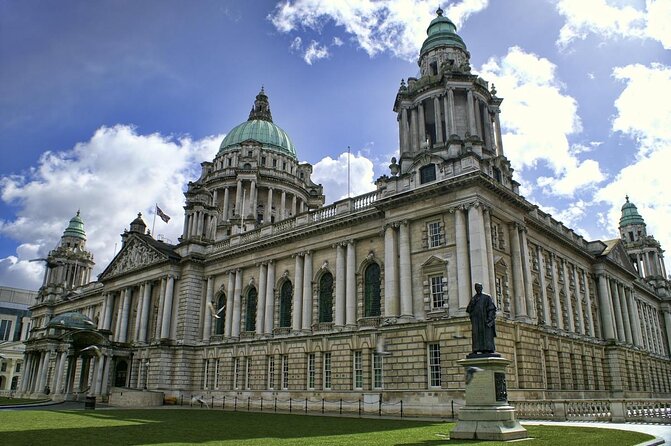
- Seven central Belfast stops: The route links City Hall, Donegall Place, Castle Lane, the Spirit of Belfast, Cathedral Quarter, Ann Street, and the Beacon of Hope.
- Local voices shape the tour: Guides such as James, Anne, Mylie, Róisín, Chris, and Rorey have led departures, with some sharing memories of growing up during the conflict.
- Easy walking route: The city center is flat, with no hills or steps, though you should wear comfortable shoes.
- Headsets are provided: These help you hear the guide in a group of up to 25 people.
- A serious but hopeful finish: The tour ends by the Lagan, looking at Belfast’s fragile peace and possible future.
Why this Belfast tour is worth your time
A standard city tour can show you Belfast’s grand buildings, shopping streets, and nightlife district. This experience asks a harder question: how did a city that looks so ordinary today live through decades of political violence?
That question gives the walk its purpose. You are not only moving from one attraction to the next. You are learning how streets were used, watched, feared, and later reclaimed. A shopping area becomes the setting for a bombing. A police station opens a discussion about changing ideas of security. A piece of public art becomes a way to consider resilience.
The tour is also useful early in a Belfast visit. It gives you context for later sights, especially if you plan to visit political murals, peace walls, or museums. You do not need a prior grasp of Northern Ireland’s politics. The guide begins with the basic relationship between Britain and Ireland, then explains how tension grew into The Troubles in the late 1960s.
The best departures seem to combine political facts with everyday details. One guide may explain a major event, then add what it meant for people going to work, shopping, or meeting friends. That human scale keeps the tour from becoming a string of dates and labels.
More City Highlights Walking Tours in the UK
- Oxford: University and City Walking Tour with Alumni Guide
★ 4.7 · 4,429 reviews - Bath: City Walking Tour with Optional Roman Baths Entry
★ 4.7 · 1,401 reviews - Glasgow City Centre Walking Tour with Local Guide
★ 5.0 · 1,326 reviews
City Hall sets the scene in 20 minutes
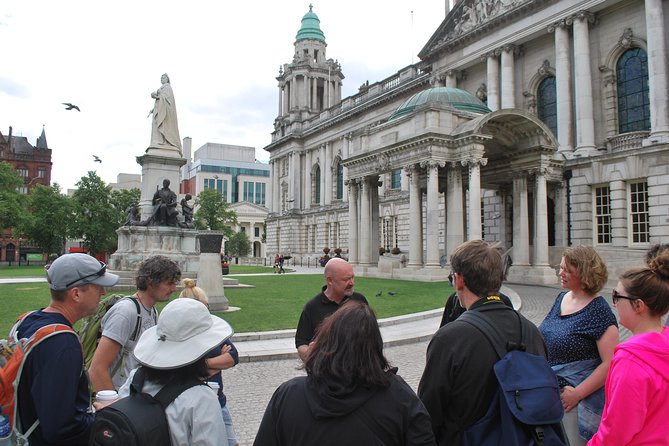
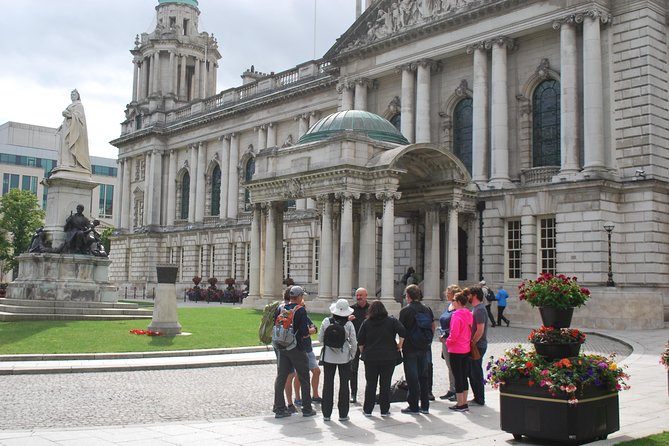
Meet at Belfast City Hall at 10:30 in the grounds of the building. This opening is important because the guide does not throw you straight into the darkest events. You first get the long background: the competing British and Irish identities, the political divisions, and the conditions that led to unrest in the late 1960s.
Expect roughly 20 minutes here. It is mostly an introduction, so this is a listening stop rather than a sightseeing segment. If you want interior access to City Hall, this walking tour does not include it. The value is the setting and the explanation.
I appreciate this beginning because The Troubles can be confusing when reduced to simple terms such as Catholic versus Protestant. The opening discussion points toward the political and national questions behind the conflict. You get a better base for understanding what follows.
Donegall Place reveals the danger behind a shopping street
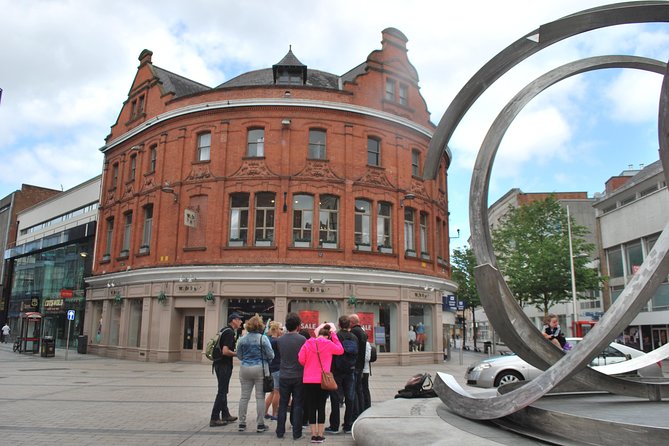
The route then moves to Donegall Place, now one of Belfast’s main shopping streets. This is a useful contrast. Modern storefronts and everyday errands make it easy to forget that the same area was once connected with a nightclub bombing in 1971 and the painful events that followed.
The guide explains the attack and the introduction of the Ring of Steel, a security system that changed how people entered and moved through central Belfast. You spend about 15 minutes here, listening to the history tied to a place that otherwise looks routine.
This stop works because it brings the conflict out of the usual tourist settings. You are not looking at a memorial behind a fence. You are standing in a normal commercial area and learning how violence altered the habits of city life. That is one reason the tour can feel sobering even when the streets around you are busy with ordinary activity.
Castle Lane brings the conflict into daily life
At Castle Lane, another 15-minute stop shows how close The Troubles came to the normal rhythm of the city center. The street is now a pedestrian shopping area, but the guide describes what life felt like at the height of the conflict and revisits an event that remains strongly remembered in Belfast.
The supplied details do not identify the event by name, and that is not a problem. The point is the connection between public space and private memory. You learn that violence was not limited to distant edges of the city. It reached the places where people went to shop, work, and meet.
This is also one of the stops where the guide’s delivery matters most. Several guides have been praised for telling individual stories alongside the political background. That approach gives names and human consequences to a period that can otherwise sound abstract.
More City Highlights Walks in the UK:
- York: City Highlights Small Group Walking Tour
★ 4.9 · 867 reviews - Roman Baths and Bath City Walking Tour
★ 4.5 · 762 reviews - London Sightseeing Walking Tour with 30+ sights
★ 5.0 · 705 reviews - Oxford: Official University and City Walking Tour
★ 4.7 · 618 reviews
The Spirit of Belfast links art with the start of escalation
The Spirit of Belfast is a large public artwork near the city center, known locally by the informal nickname the Onion Rings. The tour spends about 15 minutes here, using the artwork as a backdrop for events that began in a nearby bar in 1971.
The guide explains how those events helped push Northern Ireland into a rapidly worsening cycle of violence. The artwork itself is intended to suggest the resilience of Belfast, so the stop links two ideas that run through the whole walk: the damage caused by conflict and the city’s effort to recover.
This is a good example of how the route uses modern Belfast to explain older Belfast. You are not simply shown a sculpture and given a sentence about it. You are asked to consider what renewal means in a place where memories remain close to the surface.
Cathedral Quarter shows how much Belfast has changed
The 20-minute walk through the Cathedral Quarter is one of the most interesting parts of the route. Today, this district is known for street art, bars, cultural venues, and nightlife. The guide explains more major events from The Troubles, then turns toward the first steps on the road to peace.
You may find this section especially effective because the contrast is so strong. The lanes and streets feel social and creative now, yet the guide’s stories carry you back to the fear and uncertainty of the 1970s. The tour does not treat regeneration as a magic fix. Instead, it asks you to see the district as a place where change is visible but memory has not vanished.
This is also where the walk can feel most like a regular city tour, though the content remains serious. You see street art and lively streets, but the focus is still history and politics. If you want a tour devoted only to pubs, architecture, or food, choose something else. If you want to understand how Belfast presents itself today, this section earns its place.
Ann Street explains policing and Brexit
At Ann Street, the guide stops beside Belfast’s largest police station for about 15 minutes. Here you learn how Northern Ireland was policed during The Troubles and how policing changed after the peace agreement.
The discussion also reaches Brexit and the possible effect of border arrangements. This gives the tour a present-day edge. You are not left with the impression that the conflict ended neatly on one date. Instead, the guide explains that peace remains delicate and that political questions continue to shape Northern Ireland.
For me, this is a useful part of the tour because it connects history to current concerns without pretending to predict the future. It also gives you a clearer idea of why borders and identity remain sensitive topics here.
The Beacon of Hope ends the walk beside the Lagan
The final stop is the Beacon of Hope on Oxford Street, beside the River Lagan. The tour spends about 20 minutes here comparing Belfast today with one of the bleakest days in its past.
The guide explains how the peace was achieved and considers what may come next. The tone is hopeful but not sugary. The phrase fragile peace matters. You are encouraged to recognize the progress Belfast has made while also understanding that political and community tensions have not simply disappeared.
Ending beside the river gives the walk room to breathe. After several stops about attacks and loss, the final discussion turns toward resilience, regeneration, and the future. From the Beacon of Hope, you are about a five-minute walk from City Hall, so the finish is convenient if you need to return to the center.
What the guide and headsets add
The guide is the heart of this experience. Departures have been led by James, Mylie, Anne, Róisín, Chris, and Rorey, among others. The strongest guides combine clear facts, personal memories, and a calm way of presenting painful subjects.
Some guides have lived through The Troubles as children or young adults. That does not mean every departure will offer the same personal perspective, but the experience can include memories of growing up during the conflict. One guide was described as a Belfast native, while another brought a personal connection to the period and gave names to victims.
The tour aims for a neutral presentation. That is valuable in Belfast, where visitors can easily encounter one-sided accounts. You will still need to think for yourself, but the guide gives you enough background to understand why different communities remember the same events in different ways.
Headsets are included. They matter because the group can reach 25 people, and the route uses open streets where traffic and general city noise can interfere. One poor departure had equipment trouble halfway through, and the guide did not speak loudly enough for everyone to follow. That appears to be an exception, but it is a fair reminder that the headset is not just a small extra. It is central to hearing the story.
Walking conditions, timing, and weather
The route covers about 1.5 miles and takes approximately two hours and 30 minutes. Belfast city center is completely flat, with no hills or steps on this route. Most people who can manage a moderate walk and several standing stops should be able to take part.
Comfortable footwear still matters. The distance is not great, but you are outside for a long period and may stand at each location while the guide speaks. One useful detail is that the experience is more stop-and-listen than continuous walking. If you prefer constant movement, the pace may feel slow.
The tour runs in poor weather unless conditions force cancellation, so check the forecast. A waterproof jacket is sensible for showers, and warm clothing is needed in winter. There may be dry seats at some stops, but you should not count on sitting throughout.
The minimum age is 12. Service animals are allowed, and the tour is near public transportation. It is offered in English, with a mobile ticket.
Is $36.06 good value?
At $36.06 per person, this is not the cheapest way to spend a morning in Belfast. It is fair value if you want a guided explanation of The Troubles rather than a general orientation walk.
You are paying for 2.5 hours of live storytelling, a planned route through seven meaningful locations, headsets, and access to guides who can explain both the public record and personal experience. The walk also saves you from trying to connect scattered sites on your own.
The value depends on your interests. If you mainly want Belfast architecture, shopping, or the Titanic story, part of the time and price may feel misplaced. If you want political context and a human account of recent history, the cost is reasonable.
The tour has a 5 out of 5 rating from 2,882 ratings, with 99 percent recommending it. Those figures suggest a strong and consistent experience, though the sound-equipment complaint shows why you should still pay attention to the practical details.
Who should book this experience?
I would choose this tour if you are visiting Belfast for the first time and want a grounded introduction to the city’s recent past. It suits adults, older teenagers aged 12 and above, history-minded visitors, and anyone who wants more than a quick photo stop.
It is also a good fit if you want a balanced account. Guides have been praised for explaining both sides of the political divide, avoiding sensationalism, and presenting facts with care. Personal stories make the tour more emotional, but the aim is education rather than shock.
I would think twice if you dislike standing outdoors, have no interest in politics, or want a relaxed sightseeing walk. The tour can be sad, and it asks you to concentrate. Choose a dry morning if possible, though weather is never guaranteed in Belfast.
Book it if you want to understand how Belfast moved from violence toward peace, and if you are ready for a serious two and a half hours. Skip it if you only want bright city sights. For many visitors, this is the experience that gives the rest of Belfast meaning.
FAQ
Where does the Belfast Troubles walking tour start?
It starts in the grounds of Belfast City Hall at Donegall Square North, Belfast BT1 5GS.
What time does the tour begin?
The tour starts at 10:30 am.
Where does the tour finish?
It ends at the Beacon of Hope on Oxford Street, Belfast BT1 3NB. From there, it is about a five-minute walk back to City Hall.
How long is the tour?
The experience lasts approximately two hours and 30 minutes.
How far do you walk?
The route covers about 1.5 miles through Belfast city center.
Is the route difficult?
The city center is completely flat, with no hills or steps. Comfortable footwear is advised because you may stand during several stops.
Is the tour suitable for children?
The minimum age is 12 years.
What happens if the weather is poor?
The tour takes place in most weather conditions, so bring a waterproof jacket and suitable warm clothing. If the experience is canceled because of poor weather, you can choose another date or receive a full refund.
Can I cancel for a refund?
You can cancel at least 24 hours before the start time for a full refund. Cancellations or changes made less than 24 hours before the start are not refunded or accepted.
Just added around the UK
- Falmouth: Vibrant Historical Walking Tour (award-winning)★ 4.9 · 75 reviews
- The Must-Sees of Edinburgh: Small Group Walking Tour in French★ 4.9 · 88 reviews
- Edinburgh: Old Town History Walking Tour★ 4.9 · 528 reviews
- Edinburgh: Old Town Stories – Guided Walking Tour★ 4.9 · 86 reviews
- Ghosts, Ghouls & Gallows :The Original Bristol Ghost Walk★ 4.6 · 76 reviews
- Edinburgh: Private Walking Tour with a Local★ 4.4 · 78 reviews
- Edinburgh: Private Walking Tour in French with Clémentine★ 5.0 · 73 reviews
- Edinburgh: Multi-Sensory Old Town Historical Walking Tour★ 4.6 · 290 reviews
City Highlights Walking Tours, compared.
Berlin City walk Government District and Places of Democracy
Read our review →
Historic Charleston Guided Sightseeing Walking Tour
Read our review →
Oxford: University and City Walking Tour with Alumni Guide
Read our review →
City Highlights Temple and Market Walking Tour
Read our review →

Montmartre Hidden Gems and Scenic Highlights Walking Tour
Read our review →Browse the lists this tour appears in