
REVIEW · NICE
Nice: Sightseeing Walking Tour with certified tour guide
Nice reveals itself best on foot, and this tour gets you from Place Massena into the narrow lanes of Old Nice, then up Castle Hill for a grand view over the Bay of Angels. Along the way, a local guide connects the city’s Greek, Italian, Savoyard, and French past to its food, churches, squares, and seaside life.
I like the strong mix of major sights and local context, especially the Old Town churches, Cours Saleya, and Promenade des Anglais. I also like the practical side: guides such as Gianni share tips on ice cream, restaurants, and returning through the old center after the tour.
The main consideration is the 300-step climb to Castle Hill. It adds effort to an otherwise manageable two-hour walk, and the bilingual format may mean a slower pace or less detail in each language.
Key points to know before you book
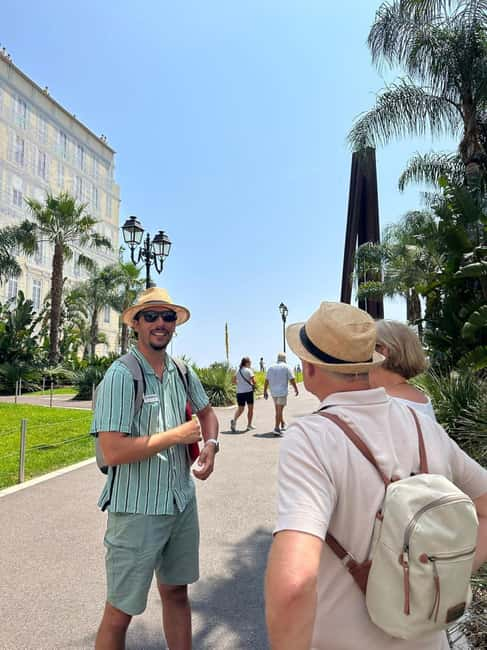
- Castle Hill finishes the walk: Allow energy for 300 steps and expect the best views at the end.
- Old Nice gets the most attention: Narrow lanes, Baroque churches, Cours Saleya, and local food culture form the heart of the route.
- Gianni is a local favorite: His tours are praised for clear history, friendly conversation, and useful food suggestions.
- The route covers Nice’s classic postcard sights: Place Massena, the Opera House, the waterfront, and the Bay of Angels.
- It is a good-value introduction: At $31 per person for two hours with a certified guide, you receive a broad first look at central Nice.
- Pack for sun and stone streets: Comfortable walking shoes, water, sunscreen, a hat, and sunglasses are not included.
Starting at Place Massena and entering old Nice
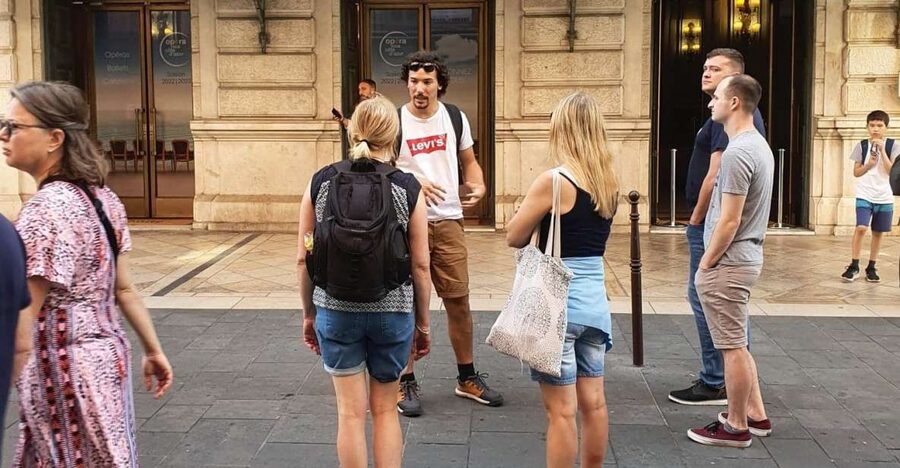
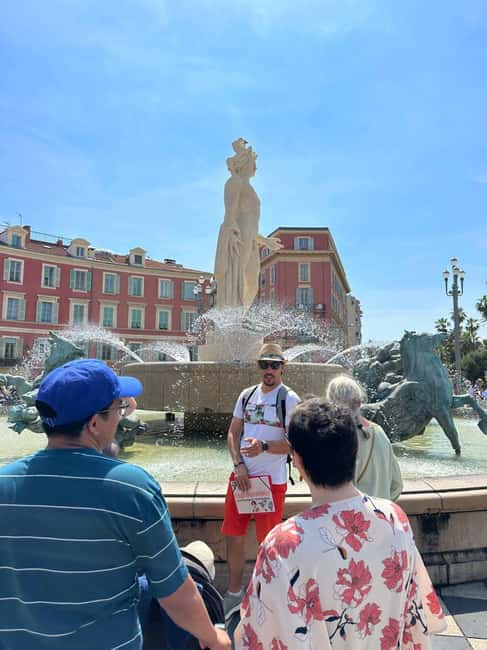
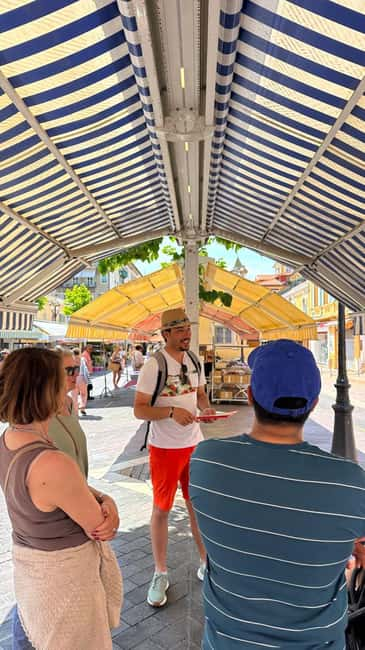
The meeting point is beside the Fontaine du Soleil on Place Massena, Nice’s grand central square. Look for the guide waving an Esplouratour sign. This is a useful starting point because the square sits between the modern city center and the older quarters, giving you a quick sense of how Nice changes block by block.
The walk begins with Neuf Lignes Obliques, a contemporary sculpture near the square. The guide uses this short stop to place modern Nice in context before leading you toward the older streets. You should expect about ten minutes here, enough for an introduction without spending too much of the tour on one artwork.
The next stop is the Nice Opera House. Its setting near the waterfront gives you an early look at the city’s polished public face. This part is more about exterior history and surroundings than a full interior visit, so do not book the walk expecting an opera-house tour.
From here, the route moves toward Cours Saleya. This long market street is one of the most enjoyable places in Nice, with colorful façades, cafés, food stalls, and a strong connection to local daily life. The guide can help you understand how the street fits into Nice’s food culture, including specialties such as socca, pan bagnat, and salade niçoise.
A small but useful food note: the local salad is traditionally made without potato. You may want to remember that when ordering later, since menus and versions vary. Pan bagnat, a round bread filled with salad ingredients and dressed with olive oil, is another classic worth trying during your stay.
More City Highlights Walking Tours in France
- Montmartre Hidden Gems and Scenic Highlights Walking Tour
★ 5.0 · 2,684 reviews - Paris: Montmartre Highlights Walking Tour with a Local Guide
★ 4.9 · 2,318 reviews - Paris in a Day: Louvre or Orsay, Eiffel Tower, City Walk & Cruise
★ 5.0 · 1,956 reviews
Cours Saleya and the churches of Old Nice
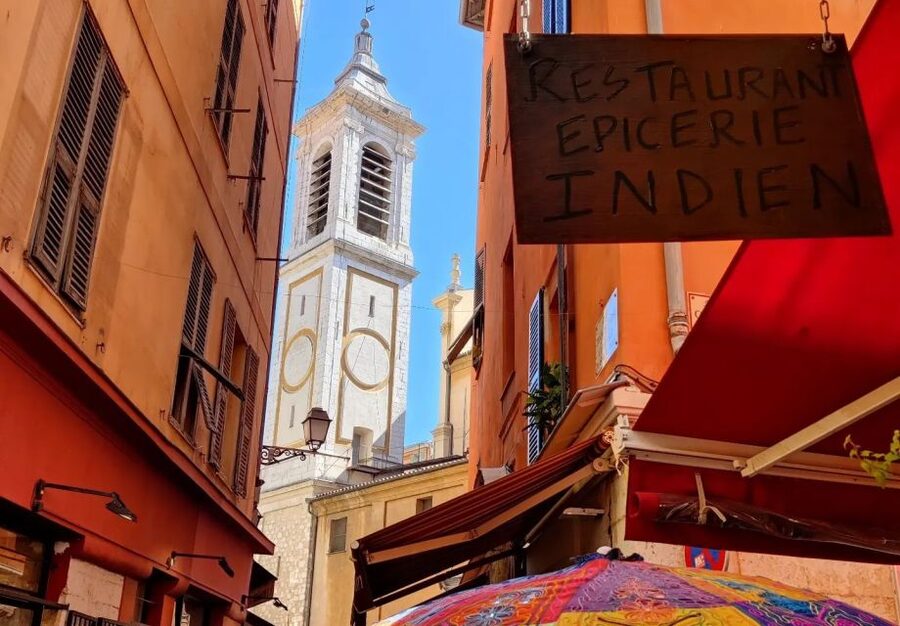
Old Nice is the section where walking with a local guide pays off most. The lanes are narrow, colorful, and easy to wander through, but their architecture can be hard to read without help. The area reflects Nice’s long connection with Provence, Italy, the House of Savoy, and the Kingdom of Piedmont-Sardinia.
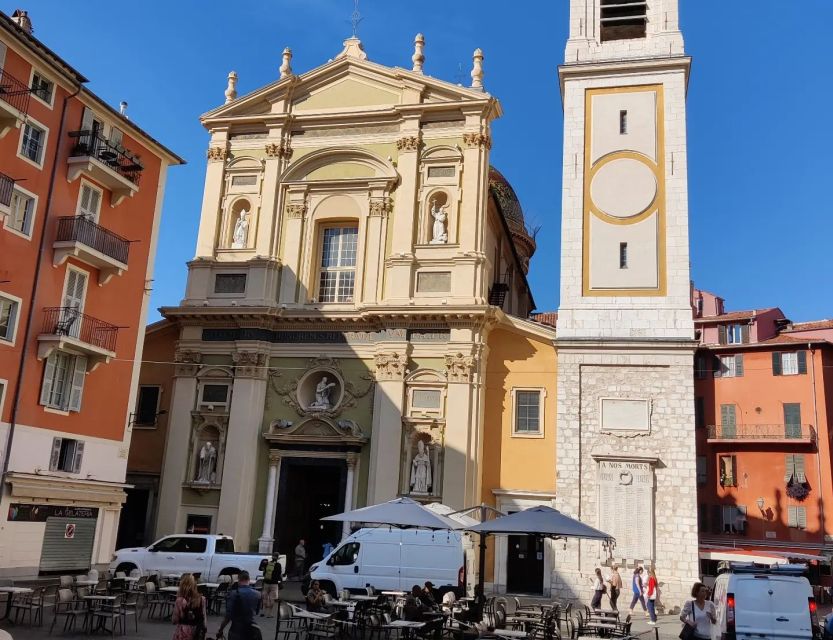
The first major church stop is Cathédrale Sainte-Réparate. Its Baroque design fits the old quarter’s Italianate feel, with a scale and decoration that can surprise you after the tight lanes outside. You should have around ten minutes to look around and hear the main story rather than a long formal visit.
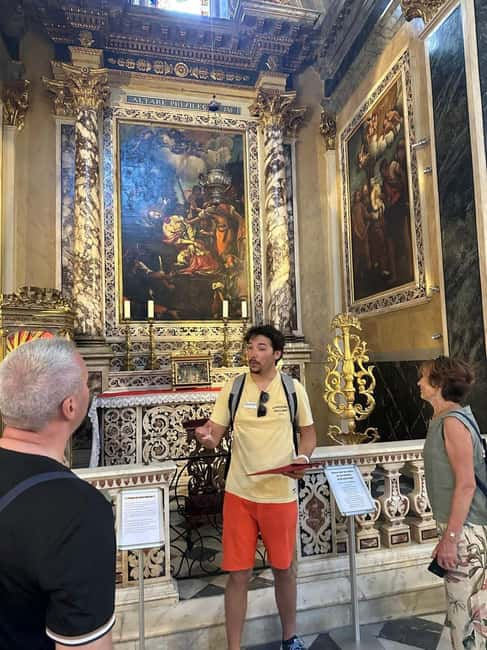
Next comes Église Saint-Jacques-le-Majeur de Nice, also known as the Church of the Gesù. This is another Baroque church, and it helps show why Nice feels different from many other French cities. Its religious art and ornate style reflect the city’s historic links across the Alps and into Italy.
The short stops work well for a first visit. You get enough background to recognize what you are seeing later, while still moving through the neighborhood at a steady pace. If you prefer long museum visits or detailed architectural study, two hours will feel brief. If you want a clear map of the old center, the rhythm is sensible.
Old Nice also has art galleries, small restaurants, bars, and shops. The guide’s local suggestions can be valuable here, particularly if you have just arrived and want ideas for ice cream, drinks, or a simple meal. Gianni is often praised for making the history easy to follow and for answering questions rather than giving a fixed speech.
From the waterfront to the Promenade des Anglais
The route then reaches Quai des États-Unis, the waterfront stretch beside the old center. This is a good place for photographs and for understanding Nice’s relationship with the Mediterranean. The broad promenade contrasts sharply with the compressed lanes behind it.
The seaside boulevard continues into the famous Promenade des Anglais. Nice’s nickname as the French Copacabana comes from this broad, social waterfront, where the sea, grand buildings, and public walking space define the city’s image. You will not spend the whole two hours on the promenade, but this stop gives you the essential view.
The guide can also explain how Nice developed as a resort city while retaining its older regional identity. That contrast is one of the city’s pleasures. One minute you are beside Baroque churches and food markets, and the next you are looking out over a broad Mediterranean road known around the world.
Plan for photo stops rather than a long seaside break. The tour keeps moving, and the waterfront is best treated as a link between Old Nice and Castle Hill. If you want time to sit by the sea, return after the tour.
Castle Hill begins with the real workout
The route continues to Bellanda Tower, then toward the Castle Hill viewpoint over the port. This is where the walking tour becomes more physically demanding. The hill is reached by about 300 steps, so the final part is not a casual stroll.
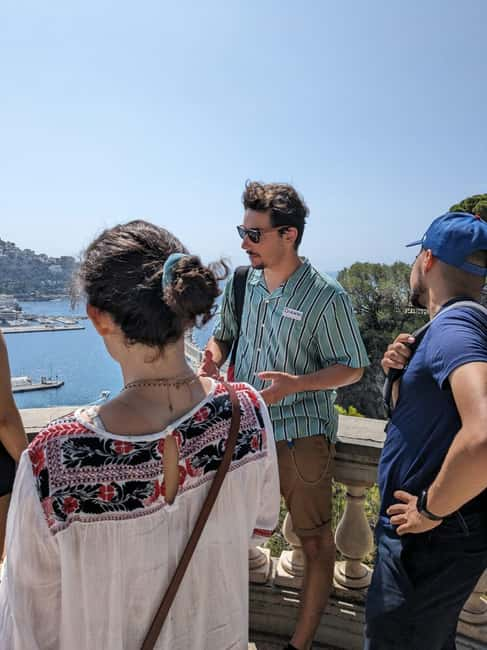
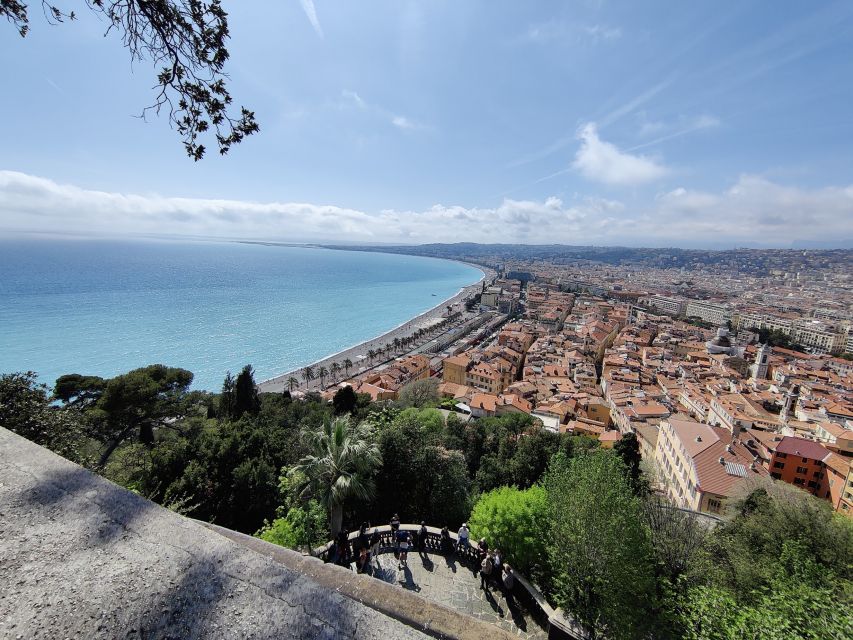
The effort is worthwhile for the views. From the hill, you can look over the Bay of Angels, Nice’s rooftops, the port, the surrounding hills, and the distant Prealps. The changing angles are one reason this area is a favorite public park for local residents as well as visitors.
The guide pauses at several viewpoints, giving you time to take photographs and understand the city’s shape. From above, the route you have just walked becomes easier to picture. You can see how the old center sits between the sea and the hill, and why Nice grew around this narrow coastal strip.
There are also archaeological excavations on Castle Hill. These offer a glimpse into the earlier settlement of Nice and add depth to the city story. The hill is not simply a lookout. It also carries traces of the older fortified settlement that once occupied this strategic position.
A waterfall is another photo stop on the hill. It provides a pleasant break from the stair climb, though you should not expect a long nature walk. The final viewpoint completes the tour at Le Chateau, leaving you above the city rather than back at Place Massena.
More City Highlights Walks in France:
- Lyon: City Highlights Walking Tour
★ 4.9 · 847 reviews - Paris: Montmartre Must-See Walking Tour with a Local Guide
★ 4.9 · 661 reviews - Paris: Montmartre Hidden Gems and Highlights Walking Tour
★ 4.7 · 378 reviews - Bordeaux: City Highlights Guided Walking Tour
★ 4.7 · 316 reviews
How much history and local detail you receive
Nice has an unusual political past. It began as a Greek settlement, later became a Gallo-Roman city, and served as the maritime gateway for the States of Savoy. The region remained tied to the Piedmont-Sardinia kingdom until 1860, when Nice joined France.
That background explains much of what you see. The food has Provençal and Italian influences. The churches and older buildings often feel more Italian than Parisian. The city’s position between the sea and the Alps also helps explain its mix of trade, tourism, military importance, and resort culture.
A strong guide makes these connections useful rather than turning the walk into a list of dates. Gianni is especially well regarded for sharing a local point of view and for bringing in stories about present-day Nice. His style is described as friendly, relaxed, and flexible, with room for questions and small adjustments when a group needs a pause.
The advertised languages are English and French. Most English-speaking customers should find the tour accessible, but one past booking noted that a bilingual tour can be less satisfying than a separate English-language walk. If precise, detailed English explanations are especially important to you, ask about the language arrangement before booking.
The $31 price and what you receive
At $31 per person, this is a reasonable price for a two-hour guided introduction to central Nice. You cover the old quarter, important churches, the waterfront, the Promenade des Anglais, and Castle Hill without paying separate entrance fees.
The value is strongest if this is your first day in Nice. You get your bearings, learn which areas deserve more of your own time, and receive food and sightseeing suggestions from someone who knows the city. Several hours of independent wandering could cover the same streets, but you would miss much of the historical connection between them.
The tour is less useful if you already know Old Nice well or want to visit interiors at length. The stops are short, and the emphasis is on orientation, stories, viewpoints, and local advice rather than formal museum-style instruction.
The experience also includes no water, sunscreen, hat, sunglasses, or walking shoes. That is normal for a walking tour, but the sun can be strong and the stone streets can be tiring. Bring your own supplies, especially in warm weather.
Who will enjoy this Nice walking tour
I would choose this tour for a first visit, a short stay, or a cruise stop when you want a quick but substantial introduction. It suits couples, families with older children, and anyone who prefers a guide to explain what they are seeing instead of reading signs alone.
It is also useful for food-minded visitors. The route does not include tastings, but the discussion of Nice specialties and the guide’s restaurant and ice cream suggestions can help shape the rest of your stay.
Fitness matters. The streets of Old Nice are manageable for many people, but the Castle Hill finish includes 300 steps. The activity is listed as wheelchair accessible, yet the stated stair climb creates an important practical question. If you use a wheelchair or have difficulty with stairs, contact Esplouratour before booking to confirm how the route can be adapted.
The tour operates rain or shine. Wear shoes with a solid grip, bring water, and prepare for sun or rain. A late-day departure may be more comfortable in hot weather, but the available start times vary.
Should you book it?
Book this tour if you want a friendly local introduction to Nice that combines history, food culture, major landmarks, and excellent views. The strongest features are the Old Town storytelling, the guide’s local suggestions, and the Castle Hill finish.
Skip it if you want a slow architectural study, long church visits, or a route with no steep climb. For most first-time visitors who can manage the stairs, $31 buys a useful two-hour orientation and leaves you with a clear plan for exploring Nice on your own.
FAQ
Where does the Nice walking tour meet?
The meeting point is next to the Fontaine du Soleil on Place Massena. The guide will be waving an Esplouratour sign.
Where does the tour finish?
The tour finishes at Le Chateau on Castle Hill.
How long does the tour last?
The walking tour lasts two hours.
Which languages are available?
The tour is offered in English and French.
How many steps are there to Castle Hill?
You will climb about 300 steps to reach the top of Castle Hill.
Is the tour suitable for wheelchair users?
The activity is listed as wheelchair accessible, but the route includes 300 steps to Castle Hill. Contact the provider before booking to confirm whether an adapted route is available for your needs.
What should I bring?
Bring water, sunscreen, a hat, sunglasses, and comfortable walking shoes. These items are not included, and the tour runs in rain or shine.
Just added around France
- Giverny Monet House and Gardens Skip the line Walking tour★ 4.0 · 217 reviews
- [Walking Tour] Discover the Best of Brest in 2 hours★ 5.0 · 102 reviews
- Bordeaux Historic and Gourmet Food Walking Tour★ 4.5 · 82 reviews
- 2-Hour Walking Tour of the City’s Iconic Sights and History★ 4.0 · 207 reviews
- Free Walking Bordeaux Tour ENG + 1 glass of wine (Tip based)★ 5.0 · 90 reviews
- Bordeaux Walking Tour with a Local Private Guide★ 5.0 · 97 reviews
- Traditional Gourmet Food & Wine Tour in Bordeaux★ 5.0 · 81 reviews
- Bordeaux City – Private Guided Walking Tour with Local Sophia★ 5.0 · 164 reviews
City Highlights Walking Tours, compared.

Berlin City walk Government District and Places of Democracy
Read our review →
Historic Charleston Guided Sightseeing Walking Tour
Read our review →
Oxford: University and City Walking Tour with Alumni Guide
Read our review →
City Highlights Temple and Market Walking Tour
Read our review →
A History of Terror – Belfast City Centre Walking Tour
Read our review →Browse the lists this tour appears in