
REVIEW · ATHENS
Athens: City Highlights Nighttime Walking Tour in Spanish
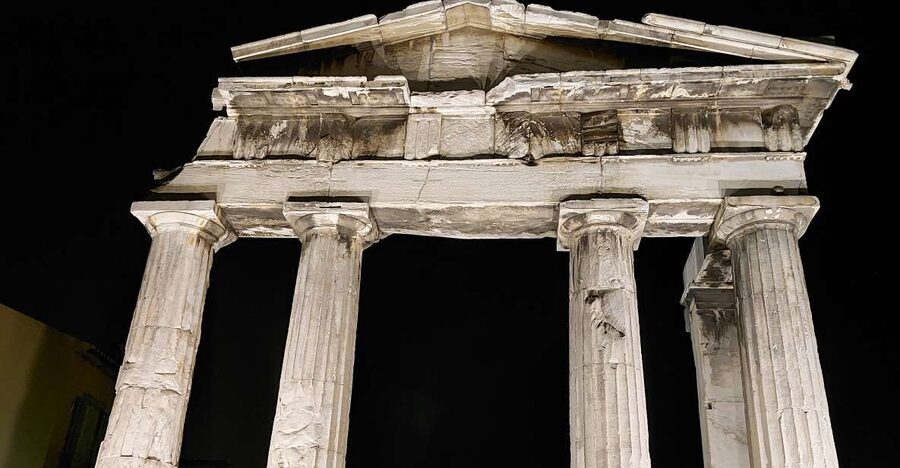
Athens changes character after sunset. This two-hour Spanish walking tour links the city’s best-known landmarks with a useful thread of Greek history, mythology, architecture, and Olympic tradition. You move from the National Library to Syntagma, through the National Gardens, and on to Monastiraki with the Acropolis glowing above the rooftops.
I like the clear route and the timing. You see major sights without spending the evening inside a museum, and the cooler night air makes the walk easier than a midday tour. I also like the Spanish-language format, especially if you want more than a quick photo stop and prefer a guide who can explain the stories in your own language.
The main consideration is that attraction tickets are not included, and the tour is not suitable for wheelchair users. You should also bring comfortable shoes and water, since the experience covers a good stretch of central Athens on foot.
Key points at a glance
- Spanish explanations from guides such as Sara and Saraita: The guide is a central part of the experience, with history, architecture, and practical city advice woven into the walk.
- A strong first-night route: The tour helps you get oriented among Syntagma Square, Monastiraki, the Acropolis, and the main central sights.
- Athens after dark: Illuminated monuments, quieter streets, and evening views give familiar landmarks a different feel.
- Olympic history in one walk: You see the Zappeion and Panathenaic Stadium, linking ancient athletic traditions with the modern Olympic movement.
- A finish at the Greek Agora: The tour ends near Monastiraki with impressive views toward the Acropolis.
- Good value at $28: For two hours with a live Spanish-speaking guide, the price is modest, though entry fees for attractions are separate.
Starting beneath the National Library
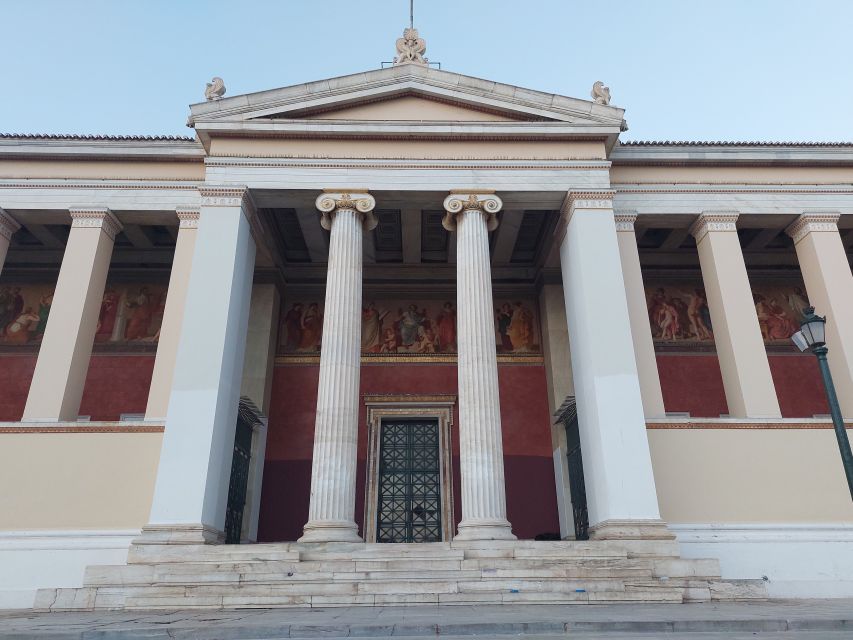
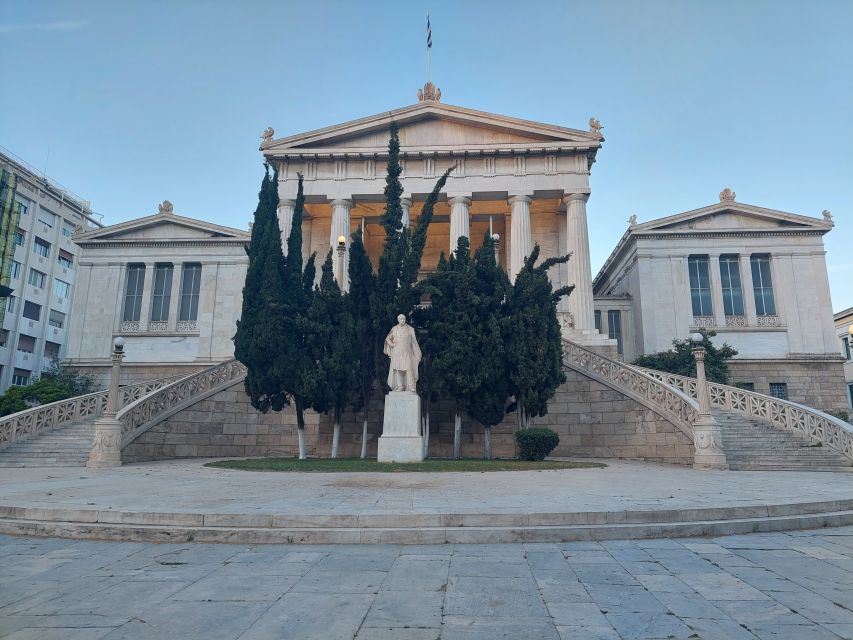
Meet your guide just below the sculpture of Panagiotis Vallianos, under the stairs of the National Library of Greece. This is a practical meeting point in central Athens, and the building itself gives the tour a suitably grand opening.
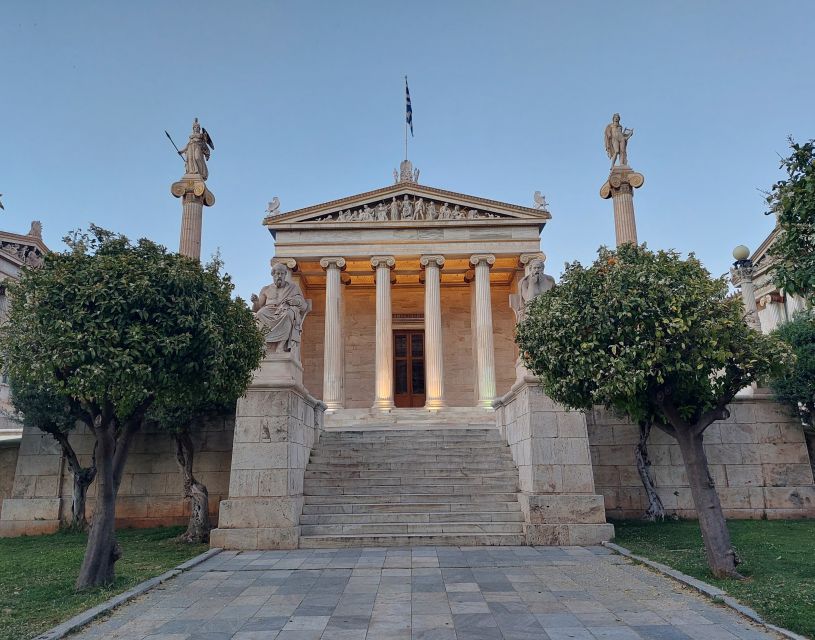
The National Library forms one part of Athens’s neoclassical trilogy. The other two buildings are the University and the Academy of Athens, which you visit early in the walk. Their formal facades help explain the city’s nineteenth-century ambition as the capital of the modern Greek state.
At night, lighting brings out columns, pediments, and stone details that can be easy to miss during a busy day. The opening section is less about entering buildings and more about reading the city from the outside. That makes the tour a good choice if you want context before visiting museums or archaeological sites on your own.
Your guide also provides the main value here. The route is familiar, but a strong explanation can turn a row of grand buildings into a story about education, government, national identity, and Greek architectural taste. Spanish-speaking guides Sara and Saraita received especially warm praise for clear explanations, useful anecdotes, and practical recommendations.
More City Highlights Walks in Athens:
- Berlin City walk Government District and Places of Democracy
★ 4.7 · 8,467 reviews - Historic Charleston Guided Sightseeing Walking Tour
★ 5.0 · 6,216 reviews - Quebec City Walking Tour
★ 5.0 · 4,716 reviews
Syntagma Square and the Evzones
From the neoclassical center, the walk continues to Syntagma Square, Athens’s main civic gathering place. The square is an important point of reference for your stay, since it connects the historic center with the Parliament, major streets, and the National Gardens.
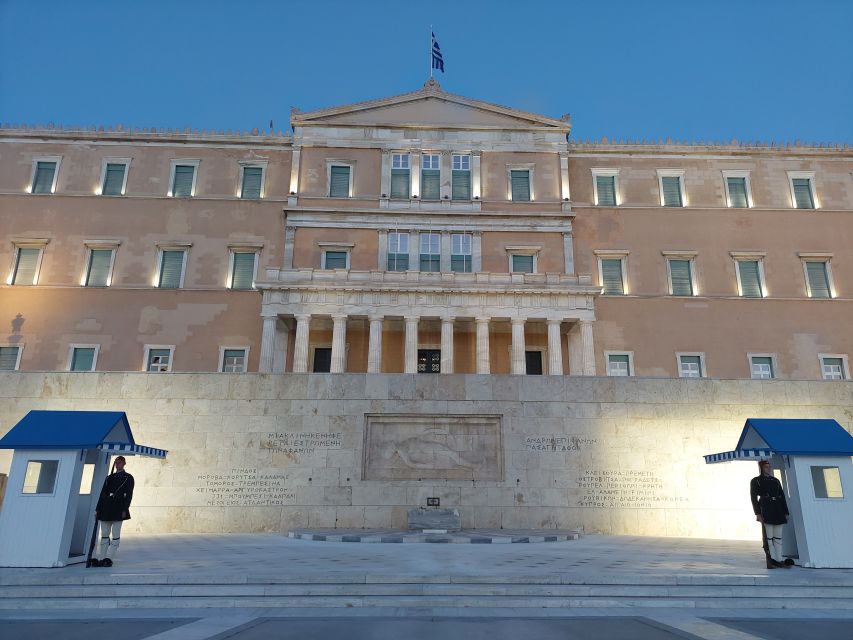
The Greek Parliament is best known here for the Evzones, the presidential guard. Their uniforms, posture, and ceremonial role offer a quick look at modern Greek national identity. Your guide can give the scene more meaning than a simple stop for photographs, especially by explaining how ancient Greek imagery and modern state traditions meet in public ceremonies.
The tour does not list a full changing-of-the-guard ceremony as part of the experience, so you should not book it specifically for that event. Instead, think of the Parliament stop as a chance to see the guards and learn why this location matters.
Syntagma is also where a guide can help you get your bearings. One Spanish-speaking participant described starting with this tour as a useful way to understand the city and collect recommendations for the rest of the visit. That is a real advantage on a first evening, when Athens can feel like a collection of separate districts rather than one connected center.
Zappeion and the modern Olympic story
The route then passes through the National Gardens to the Zappeion. The building is tied to the original Olympic Village of the modern era, adding an athletic chapter to a walk that has already covered government, education, and national culture.
This stop is worthwhile because Athens’s Olympic story has two layers. The city looks back to ancient athletic contests, yet it also helped launch the modern Olympic tradition. Zappeion represents that modern chapter, while the Panathenaic Stadium gives you a more direct visual connection to the games.
The gardens provide a change of pace from the formal avenues and crowded squares. Since this is an evening walk, the setting may feel calmer than central Syntagma, though lighting conditions can vary. Stay close to the guide and wear shoes that are comfortable for sustained walking.
Panathenaic Stadium after sunset
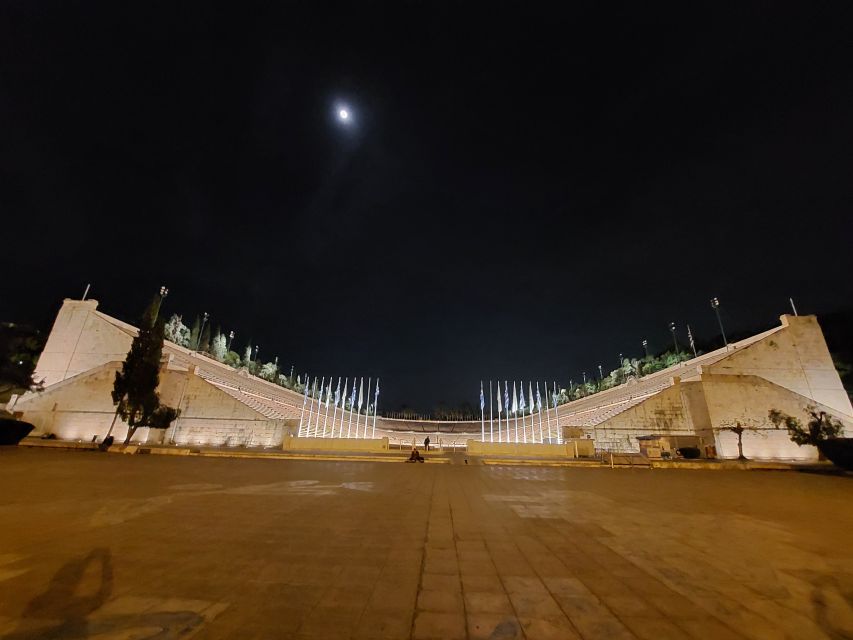
The Panathenaic Stadium is one of the route’s strongest visual stops. Built in white marble, it is immediately recognizable and looks especially striking when illuminated. The stadium is associated with the first modern Olympic Games, making it a useful place to connect the ancient past with the nineteenth-century revival of Olympic competition.
The tour focuses on seeing the stadium from the route, and attraction tickets are not included. That distinction matters. You should expect an exterior visit unless your guide explains otherwise, not a guaranteed paid entry or interior tour.
Even without entering, the stadium is easy to appreciate. Its long marble seating area and open shape make the scale clear from outside. A guide can also help you understand why this structure matters beyond its appearance. It is not simply an old stadium. It represents the way modern Greece used ancient symbols to present itself to the wider world.
If you have already paid to visit the stadium during the day, this evening stop still works well as a second look. The night setting gives you a different view, while the guide places it within the wider route.
A few more walking tours around Athens worth a look
- Athens: Acropolis and Parthenon Guided Walking Tour
★ 4.6 · 5,882 reviews - Acropolis and Parthenon Guided Walking Tour
★ 5.0 · 4,755 reviews - Greek Food Walking Tour in Athens
★ 5.0 · 4,740 reviews - Acropolis: Acropolis and Parthenon Guided Walking Tour
★ 4.7 · 3,442 reviews
Hadrian’s Arch and the Temple of Zeus
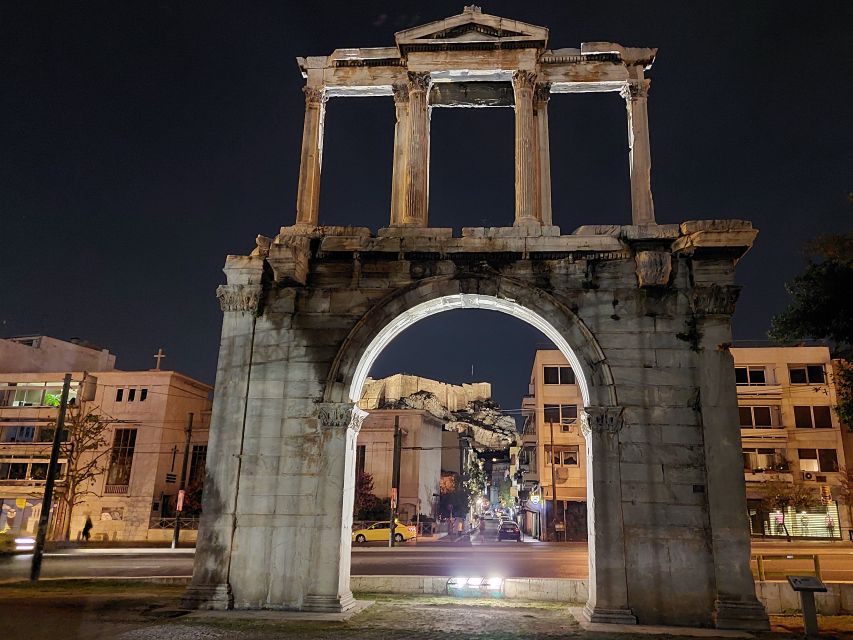
After the stadium, the walk turns toward Hadrian’s Arch and the Temple of Zeus. This is where the city’s Roman chapter comes into sharper view.
Hadrian’s Arch marks a symbolic division between old Athens and the part of the city associated with Roman expansion under Emperor Hadrian. It is a compact monument, but its location makes it useful for understanding how Athens grew beyond its earlier core.
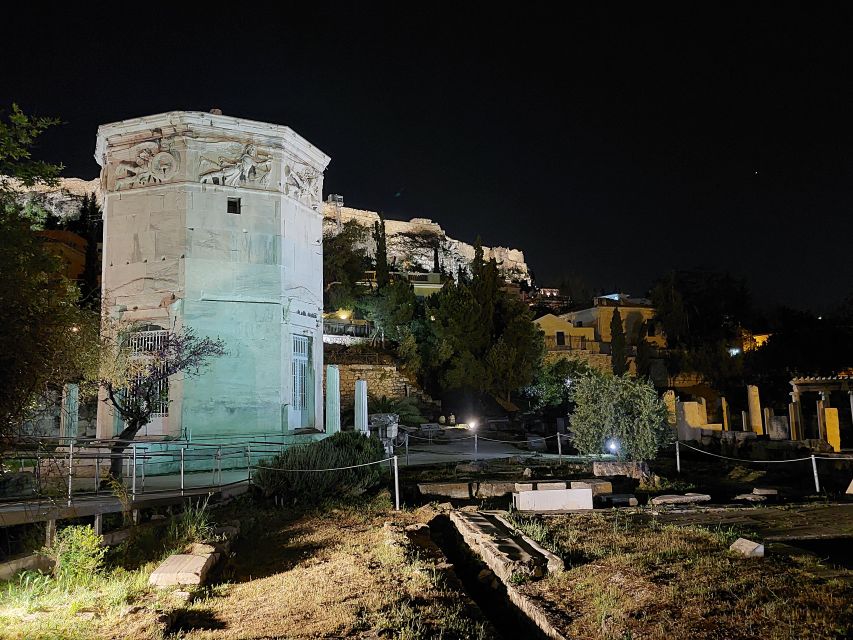
The Temple of Zeus, also known as the Olympieion, is far larger in scale. Its surviving columns hint at the size of the ancient complex without requiring you to enter an archaeological site during the tour. At night, the illuminated columns can be one of the most memorable views on the route.
This part of the walk works best if you like seeing famous monuments in context. You are not stopping at isolated postcard locations. You are following a line through classical Athens, Roman Athens, the modern Greek state, and the Olympic movement.
Keep your expectations sensible. A two-hour walk cannot provide a full archaeological lecture or detailed access to each site. It gives you a broad, well-chosen introduction, then leaves you better prepared to return during daylight if one monument catches your interest.
The Metropolitan Cathedral and Little Mitropolis
The route continues toward the Metropolitan Cathedral and the Little Mitropolis. These two churches offer a different view of Athens, moving away from ancient columns and neoclassical government buildings toward Greek Orthodox religious architecture.
The Metropolitan Cathedral is a major church in the city center. Nearby, the Little Mitropolis is much smaller and particularly notable for its compact form and historic architectural details. Seeing both in sequence lets you compare scale, purpose, and style within a short distance.
This is also one of the places where a Spanish-speaking guide can add real value. Churches often reward explanation because a visitor may not know which details matter or how the buildings fit into Greek religious life. The tour gives you a visual introduction without asking you to spend time inside a formal religious visit.
As with the other stops, the emphasis is on the outside view and the story of the place. If you want a detailed examination of church interiors, icons, or religious art, you will need additional time on your own.
Monastiraki and the Greek Agora finish
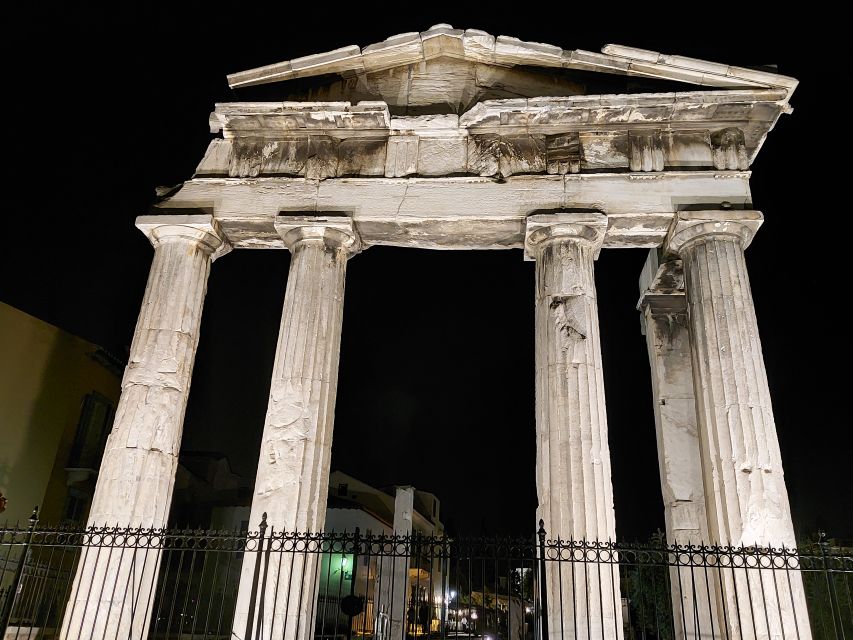
The final stretch brings you to Monastiraki Square and the Greek Agora. Monastiraki is one of the liveliest parts of central Athens, with restaurants, shops, archaeological remains, and routes leading toward the Acropolis.
Ending here is practical. You finish in an area where you can continue your evening with a meal or a walk, rather than being left far from the center. The location also gives the tour a strong final view, with the Acropolis rising above the city.
The Greek Agora provides a fitting close because it brings the route back to ancient Athens. From this point, the city’s layers are easy to see: classical ruins, Roman monuments, Orthodox churches, neoclassical buildings, and modern public squares all sit within a relatively compact area.
The word vibrant is often used too easily for Monastiraki, but here the evening energy is part of the appeal. It can also mean more people, more street noise, and less quiet around the final stop. If you want an intimate archaeological experience, this is not that. If you want a lively end with an Acropolis view, it works well.
What $28 gets you
At $28 per person, this tour offers fair value for a two-hour guided introduction to central Athens. You are paying for a live Spanish-speaking guide and a carefully connected route, not for museum access or private transportation.
The value is strongest when you are new to Athens. A guide helps you understand where the main districts sit, which monuments belong to which period, and how to plan the next day. The tour can save you from seeing the city as a string of unrelated photo stops.
It is less useful if you have already spent several days studying Athens or visiting most of these locations with a private guide. You may find the route familiar, though the nighttime lighting and Spanish commentary can still make it worthwhile.
The price does not cover entry tickets. That keeps the base cost low, but you should budget separately if you plan to return inside the Panathenaic Stadium, the Temple of Zeus area, or another paid attraction. The tour itself is primarily an exterior walking experience.
How the guide affects the experience
The guide matters a great deal here because the tour covers many sites in a short time. In two hours, you need someone who can keep the walk moving while explaining enough to make each stop meaningful.
Sara is specifically praised for her anecdotes, clear explanations, and practical suggestions. Saraita is also singled out for being professional and especially effective with a Spanish-speaking group. One couple noted that the Spanish format allowed both partners to follow the information comfortably, which is useful for mixed-language groups.
You should still understand that guide styles vary. The activity includes a Spanish-speaking live guide, but a particular person cannot be guaranteed from the information available. The strong guide feedback suggests that the commentary is a major reason to choose this tour, but the exact tone and pace may depend on who leads your group.
Who should book this evening walk
I would choose this tour if you are visiting Athens for the first time, want a quick orientation, and prefer learning through stories rather than reading plaques alone. It is also a good fit if Spanish is your preferred language and you want to ask questions without translating as you go.
The route suits couples, friends, and families with older children who can manage two hours of walking. History lovers will appreciate the sequence from neoclassical Athens to the Evzones, Olympic landmarks, Roman monuments, churches, Monastiraki, and the Acropolis.
You may want something else if you need wheelchair access, dislike walking after dark, or want extended time inside archaeological sites. This is not a hop-on, hop-off ride, a private tour, or a ticketed site visit. It is a guided street-level introduction.
Bring water and comfortable shoes. You should also check the available start time when booking, since the exact departure time can vary.
Should you book it?
Book this tour if you want an affordable first evening in Athens with Spanish commentary, strong landmark coverage, and a guide who can connect ancient, Roman, Orthodox, Olympic, and modern Greek themes.
Skip it if you want interior access, a private group, or a slow archaeological study. For most first-time visitors who have two hours free, the route gives you a useful city framework and a pleasant night walk for $28. The combination of the Acropolis view at the end, the Olympic sites, and the highly praised Spanish guides makes it a sensible way to begin your Athens stay.
FAQ
How long is the Athens nighttime walking tour?
The tour lasts two hours.
What language is the tour conducted in?
The live tour guide speaks Spanish.
Where does the tour begin?
Meet the guide below the sculpture of Panagiotis Vallianos, under the stairs of the National Library of Greece.
Where does the tour end?
The tour ends in the Greek Agora near Monastiraki Square, with views of the Acropolis.
What landmarks are included?
The route includes the National Library of Greece, the University, the Academy of Athens, Syntagma Square, the Greek Parliament, the Evzones, Zappeion, the Panathenaic Stadium, Hadrian’s Arch, the Temple of Zeus, the Metropolitan Cathedral, the Little Mitropolis, Monastiraki Square, and the Greek Agora.
Does the tour include attraction tickets?
No. Attraction tickets are not included.
Is the tour suitable for wheelchair users?
No. The activity is listed as not suitable for wheelchair users.
What should I bring?
Bring comfortable shoes and water.
How much does the tour cost?
The listed price is $28 per person.
Can I cancel the booking?
You can cancel up to 24 hours in advance for a full refund. You can also reserve the tour and pay later.
Just added around Athens
- Eat Your Way Through Athens: A Local Food Walk★ 4.9 · 97 reviews
- Athens: The Acropolis Guided Walking Tour in Dutch★ 4.9 · 107 reviews
- Athens: Women in Ancient Greece Guided Walking Tour★ 5.0 · 86 reviews
- Athens: The Acropolis Walking Group Tour with a French Guide★ 4.7 · 469 reviews
- Athens: The Acropolis Guided Walking Tour in German★ 5.0 · 362 reviews
- Athens: Private Walking Tour with a Local★ 4.5 · 93 reviews
- Athens: Evening Food Walking Tour★ 4.9 · 422 reviews
- Athens: Greek Food Discovery Small Group Walking Tour★ 4.9 · 336 reviews
City Highlights Walking Tours, compared.

Berlin City walk Government District and Places of Democracy
Read our review →
Historic Charleston Guided Sightseeing Walking Tour
Read our review →
Oxford: University and City Walking Tour with Alumni Guide
Read our review →
City Highlights Temple and Market Walking Tour
Read our review →
A History of Terror – Belfast City Centre Walking Tour
Read our review →Browse the lists this tour appears in