

REVIEW · ATHENS
Acropolis: Acropolis and Parthenon Guided Walking Tour
The best part of this Athens tour is the steady climb through the Acropolis monuments, not just the final look at the Parthenon. You begin at the Theatre of Dionysus, pass the Odeon of Herodes Atticus, and learn how this rocky hill shaped drama, religion, politics, and the image of classical Greece. I especially like the archaeologist-led storytelling and the wireless hearing devices, which help you follow the guide in a crowded place.
The main drawback is the setting itself. The Acropolis can be hot, exposed, steep, and packed with other groups. The tour lasts about two to four hours, depending on the option you choose, so you need comfortable shoes, water, sunscreen, and a sun hat. Ticket availability can also be tight, making the ticket-included option the safer choice.
Key points to know before booking
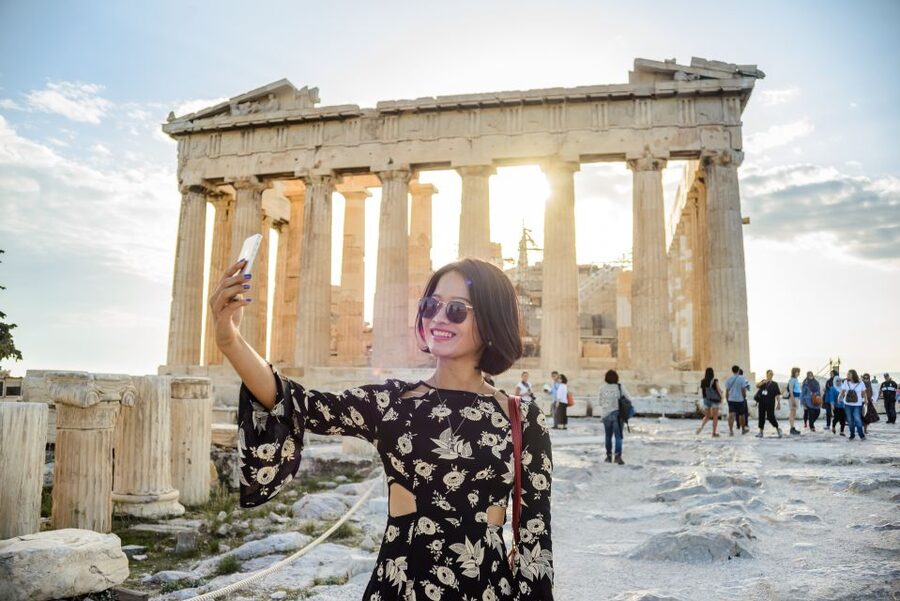
- The route covers the major Acropolis sights: Theatre of Dionysus, Asklepieion, Odeon of Herodes Atticus, Temple of Athena Nike, Propylaea, Erechtheion, and Parthenon.
- Your guide shapes the experience: Guides named in guest feedback include John the archaeologist, Hermes, Anna, Artemis, Alexia, Anastasia, Aphrodite, and Joanna.
- The 8:30 morning departure is smart: Early visits can become busier as the morning goes on.
- Tickets need careful attention: Choose the ticket-included option if you do not already have a confirmed Acropolis entry.
- The Acropolis Museum is optional: It is included only with the selected museum option, with skip-the-line museum entry for that choice.
- Expect a real uphill walk: The route is not suitable for wheelchair users and has little shade.
Why this Acropolis walk works well
The Acropolis is easy to admire and surprisingly easy to misunderstand. You can walk up, take photographs, and leave with the Parthenon in your camera roll. A guide gives the stones a human story. You learn why the Theatre of Dionysus mattered, how temples expressed civic pride, and why the Acropolis still carries such force in modern Athens.
This is a classic guided walking tour rather than a private archaeological seminar. You follow a set route with a live guide and a group, stopping at the main monuments for explanations. That format suits a first visit, especially if you have only one or two days in Athens and want the essential sites explained in a compact morning or afternoon.
The tour receives a 4.7 rating from 3,442 reviews, and the strongest praise centers on the guides. John is repeatedly singled out for his humor and command of the subject. Hermes is praised for adding cultural context and keeping the group entertained. Anna, Artemis, Alexia, Anastasia, Aphrodite, and Joanna also receive warm comments for clear explanations, friendly pacing, and good storytelling.
Guide quality can vary from one departure to another, as it does on any group tour. The useful point is that this company has a deep bench of guides who appear comfortable with both archaeological facts and the practical problem of moving a group through a crowded ancient site.
More Guided Tours in Athens:
- Athens: Acropolis and Parthenon Guided Walking Tour
★ 4.6 · 5,882 reviews - Acropolis and Parthenon Guided Walking Tour
★ 5.0 · 4,755 reviews - Athens: Guided Greek Food Walking Tour with Tastings
★ 4.9 · 2,859 reviews
Starting at Porinou 5 near the Acropolis Metro
You meet at the Athens Walks office at Porinou 5, only about a two-minute walk from the Acropolis metro station. That is a very convenient starting point. You do not need to cross central Athens searching for a distant hotel pickup, and the nearby metro makes the meeting point simple to reach.
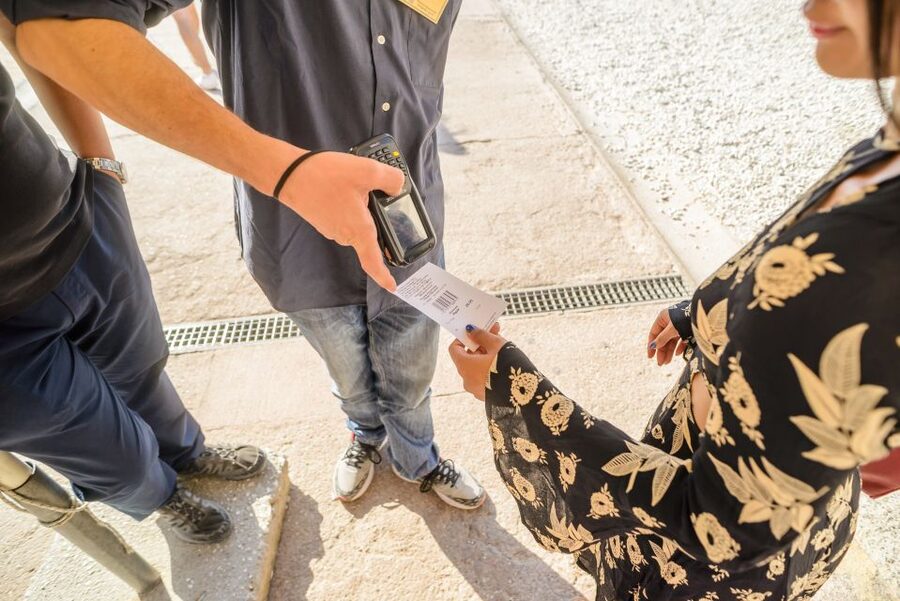
The office handles the initial organization, including tickets and group assembly. That matters at the Acropolis, where several tour groups can gather near the entrances and a delayed ticket issue can cause stress. One guide was able to resolve a ticket problem with a phone call to the office, which suggests that the local team can help when something goes wrong.
Still, arrive early. The Acropolis is not a place where you want to sprint to catch up with a group. Bring your passport or identity card, especially if you may qualify for a reduced ticket. Visitors under 25 years old should bring a passport photo or a photograph of the passport for eligibility checks.
There is no hotel pickup or drop-off. Food and drinks are not included, so eat before the walk or plan something for afterward. Large bags and luggage are not allowed, and pets and smoking are prohibited.
Theatre of Dionysus: where the tour finds its voice

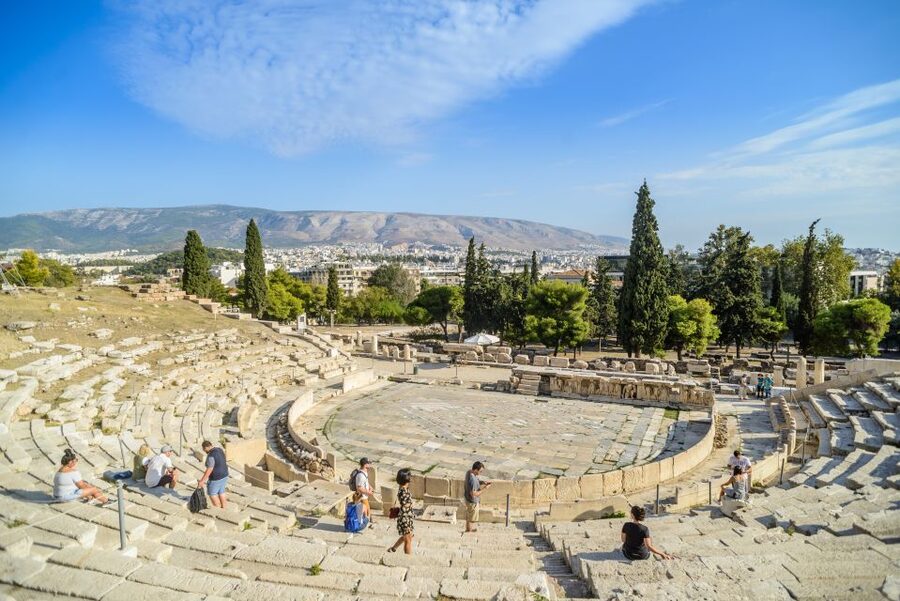
The route begins with a 15-minute walk to the Theatre of Dionysus, often treated as a warm-up stop before the main ascent. It deserves more attention than a quick photograph. This is the birthplace of Greek drama and the oldest Greek theatre still in existence.
Your guide explains how performances worked and why theatre mattered to ancient Athenian society. As you look across the stone seating, it becomes easier to picture drama as a civic event rather than a private evening out. Thousands could gather here, and plays were tied to religious festivals and public life.
This is one of the tour’s best early stops because it gives you a cultural key for the rest of the visit. The Acropolis was not only a collection of temples. It was part of a city that argued, worshipped, performed, competed, and built monuments to show its place in the Greek world.
Asklepieion and the Odeon of Herodes Atticus
The next stop is the Asklepieion of Athens, covered in about ten minutes of guided explanation. This sanctuary was linked to healing, adding another layer to the Acropolis complex. It helps you see the hill as a sacred zone with several purposes, not simply the home of one famous temple.
After that comes the Odeon of Herodes Atticus, with about 15 minutes devoted to the site. Its curved stone structure is still one of the most striking features on the southern slope. The tour gives you time to understand its place in ancient performance culture before you continue uphill.
The Odeon is also a good reminder that the Acropolis has a long life beyond classical Athens. The monument belongs to a later period than the main fifth-century structures, so the route quietly shows how the hill kept being used and reshaped over time.
The pace here is useful. Guides make stops along the way instead of treating the climb as one long push. Joanna is praised for choosing pauses that made the ascent feel manageable. Do not mistake manageable for effortless, though. You are walking uphill over an uneven ancient site, often under direct sun.
A few more walking tours around Athens worth a look
- Greek Food Walking Tour in Athens
★ 5.0 · 4,740 reviews - Acropolis monuments & Parthenon Walking Tour with Optional Acropolis Museum
★ 5.0 · 2,678 reviews - Athens Acropolis and Parthenon Walking Tour
★ 4.5 · 1,355 reviews - Acropolis, Parthenon & Athens Old City Heritage Walking Tour
★ 4.5 · 876 reviews
Temple of Athena Nike and the Propylaea
The Temple of Athena Nike receives roughly ten minutes of attention. It is a small temple, especially when compared with the Parthenon, but its position near the entrance makes it an important first statement. The guide explains its connection to Athena and victory, giving the approach a sense of purpose.
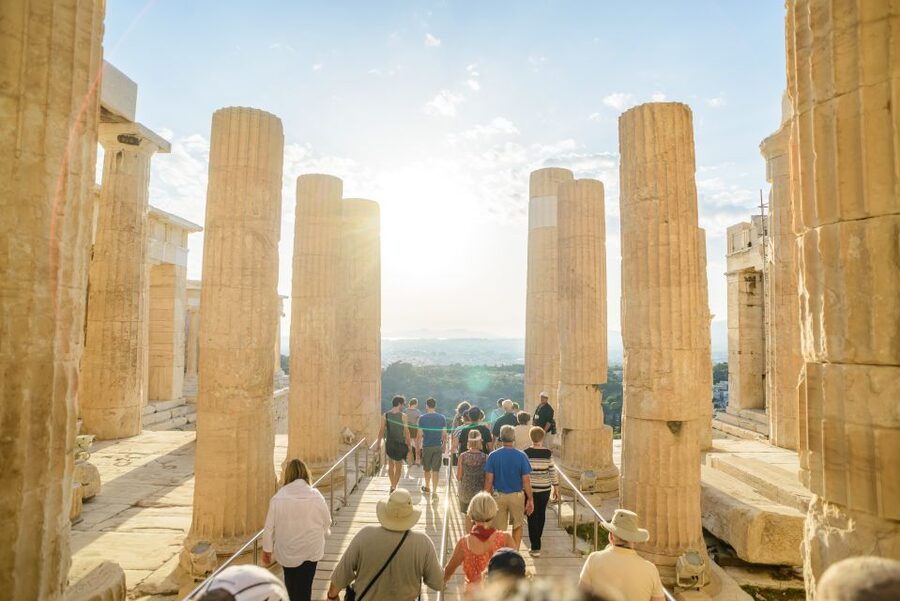
Then you reach the Propylaea, the monumental gateway to the upper Acropolis. Allow about 15 minutes here. The scale, symmetry, and approach make it one of the places where the ancient builders’ ambition becomes clear before you even reach the main temples.
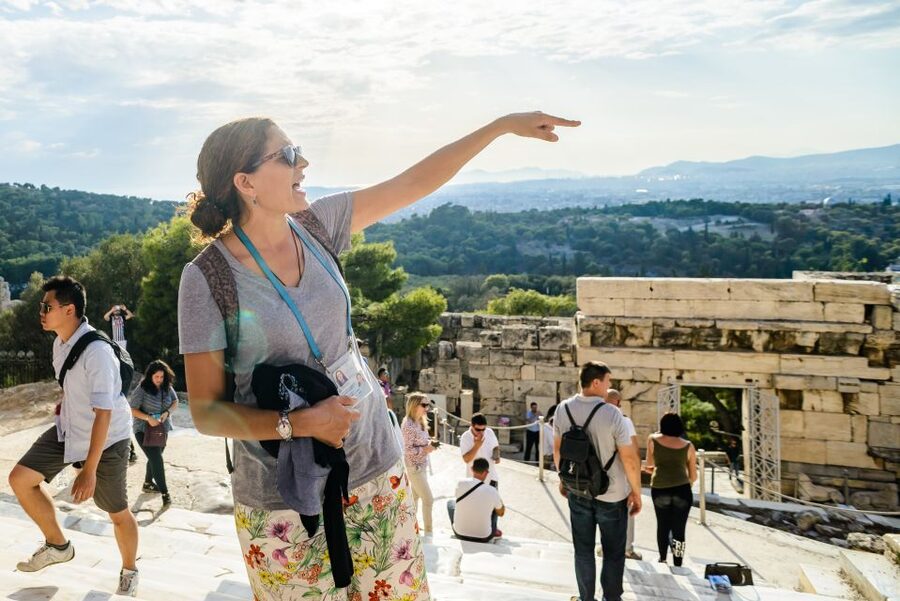
This is also where the tour becomes more physically demanding. The route passes through a major gateway and continues across the summit area, where surfaces can be uneven and crowds can compress the walking space. Keep close enough to hear your guide and watch your footing.
The wireless hearing devices are a real help. They allow the guide to speak without shouting, and they let you look at the architecture while listening. One point to keep in mind: the devices work best when you remain close to the guide. In a crowded group, drifting several meters behind can make the audio less clear.
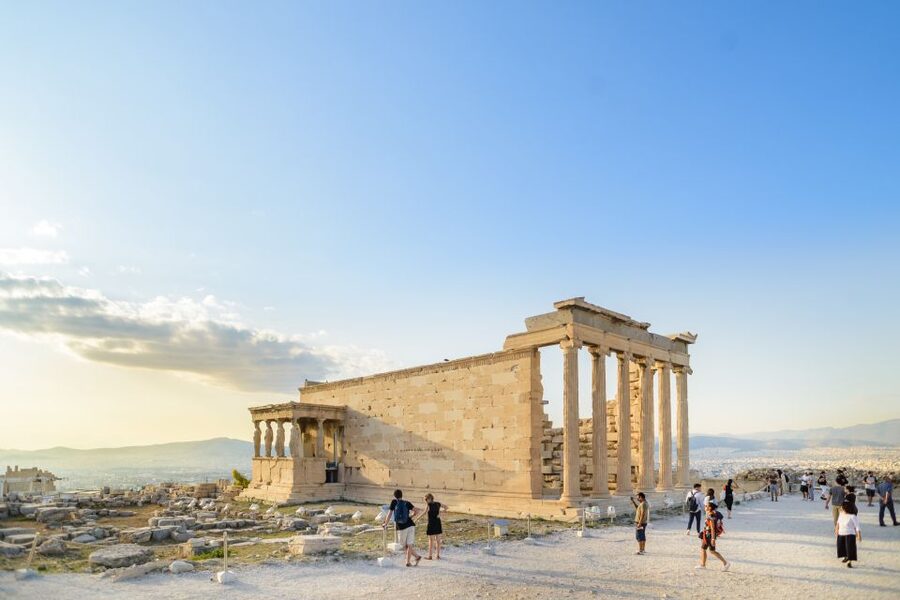
Erechtheion and the famous Caryatids

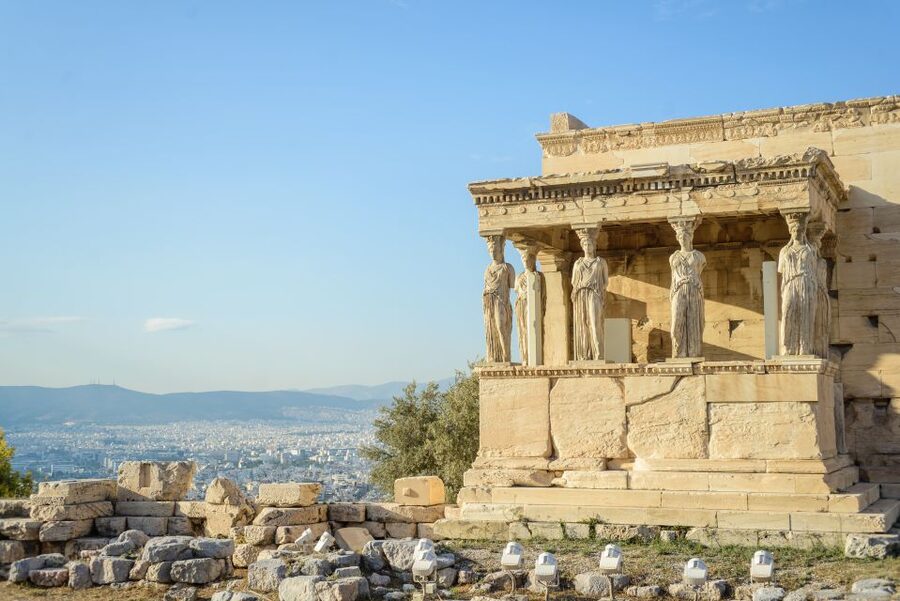
The Erechtheion is one of the most rewarding stops because it is less straightforward than the Parthenon. Its design is unusual, and its sacred stories connect several figures from Greek mythology. The guide explains the contest between Athena and Poseidon for the patronage of Athens, a story that helps explain why this place mattered so much to the city.
The Caryatids are the visual highlight. These sculpted female figures serve as architectural supports, each with a distinct stance and presence. Your guide can point out the design and the legends tied to the building instead of leaving you with only the familiar image.
This stop rewards attention to detail. The Parthenon is grand and immediately legible. The Erechtheion asks you to look more closely at its arrangement, its sacred associations, and the way practical structure and religious meaning meet.
The Parthenon in a 30-minute final stop
The Parthenon receives the longest stop, about 30 minutes, and rightly so. It was built as a sanctuary for Athena and became a symbol of Athens’ power, wealth, and influence in the ancient Greek world.
A good guide shifts your gaze from the overall outline to the care built into the structure. The tour focuses on the architects’ precision and the building’s purpose, rather than reducing it to a famous ruin. You get time to study the facade, listen to the explanation, and take in the scale of the monument.
The Parthenon is not preserved as an untouched ancient building. Damage, later use, and ongoing restoration are part of what you see. The tour’s value is in giving those visible remains a setting in time, so you can understand both the original ambition and the incomplete condition today.
The summit also gives you the broad views promised by the tour. Athens spreads below the Acropolis, and the contrast between ancient stone and present-day city is one of the visit’s strongest moments. Plan to pause here mentally, not only photographically. The view helps explain why the hill has remained the defining sight of Athens.
Should you add the Acropolis Museum?
The standard route described here ends with the Acropolis monuments, while the museum is available only if you select that option. The museum version includes a guided visit in English and skip-the-line entry to the museum.
Adding it makes sense if you want more than the outdoor ruins. The hill shows the buildings in their original setting, while the museum option gives you a chance to continue the story indoors with archaeological material connected to the Acropolis. Anastasia is praised for maintaining a manageable pace during both the hill visit and the museum tour, and another guide, Artemis, led visitors through the added museum experience after the Acropolis.
Check the exact option before booking. The details say the selected museum version ends at the Acropolis Museum, while the general meeting information says the activity ends back at the meeting point. The safest approach is to confirm the endpoint shown for your chosen departure and option.
Price, tickets, and real value at $36.14
At $36.14 per person, this is a reasonable price for an expert-led visit to Athens’ most important ancient site, especially if the cost includes the Acropolis entry ticket. You are paying for more than admission. The guide provides the context, the office handles the meeting process, and the wireless devices make it easier to hear explanations in a busy setting.
The price becomes harder to judge if you choose an option without entry tickets and still need to secure admission yourself. Availability can be limited, and the tour specifically warns that Acropolis entry times may sell out. I would choose the ticket-included option unless you already bought an official ticket for the correct date and time.
The tour also offers reserve now and pay later, plus free cancellation up to 24 hours before the activity. Those policies are useful if your Athens schedule is still shifting, but the bigger practical benefit is securing a place at a suitable time.
The best time, pace, and preparation
An early departure is the most appealing choice. An 8:30 tour can begin before the site becomes as crowded, and conditions are usually kinder before the strongest heat of the day. One morning departure became busier as it continued, which is a good reason to choose the earliest available time if your schedule allows.
The afternoon can still work, particularly if the morning is unavailable. Just remember that the Acropolis offers limited shade and the walk includes an uphill section. The guide may stop regularly, but you are still on your feet for much of the experience.
Wear sturdy, comfortable shoes. Bring a sun hat, sunscreen, and water, though food and drinks are not part of the tour. Leave luggage and large bags behind. If you use a cane or have difficulty with steep, uneven ground, consider the physical demands carefully. The experience is not suitable for wheelchair users.
The tour is offered in English, French, and German. Make sure the language and ticket choice match your booking, since the Acropolis Museum guided option is specified in English.
Who should book this tour?
I would recommend it most strongly to a first-time Athens visitor, a short-stay visitor, or anyone who wants the main Acropolis sights explained in one organized walk. It is also a good fit if mythology, architecture, and ancient civic life interest you more than simply taking photographs.
Families and mixed-age groups can benefit from the regular stops and storytelling, though children still need to cope with the heat and climb. Solo visitors gain the advantage of having both company and a guide without arranging a private tour.
You may prefer a self-guided visit if you already know the ancient Greek world well, want to linger at one monument for a long time, or dislike group pacing. You should also think twice if steep walking, sun exposure, or crowded historic sites are difficult for you.
Final verdict: a strong first Acropolis visit
Book this tour if you want the Acropolis to make sense, not just look impressive. The route covers the essential monuments, the guides bring humor and myth into the explanations, and the starting point near the Acropolis Metro is easy to reach.
Choose the ticket-included option, aim for the earliest available time, and add the museum if you want a longer archaeological visit. With comfortable shoes and realistic expectations about crowds, heat, and the uphill route, this is a practical way to meet the Parthenon and understand the city built around it.
FAQ
How long does the Acropolis tour last?
The stated duration is two to four hours. The exact length depends on the starting time and the option selected, including whether you add the Acropolis Museum.
Where does the tour begin?
You meet at the Athens Walks tour office at Porinou 5, 11742. It is about a two-minute walk from the Acropolis metro station.
Does the tour include Acropolis entry tickets?
Tickets depend on the option selected. You can choose an option with entry tickets, or arrange an official ticket yourself. Buying the ticket-included option is strongly advised if you do not already have confirmed admission.
Is the Acropolis Museum included?
The museum is included only if you select the Acropolis Museum option. That option includes a guided museum visit in English and skip-the-line museum entry.
What languages are available?
Live guides are available in English, French, and German. The Acropolis Museum guided option is specified as an English tour.
What should I bring to the tour?
Bring your passport or identity card, comfortable shoes, a sun hat, and sunscreen. Large bags and luggage are not allowed, and the tour does not include food or drinks.
Just added around Athens
- Eat Your Way Through Athens: A Local Food Walk★ 4.9 · 97 reviews
- Athens: The Acropolis Guided Walking Tour in Dutch★ 4.9 · 107 reviews
- Athens: Women in Ancient Greece Guided Walking Tour★ 5.0 · 86 reviews
- Athens: The Acropolis Walking Group Tour with a French Guide★ 4.7 · 469 reviews
- Athens: The Acropolis Guided Walking Tour in German★ 5.0 · 362 reviews
- Athens: Private Walking Tour with a Local★ 4.5 · 93 reviews
- Athens: Evening Food Walking Tour★ 4.9 · 422 reviews
- Athens: Greek Food Discovery Small Group Walking Tour★ 4.9 · 336 reviews
Walking Tours, compared.

Magical London: Harry Potter Guided Walking Tour
Read our review →
Reykjavik Food Walk – Local Foodie Adventure in Iceland
Read our review →
History and Hauntings of Salem Guided Walking Tour
Read our review →
New Orleans Premier Ghost, Voodoo and Vampire Walking Tour
Read our review →
Amsterdam Anne Frank: Small-Group Walking Tour & Local Guide
Read our review →

Edinburgh Castle: Guided Walking Tour with Entry Ticket
Read our review →
Anne Frank’s Story – Guided Walking Tour through Amsterdam
Read our review →Browse the lists this tour appears in