
REVIEW · DRESDEN
Historic Dresden Small-Group Walking Tour in English
Dresden’s story comes into focus on foot: royal ambition, wartime destruction, Communist-era change, and careful rebuilding all appear within a few city blocks. This two-hour English walking tour links the city’s grandest sights with the smaller details that are easy to miss alone.
I like the small maximum of 15 people, which gives you a better chance to ask questions and stay close to the guide. I also like the route’s balance: you get famous landmarks such as the Zwinger and Frauenkirche, plus quieter corners such as the Stallhof and a well-placed view over the Elbe.
The main drawback is sound. A group of 15 can be hard to hear in an open square, and one unusually large group reached about 18 people. There are also stairs, although the walk is not especially demanding for most people.
Key points to know before you book
- The route covers Dresden’s essential old town sights: Theaterplatz, the Zwinger, Royal Palace, Stallhof, Fürstenzug, cathedral, Brühl’s Terrace, Neumarkt, and Frauenkirche.
- The focus is on context, not museum entry: You see palace courtyards and exteriors, then receive advice on which paid collections are worth visiting later.
- The guide makes the difference: Laura, Leo, Christina, Doris, Karen, Robert, Helga, and Marion have all led tours praised for clear English, lively stories, and personal insight.
- The group is usually capped at 15: That is small enough for questions, but ask to stay near the guide if the square is noisy.
- The tour ends near Frauenkirche: You can continue into the church, visit its crypt exhibition, eat nearby, or explore Dresden on your own.
- The price is reasonable for a useful orientation: At $30.25 per person, you are paying for a licensed professional guide and a focused introduction rather than museum admission.
Why this Dresden walk works so well
Dresden’s center can look almost too polished at first. Broad squares, pale sandstone buildings, domes, courtyards, and palace façades give the city a grand appearance. The trouble is that a quick walk through the center can leave you with pretty pictures but little sense of what happened here.
This tour gives those buildings a timeline. You learn about Saxony’s rulers, the ambitions of Augustus the Strong, the destruction of Dresden, the rebuilding of its old center, and the changes since German reunification. The best guides also connect the distant past with modern Dresden.
Guide quality is the strongest part of the experience. Laura is praised for her energy, clear storytelling, and ability to answer questions. Christina brings an art history background and pays attention to small details. Doris has offered useful insight into Dresden before and after reunification, while Helga has personal memories of the city from before its rebuilding.
You may also be led by Leo, Karen, Robert, or Marion. The tone can vary by person. Most descriptions point to an engaging, well-informed style, though one guide was considered a little too chatty and familiar. That is a minor concern, but it is worth knowing that the experience depends partly on who leads your departure.
More Small-Group Walking Tours in Dresden:
- Dresden: Shared Small Group Walking Tour in English
★ 4.8 · 172 reviews - Amsterdam Anne Frank: Small-Group Walking Tour & Local Guide
★ 4.8 · 12,789 reviews - Boston: Freedom Trail History Small Group Walking Tour
★ 5.0 · 6,450 reviews
Theaterplatz puts Dresden’s grand story in one frame
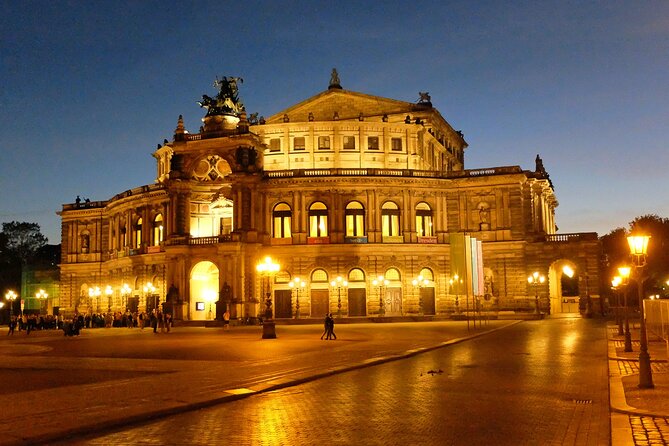
The tour begins at Schloßplatz in Dresden’s old town, close to the main historic sights. The first major stop is Theaterplatz, a superb place to understand how the city’s cultural and royal center fits together.
The Semper Opera House dominates the square with its elegant 19th-century design. Nearby are the Zwinger, the former royal residence, and the Dresden Cathedral. From here, your guide can also point out the Old Masters Gallery, helping you connect the outdoor route with the collections you might visit later.
The useful part is not simply learning the names. You see how tightly packed Dresden’s major institutions are. Opera, royal power, Catholic worship, art, and court ceremony all occupied this small area.
Allow about 15 minutes here. Theaterplatz is open and exposed, so stay close if the group is large or the square is busy. This is also a good early moment to ask how the tour will handle questions, since some guides are especially generous with them.
The Zwinger reveals Augustus the Strong’s taste for spectacle
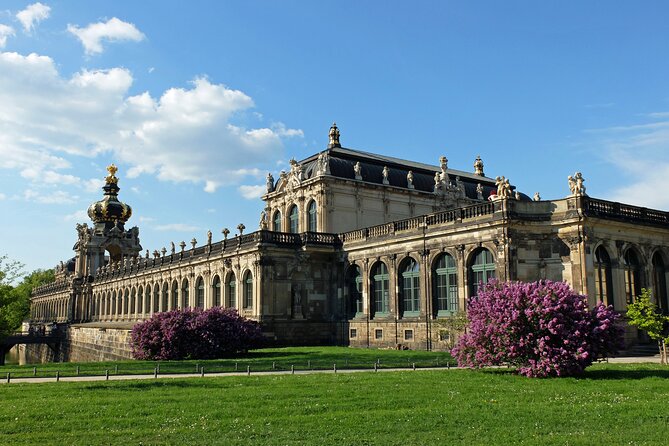
The Zwinger is more than an ornate palace complex. It was designed as a single sculptural setting and intended to serve as the grand entrance to a new royal palace that was never completed.
That unfinished plan tells you something about Augustus the Strong, the Saxon ruler who commissioned it. He wanted Dresden to project wealth, taste, power, and pleasure. The Zwinger was built for court celebrations and elaborate festivities, and its courtyards, galleries, sculpture, and decorative details still reflect that theatrical purpose.
Your guide will explain how the building worked as a stage for royal life. Look closely rather than rushing through for a wide photograph. Small details carry much of the story.
If conditions and opening hours allow, the guide may show you an open-air grotto tucked away from the usual view. This is not guaranteed, but it adds a pleasant surprise to the stop.
The tour does not include admission to the Zwinger museums. That is sensible for a two-hour walk, since entering would take the group away from the route. Ask your guide about the Old Masters Gallery or other collections if you plan to return later.
The Royal Palace courtyard connects war, fire, and royal treasure
The Residenzschloss, or Royal Palace, has been built, burned, repaired, extended, and rebuilt more than once. Its appearance is not a single clean architectural statement. It is an architectural record of Saxony’s rulers and the damage Dresden endured.
You walk through one of the courtyards rather than entering the museum. Look for the Renaissance sgraffito decoration, a painstaking technique in which layers of plaster are scratched to reveal contrasting designs beneath. It rewards a slower glance, especially when your guide points out how the surface work differs from ordinary painted decoration.
Inside the palace are major collections of royal treasures, but admission is not part of this walking tour. That limitation can actually help you choose wisely. Instead of trying to squeeze a museum visit into the walk, you get practical advice about which exhibits deserve your time and what kind of ticket to buy.
If you have only one day in Dresden, this advice matters. The palace collections can take much longer than a casual visit, and your interests may determine which rooms are most worthwhile.
A few more walking tours around Dresden worth a look
- Dresden: City & Semperoper Guided Walking Tour
★ 4.8 · 2,397 reviews - Dresden: Guided City Walk
★ 4.6 · 2,075 reviews - Dresden: Complete Walking Tour with Frauenkirche Visit
★ 4.8 · 700 reviews - Dresden: Walking Tour with a Night Watchman including a Meal
★ 4.5 · 535 reviews
Stallhof offers a quieter look at court life
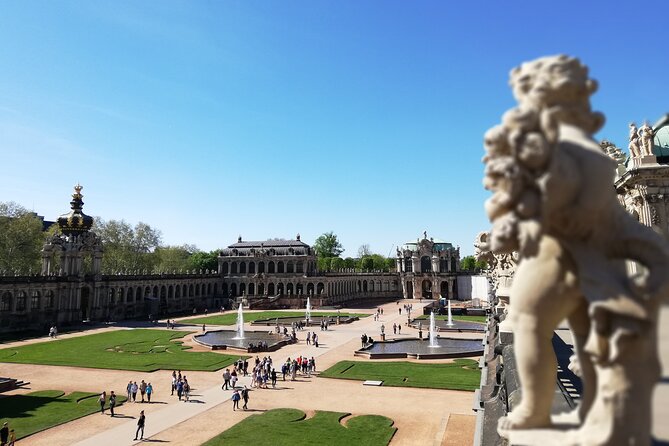
Behind the Royal Palace, the Stallhof feels more enclosed and personal than Theaterplatz or the Zwinger. This Renaissance courtyard was used for jousting tournaments and royal celebrations.
Arcaded galleries and sandstone columns frame the space. The scale makes it easier to imagine ceremonies and contests than it is in the larger squares. You are likely to spend only about five minutes here, but it is one of the route’s useful pauses.
I like this stop because it breaks up the grand sequence of façades. Dresden can sometimes feel like one monumental building after another. The Stallhof gives you a smaller setting and a clearer sense of how court life played out behind the public face of the palace.
The Fürstenzug is Dresden’s outdoor history book

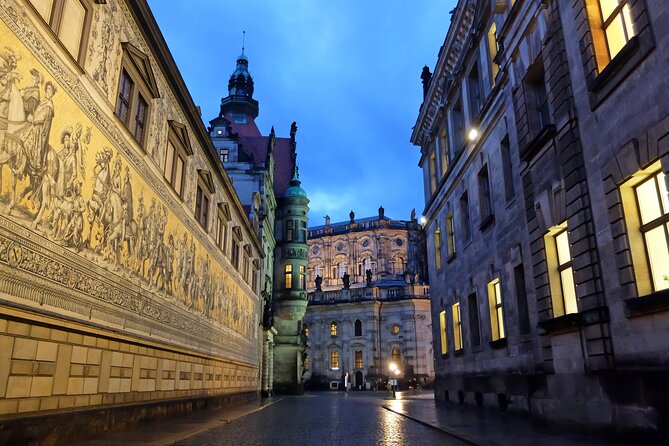
One of the route’s most memorable details is the Fürstenzug, or Procession of Princes. This outdoor porcelain mural is about 100 meters long and made with roughly 24,000 tiles.
The mural presents Saxon rulers in procession, but your guide will also point out stories and details hidden within the artwork. Do not simply walk past it while looking at the overall line. Give your eyes time to follow the figures and look for the small elements your guide identifies.
The use of porcelain is especially fitting in Dresden, a city strongly linked with Meissen porcelain. The mural’s size makes it easy to appreciate from a distance, while the smaller details reward close attention.
This is a place where a guide adds real value. Without explanation, you see a long decorative wall. With context, you begin to understand who is depicted and why the work matters to Dresden’s public identity.
The cathedral shows the religious tension of Saxony
The Dresden Cathedral is an unusual part of the route because it reflects a religious contradiction. It was built secretly by a Catholic ruler in Protestant Saxony and served as the court church.
Your guide explains its role and points out features that are easy to miss from outside. The cathedral is also one of the burial places of Saxony’s royal family.
The tour views the building from outside, so plan to return later if you want to see the interior. That is not a flaw in this format. The walk is meant to give you a map and a story, not replace every indoor visit.
Brühl’s Terrace opens the view toward the Elbe

Brühl’s Terrace is known as the Balcony of Europe, and the nickname makes sense once you reach the top of the stairs. From here, you can look over the Elbe River and take in the wider setting of Dresden.
Guides point out the river, the White Fleet’s historic steam boats, buildings along the water, church steeples, and distant wine slopes. The view helps you understand that Dresden is more than its reconstructed center.
This is also a useful planning stop. You get an idea of what lies beyond the main old town and can decide if you want to explore the riverbanks, take a boat trip, or visit areas beyond the central monuments.
There are stairs here, so the walk is not completely level. Still, one guide described the pace as manageable for older adults, and the route is not considered strenuous. Wear shoes suitable for ordinary city walking and allow a little time to pause at the viewpoint.
Neumarkt and Frauenkirche tell the hardest story
The tour usually finishes around Neumarkt, the square anchored by the Frauenkirche. Its baroque façades have been restored to recall Dresden before World War II, but the square’s appearance cannot be separated from the city’s destruction.
The Frauenkirche was reduced to rubble and remained that way for decades. Its reconstruction became a powerful symbol of Dresden rising again, with international support helping return the church to the center of city life.
A good guide does not treat this only as a triumphant rebuilding story. The setting also invites questions about wartime destruction, memory, responsibility, and reconciliation. The church’s rebuilt dome is beautiful, but the meaning goes beyond architecture.
After the tour, you can enter the Frauenkirche on your own, sit quietly inside, and visit the crypt. A small exhibition there explains the rebuilding process. The square also offers German, Saxon, and international food, making this a practical place to continue your afternoon.
What $30.25 buys you
At $30.25, this is not the cheapest way to see Dresden. Free walking tours exist, and you can visit many exteriors without paying anything. The value here is the guide’s training, the smaller group, and the chance to ask questions rather than simply follow a flag through the center.
The tour company says its guides are licensed and members of the German Guides Association, with continued training. That matters if you want more than surface-level facts. The strongest guide accounts describe clear English, good pacing, personal stories, and a strong grasp of Dresden before and after reunification.
The price does not include museum tickets or gratuities. You are buying two hours of guided orientation, not entry to the Zwinger museums, Royal Palace collections, cathedral, or Frauenkirche.
For a first morning or afternoon in Dresden, I think the price is fair. You can then spend your remaining time on the places that match your interests instead of guessing which buildings deserve a closer look.
Group size, weather, and hearing the guide
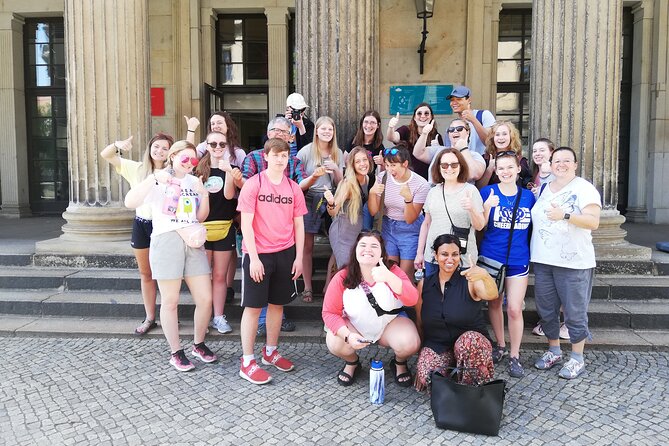
The normal maximum is 15 people, and that is an important feature. Small groups make it easier to ask about a detail, adjust the pace, or speak directly with the guide.
Still, the group size can affect sound. One group had about 18 people because delayed train passengers were accommodated, and another group found it difficult to hear in the open streets. Headsets are not provided.
If you have trouble hearing, stay near the guide and raise the issue early. This is especially useful in Theaterplatz and around the palace buildings, where open space and passing visitors can spread the group out.
The tour runs in rain as well as pleasant weather. A guide kept a group engaged during cold rain, but Dresden’s squares offer limited shelter. Check the forecast, wear suitable shoes, and bring a coat. Free cancellation is available up to 24 hours before the start time, but late cancellations are not refunded.
Who should book this walk
I would choose this tour if you are visiting Dresden for the first time and want the old town to make sense before choosing museums. It also suits anyone interested in royal history, architecture, World War II, reconstruction, German reunification, or the relationship between art and power.
It is a good fit for older walkers who want a steady, manageable route with regular stops. The stairs at Brühl’s Terrace are the main point to note.
You may want something else if you prefer to spend two hours inside museums, need guaranteed audio equipment, or dislike group walks in open city squares. This tour is also less useful if you already know Dresden’s central sights well.
Should you book the Historic Dresden Small-Group Walking Tour?
Book it if you want a clear introduction to Dresden from a trained English-speaking guide, with enough time for questions and advice about what to see next. The combination of Zwinger, royal courtyards, Fürstenzug, cathedral, river view, and Frauenkirche gives you a strong first look at the city.
Choose an early place in the group and stay close to the guide, especially if the full 15 people attend. If you enjoy the walk, return afterward to the Frauenkirche or a Royal Palace collection. That is where this tour earns its keep: it gives you the story first, then helps you spend your limited sightseeing time wisely.
FAQ
How long is the Historic Dresden Small-Group Walking Tour?
The tour lasts approximately two hours.
What language is the tour offered in?
The tour is offered in English.
Where does the tour begin?
It begins at Schloßplatz, 01067 Dresden-Altstadt, Germany.
Where does the tour end?
The activity ends back at the meeting point, although the tour usually finishes around Neumarkt and the Frauenkirche according to the route description.
What sights are included?
The route includes Theaterplatz, the Dresden Zwinger, the Royal Palace courtyard, Stallhof, the Fürstenzug mural, Dresden Cathedral, Brühl’s Terrace, Neumarkt, and the Frauenkirche from outside.
Are museum tickets included?
No. Museum admission is not included. The tour does not enter the Royal Palace museum, and the guide can offer advice about collections and tickets for a later visit.
How many people can join the tour?
The maximum is 15 travelers.
Is the walk suitable for most people?
Most people can participate. There are some stairs, especially around Brühl’s Terrace, but the walking is not considered especially demanding.
Are service animals allowed?
Yes, service animals are allowed.
Can I cancel for a full refund?
Yes, if you cancel at least 24 hours before the experience start time. Cancellations made less than 24 hours in advance are not refunded, and the activity requires a minimum number of participants.
Just added around Dresden
- Walking Through Dresden’s Past with Dr. Fraser Macdonald★ 5.0 · 72 reviews
- Dresden: Shared Small Group Walking Tour in English★ 4.8 · 172 reviews
- Dresden: Taste of Dresden Food Walk★ 4.6 · 397 reviews
- Dresden: Private Guided Walking Tour★ 4.5 · 81 reviews
- Dresden: Guided City Walk and Panometer Entrance Ticket★ 4.5 · 176 reviews
- Dresden Old Town – Guided Walking Tour in English★ 4.8 · 135 reviews
- Dresden: Neustadt District Street Art Guided Walking Tour★ 4.3 · 333 reviews
- Dresden: Guided Walking Tour and Chocolate Museum Ticket★ 4.5 · 479 reviews
Small-Group Walking Tours, compared.

Amsterdam Anne Frank: Small-Group Walking Tour & Local Guide
Read our review →
Freedom Trail History Small Group Walking Tour
Read our review →
Barcelona Tapas and Wine Experience Small-Group Walking Tour
Read our review →
Reykjavík Small group Walking Tour – by CityWalk
Read our review →

Hidden Alleyways and Historic Sites Small-Group Walking Tour
Read our review →
Old Montreal Small-Group Walking Tour | Max 10 | by MTL Detours
Read our review →Browse the lists this tour appears in