
REVIEW · BOSTON
Boston: Freedom Trail History Small Group Walking Tour
Boston’s Freedom Trail is more than a red line through downtown. It is a compact lesson in how anger over taxes, troops, politics, and power turned into revolution. This 2.5-hour walk follows all 16 official landmarks, from Boston Common to Paul Revere’s neighborhood, with a historian shaping the stops into one connected story.
I like the small group of up to 16 people, which gives you a fair chance to hear the guide and ask questions. I also like the range of guides assigned to this walk. Jon, Maura, Mark, Alejandro, Maz, Nick, and others have been praised for clear storytelling, strong command of dates and personalities, and the ability to keep the past moving.
The main drawback is simple: you walk outside for most of the tour, and you do not go inside the museums or churches. Winter can be bitter, and even in good weather 2.5 hours on your feet takes some stamina. Still, for $35.10, this is a strong way to get your bearings and understand Boston before exploring on your own.
Key points to know before booking
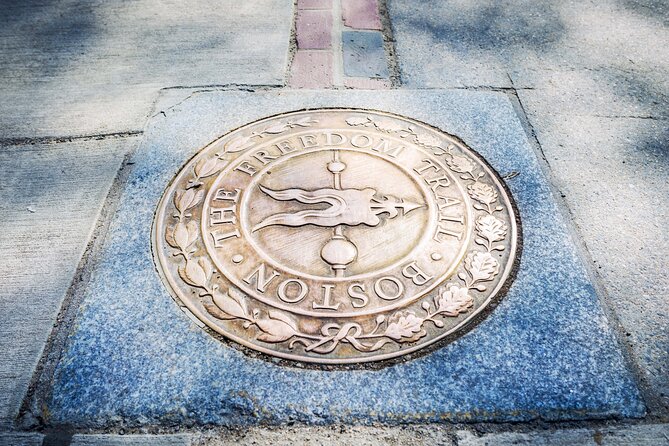
- All 16 official Freedom Trail landmarks: The route covers Boston Common, Granary Burying Ground, Faneuil Hall, Paul Revere’s home, Old North Church, and the other official sites.
- A history-first route: The guide focuses on Boston from about 1760 through 1775, the years when tension with Britain turned into open rebellion.
- Small groups capped at 16: You get a more personal walk than you would with a large crowd.
- Outdoor touring with indoor pauses possible: Guides may use covered or indoor spaces during cold weather, but this is still a walking tour.
- Ends in the North End: Copp’s Hill Terrace puts you close to Hanover Street’s Italian restaurants, bakeries, and pizza shops.
- Good value at $35.10: You see the full public trail without paying museum admission, though entry fees are not included.
Why this Freedom Trail walk works so well
The best part of this experience is its order. Boston’s historic sites can feel like scattered old buildings if you visit them without context. Here, the route moves from the city’s early Puritan foundations to the political pressure cooker of the 1770s.
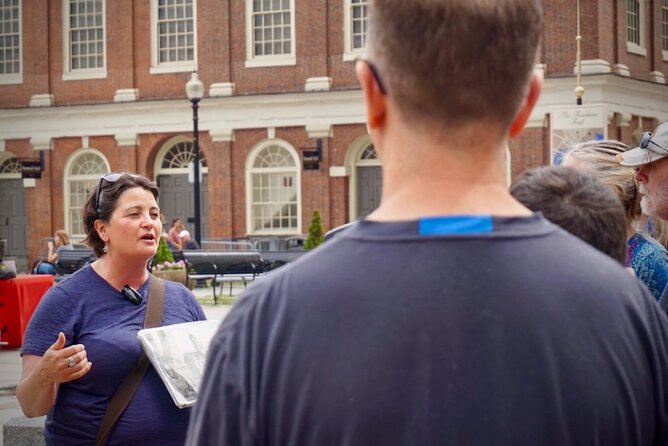
Your guide is not simply pointing out plaques. The tour centers on the years from 1760 to 1775, so you hear how local government, British military power, public protest, and individual choices built toward the American Revolution. The guide also takes questions along the way, which matters when a stop raises more questions than it answers.
The small format helps. A maximum of 16 people is large enough to create energy, but small enough for a guide to manage the group and respond to questions. Several guides, including Jon, Maura, Mark, and Alejandro, have earned especially strong praise for making the walk feel like a lesson told by a gifted teacher rather than a list of dates.
This is also a useful first activity in Boston. You pass through Boston Common, the historic center, and the North End while learning how the parts fit together. Afterward, you can return to the sites that caught your attention and pay to enter selected buildings.
More Small-Group Walking Tours in Boston:
- Boston: Freedom Trail History Small Group Walking Tour
★ 4.9 · 1,590 reviews - Boston: Full Revolution Story Epic Small Group Walking Tour
★ 4.9 · 132 reviews - Amsterdam Anne Frank: Small-Group Walking Tour & Local Guide
★ 4.8 · 12,789 reviews
Starting at the Boston Foundation Monument and Boston Common
The meeting point is the Boston Foundation Monument inside Boston Common, near the northern edge of the park, opposite 50 Beacon Street. The granite memorial shows two men shaking hands and recalls the arrival of the Puritans in 1630.
That is a fitting place to begin. Before the Boston Massacre, the Tea Party, and Paul Revere, there was a settlement with its own religious and political ideas. The opening stop gives the guide a chance to set the city’s early frame before moving into the revolutionary period.
You then spend about 20 minutes in Boston Common, the oldest public land in the Americas. It began as communal grazing land in 1634. Today, the park is one of Boston’s most useful orientation points, and the wide open space makes it easy to gather the group and begin the walk.
The route also passes the Massachusetts State House, completed in 1798, and the building associated with Boston’s famous Hub of the Solar System nickname. You should not expect a long interior visit here. The point is to connect the modern seat of state government with Boston’s earlier political life.
Granary Burying Ground and Boston’s early public life
The next major stop is Granary Burying Ground, Boston’s third-oldest burying ground. It is associated with important figures from Revolutionary Boston, and the guide uses the site to make the period feel personal.
Old cemeteries can be easy to rush through, but this one rewards a slower look at its markers and layout. You will hear about the people who helped shape Boston’s political and religious life, not just the famous battles and speeches.
Along the way, the route passes King’s Chapel, the first Church of England in Puritan Boston. It also passes Boston’s oldest burying ground, dating to 1630, and a church that remains active and was once the tallest building in 19th-century Boston.
These locations give the tour more range than a simple Revolutionary War walk. You see the tension between Puritan traditions, Anglican worship, town government, and the city’s expanding public life. The guide’s job is to connect those changes to the later conflict with Britain.
If you want to enter some churches, plan to return after the walk. Admission inside museums and historic buildings is not part of the $35.10 price. The tour provider notes that Old South Meeting House and Old North Church offer discounted admission with its Hub Town Tour ticket, and King’s Chapel is expected to offer the same discount soon. Check current terms before booking additional visits.
Benjamin Franklin, Boston politics, and the approach to conflict
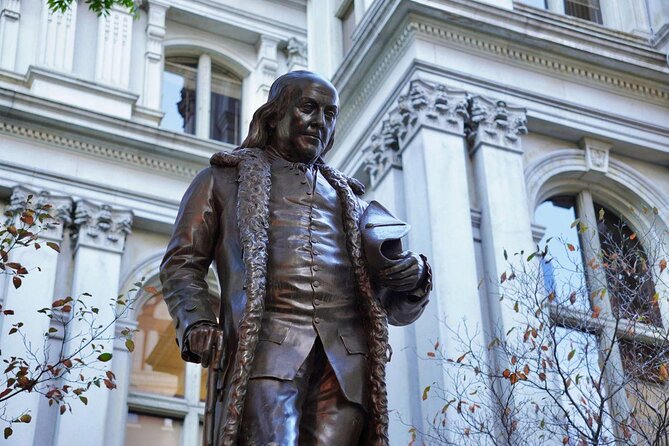
The statue of Benjamin Franklin marks the site of Boston Latin School, founded in 1635 and recognized as the oldest public school in the Americas. Franklin’s connection to Boston makes this more than a statue stop. It opens a conversation about education, public debate, printing, and the people who carried Boston’s political arguments beyond the city.
The route continues past places tied to Boston’s civic life, including the center of local politics for more than a century and the former publishing house of Ticknor & Fields. These stops may be less famous than Paul Revere’s house, but they help explain how ideas moved through the city.
You also pass a Congregationalist meeting house linked to the Boston Tea Party and the colonial capitol of the Massachusetts Bay Colony. The latter dates to 1713 and is the oldest public building in Boston.
This stretch is where a good guide makes the biggest difference. The buildings are not all equally dramatic from the street. Their value comes from the story attached to them. Guides such as Jon and Maura have been praised for putting events in chronological order and using vivid quotations and personal details to keep the timeline clear.
A few more walking tours around Boston worth a look
- Harvard University Campus Guided Walking Tour
★ 4.5 · 3,632 reviews - Boston Freedom Trail Walking Tour with Costumed Guide
★ 4.5 · 2,531 reviews - The Full Revolutionary Story Epic Small Group Boston Walking Tour
★ 5.0 · 2,356 reviews - Boston’s Freedom Trail: A Revolutionary Walking Tour
★ 4.9 · 1,748 reviews
The Boston Massacre site and the cost of protest
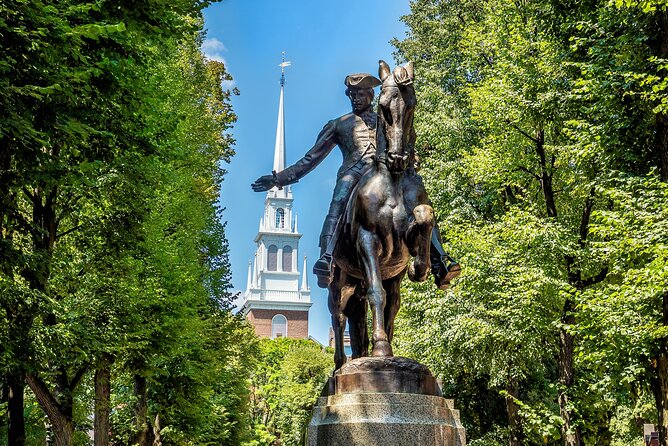
The Boston Massacre Site is one of the most important stops on the route. In 1770, British soldiers killed five Bostonians. The event became a powerful piece of anti-British political messaging, though the full story is more complicated than the name suggests.
Your guide can explain how the incident was presented to the public and why it mattered in the years that followed. This is a good moment to ask questions, especially if your understanding of the event comes mainly from school lessons.
The stop also brings you near the site associated with a major leader of Boston’s Sons of Liberty. Together, these locations show how public anger was organized. The conflict was not only about soldiers in the street. It was also about speeches, newspapers, meetings, and the ability to turn an event into political action.
Allow about 20 minutes here. The stop is outdoors, and the surrounding city continues its modern daily activity. That contrast is part of the experience. You are hearing about a crisis that helped change the country while standing in an active downtown district.
Faneuil Hall and the politics of public speech
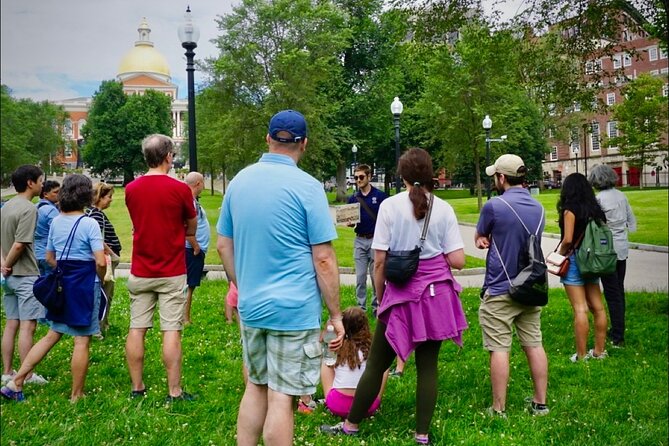
Faneuil Hall Marketplace receives about 10 minutes on the route. The historic hall hosted Boston town meetings and is known as the Cradle of Liberty.
This is one of the places where the tour shifts from individual events to public debate. Town meetings gave Boston residents a place to argue, persuade, and organize. The guide can help you see why a meeting hall mattered so much in an era when political communication relied on speeches, printed material, and personal networks.
The route also passes a historic building that now houses the oldest restaurant in the United States. You do not receive a meal or restaurant admission as part of the tour, but the stop adds a useful piece of later Boston history to the colonial setting.
I would not plan to linger over lunch during the walk. The tour keeps moving, and its purpose is the historical route. The good news is that the finish in the North End makes it easy to turn the end of the tour into a food stop.
North Square, Paul Revere’s house, and the North End
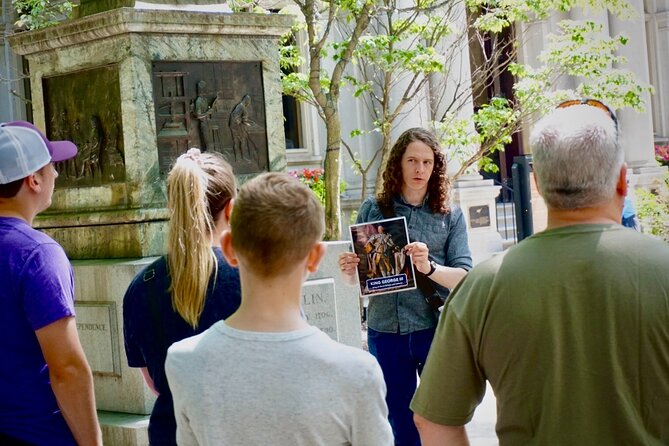
North Square Park is the heart of Boston’s North End and receives about 20 minutes. The square gives you a sense of the neighborhood’s older street pattern, with narrow lanes and historic buildings packed close together.
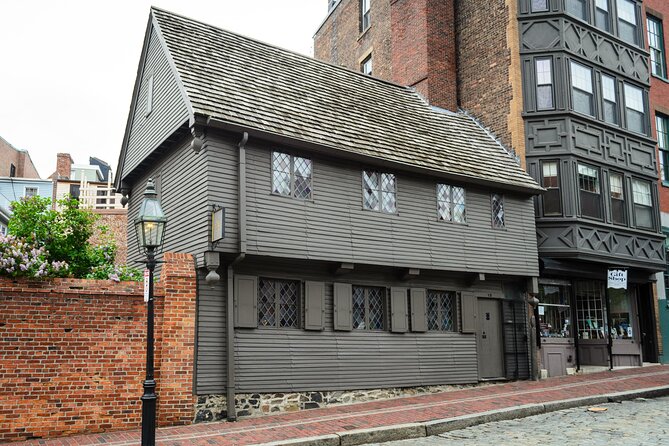
The Paul Revere House is nearby. Dating to 1680, it is the oldest structure in downtown Boston and was Revere’s home during the period surrounding his famous ride. The tour explains the house and its owner from the outside, but admission inside is not included.
That distinction matters. If Paul Revere is a major reason you are visiting Boston, plan to return with time and an admission budget. The walking tour gives you the setting and the story. A separate visit lets you examine the house itself at a slower pace.
The Paul Revere Statue and the pedestrian-only space around it provide another pause. Here, the guide can discuss how Revere’s midnight ride became one of the best-known episodes of the Revolution, while also giving you a clearer sense of the route’s North End setting.
Old North Church, Copp’s Hill, and the final view
The route continues to Old North Church, Boston’s oldest church. It is famous for the signal lanterns associated with Paul Revere’s ride in 1775.
Again, the walk does not include entry inside the church. That is a reasonable tradeoff at this price, since the tour covers all 16 official landmarks and keeps to a set time. Still, if church interiors interest you, this is one of the buildings worth revisiting.
The tour then passes a second-oldest burying ground in Boston before ending at Copp’s Hill Terrace. The final stop lasts about 20 minutes and looks toward the Charles River, the U.S.S. Constitution, and Bunker Hill Monument.
This ending is one of the route’s practical strengths. You finish near Commercial Street and Hanover Street, close to restaurants, pastry shops, pizza, and other North End food options. The end point is not beside the starting point, so you see a long slice of Boston rather than walking a short loop.
How much walking and cold weather to expect
The tour lasts about 2 hours and 30 minutes and requires a moderate level of physical fitness. You should be comfortable standing for extended periods and walking through city streets. The route is wheelchair and stroller accessible, and service animals are allowed.
Weather matters. Recent winter tours have taken place in freezing, windy conditions, and several guides used indoor or covered spaces when possible. Guests also noted that the cold made the walk harder, even when the guide did everything possible to keep the group comfortable.
If you book in winter, wear more layers than you think you need, cover your hands, and use shoes suited to a long city walk. Summer brings a different concern: much of the tour is outdoors, so sun and water matter. The experience requires good weather, and a cancellation caused by poor conditions comes with a choice of another date or a full refund.
What $35.10 gets you
At $35.10 per person, this tour offers solid value if you want a guided introduction rather than a self-guided walk. You get 2.5 hours with a historian, a group capped at 16, and coverage of all 16 official Freedom Trail landmarks.
The price does not include museum or church admissions, food, or a gratuity for the guide. That keeps the base price reasonable, but you should add admission costs if you want to see interiors at Paul Revere House, Old North Church, Old South Meeting House, or other sites.
The published rating is 4.9 from 6,450 reviews, with 98 percent of customers recommending the experience. The strongest pattern is the guides. Jon, Maura, Mark, Alejandro, Maz, Nick, Amelia, Cal, Kiera, Cyrus, and others have been singled out for enthusiasm, clear explanations, and strong storytelling.
One practical note: a rare guide absence has caused a delayed start, with a replacement guide taking over. That is not a normal feature of the tour, but if timing is critical, leave a little room in your schedule after the walk.
Who should book this walk
I would choose this tour for a first Boston visit, especially if you want a clear introduction to the city before exploring alone. It also fits history fans who prefer stories, context, and questions over a simple audio guide.
Families can make it work, particularly with older children and teenagers who can handle two and a half hours of walking. One family completed the route with children aged 11 and 14, though cold conditions can make the experience tougher for young walkers.
I would be more cautious if you dislike standing outside, need frequent seating, or mainly want to tour interiors. You may prefer a shorter visit to one or two historic buildings instead. This walk gives you the city streets and the full route, not a series of long indoor visits.
Should you book the Boston Freedom Trail tour?
Book it if you want the full Freedom Trail in one organized walk, a small group, and a guide who can explain how Boston moved from colonial settlement to revolutionary center. The price is fair, the route is efficient, and the North End finish gives you an easy next stop for food.
Skip it if you want extensive time inside churches and museums, or if a long outdoor walk sounds tiring. For most first-time visitors, though, this is a smart opening activity. Wear good shoes, check the forecast, and keep time afterward to revisit the one or two buildings that catch your interest.
FAQ
How long does the Freedom Trail walking tour last?
The tour lasts approximately 2 hours and 30 minutes.
Where does the tour start?
It starts at the Boston Foundation Monument inside Boston Common, near the northern boundary of the park and opposite 50 Beacon Street.
Where does the tour end?
The tour ends at Copp’s Hill Terrace at 520 Commercial Street in Boston’s North End.
Does the tour visit all 16 Freedom Trail landmarks?
Yes. The experience includes all 16 official historic landmarks on the Freedom Trail.
Are museum and church admissions included?
No. Admission inside museums and historic buildings is not included in the tour price.
Is the tour accessible for wheelchairs and strollers?
Yes. The tour is listed as wheelchair and stroller accessible. It requires a moderate level of physical fitness, and it is not recommended for people who have difficulty standing for extended periods.
Just added around Boston
- Boston: North End Pizza Walking Tour with 3 Slices & Cannoli★ 4.8 · 162 reviews
- Boston: Freedom Trail Guided Walking Tour in French★ 4.9 · 106 reviews
- Boston: Salem by Boat – Witch Trials & Walking Tour★ 4.3 · 263 reviews
- Boston: Full Revolution Story Epic Small Group Walking Tour★ 4.9 · 132 reviews
- Boston: 2-Hour Historic Walking Tour★ 4.7 · 88 reviews
- Self Guided Classic Freedom Trail Location Aware (GPS) Walking Audio Tour★ 4.5 · 258 reviews
- Boston History Tour: Scenic Walk Through Time & Landmarks★ 5.0 · 627 reviews
- Entire Freedom Trail Walking Tour: Includes Bunker Hill and USS Constitution★ 5.0 · 732 reviews
Small-Group Walking Tours, compared.

Amsterdam Anne Frank: Small-Group Walking Tour & Local Guide
Read our review →
Barcelona Tapas and Wine Experience Small-Group Walking Tour
Read our review →
Reykjavík Small group Walking Tour – by CityWalk
Read our review →

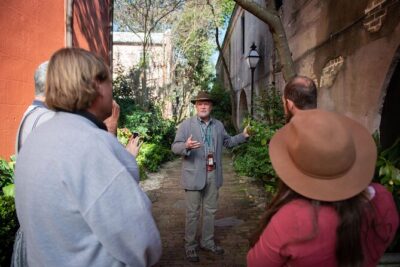
Hidden Alleyways and Historic Sites Small-Group Walking Tour
Read our review →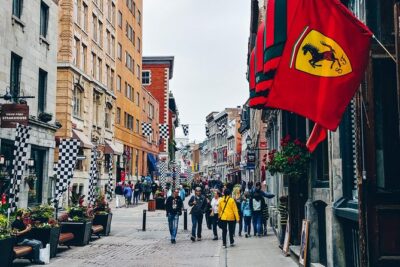
Old Montreal Small-Group Walking Tour | Max 10 | by MTL Detours
Read our review →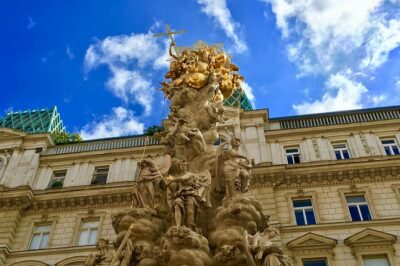
Vienna Historic Center Small Group Walking Tour
Read our review →Browse the lists this tour appears in