
REVIEW · ITALY
Ferrara: City Highlights Walking Tour with Local Guide
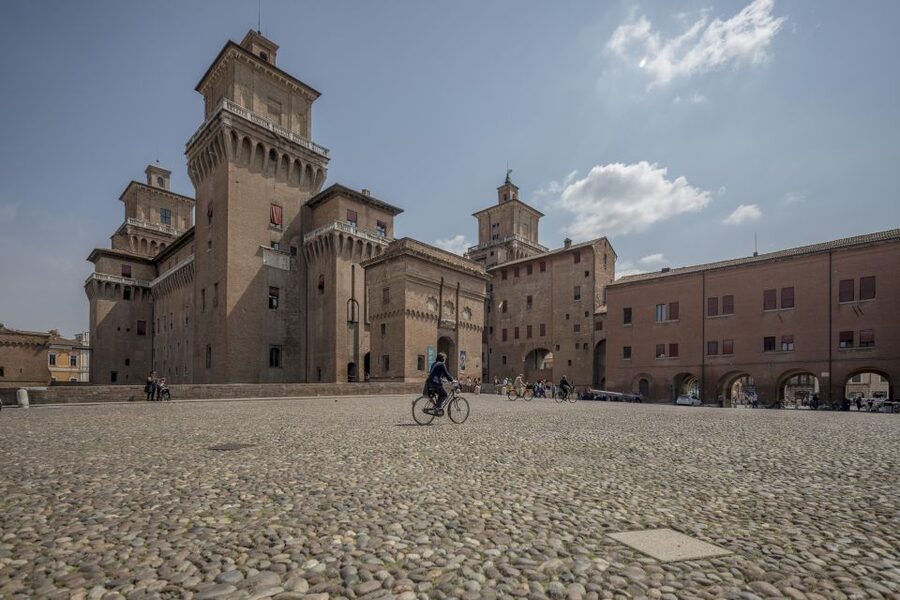
Ferrara’s best feature is how much history fits into a calm, walkable city. This two-hour route links the Estense Castle with the Renaissance streets planned by Duke Ercole I d’Este, then continues to Palazzo dei Diamanti, Certosa, and Piazza Ariostea.
I like the clear progression from medieval power to Renaissance town planning, and I like that the tour includes the beautiful church of San Cristoforo alla Certosa. The strong ratings also point to guides who are punctual, polite, prepared, and passionate, with Maria Chiara receiving special praise.
The main limitation is language: the live tour and audio guide are in Italian. Entrance tickets are not included, and two hours gives you an introduction rather than a full look inside Ferrara’s major buildings.
Key points to know before you book
- Begin at Estense Castle: Meet in the castle courtyard near the loggia, a handy central point for starting your walk.
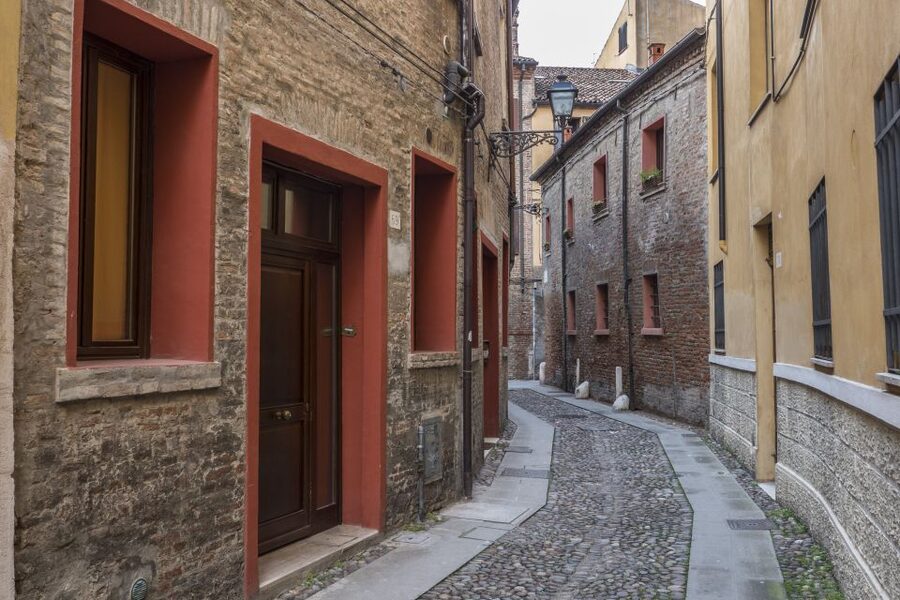
- Follow a Renaissance master plan: Corso Ercole I d’Este leads through the Addizione Erculea, Ferrara’s grand northern expansion.
- See Palazzo dei Diamanti: The palace’s unusual diamond-shaped stonework is one of the city’s most memorable sights.
- Visit San Cristoforo alla Certosa: The route includes the interior of this Renaissance church, later connected with Ferrara’s monumental cemetery.
- Finish at Piazza Ariostea: End beneath the square’s loggia, near the statue honoring poet Ludovico Ariosto.
- Plan for Italian: The live guide and included audio guide are in Italian, so this is best for Italian speakers or those comfortable following an Italian tour.
Starting with Ferrara’s Estense Castle
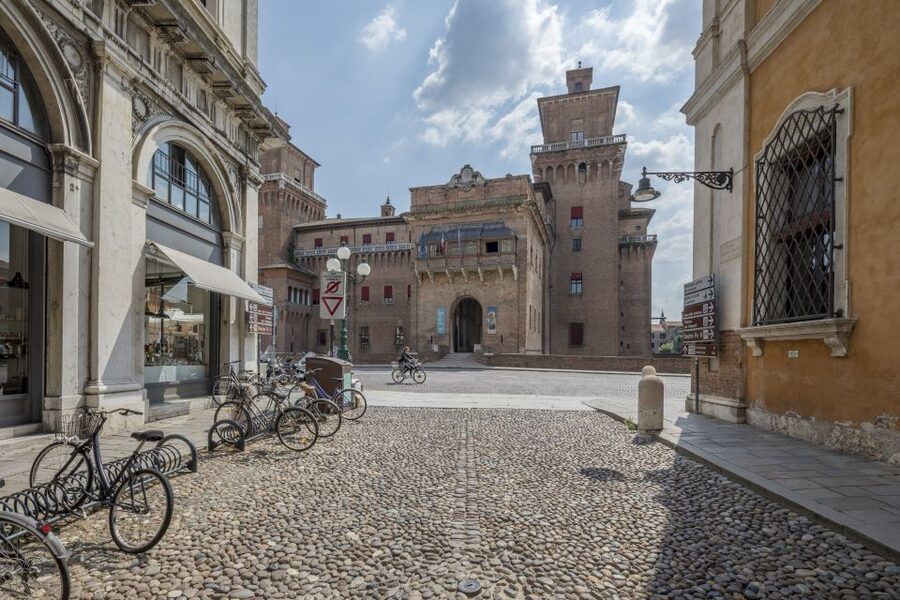
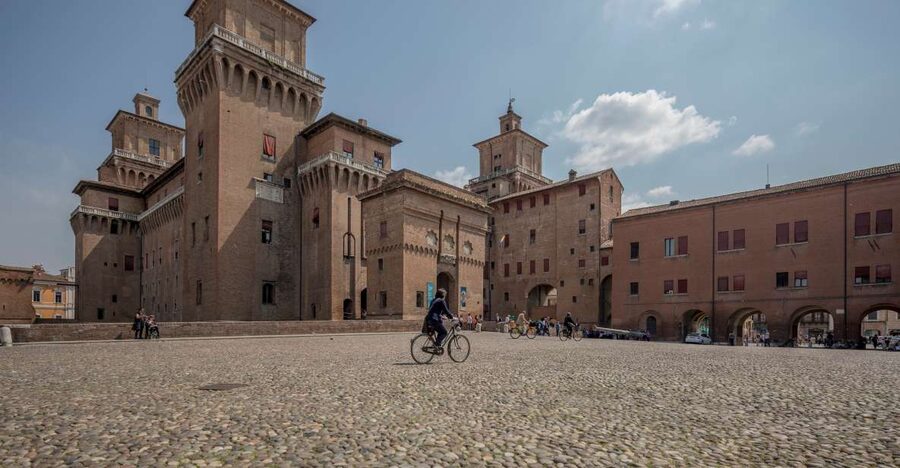
The meeting point is in the courtyard of Estense Castle, near the loggia. This is an easy place to find in central Ferrara, and it puts you beside the city’s clearest symbol from the first minute.
The castle tells you much about Ferrara’s ruling Este family. Its towers, moat, and defensive shape recall a time when court politics and military danger were part of daily life. Yet this was not only a fortress. The Este court also made Ferrara a center of art, learning, architecture, and music.
Your guide uses the castle as a starting point for stories about the Este family, including the legends tied to the dynasty. The exact stories can vary with the guide, but the purpose is clear: you are not simply looking at old walls. You are learning how the family shaped the city around them.
I like this opening because it gives the rest of the walk a useful frame. You can see Ferrara’s medieval authority in the castle, then watch the city grow outward into a carefully planned Renaissance capital.
The castle itself may tempt you to wander inside. Keep in mind that entrance tickets are not part of this walking tour. The experience focuses on the streets, views, monuments, and the included church visit, so you should not expect a full castle tour unless you arrange separate admission.
More City Highlights Walking Tours in Italy
- Florence: Highlights Walking Tour with Expert Guide
★ 4.6 · 4,662 reviews - Bologna: City Center Walking Tour
★ 4.5 · 3,478 reviews - Florence: Duomo Complex with Tickets & City Walk Guided Tour
★ 4.7 · 2,057 reviews
Walking Corso Ercole I d’Este
From the castle, the route follows Corso Ercole I d’Este. This long road connects the castle with the northern gate of Ferrara’s walls and crosses the area known as the Addizione Erculea.
This expansion was commissioned by Duke Ercole I d’Este at the end of the 15th century and designed by Ferrarese architect Biagio Rossetti. The important point is that Ferrara was not simply patched together as it grew. The Addizione Erculea was planned as a major urban project, with broad streets, palaces, gardens, and views arranged as part of a larger design.
That makes the walk more interesting than a simple list of buildings. You begin to notice how streets line up, how palaces face one another, and how open spaces soften the formal architecture. Ferrara’s Renaissance character comes from this balance between grand planning and a manageable city scale.
You will want comfortable shoes. The route lasts two hours and includes several areas, so this is not a stop-and-start coach excursion. You move through the city on foot, with the guide explaining what you are seeing as the setting changes around you.
The course also gives you a good sense of Ferrara as a human-sized city. The monuments are important, but they are not separated from ordinary streets. You encounter architecture in the same places where people walk, study, work, and pass through town.
Palazzo dei Diamanti and the city’s Renaissance face
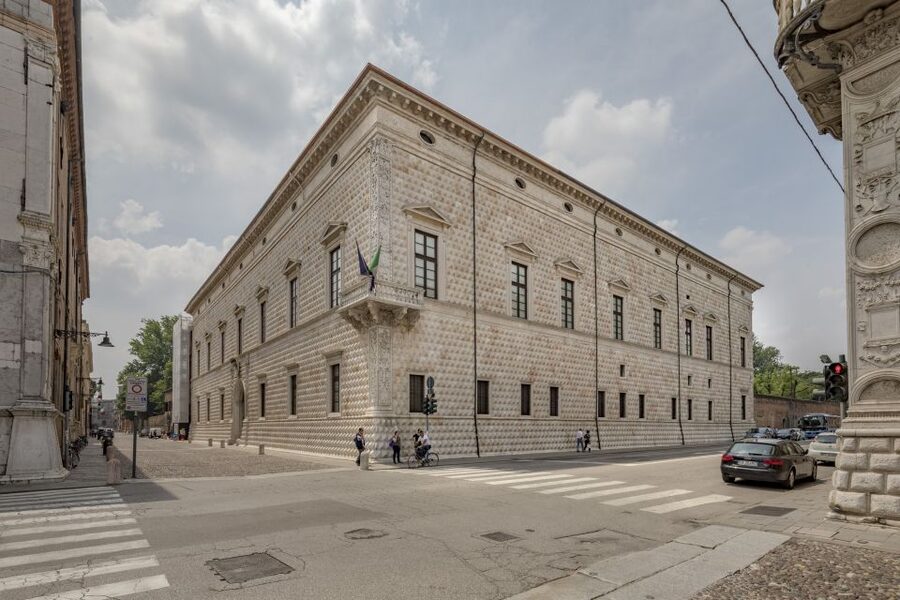
The route reaches Palazzo dei Diamanti in the heart of the Addizione Erculea. Its name comes from the diamond-shaped points covering the outside walls. Light and shadow break across the facade, giving the palace a look unlike the usual smooth Renaissance buildings.
The building is a useful stop because it shows how Ferrara’s rulers used architecture to make a statement. Palazzo dei Diamanti is not merely decorative. Its unusual exterior announces wealth, confidence, and a taste for design that visitors can understand without being architecture experts.
The guide places the palace within the wider plan created by Rossetti. That context matters. If you see the building alone, you may admire its stonework and move on. If you understand its place in the new quarter, you see how it helped define the city’s northern expansion.
The tour description refers to reaching the original Palazzo dei Diamanti. You should treat this as an exterior and city-planning stop unless the guide explains otherwise, since entrance tickets are not included. The walk is designed around Ferrara’s public spaces and views rather than extended interior visits.
This part should suit you if you enjoy architecture but do not want a technical lecture. The route connects the visual details to the people and decisions behind them, keeping the focus on what you can see while walking.
Massari Park and the calmer side of the route
After the historic crossroads, the walk continues toward Massari Park. The park is known for its old cedars of Lebanon and substantial plant life, with the University Botanical Garden nearby.
This change of setting helps the tour avoid becoming a parade of palace facades. Ferrara’s appeal comes partly from its quiet rhythm, and the park gives you a pause from stone streets and formal buildings. The trees and open space also help you understand how greenery was used alongside the Renaissance plan.
You may find this section less dramatic than the castle or Palazzo dei Diamanti. That is not a fault, but it is worth knowing. The reward is atmosphere and contrast rather than one unforgettable facade.
I like the inclusion of Massari Park because it makes the route feel like a portrait of the city instead of a greatest-hits sprint. Ferrara has room to breathe. A tour that moves only from one famous building to another would miss that quality.
The nearby University Botanical Garden is part of the setting, but no separate visit is specified. Expect to see it in relation to the route, not necessarily to enter it.
More City Highlights Walks in Italy:
- Lucca: 2-Hour City Center Walking Tour
★ 4.7 · 1,314 reviews - Venice: Walking Guided Tour of the City Must-See Sites
★ 4.7 · 1,095 reviews - Florence in a Day: Michelangelo’s David, Uffizi and Guided City Walking Tour
★ 4.5 · 1,048 reviews - Rome: Guided City Center Evening Sightseeing Walking Tour
★ 4.4 · 953 reviews
San Cristoforo alla Certosa and the monumental cemetery
A few steps away, the route reaches the complex of San Cristoforo alla Certosa. The church was originally connected with Carthusian monks, who were called to Ferrara by Duke Borso d’Este in the middle of the 15th century.
Over time, the wider complex became a monumental cemetery. The square in front, framed by elegant arcades, creates a quieter and more reflective mood than the busy central streets. This is one of the most distinctive parts of the walk because the setting combines religious architecture, memorial space, and Renaissance planning.
The tour includes an interior visit to the Renaissance church. That detail adds real value. Many city walks show you church facades but keep you outside. Here, you get a chance to see the interior of a building tied directly to Ferrara’s Este-era development.
The church visit also gives the guide another way to explain the city. The Este family’s influence was not limited to government buildings and roads. Religious institutions formed part of Ferrara’s social and architectural life, and the Certosa complex shows how those layers changed over time.
You should allow for a quieter pace here. The arcades and cemetery are places for looking closely, not rushing through. The tour description does not promise a long interior talk or access to every part of the complex, so think of this as a focused church visit within a broader walk.
For me, this is likely the route’s strongest stop after the castle. It feels less expected than the major palace and gives the tour a more human side, with memory and devotion woven into the city’s grand design.
Ending at Piazza Ariostea
The final stop is Piazza Ariostea, a historic square named for the great poet Ludovico Ariosto. His statue rises above the central column, giving the open space a clear focal point.
The tour ends beneath the loggia along the green area. That is a fitting finish. After the castle, long Renaissance avenue, palace facade, park, and church, you reach a square that brings together literature, public space, and everyday city life.
Piazza Ariostea is not presented as a grand finale with an elaborate show. Its appeal is more relaxed. You have time to connect Ferrara with Ariosto, one of the city’s most famous cultural figures, while taking in the square’s proportions and surrounding greenery.
This ending also leaves you in a useful part of town for continuing on your own. The tour does not include a meal, shopping stop, or extra attraction, so you can decide what to do next rather than being carried into another scheduled activity.
What the guide adds to the walk
The live guide is Italian-speaking, and an Italian audio guide is included. That makes the experience a good match for you if Italian is your preferred language or if you are comfortable following explanations in Italian.
The guide’s role is especially important here because Ferrara’s most rewarding details are connected to planning, family power, and local stories. A silent walk would show you the castle and palace, but it would not explain why Corso Ercole I d’Este exists, how Biagio Rossetti shaped the expansion, or why the Certosa complex matters.
Recent feedback points to several qualities worth looking for: preparation, punctuality, courtesy, and an engaging manner. Maria Chiara is specifically praised by name, while other comments describe the route as well structured and unexpectedly beautiful. Those details suggest that the quality of the experience depends heavily on the individual guide’s ability to connect the stops.
You should not expect an English-language explanation based on the information provided. If you need English, confirm availability before booking rather than assuming that the audio guide solves the problem.
Is $17 a fair price for two hours?
At $17 per person, the tour is priced as an affordable introduction to Ferrara. You are paying for a guided route through several important areas, local context, an Italian audio guide, and the internal visit to San Cristoforo alla Certosa.
That is good value if you are visiting Ferrara for a short time or want a clear orientation before exploring alone. A local guide can save you from seeing the Addizione Erculea as simply a pleasant street. You learn that it was a planned Renaissance expansion, tied to a specific duke and architect.
The value is lower if you want long interior visits or detailed access to every major monument. Entrance tickets are not included, and the castle and Palazzo dei Diamanti should not be treated as full admissions within the two-hour route.
The walk also works well as a first activity of the day. You can use the route to decide which buildings deserve a separate ticket or a longer return visit. At this price, it is a sensible way to get your bearings without committing to a costly full-day program.
Practical details for a comfortable visit
The tour lasts two hours, and starting times depend on availability. Meet in the courtyard of Estense Castle near the loggia. Since the route is on foot, wear shoes suited to city walking and leave enough time to reach the castle before the start.
The experience is wheelchair accessible. The listed language is Italian for both the live guide and audio guide. An umbrella is recommended in case of rain, a small but useful warning for a walking route with several outdoor sections.
Cancellation is free up to 24 hours before the activity for a full refund. You can also reserve now and pay later, which helps if your Ferrara plans are still taking shape.
The overall rating is 4.6 from 219 ratings, and the written feedback gives particular weight to the guides’ professionalism and warmth. The comments also support the idea that the route is punctual and well structured, rather than loose or improvised.
Who should book this Ferrara walk?
I would choose this tour if you want the main story of Ferrara’s medieval and Renaissance development in a compact format. It is especially useful for first-time visitors, architecture fans, Italian speakers, and anyone who prefers a calm city walk to a packed attraction schedule.
It also suits you if you like seeing how a city was planned. The Addizione Erculea is not just a collection of pretty streets, and this tour gives that urban design a central role.
I would look elsewhere if you need English, want a private tour, or expect admission to several interiors. Those features are not listed. The walk is also less suitable if rain would spoil your plans, since much of the experience takes place outdoors.
Should you book the Estense Castle to Piazza Ariostea tour?
Book it if you want a well-priced, two-hour introduction to Ferrara that combines the castle, Renaissance planning, Palazzo dei Diamanti, Massari Park, Certosa, and Piazza Ariostea. The route has enough variety to keep the walk moving, and the church visit gives it more substance than a purely exterior city stroll.
The strongest reasons to choose it are the clear route through the city’s Middle Ages and Renaissance story, the inclusion of San Cristoforo alla Certosa, and the repeated praise for guides who are prepared, courteous, and enthusiastic. Maria Chiara is one name to note, though your assigned guide may differ.
Skip it if you need an English-language tour or want extensive museum time. For Italian-speaking visitors who value context, good pacing, and a modest price, this is a practical way to meet Ferrara on foot.
FAQ
Where does the Ferrara walking tour begin?
The meeting point is in the courtyard of Estense Castle, near the loggia.
How long does the tour last?
The walking tour lasts two hours.
What language is the tour in?
The live tour guide speaks Italian, and the included audio guide is also in Italian.
Is the tour wheelchair accessible?
Yes, the activity is listed as wheelchair accessible.
Are entrance tickets included?
No. Entrance tickets are not included in the tour price.
Does the tour include an interior visit?
Yes. The route includes an internal visit to the Renaissance church of San Cristoforo alla Certosa.
What places do you see during the walk?
The route includes Estense Castle, Corso Ercole I d’Este, Palazzo dei Diamanti, Massari Park, the University Botanical Garden area, San Cristoforo alla Certosa, and Piazza Ariostea.
Can I cancel the booking for a refund?
Yes. You can cancel up to 24 hours in advance for a full refund. You can also reserve now and pay later.
Just added around Italy
- Verona: Romeo and Juliet Guided Walking Tour★ 4.6 · 82 reviews
- Discover Pompeii: French Walking Tour of the Buried City★ 4.8 · 253 reviews
- Naples: Maradona Stadium Guided Exterior Walking Tour★ 4.3 · 113 reviews
- Dark Heart of Rome – Facts, Legend & Mystery Walking Tour★ 4.5 · 329 reviews
- Cefalù: History and Legends Guided Walking Tour★ 4.8 · 132 reviews
- Catania: Street Food Guided Walking Tour★ 4.9 · 326 reviews
- Catania: Guided Street Food Walking Tour★ 4.7 · 300 reviews
- Cagliari: walking tour through the alleys of Castello★ 4.9 · 74 reviews
City Highlights Walking Tours, compared.
Berlin City walk Government District and Places of Democracy
Read our review →
Historic Charleston Guided Sightseeing Walking Tour
Read our review →
Oxford: University and City Walking Tour with Alumni Guide
Read our review →
City Highlights Temple and Market Walking Tour
Read our review →
A History of Terror – Belfast City Centre Walking Tour
Read our review →Browse the lists this tour appears in