
REVIEW · FLORENCE
Medici Legends & Renaissance Wonders: Florence Small Group Tour
Florence makes more sense when you follow the Medici family from their church and palace to the Duomo, Palazzo Vecchio, Ponte Vecchio, and Uffizi. This small-group walking tour links those famous sights with the political choices, family rivalries, and artistic ambitions that helped shape the city.
I like the tight route and the guide-led storytelling. In less than two hours, you get a useful first look at Florence, and the group limit of 15 people gives the guide room to answer questions. The tour also works well on your first day, since it helps you recognize the Medici crest and understand what you are seeing later.
The main caution is that this is an overview, not a full museum tour. Most stops last about five minutes, admission tickets are not included, and the Medici family may not receive as much attention as the title suggests, depending on your guide.
Key points to know before booking

- The route connects 14 major sights, from San Lorenzo and the Medici Chapels to the Uffizi and Ponte Vecchio.
- The focus is Florence through the Medici story, but the tour also covers the Duomo, medieval Florence, Renaissance art, and civic power.
- Groups are limited to 15, a useful middle ground between a private tour and a large crowd.
- The tour lasts about 1 hour 45 minutes, making it a good fit for a busy sightseeing day.
- Tickets are not included, so expect an exterior-focused walk unless your booking includes a separate entry arrangement.
- Guide quality matters here. Manuel, Martina, Amanda, and Giacomo are singled out in the supplied feedback for clear stories, humor, passion, and helpful answers.
Why the Medici are the right key to Florence
The Medici were not simply wealthy patrons who paid for pretty buildings. They were bankers, political operators, church leaders, collectors, and rulers of Tuscany. Their power appears in Florence’s churches, chapels, palaces, public squares, and museums.
That makes this route more useful than a basic list of monuments. At San Lorenzo, you see the family’s connection to religion and burial. At Palazzo Medici Riccardi, you see where family power took physical form. At the Duomo and Uffizi, you see how money and influence helped produce the art and architecture now associated with Florence.
I like this approach because Florence can feel like a parade of marble façades unless somebody explains the links between them. A good guide turns separate sights into a story. Several guides have been praised for doing exactly that, especially Manuel, who is described as a passionate local expert, and Martina, whose explanations encouraged people to notice the Medici crest around town.
The format also suits visitors who have limited time. You will not master Medici politics in 105 minutes, but you can leave with a useful framework for the rest of your stay.
More History Walking Tours in Florence:
- Florence: Renaissance and Medici Tales Guided Walking Tour
★ 4.8 · 1,549 reviews - Renaissance & Medieval Florence Guided Walking Tour plus mobile App
★ 4.0 · 140 reviews - Florence: LGBTQ Renaissance Walking Tour with Mila
★ 4.9 · 85 reviews
San Lorenzo and the Medici family’s first claim on the city
The walk begins near Caffè Scudieri Firenze in Piazza di San Giovanni at 12:15 p.m. From there, the route heads toward the Basilica di San Lorenzo, one of Florence’s major churches and the burial place of principal Medici family members from Cosimo the Elder to Cosimo III.
San Lorenzo is an important opening stop because it puts the family in a religious and civic setting, not just an artistic one. The Medici did not merely visit Florence’s institutions. They attached their name and money to them.
The scheduled stop is short, about five minutes. That tells you what kind of experience this is. You will receive an explanation of the site rather than a long interior visit. Admission is not included, so check your plans if you want to explore the church or chapels afterward.
The nearby Biblioteca Medicea Laurenziana adds another side of the Medici story. Clement VII, the Medici pope, supported the library to show that the family had moved beyond its origins as merchants and bankers into the world of learning and the Church. Its architecture, designed by Michelangelo, is famous for its Mannerist character.
That detail is worth hearing on site. The library was not only a place to store books. It helped present the Medici as an educated, cultured dynasty. Again, the five-minute stop gives you context, but not a full architectural study.
Medici Chapels and Palazzo Medici Riccardi
The Medici Chapels were built in the 16th and 17th centuries as additions to San Lorenzo. Their purpose was clear: celebrate the Medici as patrons of the church and Grand Dukes of Tuscany.
The New Sacristy, designed by Michelangelo, is the artistic centerpiece. If you have seen Michelangelo mainly through the David or the Sistine Chapel, this site gives you another way to understand his work. The chapel joins sculpture, architecture, and dynastic memory in one place.
The tour allows about five minutes here, and entry is not included. If you want time with Michelangelo’s work, plan a separate visit rather than expecting this walk to provide it. This is one of the most important practical points in the description, since the route visits many major interiors and collections without including their admission.
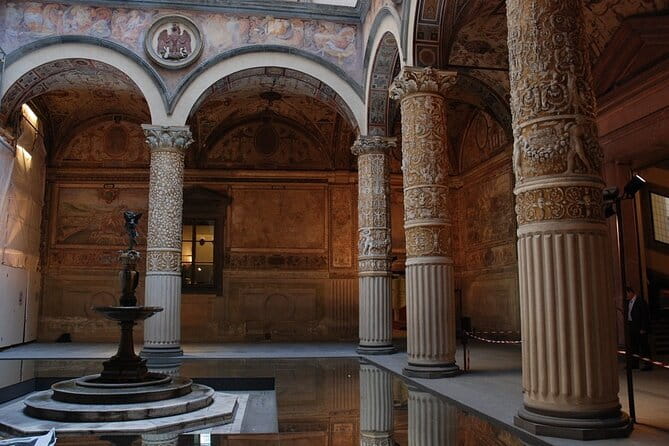
At Palazzo Medici Riccardi, the story shifts from burial and religion to family power. Cosimo de’ Medici commissioned the palace, built between 1444 and 1484. Its presence helped establish the Medici as a leading force in Florence.
I would pay close attention to how your guide explains the contrast between public modesty and private power. The family was skilled at appearing like respectable citizens while building influence across Florence. A strong storyteller can make this political balancing act easier to grasp than a page of dates.
The guides praised in the supplied feedback often use humor, role-playing, and small details to make such stories easier to remember. That matters on a short walk. You need a clear story, not a flood of names.
The Duomo complex in five quick views
The tour then reaches the Duomo area, where several stops cover the cathedral, Baptistery, Brunelleschi’s dome, and Giotto’s Campanile. On paper, the itinerary lists the cathedral twice. In practice, think of this as several short explanations of the cathedral complex rather than two separate cathedral visits.
Santa Maria del Fiore began in 1296 in the Gothic style, based on a design by Arnolfo di Cambio. Its white, green, and pink marble façade is one of Florence’s most familiar sights, but the building becomes more interesting when you understand the scale of the project and the competition behind it.
The Baptistery of Saint John is one of Florence’s oldest buildings, built between 1059 and 1128 in the Florentine Romanesque style. Located across from the cathedral and campanile, it helps you see that the Duomo is a group of connected monuments, not one building standing alone.
Brunelleschi’s dome is the engineering star of the complex. It was the largest dome in the world at the time and remains the largest brick dome ever built. The short stop cannot explain every construction detail, but it gives you the central problem: how do you cover a vast cathedral space without the traditional support methods?
Giotto’s Campanile adds a different kind of beauty. Its sculptural decoration and colored marble fit the Florentine Gothic style, while its position beside the cathedral and Baptistery completes the visual group.
The advantage of seeing these sights with a guide is scale. You can look at the dome, tower, and cathedral as separate achievements, then understand how they work together. The drawback is crowd noise. One person noted that the sound system made it hard to hear while walking, especially with street noise. If hearing is a concern, stay close to the guide and ask for a quieter explanation when possible.
Same streets, a different route:
- Florence: Highlights Walking Tour with Expert Guide
★ 4.6 · 4,662 reviews - Uffizi & Accademia Timed Entry: Small Group Duomo Walking Tour
★ 4.5 · 3,630 reviews - Florence: Duomo Complex with Tickets & City Walk Guided Tour
★ 4.7 · 2,057 reviews - Michelangelo’s David, Accademia & Uffizi Small Group Tour
★ 4.5 · 1,986 reviews
Palazzo Vecchio and the politics of Piazza della Signoria
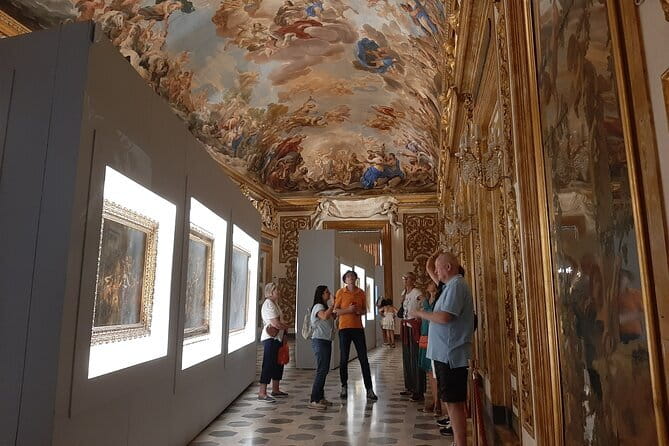
From the Duomo, the route continues to Palazzo Vecchio and Piazza della Signoria. Here Florence’s story becomes openly political.
Palazzo Vecchio is the city hall, built like a fortress-palace. It overlooks the square, where a copy of Michelangelo’s David and the statues in the Loggia dei Lanzi create one of Italy’s most important public settings.
This is a good place to connect Medici power with the wider political life of Florence. The family’s influence was not limited to private palaces. It affected the spaces where the city displayed authority, civic pride, and public art.
Piazza della Signoria is an L-shaped square and a natural meeting point near the Duomo and Uffizi. Your guide can help you read the statues and buildings as political messages rather than decoration alone.
The tour does not include entry to Palazzo Vecchio. That is not a weakness if you want a fast introduction, but it matters if you hoped to see the interior halls. The route keeps moving, so plan separate museum time if you want more than exterior context.
Ponte Vecchio, Pitti Palace, and the Medici move across the Arno
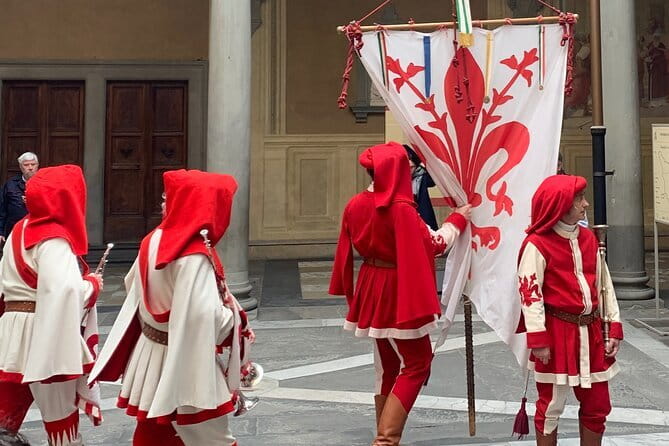
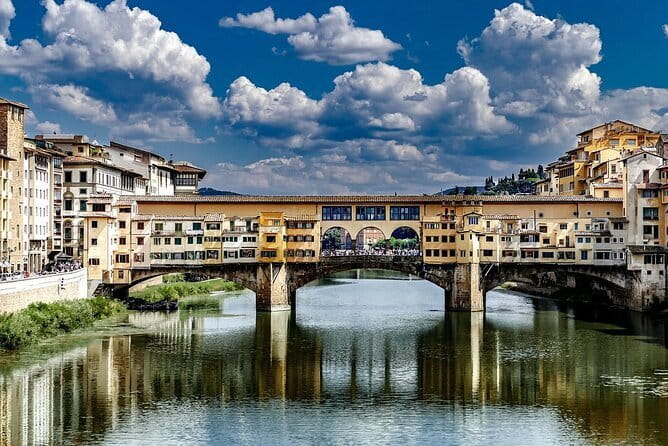
Ponte Vecchio is the only listed stop with free admission, and the tour ends in this area. The medieval bridge crosses the Arno and is famous for the shops built along it. Butchers, tanners, and farmers once occupied those shops. Today, jewelers and art dealers fill them.
The bridge is more than a photogenic crossing. It shows how commerce, daily life, and Medici authority met in one narrow space. The guide can help place the bridge within the city’s larger story, especially as the route moves toward the ruling family’s residence on the south side of the river.
Palazzo Pitti was purchased by the Medici in 1549 and became the main residence of the ruling families of the Grand Duchy of Tuscany. Later generations filled it with paintings, plates, jewelry, and luxurious possessions.
This stop gives the Medici story a clear change of scale. The family began with banking power in the city and ended with the trappings of a ruling dynasty. If you enjoy seeing how a family’s social position changes over time, this is one of the most useful stops.
The official endpoint is Ponte Vecchio, though it can vary slightly within the area. That is convenient if you want to continue toward the Oltrarno, but remember that the route does not finish back at the starting point.
The Uffizi and the question of tour depth
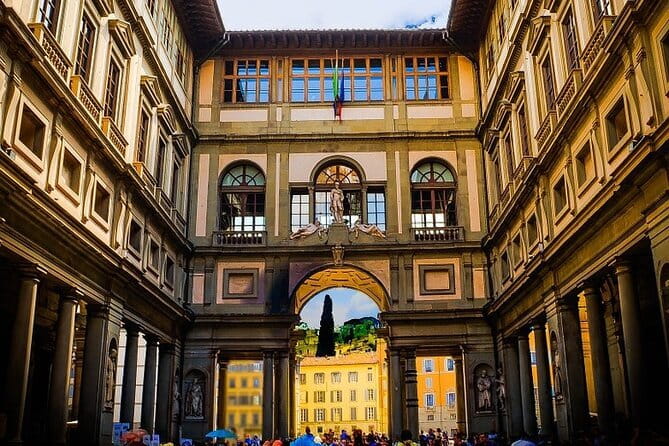
The final major sight is the Gallerie degli Uffizi, one of Italy’s most important museums and home to major Renaissance works by Michelangelo, Leonardo da Vinci, Raphael, Botticelli, and others. The collection covers art from the 12th through the 16th century across more than 80 halls.
The Uffizi is a natural ending because it shows what Medici patronage and collecting helped preserve. It also brings the family story back to art. The dynasty’s political power, private taste, and public image all meet in Florence’s museums.
But be clear about the format. A five-minute stop and no included admission cannot replace an Uffizi visit. You will get an introduction and a reason to return, not the museum experience itself.
This distinction explains the mixed response from one person who wanted the Medici family to be the central subject. If your main goal is detailed Medici genealogy, the Medici Palace museum and Medici Family Museum are better choices for additional study. This walking tour is broader. It uses the Medici as a thread through Florence rather than treating the family as the only topic.
Price, group size, and guide quality
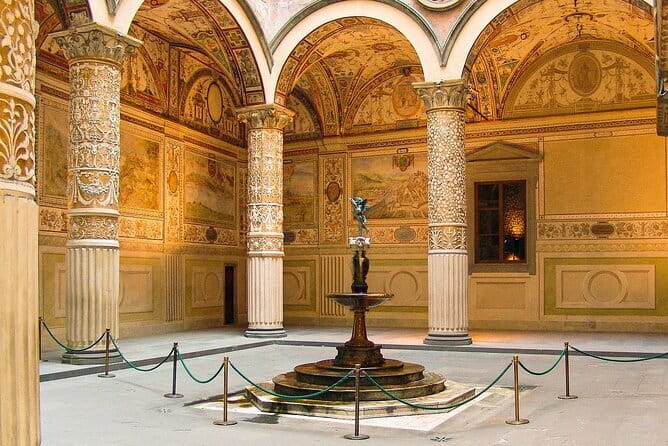
At $119.77 per person, the price is high for a 1-hour-45-minute walking tour, especially since entrance tickets are not included. The value depends on what you want from the guide.
You are paying for a licensed guide, a small group, a listening system, and a carefully connected route through the city center. If you would otherwise wander between these sights without understanding their links, the orientation can be useful. If you already know Florence and the Medici well, the coverage may feel too basic.
The group limit of 15 is a real advantage. It is small enough for questions and easier listening than a large city tour, but it is not the same as a private walk. One booking was described as private because of the small number of participants, which shows why it is wise to check your expectations. The advertised format is small group, not guaranteed private.
Guide quality makes the largest difference. Manuel receives repeated praise for clear explanations, local insight, patience, and a strong sense of Florence. Martina is praised for enthusiasm and memorable details. Amanda is described as smart, funny, and highly focused on the Medici. Giacomo is noted for answering questions and offering suggestions for later activities.
Those names do not guarantee who will lead your departure, but they show the level of guide-led interpretation this tour can provide. Some guides use humor and role-playing. Others focus on buildings and dates. Either way, ask questions when you can. This is where the value lies.
Who should book this Florence walk?
I would choose this tour if you are visiting Florence for the first time, have only a few hours, or want a clear introduction before visiting the museums on your own. It also suits families with older children and teenagers, since the mix of stories, buildings, and famous names can hold attention better than a long formal lecture.
It is a sensible first-day activity. You can use the route to decide which places deserve a return visit, especially the Medici Chapels, Palazzo Vecchio, and Uffizi.
I would be more cautious if you want a specialist Medici study, extensive interior access, or a slow architectural tour. The pace is steady, but each sight receives only a short explanation. Street noise can also affect the whisper system, particularly if you are hard of hearing.
The tour is offered in English, starts at 12:15 p.m., and is near public transportation. Most people can participate. Free cancellation is available up to 24 hours before the start time, while poor weather or failure to meet the minimum group size can lead to a new date, another experience, or a refund.
Should you book it?
Book this tour if you want a lively introduction to Florence through the Medici, with a compact route and a guide who can connect famous sights to politics, art, religion, and family ambition. It is especially useful at the beginning of a Florence visit.
Skip it if you mainly want museum entry or a detailed family history. In that case, spend the $119.77 on a more focused Medici experience, or visit the museums independently and give them more time.
For the right visitor, this walk does something valuable: it gives Florence a storyline. You may not see every interior, but you will look at the city with sharper eyes afterward.
FAQ
How long does the Medici Legends & Renaissance Wonders tour last?
The tour lasts approximately 1 hour and 45 minutes.
Where does the tour begin?
It begins at Caffè Scudieri Firenze, Piazza di San Giovanni, 19R, Florence, at 12:15 p.m.
Where does the tour end?
It ends in the Ponte Vecchio area. The exact endpoint may vary slightly within the indicated area.
Are admission tickets included?
No. Admission tickets are not included for the listed attractions. Ponte Vecchio is free to visit.
How many people can join the group?
The group has a maximum of 15 participants.
What happens if I need to cancel?
You can receive a full refund if you cancel at least 24 hours before the experience start time. Cancellations or changes made less than 24 hours in advance are not accepted for a refund.
Just added around Florence
- Tasty Florence Street Food with Guided Walking of the City★ 5.0 · 174 reviews
- Florence: Whispers of the Renaissance walking tour★ 4.5 · 78 reviews
- Florence Food Tour of 10+ Authentic Tastings with Cheeses & Wines★ 5.0 · 155 reviews
- Florence Private Walking tour with Skip-the-line to Accademia★ 4.5 · 236 reviews
- Private Florence Tour: 3-Hour Walking Tour with a Licenced Guide★ 5.0 · 233 reviews
- The Best of Florence Walking Tour in a Small Group★ 5.0 · 503 reviews
- Private Skip-the-Line Florence Highlights and David Walking Tour★ 4.5 · 78 reviews
- Experience Florence’s Art and Architecture on a Walking Tour★ 5.0 · 318 reviews
History Walking Tours, compared.

Berlin’s Best: 2 Hour Walking Tour Third Reich and the Cold War
Read our review →
Third Reich Berlin: Hitler and WWII Walking Tour
Read our review →
New Orleans Garden District History Walking Tour
Read our review →
Cartagena: Historic Center and Getsemaní Shared Walking Tour
Read our review →
Imperial Palace and Shogun Historical Walking Tour
Read our review →Browse the lists this tour appears in