

REVIEW · BARCELONA
Barcelona Historical Walking Tour: Gothic Quarter and El Born
Barcelona’s oldest streets hold more surprises than a bus window can show. This two-hour walk threads through the Gothic Quarter and El Born, linking Roman ruins, medieval lanes, royal buildings, Civil War scars, and churches tied to the city’s working past.
I like the compact route and the human stories. Guides such as Juan, Lidia, Jordan, Vanesa, and Darren have been praised for clear history, humor, family-friendly energy, and useful food suggestions. I also like that the group is capped at 20 people. The main drawback is that the tour moves through many stops quickly, and entry to Barcelona Cathedral and Santa Maria del Mar costs extra.
Key points at a glance
- Picasso and Gaudí’s old café: Els 4 Gats offers a direct link to Barcelona’s modernist art world.
- Roman Barcelona beneath your feet: Casa de l’Ardiaca and nearby streets reveal traces of ancient Barcino.
- Stories beyond the postcard: Hear about Catalan identity, the Spanish Civil War, Jewish Barcelona, and local legends.
- A manageable two-hour route: The walk is considered easy by past participants, with time for photos.
- A strong starting tour: Guides often add restaurant, bar, and sightseeing suggestions for the rest of your stay.
- A small-group format: The maximum of 20 people gives you a better chance to hear the guide than on a large city walk.
A smart first look at Barcelona’s Old Town
At $30.25 per person, this is priced as an affordable orientation walk rather than a full museum tour. You are paying for a guide who connects scattered sights into one story, not for admission to every building.
That distinction matters. The route takes you past major churches and historic interiors, but admission is not included for Barcelona Cathedral or the Basilica de Santa Maria del Mar. If you want to explore those churches inside, budget extra time and money.
The tour starts at Plaça del Vuit de Març in Ciutat Vella and finishes at Santa Maria del Mar in El Born. That ending is useful: you finish near one of Barcelona’s most important medieval churches, with the El Born area close at hand for further exploring.
The walk lasts about two hours and includes roughly ten minutes at each of eleven stops, along with the time needed to move between them. It is a steady introduction rather than an exhaustive historical study. I would book it near the start of your visit, when the city still feels like a puzzle and you need a clear map in your head.
More History Walking Tours in Barcelona:
- Barcelona: The Spanish Civil War Historical Walking Tour
★ 4.9 · 239 reviews - Barcelona: La Boqueria Food, Wine & History Walking Tour
★ 5.0 · 126 reviews - Berlin: Third Reich & Cold War Guided Walking Tour
★ 4.9 · 8,378 reviews
Els 4 Gats and Barcelona’s artistic crowd
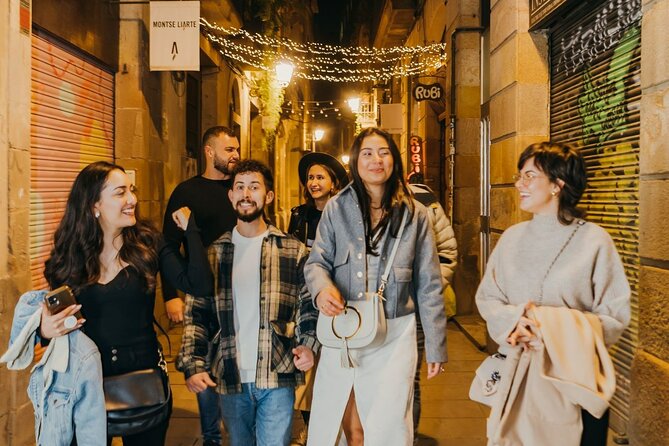
The first stop, Els 4 Gats, brings you into the social world behind Barcelona’s art. This historic café and restaurant was linked with artists, writers, intellectuals, and modernists. Pablo Picasso and Antoni Gaudí were among the figures associated with the place.
The value here is not simply seeing a pretty Art Nouveau interior. Your guide can explain why cafés mattered so much to creative life in the late nineteenth and early twentieth centuries. You begin to see Barcelona not only as a city of grand buildings, but as a place where artists met, argued, traded ideas, and built reputations.
You should not expect a long sit-down visit during the ten-minute stop. It is a quick orientation to the café’s role and a chance to connect famous names with an actual address.
Catalan memory at El Món Neix en Cada Besada
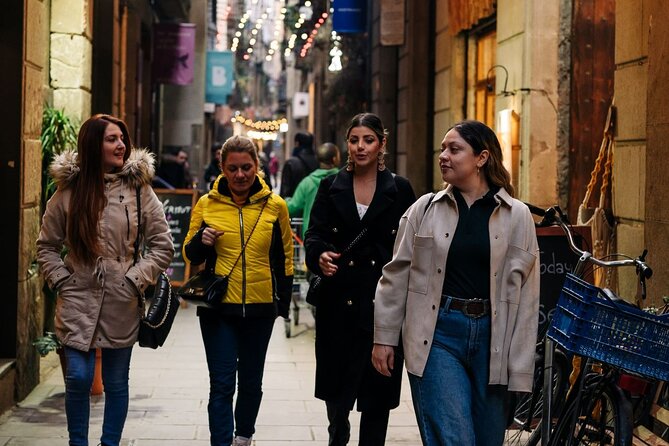
The next stop shifts from art to politics and identity. El Món Neix en Cada Besada, or The World Begins with Every Kiss, is a large photo mosaic created in 2014.
The image relates to the Catalan defeat on September 11, 1714, during the War of Spanish Succession. That date later became La Diada, Catalonia’s national day. The artwork gives your guide a way to explain how public art can carry ideas about freedom, memory, and belonging.
This is one of the tour’s more modern stops. It keeps the walk from becoming a parade of medieval stone and helps you understand that Barcelona’s past remains part of present-day life. The explanation will likely matter more than the object itself, so stay close enough to hear the context.
Barcelona Cathedral and the story of Saint Eulalia
Barcelona Cathedral sits at the heart of the Gothic Quarter. Its Gothic design and connection to Saint Eulalia, the city’s patron saint, make it one of the route’s major landmarks.
The cathedral honors Eulalia, who was tortured and killed by the Romans. That story links the Christian history of Barcelona with the city’s Roman beginnings. It also shows how legends, religion, and civic identity often overlap in old European cities.
The stop is listed at about ten minutes, so this is mainly an outside explanation unless you choose to enter separately. Admission is not included. If the cathedral is high on your list, consider returning later when you can give the interior proper attention.
A few more walking tours around Barcelona worth a look
- Barcelona Tapas and Wine Experience Small-Group Walking Tour
★ 5.0 · 5,804 reviews - Barcelona: Tapas Walking Tour with Food, Wine, and History
★ 4.8 · 4,261 reviews - Barcelona: Food Walking Tour with Tapas and Wine
★ 4.9 · 2,180 reviews - Barcelona Tapas Walking Tour: Food, Wine & History
★ 4.5 · 1,928 reviews
Roman traces at Casa de l’Ardiaca
Casa de l’Ardiaca is an unusual building that brings several periods together. Its Gothic and Renaissance elements surround parts of the Roman wall and aqueducts.
This is the sort of place that is easy to miss on your own. It does not announce its importance like a major church or palace. A guide helps you notice how Barcelona was built layer upon layer, with later homes and civic buildings absorbing pieces of the Roman city.
The stop also gives you a useful way to read the Gothic Quarter. Look down narrow lanes and around courtyards, and you may find that the old city is not one neat period. Roman, medieval, Renaissance, and modern Barcelona often sit within a few steps of one another.
The Bishop’s Bridge and its famous superstition
Carrer de Bisbe was one of the main routes through Roman Barcino, and the Neo-Gothic Pont del Bisbe now forms one of the most photographed views in the quarter.
The bridge looks medieval, but its style is Neo-Gothic. That makes it a good reminder that old-looking does not always mean ancient. Your guide also shares the superstition attached to the bridge, giving the stop a touch of mystery.
This is a short photo stop, and it can be busy. You will get more from it if you listen for the story rather than treating it as a quick backdrop for a picture. The narrow street also shows why a walking tour can reach corners that a coach cannot.
Plaça Sant Felip Neri and the scars of war
Plaça Sant Felip Neri is one of the most affecting places on the route. Its quiet appearance contrasts with its painful connection to the Spanish Civil War. Marks on the surrounding walls remain visible reminders of the violence that reached this small square.
The setting can feel almost too peaceful for its past. That contrast gives the guide an opening to discuss how conflict leaves physical traces in ordinary neighborhoods, not just in museums and monuments.
This stop rewards a slower look. Do not rush to photograph the fountain and move on. Take a moment to notice the damaged walls and the enclosed shape of the square. The ten-minute visit is brief, but the subject deserves more than a passing glance.
El Call and Barcelona’s Jewish quarter

MUHBA El Call takes you into Barcelona’s former Jewish quarter. The area is defined by narrow streets, medieval buildings, and the remains of a community that shaped the city’s story.
The route includes discussion of the synagogue and local legends. This is important because the Gothic Quarter can otherwise seem like a purely Christian medieval district. El Call adds another layer, showing that different religious and cultural communities lived, worked, and worshipped within the old city.
Expect a street-level introduction rather than a long museum visit. If this subject interests you, use the tour as a starting point and return to explore more carefully. The guide’s explanation can help you understand the layout before you wander on your own.
Plaça de Sant Jaume and civic Barcelona
Plaça de Sant Jaume is a working square as well as a historic one. Government buildings surround it, and public activity continues here today.
This stop gives the walk a civic center. After churches, alleys, and old walls, you see where political life is still carried out. It is also a useful place to connect Barcelona’s past with Catalan government and identity.
The square may feel less intimate than the tiny lanes nearby, but that is part of its role. It is a broad public stage, and your guide can explain why this location has remained important across centuries.
Plaça del Rei, royal power, and darker stories
Plaça del Rei appears elegant and controlled, with the Royal Palace forming its central historical focus. The square offers a look at Barcelona’s royal past, but the stop also points toward darker events connected with the city.
This is where a good guide can make a difference. A list of kings and dates can become dry very quickly. Stories about power, ceremony, and the less comfortable side of royal rule make the buildings easier to remember.
The square is also a strong visual pause in the route. Compared with the tight streets of El Call, its open space lets you take in the scale of medieval authority. Again, the ten-minute stop is an introduction, not a substitute for a museum visit.
Plaça de l’Àngel and the angel legend
Plaça de l’Àngel was once known as Wheat Square, a name tied to grain trading. Its present name comes from a heavenly legend.
This stop shows how ordinary commerce and religious storytelling helped shape Barcelona’s street names. You get a glimpse of the practical city, where grain was bought and sold, alongside the symbolic city of saints and angels.
It is a small piece of the larger route, but these details are useful. After the tour, you are more likely to notice that Barcelona’s plazas often preserve clues about what happened there long before modern traffic and cafés arrived.
Santa Maria del Mar and the route’s strong finish
The walk ends at the Basilica of Santa Maria del Mar in El Born. This Catalan Gothic church is closely tied to Barcelona’s maritime history and gives the tour a fitting final landmark.
Santa Maria del Mar feels different from the cathedral because its identity is closely connected to the people and trade of the waterfront district. The church helps bring together several themes from the walk: medieval religion, commerce, architecture, and the importance of the sea to Barcelona’s growth.
Admission is not included, so plan to return if you want to see the interior. Ending here is still practical even if you do not go inside. You are already in El Born, an area worth exploring for its streets, food, and further historic sites.
Guides, pace, and group size
The guide is central to the value of this experience. Names associated with the tour include Juan, Lidia, Jordan, Vanesa, Darren, Petra, Sonia, Thami, Jorge, Tammy, Mariah, Sara, Craig, Justin, and David. You may not receive a particular guide, but the feedback points to a broad mix of storytelling styles.
Juan has been praised for explaining Spanish history, answering questions, using an iPad to show the past, and offering suggestions for food, bars, and attractions. Lidia is known for energy, humor, and local knowledge. Jordan brings comedy into the history, while Vanesa has been especially good at keeping children involved.
The pace is generally described as easy, with enough time for photos. One useful tip is to choose a morning departure when possible. It is cooler and usually less crowded, which makes it easier to hear the guide and move through narrow streets.
The group limit is 20 people. That is not private-tour size, but it is small enough to feel more personal than a large crowd. One caution: guide quality can vary. A rare poor experience involved a guide who spoke too softly for the group to hear. If that happens, speak up early and ask the guide to project more.
Is $30.25 good value?
I consider the price fair for a two-hour English-language walk through the city’s oldest districts. You receive a local guide, a planned route, historical context, and access to streets that buses cannot reach.
The value is strongest if you are new to Barcelona or want a clear introduction before exploring alone. It is also useful for repeat visitors who have seen the main sights but never understood how the Roman, Jewish, royal, religious, and artistic stories fit together.
The value is weaker if you want long interior visits. Two church admissions are not included, and the route covers many stops in a short period. Think of the tour as a guided framework. You will still need to choose which places deserve a return visit.
Carpe Diem Tours offers free cancellation up to 24 hours before the start time. Confirmation arrives when you book, and the meeting point is near public transportation. Most people can take part, but remember that this remains a walking tour on old-city streets.
Who should book this Barcelona walking tour?
I would choose it for first-time visitors, couples, families with older children, and anyone who wants a useful orientation without spending half a day on a formal museum tour.
It suits you especially well if you enjoy stories about people and places. Picasso, Gaudí, Saint Eulalia, Catalan memory, the Spanish Civil War, Jewish Barcelona, royal power, and maritime trade all appear along the way.
I would look elsewhere if your priority is interior access, deep architectural study, or a private pace. You may also prefer another option if a short list of major sights matters more to you than small lanes and local anecdotes.
Should you book it?
Yes, if you want a friendly, efficient introduction to Barcelona’s Gothic Quarter and El Born. The route is well chosen, the price is reasonable, and the best guides add useful advice for the rest of your stay.
Book it early in your visit, aim for the morning, and treat the church stops as previews rather than full visits. With that expectation, this two-hour walk can give you the city’s oldest center in a form that is easy to understand and simple to explore afterward.
FAQ
How long does the Barcelona Historical Walking Tour last?
The tour lasts approximately two hours.
How much does the tour cost?
The listed price is $30.25 per person.
What language is the tour offered in?
The tour is offered in English.
Where does the tour begin?
The meeting point is Plaça del Vuit de Març in Ciutat Vella, Barcelona.
Where does the tour end?
The tour ends at the Basilica of Santa Maria del Mar, at Plaça de Santa Maria, 1, in Ciutat Vella.
Is admission to Barcelona Cathedral included?
No. Admission to Barcelona Cathedral is not included in the tour price.
Is admission to Santa Maria del Mar included?
No. Admission to the Basilica of Santa Maria del Mar is not included.
How many people can join the tour?
The activity has a maximum group size of 20 people.
Can I cancel for a refund?
Yes. You can cancel at least 24 hours before the experience begins for a full refund. Cancellations or changes made less than 24 hours before the start time are not accepted for a refund.
Just added around Barcelona
- Private Barcelona Old Town and Gothic Quarter Walking Tour★ 5.0 · 134 reviews
- Barcelona Gothic Quarter Walking Tour with Tapas★ 5.0 · 248 reviews
- Barcelona Private Food Tour: Tapas, Paella & 8+ Food Tastings★ 5.0 · 164 reviews
- Picasso Museum and Walking Tour Plus Optional Wine & Food Tasting★ 5.0 · 596 reviews
- Semi-Private Montserrat Monastery, Funicular & Scenic Nature Walk★ 5.0 · 172 reviews
- Barcelona Architecture Walking Tour With Casa Batlló Upgrade★ 5.0 · 137 reviews
- Montjuïc Walking Tour With Optional Flamenco Show★ 5.0 · 196 reviews
- Private Tour Spanish Civil War & Franco’s Dictatorship★ 5.0 · 116 reviews
History Walking Tours, compared.

Berlin’s Best: 2 Hour Walking Tour Third Reich and the Cold War
Read our review →
Third Reich Berlin: Hitler and WWII Walking Tour
Read our review →
New Orleans Garden District History Walking Tour
Read our review →
Cartagena: Historic Center and Getsemaní Shared Walking Tour
Read our review →
Imperial Palace and Shogun Historical Walking Tour
Read our review →Browse the lists this tour appears in