
REVIEW · BARCELONA
Barcelona Architecture Walking Tour With Casa Batlló Upgrade
Barcelona’s great architectural story unfolds along this route, from the former Sant Pau hospital to the grand façades of Passeig de Gràcia. The tour gives you the useful context that can be hard to find when you are simply standing beneath Gaudí’s twisting balconies and colorful tiles.
I like the clear choice between a basic walking tour and one with Casa Batlló admission, and I like the stop at Casa Amatller, where you sample Barcelona chocolate instead of only taking pictures. The main drawback is sound: one group found the guide walked too quickly and was hard to hear on noisy streets without listening devices.
Key points at a glance
- Sant Pau starts the story: Begin at Lluís Domènech i Montaner’s former hospital complex, one of Barcelona’s major Modernist works.
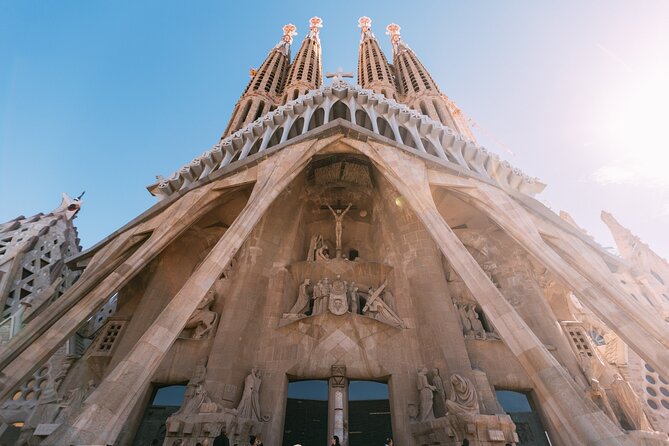
- Sagrada Família is viewed from outside: You get time to study its façades and symbols, but entry is not included.
- Passeig de Gràcia supplies the grand finale: Casa Milà, Casa Batlló, Casa Amatller, and Casa Lleó Morera appear in one remarkable stretch.
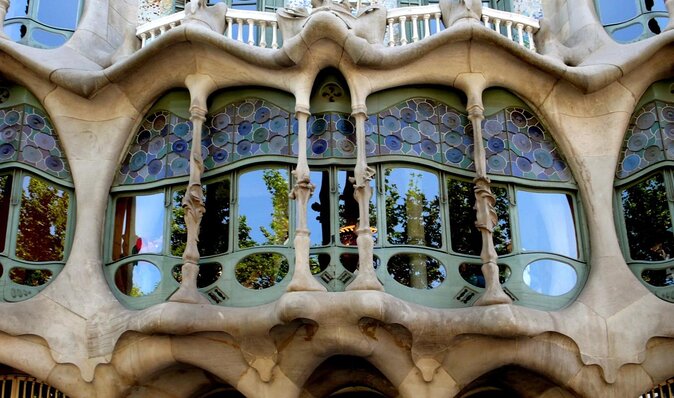
- Casa Batlló is an optional upgrade: Add admission if you want to go inside one of Gaudí’s most elaborate buildings.
- Chocolate makes a welcome stop: The tour enters Casa Amatller’s ground-level shop for a sample.
- Expect a brisk urban walk: The route lasts about two to two and a half hours and can include up to 20 people.
Why this route works for Barcelona architecture
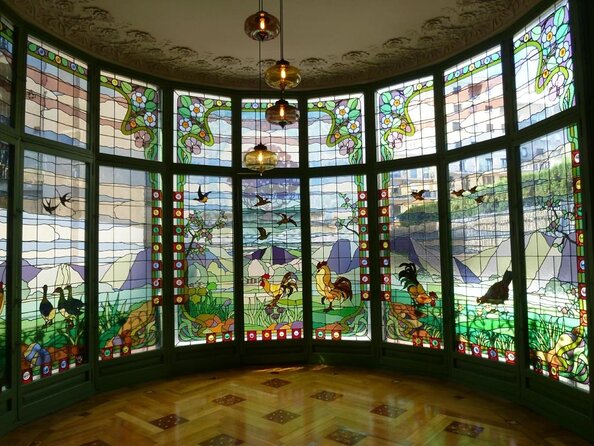
Barcelona’s Modernist buildings are not grouped in one tidy museum. They line avenues, fill city blocks, and appear in places you might otherwise rush past. This tour connects several of the best-known examples, giving you a visual thread from hospital design to churches, apartment houses, and elaborate private residences.
The route is especially useful if you are new to Barcelona. An architecture guide can point out how Lluís Domènech i Montaner, Antoni Gaudí, and Josep Puig i Cadafalch approached similar ideas in very different ways. You will see curves, ceramic decoration, sculpted stone, ironwork, towers, and symbols that make more sense once someone explains what you are looking at.
The advertised price is $35.07 per person. For that amount, you receive the walking tour, a local guide, and the Casa Amatller chocolate sample. It is a reasonable price for a focused introduction, but remember that major building entrances are not part of the standard option. The Casa Batlló upgrade costs more, and Sagrada Família entry must be arranged separately if you want to see the interior.
A few more walking tours around Barcelona worth a look
- Barcelona Tapas and Wine Experience Small-Group Walking Tour
★ 5.0 · 5,804 reviews - Barcelona: Tapas Walking Tour with Food, Wine, and History
★ 4.8 · 4,261 reviews - Barcelona: Food Walking Tour with Tapas and Wine
★ 4.9 · 2,180 reviews
Sant Pau begins with a former hospital
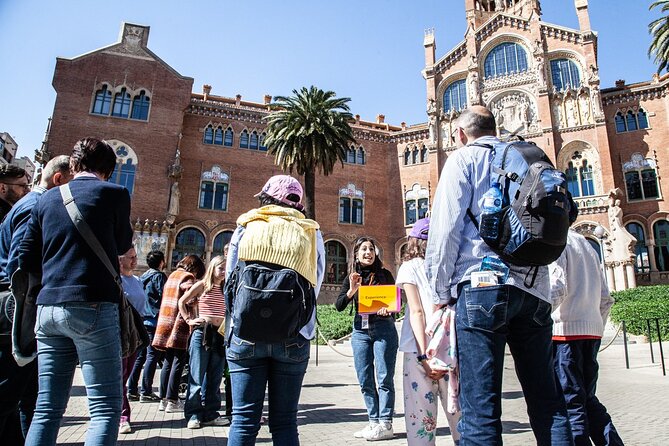
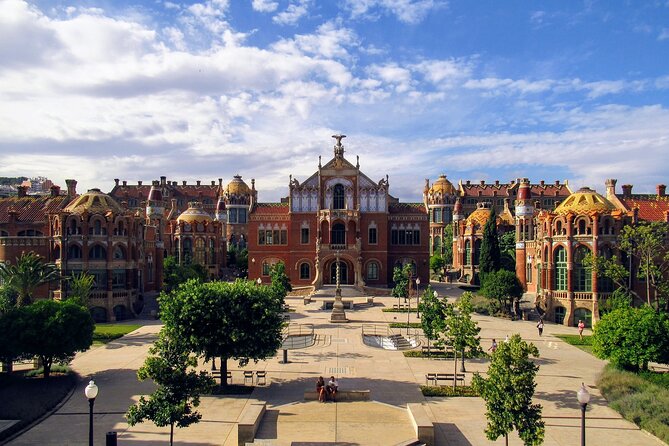
Meet at Recinte Modernista de Sant Pau, at Carrer de Sant Antoni Maria Claret, 167. This is more than a convenient starting point. Sant Pau is one of Barcelona’s most important Modernist sites, designed by Domènech i Montaner and once used as one of the city’s leading hospitals.
The complex served as a hospital until the late 1990s, which gives the architecture an unusual practical background. This was not simply a grand residence or decorative public monument. It was a working medical campus, designed with courtyards, pavilions, ornament, and careful attention to the setting.
You spend about 15 minutes here. Admission to the complex is not included, so the focus is on viewing and discussing the exterior. That short stop works as an introduction to Catalan Modernism, although you should not expect a full visit to the hospital buildings.
From Sant Pau, the route continues along Avinguda Gaudí. This connection is useful because you are not being whisked between unrelated sights. You walk toward the Sagrada Família while the guide develops the architectural story.
Sagrada Família from every useful angle
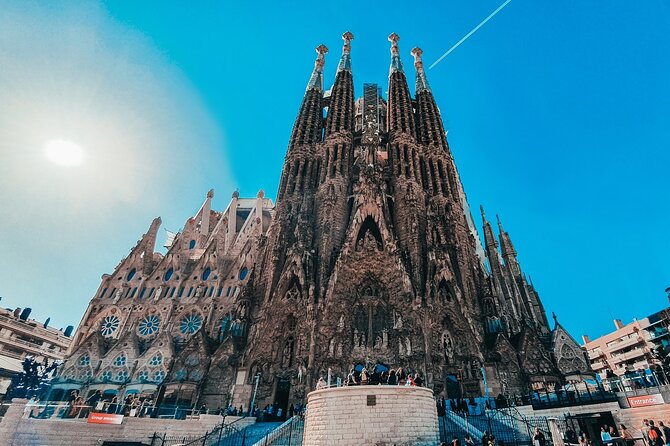
The Basilica de la Sagrada Família is the tour’s biggest landmark, but this experience does not include entry. You study the church from the outside for about 30 minutes, looking at its façades, sculptural details, and symbols.
That distinction matters. You will learn how to read the exterior and see the basilica from several angles, but you will not climb the towers or enter the nave on this tour. If Sagrada Família is a top priority, reserve a separate interior visit for another time. Combining that visit with this walking tour makes sense: the tour gives you background and orientation, while a separate ticket lets you spend time inside at your own pace.
The exterior can be visually overwhelming. There are biblical scenes, unusual forms, towers, and layers of decoration competing for your attention. A guide helps narrow the field. Instead of only taking in the famous silhouette, you can focus on the meaning behind details on the Nativity and Passion façades.
Allow yourself some flexibility here. A city street near a major monument is rarely quiet, and one past group found it difficult to hear the guide without listening equipment. Stay close, ask questions promptly, and choose a position where you can see the guide’s face. The group may have up to 20 people, though some departures can be much smaller.
Two shorter stops with a different feel
The next stops broaden the picture beyond the famous Gaudí sites. At CaixaForum Macaya, you spend about 10 minutes hearing the story behind this lesser-known building. It offers a quick reminder that Barcelona Modernism was not the work of one architect alone.
Casa de les Punxes follows, with about 15 minutes devoted to what the tour presents as one of the city’s most fairy-tale-like houses. Its towers and decorative silhouette make it easy to understand why Barcelona architecture rewards looking up. You may not spend long enough to explore every feature, but the stop gives you another example of how private buildings were designed to display wealth, personality, and artistic ambition.
These shorter stops are part of the route’s strength. The tour does not treat Barcelona as a one-architect city. Gaudí gets much of the attention, naturally, but the city’s Modernist identity came from several architects working in the same broad period.
Same streets, a different route:
- Barcelona Tapas Walking Tour: Food, Wine & History
★ 4.5 · 1,928 reviews - Barcelona Helicopter, Sailboat & Old Town Private Walking Tour
★ 5.0 · 1,395 reviews - Barcelona: Old Town and Gothic Quarter Walking Tour
★ 4.8 · 1,393 reviews - Barcelona: City Walking Tour with a Local Guide
★ 4.9 · 1,384 reviews
Passeig de Gràcia gathers the famous façades
The walk reaches Passeig de Gràcia, one of Barcelona’s most rewarding streets for architecture. Over roughly 30 minutes, the guide focuses on Casa Milà, Casa Batlló, Casa Amatller, and Casa Lleó Morera.
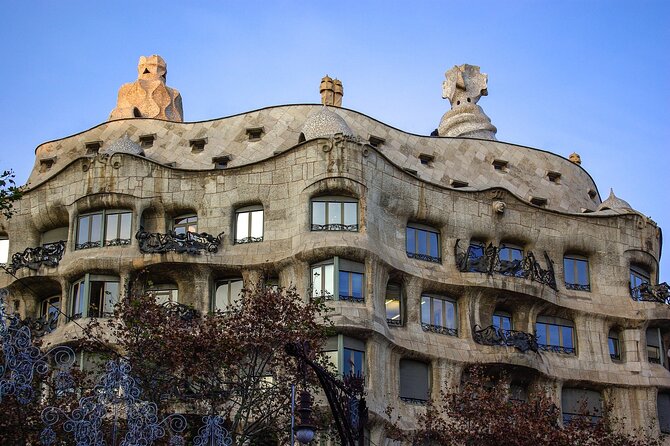
This is where the tour’s comparisons become most useful. The buildings sit close enough together for you to see different approaches side by side. Casa Milà has its famous stone exterior and sculptural roofline. Casa Batlló uses color, curved surfaces, and elaborate window decoration. Casa Amatller has its own distinct façade, while Casa Lleó Morera adds another voice to the same grand avenue.
The collection is known as La Mansana de la Discordia, or the Block of Discord, because several leading architects created competing works along the same stretch. You do not have to be an architecture student to enjoy the effect. It is simply one of the best places in Barcelona to compare buildings without crossing the entire city.
The guide’s value is highest here. A good explanation can help you separate Gaudí’s work from that of Domènech i Montaner and Puig i Cadafalch, rather than reducing every unusual building to the label Gaudí. Guides named in past departures include Perrine, Cal, and Patricio. Perrine was particularly praised for connecting architecture with Catalan culture, politics, and economics. Patricio was singled out for his clear focus on Gaudí and his work.
Casa Batlló: decide if the upgrade fits
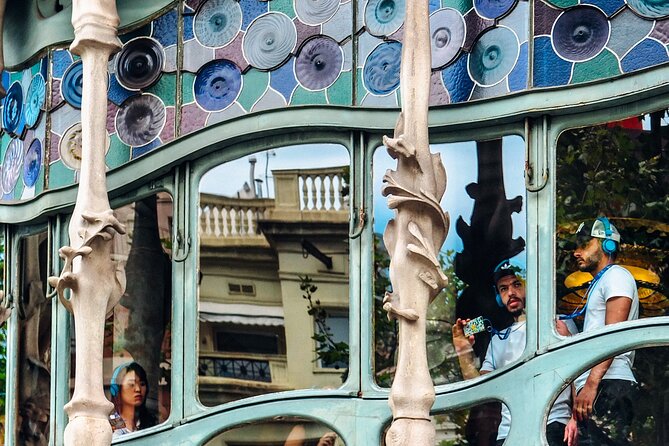
The optional Casa Batlló admission is the main choice you make when booking. The standard walk lets you see the exterior and hear the story. The upgrade adds entry to one of Gaudí’s most elaborate creations.
I think the upgrade makes the most sense if you care about interiors, not just façades. Casa Batlló’s exterior already gives you plenty to study, including color, windows, curves, and decorative details. Inside, the building’s design can be understood as a complete environment rather than a pretty front on Passeig de Gràcia.
The upgrade is also a good choice if you have limited time in Barcelona and want one major interior included with your architecture day. On the other hand, budget-minded visitors can skip it and use the walking tour as a guide to the outside of the building. You can then decide later how many interiors you want to pay for.
The tour timing places the Passeig de Gràcia section near the end, so the Casa Batlló visit functions as an add-on rather than the core of the walking route. Check the exact booking option carefully. Entry to other buildings, including Sagrada Família, is not included.
Casa Amatller adds chocolate to the architecture
Casa Amatller provides one of the more memorable small touches on the route. You enter the ground-level shop for a Barcelona chocolate sample and hear more about the building.
This is not a full interior tour of Casa Amatller. Still, it breaks up the steady parade of façades and gives you a taste tied to the setting. The stop lasts about 15 minutes and is included, unlike most major building admissions.
It also reinforces a useful point about Passeig de Gràcia: these were not abstract art projects floating apart from daily life. They were homes, shops, commercial spaces, and city buildings. A short chocolate stop helps the street feel less like an outdoor architecture exam.
Pace, group size, and hearing the guide
The advertised duration is about two to two and a half hours. You cover a substantial part of central Barcelona on foot, so comfortable shoes are sensible. The tour begins at Sant Pau and ends at Passeig de Gràcia, in front of Casa Lleó Morera at Passeig de Gràcia, 35.
The route is near public transportation at both ends, which makes it practical to fit into a day of sightseeing. You can start at Sant Pau, continue with other sights around Eixample, or use the ending near Passeig de Gràcia for your next stop.
The group limit is 20 people. That is small enough for a personal feel when the guide manages the group well, but it is not a private tour. One past group of 12 found the walking pace too fast and had trouble hearing because there were no listening devices and the streets were noisy. This is the most important practical caution.
Some guides clearly bring strong subject knowledge and energy. Perrine was praised for giving cultural, political, and economic context, while another guide brought a trainee who added local tips. But guide quality and group management can vary from one departure to another. Stay near the front if you want to catch every explanation, and ask the guide to repeat a point if street noise gets in the way.
Who will get the most from this tour
This is a strong match for you if you want a structured introduction to Barcelona’s architecture without spending the day inside museums. It suits history and architecture fans, first-time visitors, and anyone who wants to understand the city before visiting Sagrada Família or Casa Batlló on their own.
It also works well for couples or small groups with different interests. The architecture fan gets the façades and design details. The history-minded person gets context about Catalan Modernism and Barcelona’s development. The chocolate stop adds a lighter moment.
You may want another plan if you dislike walking, need a slow pace, or want extensive interior visits included. This is an outdoor-focused route, and the standard ticket does not cover entry to the major buildings. It is also less suitable if you need every explanation delivered through a headset, since listening devices were not available to at least one group.
Booking value and cancellation terms
At $35.07, the basic option offers a useful amount of guided context for the price. You are paying for a focused route, a local guide, and the chocolate sample, not a collection of entrance tickets. That keeps the base price manageable and lets you choose which interiors matter most.
The Casa Batlló upgrade is worth considering if you already know you want to go inside. If you plan to visit only exteriors, save the extra cost and use the guide’s explanations to make your later sightseeing more meaningful.
The experience is offered in English and uses a mobile ticket. You receive confirmation at booking. Free cancellation is available up to 24 hours before the start time, while cancellations or changes made inside that window are not accepted for a refund.
Should you book it?
Book this Barcelona Architecture Walking Tour if you want the city’s Modernist buildings explained as a connected story rather than seen as isolated photo stops. The route covers Sant Pau, Sagrada Família, Casa de les Punxes, and the architectural concentration on Passeig de Gràcia, with a practical choice to add Casa Batlló.
I would choose the upgrade if Casa Batlló is high on your list and you value seeing one major interior. I would choose the basic option if you are watching your budget or have already arranged your own building tickets. Either way, plan for a brisk walk, stay close enough to hear, and treat the tour as an architectural orientation rather than a full entry tour of Barcelona’s monuments.
FAQ
How long does the Barcelona Architecture Walking Tour last?
The tour lasts approximately two hours to two hours and 30 minutes.
Where does the tour begin?
It begins at Recinte Modernista de Sant Pau, at Carrer de Sant Antoni Maria Claret, 167, Barcelona.
Where does the tour end?
The tour ends at Passeig de Gràcia, 35, in front of Casa Lleó Morera.
Is Sagrada Família admission included?
No. The tour views Sagrada Família from outside, and admission to the basilica is not included.
Can I visit Casa Batlló during the tour?
Yes, if you select the optional Casa Batlló admission upgrade when booking.
Is the chocolate sample included?
Yes. A chocolate sample at Casa Amatller is included in the experience.
How large can the tour group be?
The tour has a maximum group size of 20 people.
Is the tour offered in English?
Yes. The experience is offered in English and uses a mobile ticket.
Just added around Barcelona
- Private Barcelona Old Town and Gothic Quarter Walking Tour★ 5.0 · 134 reviews
- Barcelona Gothic Quarter Walking Tour with Tapas★ 5.0 · 248 reviews
- Barcelona Private Food Tour: Tapas, Paella & 8+ Food Tastings★ 5.0 · 164 reviews
- Picasso Museum and Walking Tour Plus Optional Wine & Food Tasting★ 5.0 · 596 reviews
- Montjuïc Walking Tour With Optional Flamenco Show★ 5.0 · 196 reviews
- Semi-Private Montserrat Monastery, Funicular & Scenic Nature Walk★ 5.0 · 172 reviews
- Private Tour Spanish Civil War & Franco’s Dictatorship★ 5.0 · 116 reviews
- Barcelona: La Boqueria Food, Wine & History Walking Tour★ 5.0 · 126 reviews
Walking Tours, compared.

Magical London: Harry Potter Guided Walking Tour
Read our review →
Reykjavik Food Walk – Local Foodie Adventure in Iceland
Read our review →
History and Hauntings of Salem Guided Walking Tour
Read our review →
New Orleans Premier Ghost, Voodoo and Vampire Walking Tour
Read our review →
Amsterdam Anne Frank: Small-Group Walking Tour & Local Guide
Read our review →

Edinburgh Castle: Guided Walking Tour with Entry Ticket
Read our review →
Anne Frank’s Story – Guided Walking Tour through Amsterdam
Read our review →Browse the lists this tour appears in