
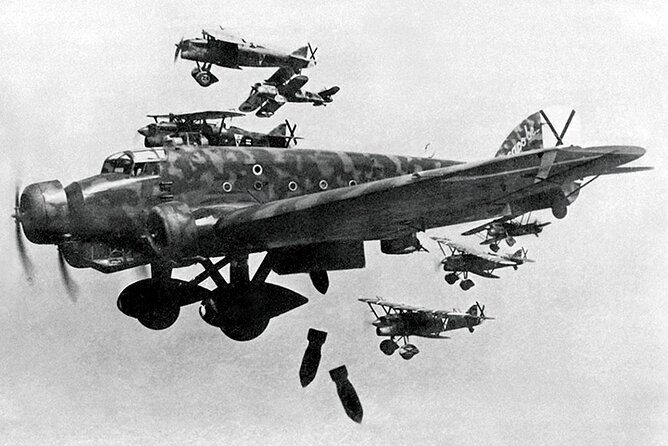
REVIEW · BARCELONA
Private Tour Spanish Civil War & Franco’s Dictatorship
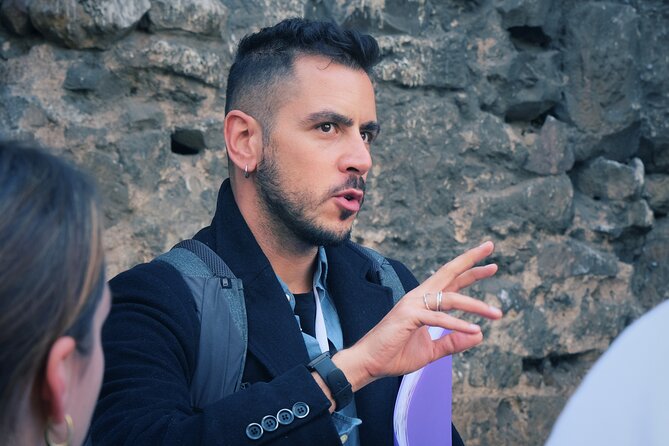
Barcelona’s Civil War story is written into ordinary streets, church walls, and old buildings. This private walking tour connects those places, from the fight for the Telefonica building at Plaça de Catalunya to the bomb scars at Sant Felip Neri. Yannis is one guide associated with the experience, and his clear, passionate teaching can help turn a difficult subject into a human story.
I like the private format, since you can give your guide your full attention and ask questions without keeping pace with a large group. I also like the route’s focus on overlooked details, including George Orwell’s Barcelona connection and the International Brigades. The main drawback is the price: at $181.41 per person, it is a serious spend for a two-and-a-half-hour walk, especially for a solo visitor.
Key points to know before booking
- Six central Barcelona stops: The route runs from Plaça de Catalunya to Plaça Nova near the Cathedral.
- A private English-language tour: Only your group takes part, with an expert guide leading the walk.
- A difficult subject handled on location: You discuss fighting, hunger, political conflict, bombing, injury, and dictatorship where those events unfolded.
- George Orwell and the International Brigades: The tour adds personal and international angles to the conflict.
- Flexible scheduling: Tour times are designed to fit around your Barcelona plans.
- Good weather matters: The experience can be moved or refunded if poor weather forces cancellation.
Why Barcelona’s Civil War story works best on foot
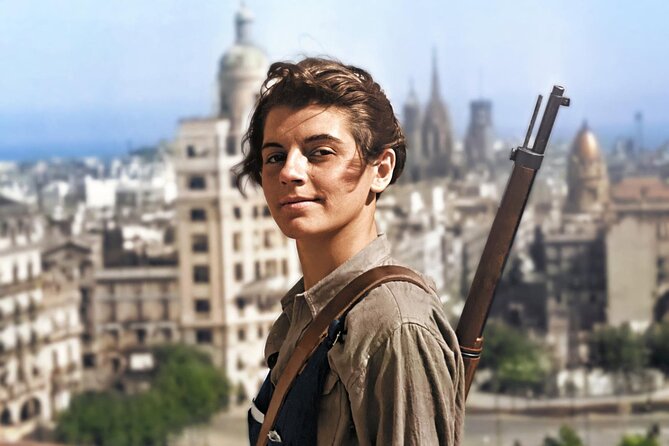
The Spanish Civil War can feel distant when you meet it only in books or museums. In Barcelona, the subject becomes easier to grasp because the route uses real streets and surviving structures. You are not simply given a list of dates. You move through the city and see how political violence affected workers, soldiers, civilians, writers, churches, and ordinary neighborhoods.
This is a history-focused walking tour, not a general introduction to Barcelona. You should book it because you want to understand the conflict and Franco’s dictatorship, not because you are looking for postcard views or a relaxed city stroll.
The private setup makes a difference here. Civil War history brings up political divisions, anarchism, foreign intervention, cultural repression, and the human cost of bombing. With only your own group present, you can ask for more background on the parts that interest you, or slow down when a site needs explanation.
The tour lasts about two hours and 30 minutes. The listed timing adds up to roughly two hours and 50 minutes, so you should allow some flexibility in your day. Walking times, questions, and the pace of the group can affect the schedule.
Other walking tours people book in Barcelona:
- Barcelona Tapas and Wine Experience Small-Group Walking Tour
★ 5.0 · 5,804 reviews - Barcelona: Tapas Walking Tour with Food, Wine, and History
★ 4.8 · 4,261 reviews - Barcelona: Food Walking Tour with Tapas and Wine
★ 4.9 · 2,180 reviews
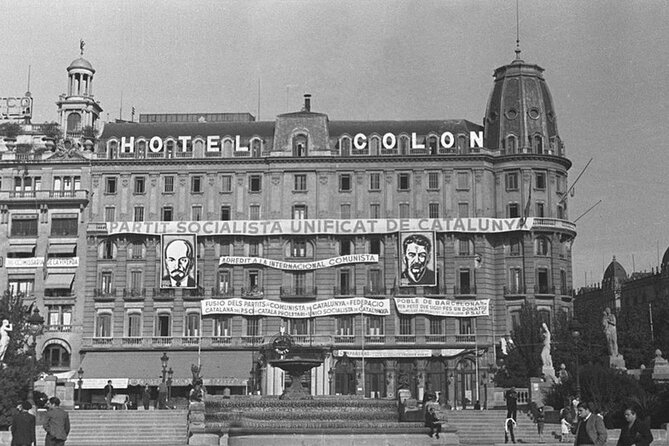
Plaça de Catalunya and the fight for Telefonica
The tour begins outside Foot Locker at Plaça de Catalunya, 20. This is a practical meeting point in central Barcelona, close to public transportation and easy to place on a sightseeing day.
The opening discussion focuses on the struggle over the Telefonica building during the Civil War. That gives your guide a strong way to introduce the conflict, since the subject begins with a specific building and a fight over control rather than with a long lecture.
You can expect about 30 minutes here. Your guide will set out the wider political situation and explain why this location mattered during the fighting. This first stop is useful if you know little about the war, since it gives the rest of the walk a basic framework.
Plaça de Catalunya is a busy city space, so the setting may not feel quiet or reflective. Still, that contrast has value. You are discussing armed conflict in a place that now functions as a normal urban meeting point.
La Rambla and Orwell’s Barcelona

The next stop is La Rambla, where the tour discusses the hotel in which George Orwell stayed during the Spanish Civil War. The stop lasts about 20 minutes and adds a personal, literary angle to the political story.
Orwell’s connection helps explain how the conflict looked to a foreign observer who was directly involved in Barcelona’s tense political world. It also gives you a way to connect the city’s street fighting and ideological divisions with the experiences of people who came from abroad.
This stop may appeal most if you have read Orwell or want to understand why international writers and political activists paid attention to Spain. If you have no interest in literature, the site still matters because it broadens the story beyond Spanish institutions and military events.
Do not expect an interior hotel visit or a literary museum. The value is in the guide’s explanation of what happened in and around the building, not in a formal attraction with displays.
Raval, workers, and anarchist resistance
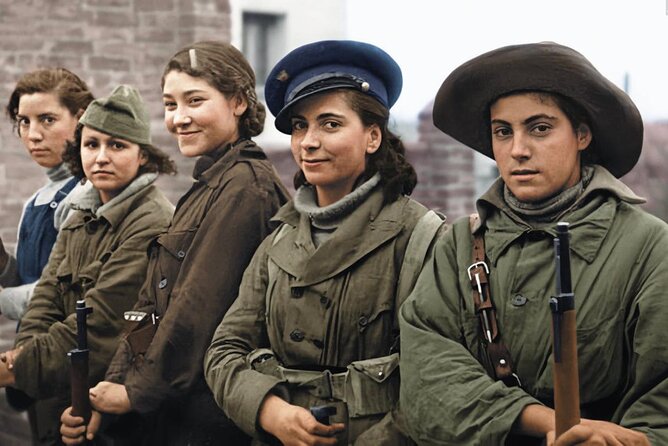
At Plaça de Vicenç Martorell, the tour enters the Raval neighborhood’s wartime story. The discussion centers on working-class suffering, resistance, and anarchism, with about 20 minutes at the square.
This is one of the route’s most important stops because it shows that the Civil War was not only a contest between armies. Political ideas shaped daily life, and working people faced the direct effects of shortages, violence, and social upheaval.
Anarchism is often reduced to a label in a general history lesson. Here, the neighborhood gives the subject a physical setting. Your guide can explain why the Raval became linked with working-class politics and resistance, while also addressing the hardship endured by local people.
The stop is brief, so the private format helps. You can ask your guide to clarify terms or political groups instead of trying to absorb everything while a large crowd waits.
Same streets, a different route:
- Barcelona Tapas Walking Tour: Food, Wine & History
★ 4.5 · 1,928 reviews - Barcelona Helicopter, Sailboat & Old Town Private Walking Tour
★ 5.0 · 1,395 reviews - Barcelona: Old Town and Gothic Quarter Walking Tour
★ 4.8 · 1,393 reviews - Barcelona: City Walking Tour with a Local Guide
★ 4.9 · 1,384 reviews
Antic Hospital de la Santa Creu and the war’s human cost
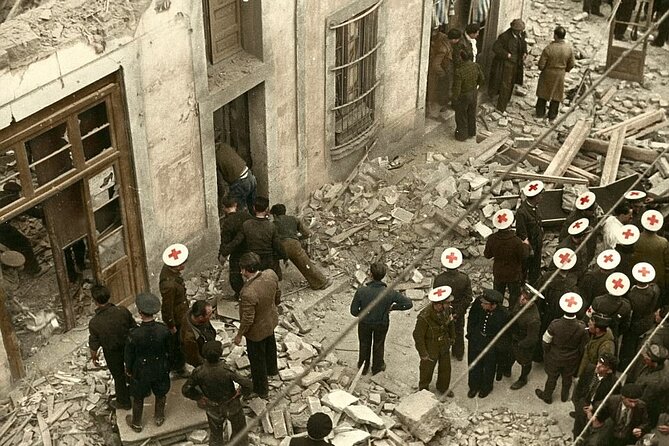
The Antic Hospital de la Santa Creu brings the focus back to wounded soldiers and civilians. This old hospital dates to the 15th century, and the tour allows about 20 minutes to discuss the people who passed through during the conflict.
A hospital is a useful place to consider war from the point of view of injury and care. Military campaigns and political arguments can sound abstract. The hospital makes the consequences more immediate: people were hurt, treated, and left to deal with the results.
Your guide also discusses the end of the war and cultural oppression under Franco’s dictatorship. That transition is important. The experience does not stop when the fighting ends. It follows the story into the years of political control and limits on culture.
The site has its own architectural interest, but the tour’s main purpose here is historical. If you want a long visit inside the hospital complex, this walk may not provide it. The stop is about context rather than a full architectural tour.
Santa Maria del Pi and the International Brigades
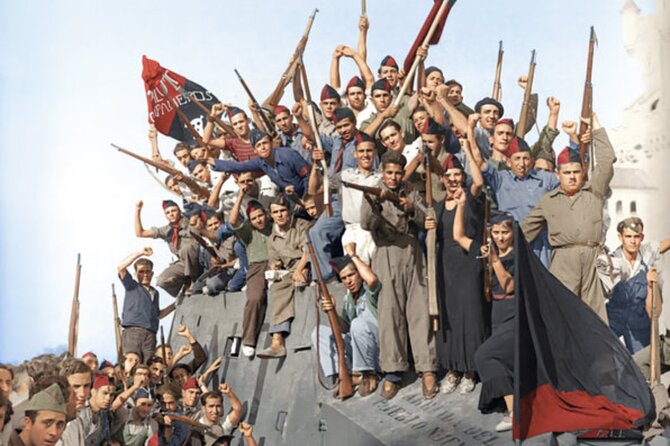
At the Basilica de Santa Maria del Pi, the tour points out a little-known surviving reminder of the Spanish Civil War. The church becomes the setting for a discussion of the International Brigades, the foreign volunteers who came to fight for the Republican side.
This stop adds an international dimension to the route. The war drew people from outside Spain, and the International Brigades remain a powerful part of the conflict’s memory. A church is also a fitting place to consider how public buildings can carry traces of political and military history long after the fighting has ended.
The tour allows about 30 minutes here. That gives your guide time to explain the connection and answer questions. You should expect the emphasis to remain on the Civil War story, not on a full religious or art-history visit to the basilica.
The phrase little-known remnant is important. The evidence here is not presented as a major monument with a large interpretation center. Your guide’s explanation supplies much of the meaning.
Plaça Sant Felip Neri and the visible scars of bombing
The final stop, Plaça Sant Felip Neri, is perhaps the most visually direct part of the walk. It contains some of Barcelona’s clearest surviving damage from aerial bombing, and the tour spends about 30 minutes discussing the attack.
Here, the subject shifts from political struggle to civilian danger from the air. Your guide also explains the role of the Axis powers in the war. That brings in the wider international setting and shows that events in Spain were connected to forces beyond the country’s borders.
The square’s physical damage gives the discussion a strong focus. You can look at the walls while hearing about the bombing, rather than trying to picture destruction from a textbook description. The setting may be emotionally difficult, particularly because the story concerns civilians as well as soldiers.
This is a place where a respectful pace matters. The tour ends near Plaça Nova, close to the Cathedral, so you can continue exploring central Barcelona afterward.
What the private format adds
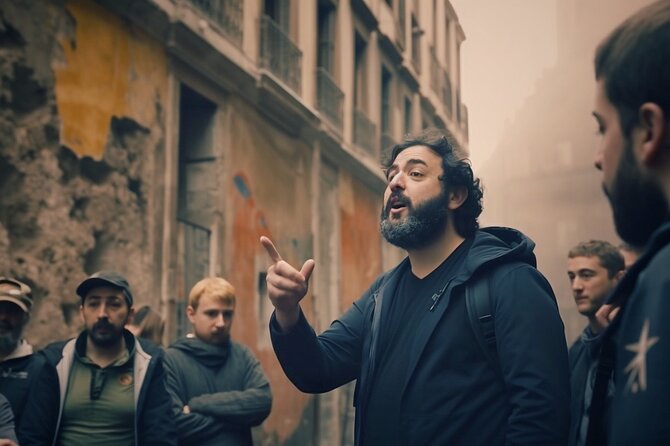
A private tour is most useful when the subject benefits from questions and discussion. You are not limited to a fixed group conversation, and your guide can spend more time on the parts that matter to you.
The format is also practical for mixed-age or mixed-interest groups. One person may want more on Orwell, another may ask about anarchism, and someone else may be most interested in the bombing of Barcelona. A private guide can adjust the conversation more easily than a large scheduled group.
The guide is the main attraction. The route itself uses free public spaces, so the quality of the experience depends heavily on how clearly the guide explains events and links them together. Yannis is specifically associated with an outstanding, passionate approach, so you can ask whether he is available when booking if that matters to you.
The private format does not make the tour cheap. At $181.41 per person, the value improves for a small group that can share the cost. Group discounts may also help. For one person or a couple on a tight budget, a public history walk or museum visit may be a better financial fit.
Timing, walking, and practical planning
The experience is offered in English and uses a mobile ticket. It begins at Foot Locker, Plaça de Catalunya, 20, and ends at Plaça Nova near the Cathedral. Since both points are in central Barcelona, the route can fit before or after other sightseeing in Ciutat Vella.
Tour times are flexible, which is useful if you are working around museum reservations, meals, or a packed city itinerary. Still, I would avoid placing a strict timed booking immediately afterward. The listed stop times total slightly more than the approximate duration, and questions or street conditions can affect the pace.
No food or drink is included. Plan a meal or coffee before or after the walk, especially if you book a morning or midday departure. Tips are not included either, and guides gladly accept gratuities.
Most people can take part, and service animals are allowed. The tour is outdoors and requires walking between central sites. The experience also requires good weather. If poor weather cancels it, you can receive a full refund or choose another date.
Who will get the most from this tour
I would recommend this experience to you if you want political and social context during a Barcelona visit. It is especially suited to readers of Orwell, people interested in the International Brigades, and anyone who wants to understand how Franco’s dictatorship affected culture after the war.
It also works well for a private family group or a few friends who prefer to ask questions freely. The route is compact enough to fit into a sightseeing day, but serious enough to deserve your full attention.
I would think twice if you want a general city tour, indoor attractions, or a purely visual walk. The subject includes suffering, repression, injury, and bombing. It is not light entertainment, though the central route and direct explanations make it accessible.
You should also compare the cost with the size of your group. The $181.41 per-person price is easier to justify when several people share the private guide. For a solo visitor, the personal attention is valuable, but the cost is harder to defend unless this subject is a top priority.
Should you book the Spanish Civil War and Franco tour?
Book it if you want to see Barcelona through its 20th-century political story rather than only its architecture and food. The strongest parts are the specific locations: the Telefonica struggle, Orwell’s hotel, the Raval’s working-class politics, the International Brigades, the old hospital, and the bombing scars at Sant Felip Neri.
The private English-language format and flexible times make it easy to shape the experience around your interests. Ask about Yannis if he is available, and allow extra time beyond the stated two hours and 30 minutes.
Skip it if you are watching every euro, dislike serious historical subjects, or want a tour with included refreshments and interior visits. For the right audience, though, this is a focused way to understand a part of Barcelona that many city tours leave out.
FAQ
How long does the tour last?
The experience lasts approximately two hours and 30 minutes. The listed stop times add up to slightly longer, so allow some flexibility.
What language is the tour offered in?
The tour is offered in English.
Is this a private tour?
Yes. Only your group participates in the activity.
Where does the tour start?
It starts at Foot Locker, Plaça de Catalunya, 20, Ciutat Vella, 08002 Barcelona, Spain.
Where does the tour end?
It ends at Plaça Nova in Ciutat Vella, close to the Cathedral.
What locations are included?
The route includes Plaça de Catalunya, La Rambla, Plaça de Vicenç Martorell, the Antic Hospital de la Santa Creu, the Basilica de Santa Maria del Pi, and Plaça Sant Felip Neri.
Is food included?
No. Lunch, food, and drinks are not included.
Are tips included?
No. Guides gladly accept tips, but gratuities are not included in the price.
Can I cancel for a full refund?
Yes, if you cancel at least 24 hours before the experience start time. Cancellations or changes made less than 24 hours in advance are not refunded or accepted. If poor weather causes the tour to be canceled, you will be offered another date or a full refund.
Just added around Barcelona
- Private Barcelona Old Town and Gothic Quarter Walking Tour★ 5.0 · 134 reviews
- Barcelona Gothic Quarter Walking Tour with Tapas★ 5.0 · 248 reviews
- Barcelona Private Food Tour: Tapas, Paella & 8+ Food Tastings★ 5.0 · 164 reviews
- Picasso Museum and Walking Tour Plus Optional Wine & Food Tasting★ 5.0 · 596 reviews
- Montjuïc Walking Tour With Optional Flamenco Show★ 5.0 · 196 reviews
- Semi-Private Montserrat Monastery, Funicular & Scenic Nature Walk★ 5.0 · 172 reviews
- Barcelona Architecture Walking Tour With Casa Batlló Upgrade★ 5.0 · 137 reviews
- Barcelona: La Boqueria Food, Wine & History Walking Tour★ 5.0 · 126 reviews
Barcelona Walking Tours, compared.

Barcelona Tapas and Wine Experience Small-Group Walking Tour
Read our review →

Barcelona Tapas Walking Tour: Food, Wine & History
Read our review →
Barcelona Helicopter, Sailboat & Old Town Private Walking Tour
Read our review →
Helicopter Flight, Boat Ride, and Walking Tour
Read our review →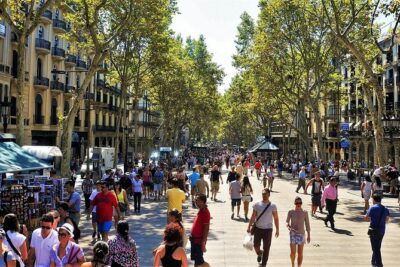
Barcelona Old Town & Gothic Quarter Small Group Tour
Read our review →Browse the lists this tour appears in