
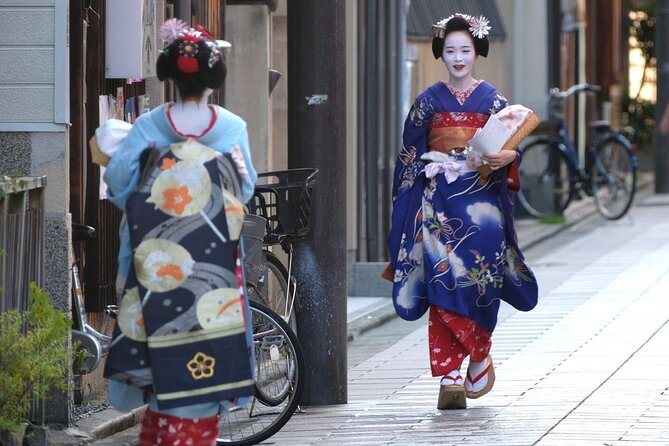
REVIEW · KYOTO
Kyoto Gion: 2-Hour Geisha Culture & History Walking Tour
Gion is best understood on foot, and this tour gives you a useful two-hour introduction to the district’s geisha traditions and old streets. You’ll visit Hanamikoji, quiet lanes, shrines, temples, Pontocho, and the Kamogawa River, with stories that turn attractive scenery into places with meaning.
I like the mix of famous photo stops and less obvious backstreets. I also like the practical local advice, including restaurant suggestions and tips on when you might spot a geisha. The main drawback is pace: two hours covers a lot, so some stops are brief, and hot weather can make the walk tiring.
Key points to know before booking
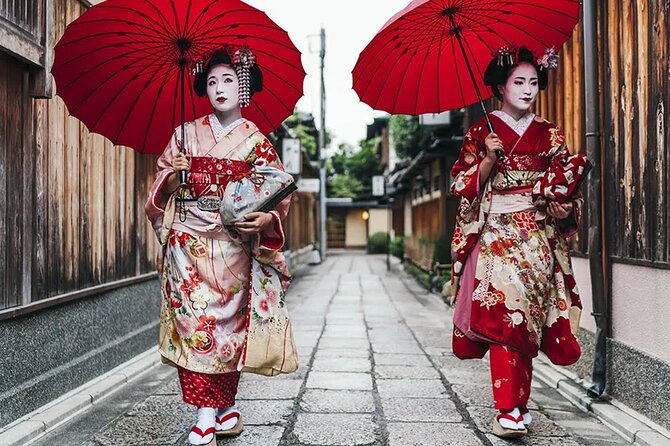
- You may see a geisha or maiko: Sightings are never promised, but tours around 5 to 6 p.m. may give you a better chance.
- The route packs in seven areas: Hanamikoji, Sannenzaka and Ninenzaka, Yasaka Shrine, Hokan-ji, Pontocho, Gion Shirakawa, and Yasui-Konpiragu.
- The group is limited to 15 people: That is small enough for questions, though not a private tour.
- You get more than photo stops: Guides explain geisha training, kimono work, hairstyles, Shinto worship, and Kyoto’s wooden townhouses.
- The price is low for a guided city walk: At $23.88, it offers a useful orientation before you explore Gion on your own.
- Plan for walking and weather: You need moderate fitness, and the tour can be canceled for poor weather.
Why this short Gion walk works
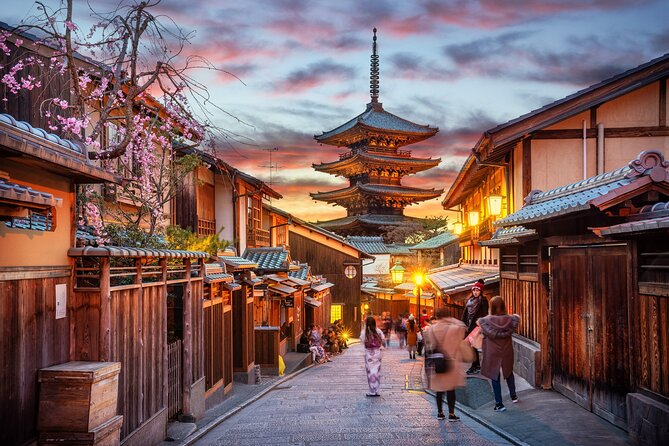
Gion can feel confusing at first. Hanamikoji is easy to find, but the district’s meaning is not always obvious when you are simply passing tea houses, wooden facades, shrines, and narrow lanes. A good guide connects those pieces.
That is the real value here. You are not only shown a street where geisha may appear. You learn how geisha and maiko train, why their dances matter, and how their kimonos and hairstyles reflect years of work and custom.
The tour also gives you several different views of Kyoto in a short time. You move from the formal geisha quarter to temple lanes, from a major shrine to an old dining street, then back toward the traditional buildings of Gion Shirakawa.
I would treat this as an orientation walk, not a slow, in-depth architectural tour. The route includes many stops, and some are only 15 or 20 minutes long. That keeps the outing lively, but you will not have long periods for shopping, extended photography, or quiet reflection.
More History Walking Tours in Japan
- Tokyo: Imperial Palace and Shogun Historical Walking Tour
★ 5.0 · 2,251 reviews - Tokyo: Imperial Palace Japanese History Walking Tour
★ 4.9 · 987 reviews - Hiroshima Historical Walking Tour – Why A-Bomb was Dropped
★ 4.8 · 893 reviews
Meeting at Shijo-ohashi Bridge
The meeting point is the McDonald’s at 105-1 Hashibachō, near Shijo-ohashi Bridge. This is a practical starting place because the tour begins near public transportation and close to the main Gion area.
The walk ends back at the same meeting point. That makes it easier to plan dinner or another evening activity afterward, although you should allow a little extra time if the group runs close to the approximate two-hour duration.
The group can include up to 15 people. That is a reasonable size for a city walk. You get the energy of a shared outing without the scale of a large coach group, and you should have a fair chance to hear the guide in the street.
Guides named in the tour feedback include Uta, Soyo, Dan, Kenta, Ukyo, Alex, Oliver, and Naoya. Their styles vary, but the strongest comments focus on clear English, storytelling, patience, and useful local suggestions.
Hanamikoji Street and the world of geisha
Hanamikoji Street is the natural opening to a Gion tour. It is known as the heart of the geisha district, and it gives your guide a place to explain the customs that still shape this part of Kyoto.
You will hear about the demanding path from maiko to geisha, along with dance training, clothing, hair styling, and the work behind a polished public appearance. This context matters because it helps you look past the costumes. Geisha culture is not simply a street performance or a photo opportunity. It is a professional tradition built on discipline and long training.
You might see a geisha or maiko moving between appointments, particularly if your tour takes place around 5 to 6 p.m. The possibility adds excitement, but you should not book this solely for a sighting. There is no guarantee, and respectful behavior is essential.
Your guide may also explain where visitors should and should not walk or take photographs. That is useful in Gion, where local residents and working entertainers share the same narrow streets. The best approach is to watch from a respectful distance and follow the guide’s directions.
Sannenzaka and Ninenzaka: Kyoto’s famous picture streets
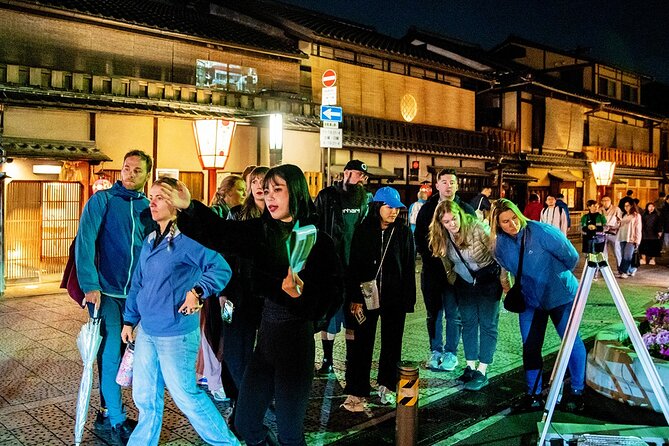
Sannenzaka and Ninenzaka are among Kyoto’s most recognizable lanes. Their sloping streets, traditional buildings, and sightlines toward temples make them natural places for photographs.
The tour spends about 15 minutes here. That is enough for an introduction and a few pictures, but not enough for a leisurely look at every shop or side lane. If you want more time, return later on your own.
Your guide also explains the local rumor about falling on the steps and dying within two years. The story sounds grim, but the point is to separate folklore from fact and show how local sayings become part of a place’s character.
This is one of the more crowded portions of the walk, especially at popular times. Stay close to the group and wear shoes that handle slopes and uneven walking surfaces comfortably. The short stop works well as part of a larger route, but it will feel rushed if your main goal is photography.
More History Walking Tours in Kyoto:
- Berlin: Third Reich & Cold War Guided Walking Tour
★ 4.9 · 8,378 reviews - Munich: Third Reich & WWII Walking Tour
★ 4.6 · 6,181 reviews - Berlin’s Best: 2 Hour Walking Tour Third Reich and the Cold War
★ 5.0 · 5,486 reviews - Third Reich Berlin: Hitler and WWII Walking Tour
★ 5.0 · 3,301 reviews
Yasaka Shrine and a thousand years of worship
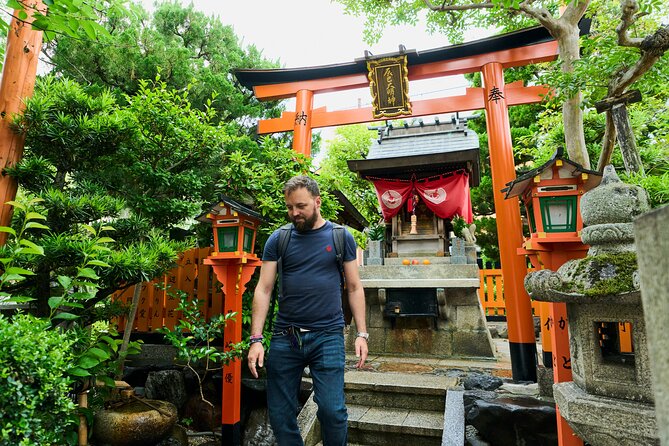
Yasaka Shrine provides a change of mood. After the narrow lanes and commercial streets, you enter a major religious site with a long connection to Kyoto.
The tour describes Yasaka as a 1,000-year-old shrine and allows about 20 minutes here. That gives you time to see the main setting and learn how Shinto worship works.
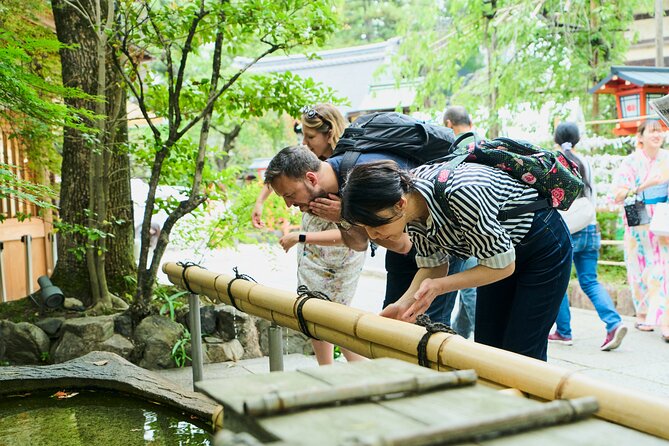
A guide can make a shrine visit easier to understand. You may see people approaching the worship area, making offerings, bowing, and following the expected steps. Instead of copying what others do without context, you get a basic explanation of the customs.
This stop is also valuable for showing that Gion is not only about geisha. Religious life, neighborhood traditions, festivals, food streets, and historic buildings all overlap here. You get a better sense of the district when you see those connections.
Hokan-ji and the classic Kyoto view
Hokan-ji Temple is one of the route’s most photogenic stops. Its distinctive pagoda and surrounding streets provide the familiar Kyoto scene many people hope to see.
The planned visit lasts about 20 minutes. That is enough to take photographs and hear the guide explain the setting, though the tour does not present this as an extended temple visit.
The surrounding lanes can be crowded, so your best photographs may require patience. You should also remember that the tour is moving through a living neighborhood, not a staged film set. Keep doorways clear, avoid blocking the road, and listen when the guide asks the group to move.
This stop is likely to appeal most to first-time visitors who want a classic Kyoto image without spending half a day at one temple. It is less suited to someone seeking a detailed study of temple architecture.
Pontocho and a pause by the Kamogawa River
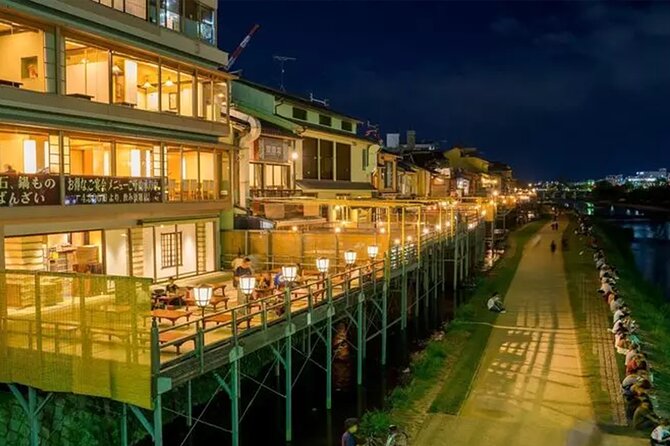
Pontocho is a historic gourmet street, known for its narrow passage and dining atmosphere. The tour gives you about 15 minutes here, enough to understand the street’s role and note places you may want to investigate later.
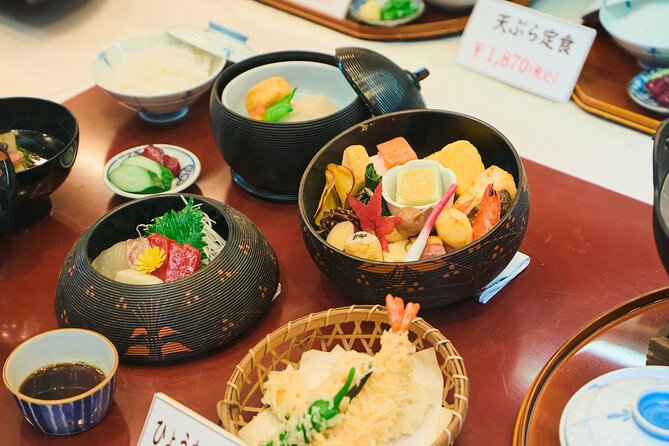
This is where the guide’s local recommendations can become especially useful. Several guides have pointed out restaurants and rooftop bars, giving you ideas for the rest of your Kyoto stay. You should treat those suggestions as starting points rather than a fixed dining plan.
The route also includes a local relaxation spot by the Kamogawa River. The riverfront offers a welcome change from the tight streets, and it gives the group a moment to slow down.
Do not expect a long refreshment break. One account specifically noted that there was no drink stop, which mattered during very hot weather. Carry water, especially in summer, because a two-hour walk through Kyoto can feel demanding even when the distance seems modest.
Gion Shirakawa and Edo-period townhouses

Gion Shirakawa is one of the strongest parts of the route for understanding old Kyoto. Here you see traditional wooden townhouses connected with the city’s Edo-period character.
The tour allows about 20 minutes in this area. Your guide explains the stories behind the buildings and helps you notice details you could easily pass without a second thought.
The appeal is not only visual. Wooden facades, narrow streets, and traditional design show how Kyoto’s older neighborhoods functioned before modern construction changed many city centers. The guide’s explanation gives those buildings a human and historical setting.
Gion Shirakawa also offers a calmer contrast to the busier photo streets. Quiet lanes can be more memorable than famous viewpoints because you have a chance to notice the rhythm of the neighborhood. Still, quiet does not mean empty, and respectful behavior remains important.
Yasui-Konpiragu and Shinto practice
The final listed stop is Yasui-Konpiragu, where you learn more about Shinto worship. The visit lasts about 15 minutes.
This is a useful ending because the tour returns to a central theme: Kyoto’s traditions are not just performances for visitors. They are tied to religious practice, personal hopes, local customs, and everyday acts of worship.
Your guide can explain what you are seeing and how to behave at the site. That is particularly helpful if you have never visited a Shinto shrine before.
Because the tour includes several religious places, you should expect a cultural overview rather than a formal religious experience. You are there to observe respectfully and learn the basic meaning of the sites.
What the guides do best
The strongest part of this experience is the human explanation. The route itself is easy to find, but the guide gives each location a reason to matter.
Uta is praised for an engaging style, clear English, and a lively approach. Dan is described as a strong storyteller who makes Gion’s past easier to follow. Naoya is noted for patience, helpful photo stops, and calm assistance when someone arrived late after taking the wrong bus.
Other guides, including Soyo, Kenta, Ukyo, Alex, and Oliver, are also singled out for friendly service, local knowledge, and good communication. Since the exact guide depends on the departure, you should expect variation in personality rather than one fixed presentation.
The group format means you may not receive a private conversation at every stop. Still, a maximum of 15 people keeps the tour manageable, and the two-hour length helps prevent the history from becoming too heavy.
Price, timing, and practical value
At $23.88 per person, this is inexpensive for a two-hour guided walk in one of Kyoto’s most visited districts. You are paying mainly for interpretation and route planning, not for admission tickets. The listed stops are free to enter, so the guide is the central product.
I think the price works best for first-time visitors. You get a quick orientation, cultural background, photo locations, and restaurant suggestions. Afterward, you can return to the places that interested you most and explore them at your own pace.
Timing matters. Evening departures around 5 to 6 p.m. may improve your chance of seeing a geisha or maiko, and several parts of Gion can look especially appealing near sunset. At the same time, a later start may mean some sites or nearby businesses are closing, so an early evening tour is the safer choice if you want open shops and active streets.
The tour requires moderate physical fitness. You will be walking through busy lanes, sloped streets, shrine grounds, and older parts of the district. Good walking shoes and water are sensible choices, especially in hot weather.
Confirmation arrives when you book, and the activity is near public transportation. The mobile ticket is convenient for a last-minute plan. One person booked about 90 minutes before the start and found the tour useful, but last-minute availability can change.
Free cancellation is available up to 24 hours before the start time. Cancellations or changes inside that window are not refunded, and poor weather can lead to a new date or a full refund.
Who should book this Gion tour?
I would recommend it to first-time Kyoto visitors who want a quick cultural framework before exploring Gion independently. It also suits solo visitors, couples, and small groups who prefer stories and local orientation over a formal museum presentation.
It is a good choice if you want to learn about geisha culture without booking a costly evening performance. You may see a geisha, but the real benefit is understanding the tradition and knowing how to behave respectfully in the district.
The tour is less ideal if you dislike walking, need long breaks, or want extensive time at each temple and shrine. It may also disappoint you if your only goal is a guaranteed geisha sighting.
Should you book it?
Book this tour if you want an affordable introduction to Gion with a friendly guide, a compact route, and useful local advice. The mix of Hanamikoji, shrines, Hokan-ji, Pontocho, the river, and Gion Shirakawa gives you a broad first look at Kyoto’s traditional center.
Choose an early evening departure, carry water, and think of the geisha sighting as a bonus rather than the promise. For $23.88, this is a strong starting point before you return to Gion on your own for dinner, photographs, or a slower walk.
FAQ
How long is the Kyoto Gion walking tour?
The tour lasts approximately two hours.
How much does the tour cost?
The listed price is $23.88 per person.
Where does the tour begin?
It begins at the McDonald’s near Shijo-ohashi Bridge, at 105-1 Hashibachō, Shimogyo Ward, Kyoto.
Where does the tour end?
The activity ends back at the meeting point.
Can I see a geisha on the tour?
You might see a geisha or maiko, but sightings are not guaranteed. A departure around 5 to 6 p.m. may offer a better chance.
How many people can join the tour?
The maximum group size is 15 people.
What places does the tour visit?
The route includes Hanamikoji Street, Sannenzaka and Ninenzaka, Yasaka Shrine, Hokan-ji Temple, Pontocho, a local spot by the Kamogawa River, Gion Shirakawa, and Yasui-Konpiragu.
Do I need to be physically fit?
You should have a moderate level of physical fitness because this is a walking tour through streets, shrine areas, and sloped lanes.
What is the cancellation policy?
You can cancel up to 24 hours before the start time for a full refund. Cancellations or changes made less than 24 hours before the experience are not refunded. If poor weather causes the tour to be canceled, you will be offered another date or a full refund.
More Two-Hour Tours in Kyoto
- Budapest City Landmarks Walking Tour in 2 Hours
★ 5.0 · 2,048 reviews - Leipzig: 2-Hour Guided Walking Tour in German
★ 4.8 · 1,612 reviews - Lucca: 2-Hour City Center Walking Tour
★ 4.7 · 1,314 reviews - 2-Hour Bonaventure Cemetery Walking Tour
★ 5.0 · 1,270 reviews
Just added around Kyoto
- Kyoto: Meet the Geisha Maiko with Gion Walking Tour★ 4.8 · 371 reviews
- Cool Kyoto: 5-Hour Walking Tour with the Last Samurai★ 4.8 · 73 reviews
- Gion Walking Tour by Night★ 4.5 · 429 reviews
- Kyoto Sake Brewery & Tasting Walking Tour★ 5.0 · 623 reviews
- Kyoto Gion Night Walk & Geisha District Guided Tour★ 5.0 · 786 reviews
- Kyoto: Izakaya Bars Guided Walking Tour★ 4.9 · 815 reviews
- Kyoto Arashiyama Walking Tour: Bamboo, Monkeys, Gardens & Secrets★ 5.0 · 1,216 reviews
- Nishiki Market Brunch Walking Tour (7 Tastings + Brunch)★ 5.0 · 1,355 reviews
History Walking Tours, compared.

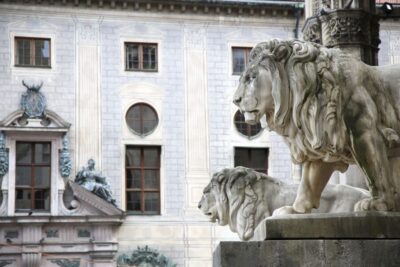

Berlin’s Best: 2 Hour Walking Tour Third Reich and the Cold War
Read our review →
Third Reich Berlin: Hitler and WWII Walking Tour
Read our review →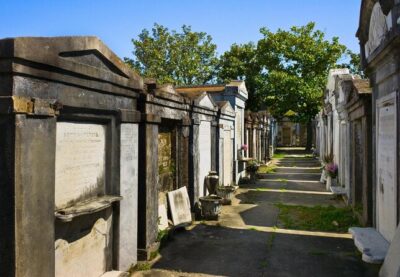
New Orleans Garden District History Walking Tour
Read our review →
Cartagena: Historic Center and Getsemaní Shared Walking Tour
Read our review →
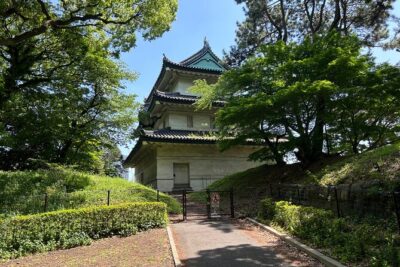
Imperial Palace and Shogun Historical Walking Tour
Read our review →Browse the lists this tour appears in