
REVIEW · BELFAST
Belfast: Best of Belfast History, Culture & Art Walking Tour
Belfast’s story is much bigger than the Titanic and the Troubles. This three-hour walk connects medieval beginnings, Victorian industry, Irish music, punk, public art and everyday people, so you get a useful picture of how the city became what it is today. I especially like the historic Entries, narrow lanes many people pass without noticing, and the guide’s attention to Belfast’s lesser-known characters, from reformers and rebels to artists and merchants. The headsets are another smart touch: you can hear the guide clearly without crowding around a street corner.
The tour also gives you a good first-day orientation. Guides such as Mark, Steve, James, Chris and others are praised for clear storytelling, local pride, humour and practical advice on places to eat, drink and listen to music. The main consideration is pace: although the walk is under two miles, three hours is a long time on your feet, and one review found it ran too long while missing some other sights.
Key points at a glance
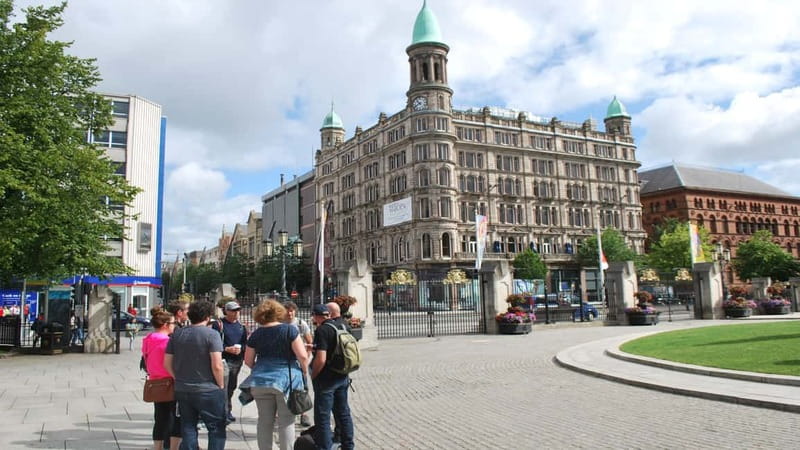
- Fourteen stops in under two miles: You cover the central city without facing a strenuous hike.
- A wider Belfast story: Industry, religion, politics, music, architecture and ordinary life all receive attention.
- Cathedral Quarter and historic Entries: You see the lanes, streets and buildings that reveal older Belfast.
- Clear audio throughout: Individual headsets help you follow the guide in busy streets and open spaces.
- Local advice you can use: Guides offer tips on food, pubs, Irish trad music, shops and free things to do.
- A balanced look at difficult subjects: Titanic and the Troubles are included, but they do not swallow the whole tour.
Starting at City Hall, then meeting Belfast properly
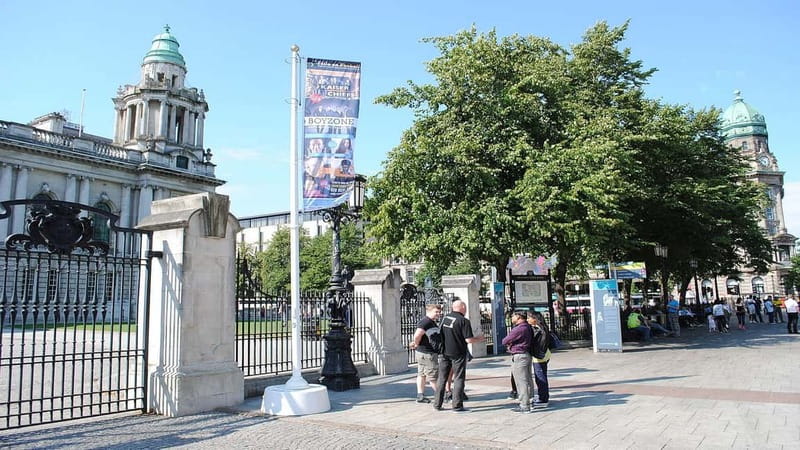
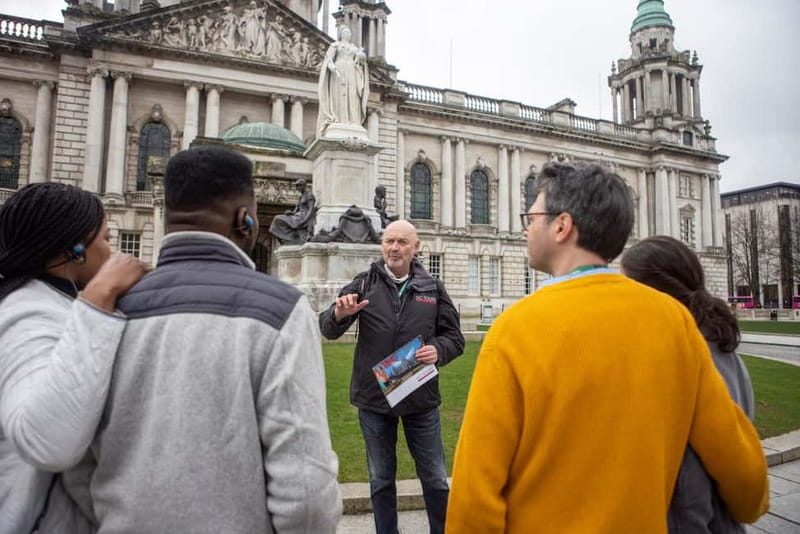
You meet at the front gates of Belfast City Hall in Donegall Square North. It is an easy place to find in the city centre, and your guide wears a black jacket or T-shirt with the DC Tours logo on the left side.
Starting here makes sense. City Hall puts you in the middle of Belfast’s civic and commercial core, and it gives the guide a natural place to explain how the city grew. You will hear about Belfast as a small settlement beside the River Lagan, then follow the changes that turned it into an industrial city with international trade links.
The tour is delivered in English by a live local guide. That local connection matters here. Belfast’s past includes subjects that can become flat or overly political when presented as a list of dates. The best guides on this walk, including Mark, Steve, James, Chris and Thomas, are praised for making the story understandable without turning it into a lecture.
I like that the guides appear to bring different personalities to the route. Steve is often described as witty and especially strong at linking old and modern Belfast. James is praised for warmth, clear explanations and personal touches. Chris is noted for storytelling and dry humour, while Mark is valued for keeping the detail digestible and answering questions. You cannot assume which guide you will receive, but the repeated strength of the guiding team is part of the tour’s appeal.
A few more walking tours around the UK worth a look
- Magical London: Harry Potter Guided Walking Tour
★ 4.7 · 22,044 reviews - Edinburgh: Harry Potter Magical Guided Walking Tour
★ 4.8 · 11,944 reviews - Edinburgh Castle: Guided Walking Tour with Entry Ticket
★ 4.7 · 11,699 reviews
Medieval beginnings and the city’s industrial rise
Early in the walk, you get the basic framework for Belfast. The guide explains how the settlement developed around the river, then grew through trade, linen production and industry.
This section is useful because it gives the rest of the tour a clear shape. Victorian buildings are not just attractive façades. They reflect the money, ambition and social structure created by Belfast’s industrial success. The linen trade, often linked with Belfast’s identity as Linenopolis, receives attention alongside the wider forces that changed the city.
You will hear about merchants, workers, reformers and other people who helped shape the city. That human focus keeps the tour from becoming a tour of buildings alone. A grand stone façade can tell you about wealth, but a story about the people who worked, protested, worshipped or lived nearby tells you how the city actually functioned.
The architectural side is varied. Expect Victorian grandeur alongside newer buildings and public art that reflect Belfast’s more recent changes. The point is not to inspect every façade in detail. Instead, you learn how architecture records shifts in power, trade, taste and public life.
For me, this is one of the strongest reasons to take the walk early in your stay. Once you understand why Belfast looks the way it does, you can make more sense of the streets you pass later.
The Entries and the small details in old Belfast
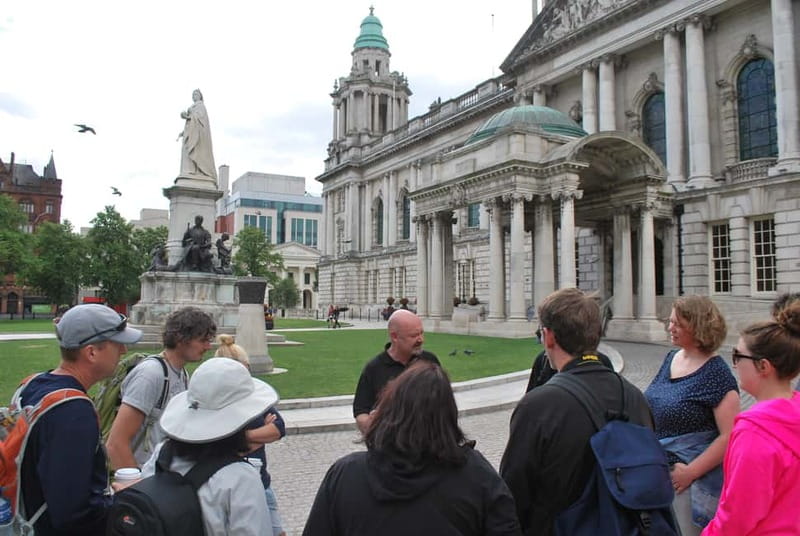
The historic Entries are among the most useful parts of the route. These narrow lanes and passages are easy to miss if you stick to the main shopping streets, yet they hold some of the clearest clues to older Belfast.
Your guide points out the history attached to these spaces and explains how everyday movement through the city once worked. This is not simply a stop for photographs. The Entries help you picture a tighter, more crowded city, where small lanes connected homes, businesses, pubs and major streets.
Look up as you walk. The route is designed to help you notice architectural details, signs, public art and features that are easy to overlook when you are focused on getting from one major attraction to the next.
The trade-off is that this is still a central-city walk, not a tour of every historic district in Belfast. You will see selected lanes and important streets rather than a full survey of the city. That is a reasonable limit for a three-hour introduction, but you should not expect to cover every major landmark.
Cathedral Quarter, music and Belfast’s creative side
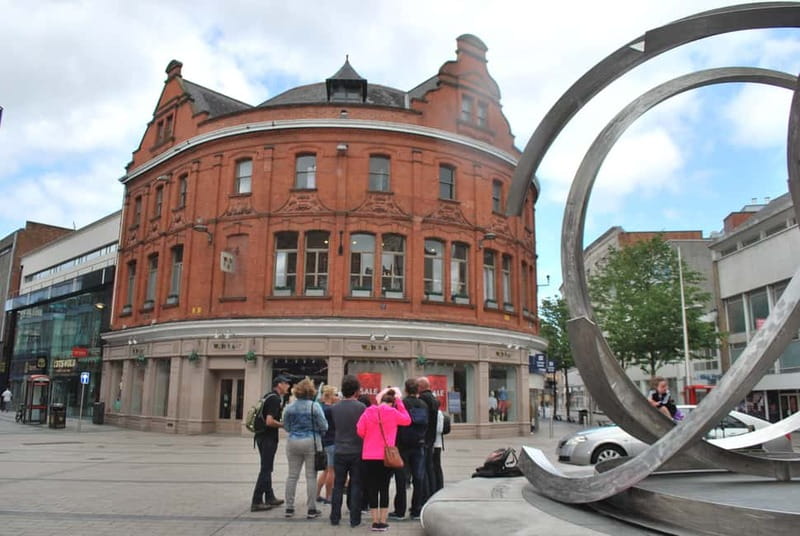
The Cathedral Quarter is presented as Belfast’s cultural and creative centre. Here, the guide connects older streets and buildings with pubs, art, music and the area’s changing identity.
The tour includes advice on where to hear Irish trad music, which is practical information you can use the same evening. Music is treated as part of Belfast’s social story rather than as a decorative extra. You also hear why punk matters to the city, adding a sharper and less predictable note to the usual tourist narrative.
This is where the tour’s balance works well. Belfast is often packaged through a few familiar subjects, but this route adds music and popular culture to the picture. Trad music and punk may seem worlds apart, yet both help explain how people express belonging, frustration, humour and pride.
The Cathedral Quarter can be lively, and street conditions may vary with weather and crowds. The headsets help here. You can keep listening while standing a little apart from the guide, rather than missing half the explanation because you are trying to hear over the street.
You also get a sense of the area’s creative revival. Public art and modern buildings are used to show how Belfast is still reshaping its identity. The guide does not present the past as finished. Instead, you see how older conflicts, industries and traditions continue to influence the city now.
Same streets, a different route:
- Underground Vaults Walking Tour in Edinburgh Old Town
★ 4.5 · 8,506 reviews - London: The Original Jack the Ripper Walking Tour
★ 4.7 · 7,833 reviews - Oxford University Walking Tour With University Alumni Guide
★ 5.0 · 6,905 reviews - Edinburgh Castle: Guided Walking Tour with Entry Ticket
★ 5.0 · 5,540 reviews
The Waterfront and the River Lagan
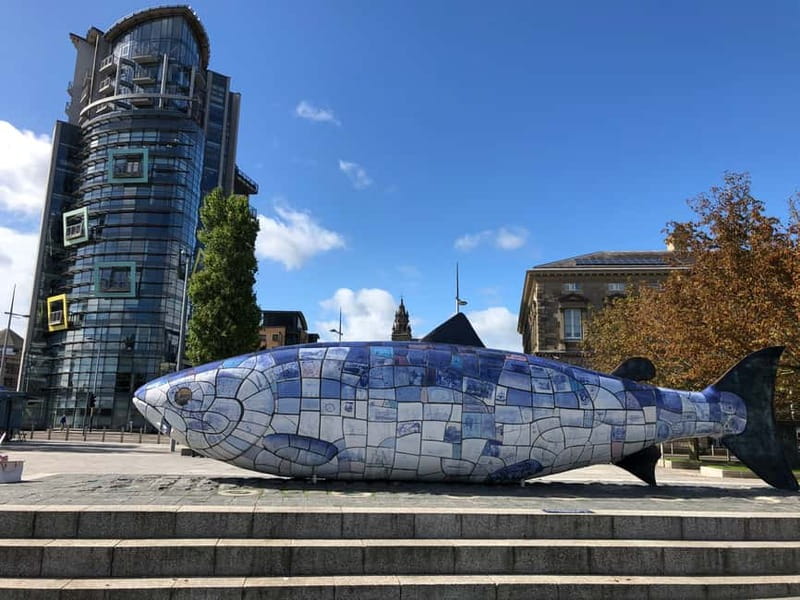
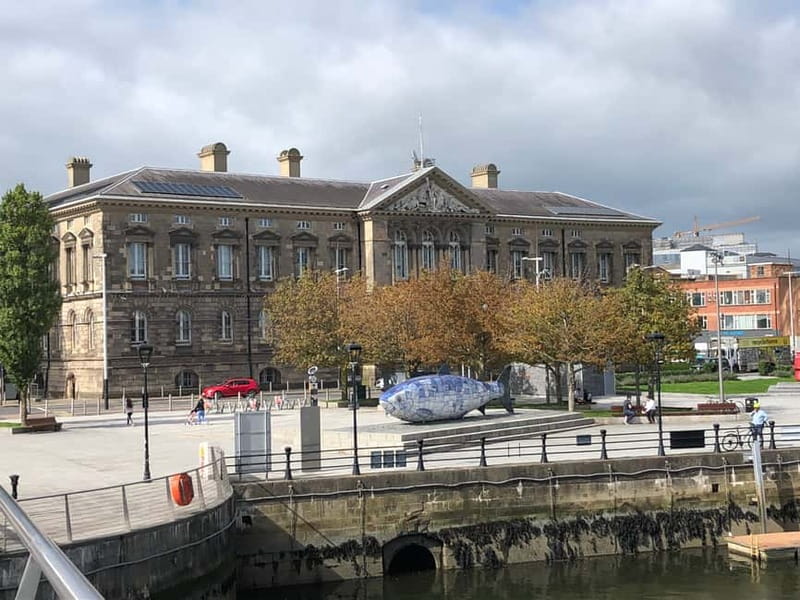
The route reaches the Waterfront and the River Lagan, shifting the focus from tight lanes to open space and the city’s connection with trade and transport.
This part helps explain Belfast’s industrial growth. The river was not just a scenic feature. It supported the movement of goods and people and helped make Belfast an important industrial centre. The guide also connects the waterfront to modern architecture and the city’s changing public face.
The Titanic is given context here, but it is not the only subject. That distinction matters. If you want a full Titanic experience, you will need to visit Titanic Belfast separately. This walking tour helps you understand where the shipbuilding story fits into Belfast’s wider economic and social development.
The Waterfront can feel like a change of pace after the Entries and Cathedral Quarter. You get more room to look around and consider the city’s relationship with the river. On a wet or windy day, however, this section may feel exposed. The tour runs rain or shine, so bring a waterproof layer and do not rely on a pleasant forecast holding all day.
The Troubles, religion and a careful account of Belfast
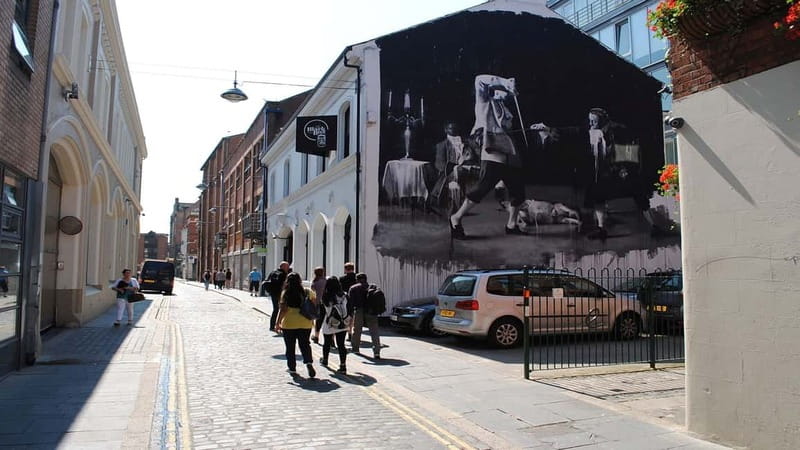
The Troubles are included because they are essential to understanding Belfast today. The treatment described here aims to place the conflict within wider religious, political, economic and social structures instead of presenting it as the only story Belfast has to tell.
That approach is valuable. You will hear about key moments connected with Northern Ireland’s creation, community divisions and the effect of the conflict on ordinary people. The tour also touches on transgenerational trauma, which gives you a way to think about how the past can continue to affect families and communities.
At the same time, the guide avoids letting the subject dominate every minute. The walk also covers industry, civic life, art, music, famous residents and modern Belfast. That makes it a good fit if you want serious context but do not want a tour focused solely on political murals or conflict history.
The tone is described as balanced, with humour used carefully. That does not mean the difficult material is brushed aside. It means the guide tries to make a complicated subject understandable without reducing Belfast to a simple argument between two sides.
You should still expect light historical themes and some serious discussion. The tour suits adults and teenagers who are comfortable with that material. If you want a highly focused Troubles tour, this is not the most specialised choice. If you want the Troubles placed within a wider account of Belfast, it is much better suited.
Legends, famous people and the human scale
The walk includes local legends such as the Salmon of Knowledge. Stories like this give the tour a more personal and imaginative side, while also showing how local identity is built through folklore as well as formal history.
You will hear about people who shaped Belfast across several centuries, including merchants, rebels, reformers and artists. The emphasis on individuals makes the city easier to remember. Instead of trying to retain a long chain of dates, you connect places with people and actions.
The guides also add personal stories and present-day observations. That is where the experience can feel less like a standard sightseeing route. You are not simply told what a building is called. You get clues about how Belfast residents understand the place and how the city’s past appears in everyday life.
A short coffee and comfort break may be included around the middle of the walk, with one stop taking place near a theatre or café area. This is not a full meal stop, so bring water and plan food separately, but the pause helps break up three hours of listening and walking.
How much walking and how the headsets help
The entire route is less than two miles and includes 14 stops. That is a modest distance, but the three-hour duration means you spend plenty of time standing while the guide speaks.
The pace is generally described as manageable rather than strenuous. Guides check that people are keeping up, and one account specifically praised the relaxed pace. Still, comfortable shoes are important. Belfast weather can make pavement conditions unpleasant, and the tour operates in rain or shine.
The supplied headsets are one of the practical strengths. You can hear the guide clearly while moving between stops, and you do not need to crowd around a single speaker. This is especially helpful for people with hearing concerns or anyone who dislikes fighting through a group to catch the explanation.
The route is wheelchair accessible, but you should still dress for weather and be prepared for an urban walk through streets and lanes. If you prefer frequent seating or dislike standing for long explanations, ask about the day’s arrangements before booking.
Is $35 good value for three hours?
At $35 per person, this is a fair price for a three-hour guided introduction to central Belfast. You are paying for a local guide, a structured route, headsets and practical orientation, not simply a walk between famous buildings.
The value is strongest if you are new to Belfast. A good guide can save you time by showing you how the city fits together and by pointing out places you might otherwise miss. Restaurant, pub, music and free-activity suggestions add value after the tour ends.
It is also a sensible choice before visiting other attractions. You will have context for Titanic Belfast, the Cathedral Quarter, museums, churches and the city’s public art. The tour does not replace those visits, but it helps you decide what deserves more of your time.
The value is weaker if you already know central Belfast well or want entry into major attractions. This is an outdoor orientation walk, not a ticketed museum tour. You also need to accept that the quality of the experience depends partly on the guide assigned to your departure, though the range of strong guide feedback suggests a solid team.
Free cancellation up to 24 hours before the start and the option to reserve now and pay later make it easier to fit into a changing schedule. Those policies are useful, but the main reason to book is the content and local perspective.
Who should book this Belfast walk?
I would choose this tour for a first visit, especially if you have one or two days in Belfast and want to get your bearings quickly. It suits history and culture fans, curious adults, older teenagers and anyone who prefers stories over a checklist of landmarks.
You should also book it if you want more than a Troubles-focused experience. The route gives that period its proper place while also covering linen, Victorian architecture, music, punk, folklore, public art, Titanic and modern city life.
It may not suit you if you dislike long guided walks, need a highly specialised architectural or political tour, or want to spend most of the day inside attractions. One three-hour walk cannot cover every district, and one review found that the length felt excessive.
For the best use of your time, take it near the start of your Belfast stay. Keep a note of the food, music and free-activity suggestions, then return to the areas that interest you most.
FAQ
Where does the Belfast walking tour meet?
It meets at the front gates of Belfast City Hall in Donegall Square North.
How do I identify the guide?
The guide wears a black jacket or T-shirt with the DC Tours logo on the left breast.
How long does the tour last?
The tour lasts three hours.
How far do you walk?
The entire walk is less than two miles and includes 14 stops.
What areas does the tour cover?
It covers the Cathedral Quarter, Belfast’s historic Entries, the Waterfront and areas around the River Lagan and city centre.
What subjects are included?
The tour covers Belfast’s medieval beginnings, linen and industry, Victorian architecture, Titanic, the Troubles, religion, music, punk, folklore, public art and important local people.
Is the tour wheelchair accessible?
Yes, the activity is listed as wheelchair accessible.
What should I bring?
Bring comfortable shoes and clothing suitable for the weather. The tour runs in rain or shine.
Is the tour offered in languages other than English?
No. The live tour guide and activity language are English.
Can I cancel the booking?
Yes. You can cancel up to 24 hours in advance for a full refund. You can also reserve now and pay later.
Should you book the Best of Belfast walking tour?
Yes, if you want a strong first look at Belfast rather than a single-subject tour. The combination of the Entries, Cathedral Quarter, Waterfront, architecture, music, local legends and carefully handled political history gives you a fuller sense of the city in three hours.
I would be especially happy to pay $35 for this on the first morning or afternoon of a Belfast visit. You get practical orientation, clear audio, useful local suggestions and enough historical context to make the rest of your stay more rewarding. Just wear good shoes, dress for the weather and remember that three hours on city streets is still a commitment.
Just added around the UK
- Falmouth: Vibrant Historical Walking Tour (award-winning)★ 4.9 · 75 reviews
- The Must-Sees of Edinburgh: Small Group Walking Tour in French★ 4.9 · 88 reviews
- Edinburgh: Old Town History Walking Tour★ 4.9 · 528 reviews
- Edinburgh: Old Town Stories – Guided Walking Tour★ 4.9 · 86 reviews
- Ghosts, Ghouls & Gallows :The Original Bristol Ghost Walk★ 4.6 · 76 reviews
- Edinburgh: Private Walking Tour with a Local★ 4.4 · 78 reviews
- Edinburgh: Private Walking Tour in French with Clémentine★ 5.0 · 73 reviews
- Edinburgh: Multi-Sensory Old Town Historical Walking Tour★ 4.6 · 290 reviews
Walking Tours, compared.

Magical London: Harry Potter Guided Walking Tour
Read our review →
Reykjavik Food Walk – Local Foodie Adventure in Iceland
Read our review →
History and Hauntings of Salem Guided Walking Tour
Read our review →
New Orleans Premier Ghost, Voodoo and Vampire Walking Tour
Read our review →
Amsterdam Anne Frank: Small-Group Walking Tour & Local Guide
Read our review →
Edinburgh Castle: Guided Walking Tour with Entry Ticket
Read our review →
Anne Frank’s Story – Guided Walking Tour through Amsterdam
Read our review →Browse the lists this tour appears in