
REVIEW · ATHENS
Athens Acropolis and Parthenon Walking Tour
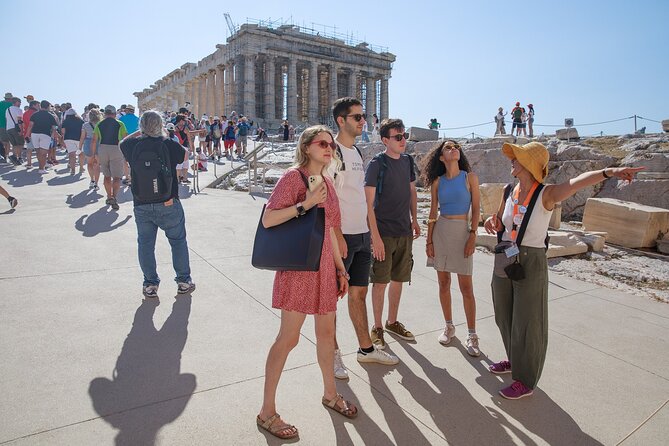
The best part of this two-hour Acropolis walk is the way it turns a hill covered in famous ruins into a readable story. You move from the birthplace of theater to the temples of Athena, with a licensed guide explaining what each broken column and marble gateway once meant.
I like the clear earsets, which let you hear the guide in a moving group, and I like the steady pace, with pauses for photos, shade, and questions. The main drawback is the uphill walk over uneven stone, often under a hot sun. Faulty headsets have also caused trouble on some departures, so the audio equipment is useful but not flawless.
Key points to know before booking
- A focused two-hour route: You see the major Acropolis monuments without giving up half a day.
- The Parthenon is the finale: The route builds toward Athens’ most famous temple, with the Erechtheion and Caryatid Porch along the way.
- Audio equipment helps: Personal earsets make it easier to follow the guide in a group of up to 24 people.
- Tickets need careful attention: The base price is $41.12, but admission is not included unless you select that option or arrange a valid ticket yourself.
- The climb is real: Wear sturdy shoes, carry water, and expect sloping paths and rough ground.
- Good guides make the difference: Alexia, Elena, Dora, Hermes, Victor, Andrea, and Phillipa are among the guides praised for clear explanations, humor, patience, and storytelling.
Why a guided Acropolis visit works so well
The Acropolis is not hard to recognize. The Parthenon is right there in front of you. The challenge is understanding what you are seeing while crowds move around you, the sun beats down, and the site’s many names begin to blur together.
That is where this tour earns its keep. Instead of simply walking up to the Parthenon, you follow a short historical sequence. The Theatre of Dionysus connects the hill to Greek drama. The sanctuary of Asclepius shows its role in ancient medicine. The temples explain the religious life of Athens. By the time you reach the Parthenon, the hill feels less like a collection of ruins and more like the center of an ancient city.
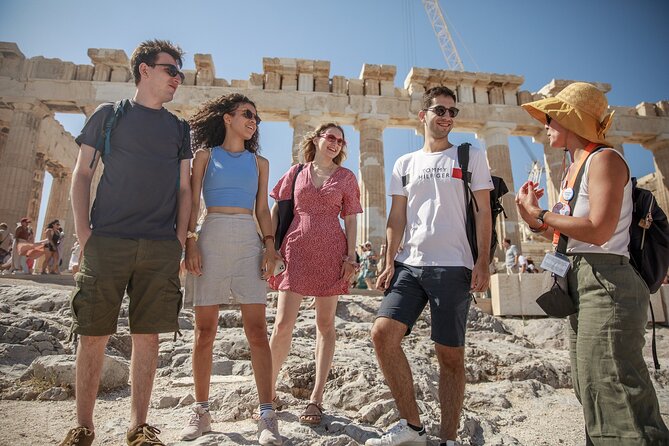
The guides use personal earsets, with a small receiver and headphones for each person. This is especially helpful when the group is spread across a path or when other groups are nearby. A good guide can answer questions about mythology, architecture, ancient society, and modern Athens without forcing everyone to crowd around one spot.
The group can contain up to 24 people, so this is not a private walk. Still, the equipment and frequent stops keep it from feeling like a guide shouting into a noisy pack. The best guides, including Phillipa and Elena, have been praised for mixing facts with stories and for leaving time to take pictures.
A few more walking tours around Athens worth a look
- Athens: Acropolis and Parthenon Guided Walking Tour
★ 4.6 · 5,882 reviews - Acropolis and Parthenon Guided Walking Tour
★ 5.0 · 4,755 reviews - Greek Food Walking Tour in Athens
★ 5.0 · 4,740 reviews
Meeting near Dionysiou Areopagitou Street
The meeting point is at Lukumades, a yogurt bar at Dionysiou Areopagitou 3, near the foot of the Acropolis. This is a practical starting place, close to public transportation and the pedestrian route around the hill.
Arrive early. Acropolis entry times are strict, and the group cannot wait for latecomers. If you are delayed, there is no refund, so allow time to find the meeting point, use a restroom, and gather your water before the walk begins.
You should also check your ticket choice before the day of the tour. The advertised price is $41.12 per person, but the standard option does not include the €30 Acropolis entrance fee. If you choose the no-ticket option, you receive a separate email with a link for buying your admission. That step must be completed within 48 hours of booking and no later than 24 hours before the tour begins.
The operator says it has prepaid access for the group, so you do not need to buy a ticket at the office or wait in that ticket line. But you still need a valid admission ticket to enter. If you qualify for a reduced price, bring a passport or valid identification to prove your age and nationality.
The Theatre of Dionysus begins the story
The lower slopes of the Acropolis introduce you to the Theatre of Dionysus, traditionally linked with the birth of Western drama. This is where plays by Aeschylus, Sophocles, and Euripides were performed for ancient Athenian audiences.
It is easy to look at the stone seating and move on. A guide gives the place a purpose. You can picture an audience gathered for tragic stories, political ideas, and public debate, all performed in a setting tied closely to civic life.
The stop lasts about 15 minutes, and it is a smart early pause. You are still near the lower part of the hill, so the guide can explain the site before the steeper sections begin. It also gives you a chance to settle into the pace and test your earset.
The Asklepeion and the ancient search for healing
The Temple of Asclepius, also called the Asklepeion, is a quieter part of the route. It was a sanctuary devoted to Asclepius, the god of medicine, where people came seeking cures and giving thanks for recovery.
This stop adds useful balance to the usual Acropolis story. The hill was not only about grand temples and military victories. It was also a place where ordinary people brought illness, hope, and gratitude.
The visit here is brief, about 10 minutes. Do not expect a large intact building. The value comes from the explanation of the site and its role in ancient life, not from a dramatic standing monument.
Same streets, a different route:
- Acropolis: Acropolis and Parthenon Guided Walking Tour
★ 4.7 · 3,442 reviews - Athens: Guided Greek Food Walking Tour with Tastings
★ 4.9 · 2,859 reviews - Acropolis monuments & Parthenon Walking Tour with Optional Acropolis Museum
★ 5.0 · 2,678 reviews - Acropolis, Parthenon & Athens Old City Heritage Walking Tour
★ 4.5 · 876 reviews
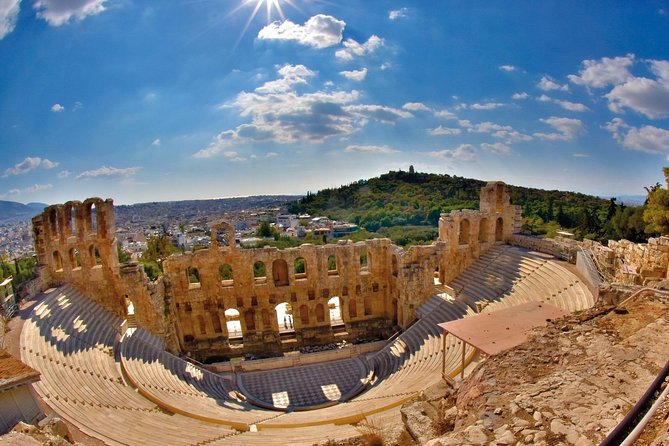
The Odeon of Herodes Atticus and a theater still in use
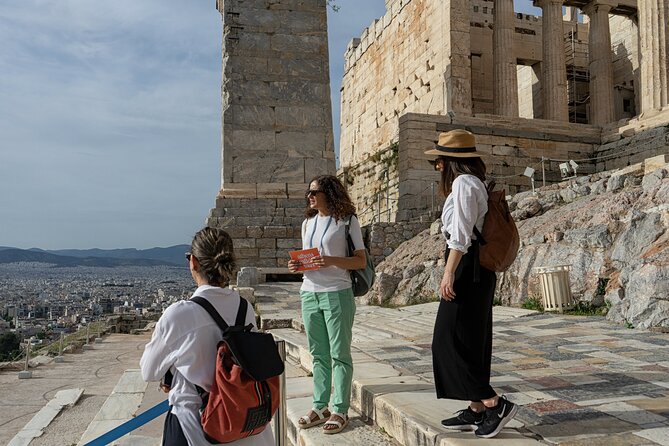
The Odeon of Herodes Atticus is one of the most striking structures on the southern slope. Built in AD 161, this stone theater remains tied to performances today.
Its shape makes the past feel unusually close. You can look at an ancient performance space and know that music and theater still take place there. The guide explains the building while giving you time to appreciate its scale.
The stop is listed at roughly 10 minutes. That is enough for an introduction and photographs, but not a full exploration of the theater. The tour focuses on the view from the route rather than a long visit inside.
Philopappos Hill and a pause above Athens
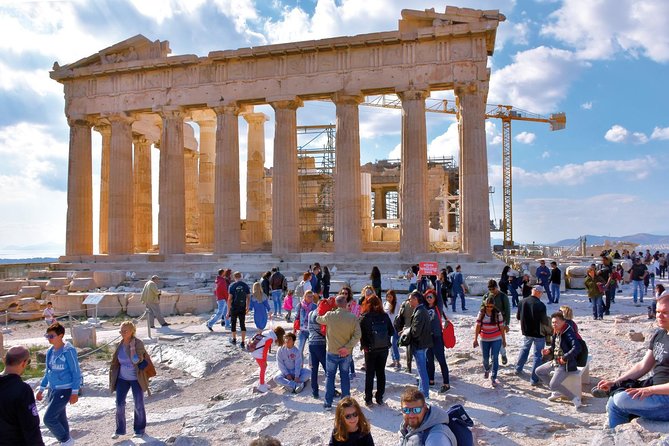
The route also offers a view toward Philopappos Hill, known in antiquity as the Hill of the Muses. The monument of Philopappos honors a Roman-era benefactor and gives the area a strong visual landmark.
This part of the walk provides a welcome pause from the close-up ruins. You get a wider look at Athens and a moment to catch your breath before reaching the upper entrance. Guides often use these breaks well, especially for travelers who want photographs or need a slower pace.
The tour requires moderate physical fitness. One useful feature is that the guide does not need to rush everyone upward. Stops along the way let you listen, rest, and keep moving without arriving at the top exhausted.
The Temple of Athena Nike and the Propylaea
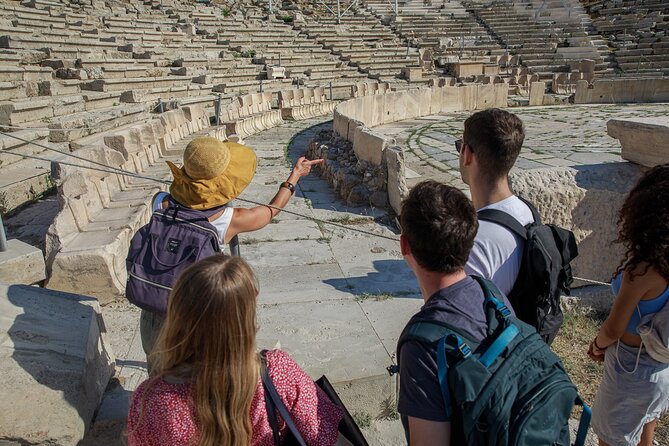
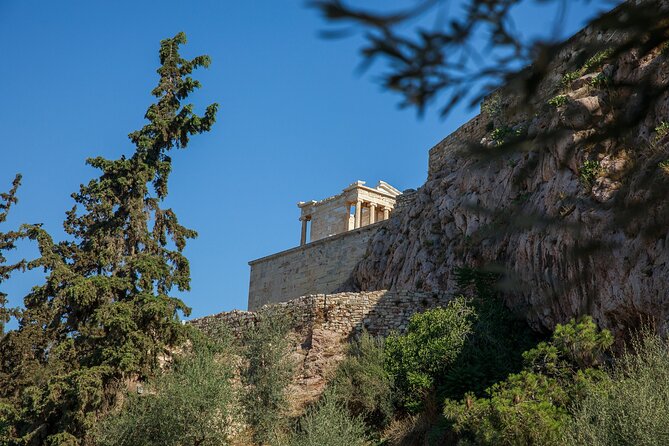
Near the southwestern edge of the Acropolis, the small Temple of Athena Nike sits on a raised bastion. It honored Athena in her role as the goddess of victory. The position gives it strong views over Athens, even though the temple itself is much smaller than the Parthenon.
The Propylaea follows as the grand entrance to the upper Acropolis. Designed by Mnesikles, this marble gateway was meant to create a sense of arrival. Its columns and broad approach still do that, although modern crowds and security procedures can interrupt the effect.
The guide’s explanation is important here because the Propylaea is easy to treat as a passageway. In fact, it was part of the architectural design of the hill, preparing visitors for the sacred monuments beyond it.
Security can slow the experience. All visitors pass through airport-style checks, and at busy times the wait can reach 30 minutes or more. A skip-the-ticket-line option helps with the ticket office, but it does not guarantee that you will avoid security lines or crowds inside the site.
The Erechtheion and the Caryatid Porch
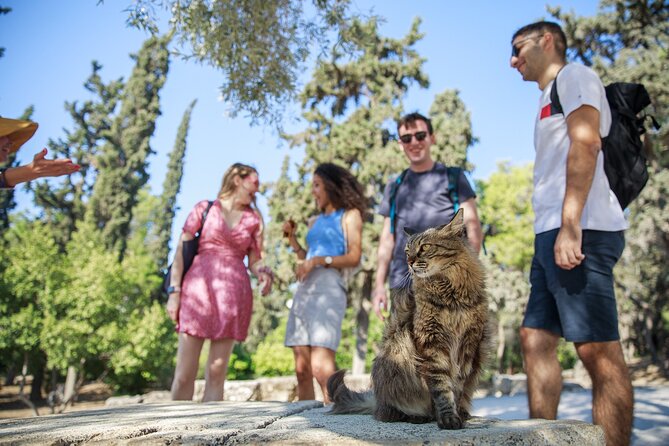
The Erechtheion is one of the most graceful buildings on the Acropolis. Its uneven plan reflects the complex traditions connected with the hill, and it was dedicated to both Athena and Poseidon.
Most people come for the Caryatid Porch, where six sculpted female figures support the roof. The originals are protected, but the porch remains one of the most memorable views on the hill. A guide can point out how the building differs from the more regular Parthenon and explain why its shape is so unusual.
This is a good place to slow down. The tour allocates about 15 minutes, enough to hear the main story and take pictures. Since the Acropolis can be crowded, your exact view may depend on the flow of people and the rules in effect that day.
The Parthenon, the final and essential stop
The Parthenon receives about 25 minutes, the longest single stop on the listed route. That makes sense. This is the building most people came to see, but it is also the one that benefits most from a guide.
Dedicated to Athena Parthenos, the temple represents the power and confidence of classical Athens. Its columns, sculptural program, and position on the hill were carefully planned to impress. Today, restoration work and missing sculptures change what you see, yet the scale and setting remain extraordinary.
You will not enter the temple interior on this walk. The experience is about viewing the exterior, hearing its story, and understanding how it relates to the other buildings around it. The guide can also help you separate the Parthenon from the Acropolis itself: the Acropolis is the fortified hill, while the Parthenon is its most famous temple.
The route ends near Acropoli station in the Acropolis area. That leaves you well placed to continue on your own, find lunch, visit the Acropolis Museum if it is part of your separate plan, or walk through the surrounding neighborhoods.
What the $41.12 price really buys you
At $41.12, this tour is not simply a ticket purchase. You are paying for a licensed guide, group coordination, earsets, an Athens map, and a guide magazine with ideas for further sightseeing.
The value depends heavily on your alternative. If you already know the monuments well and prefer to read signs at your own pace, you may want to arrange admission and explore alone. If this is your first visit, the guide adds order to a site that can otherwise feel confusing.
The admission issue matters. A €30 entrance fee is extra unless you select the ticket option, so compare the final checkout price rather than the headline figure. The ticket option can be worthwhile if you want less work before arrival. The no-ticket option may suit you if you already have a valid pass, qualify for free entry, or prefer to handle admission yourself.
The tour is also a good value for a short stay. In about two hours, you see the main monuments and get enough context to continue exploring Athens with confidence. It does not replace a full day at the Acropolis and museum, but it gives you a strong first visit without taking over your schedule.
Practical advice for heat, stone, and crowds
Wear shoes with a firm sole. The surfaces are uneven, and some parts of the route are steep. This is not a hard athletic hike, but it is not a flat city stroll either.
Bring water, sunscreen, and a hat. There are no toilets once you are inside the archaeological site, so use facilities before entry. Baby strollers are not allowed on the Acropolis, and the side entrance used by the tour has no cloakroom. A baby pouch is the more practical choice.
Dress for the weather. Rain does not always ruin the visit, and guides may use sheltered areas when possible, but wet stone can make footing less comfortable. The experience may be canceled in poor weather, with a different date or full refund offered.
The tour is offered in English only. The operator provides an Athens map and magazine at the end, which is useful for planning other walks, markets, museums, and neighborhoods after the Acropolis.
The earsets generally make a major difference, especially in a group. Still, two technical problems are worth knowing about: some equipment has produced static or cut in and out, and strong wind can make the guide hard to hear. If your sound fails, tell the guide right away rather than trying to follow silently.
Who should book this Acropolis walk?
I would choose this tour if you have limited time, want historical context, or prefer not to manage the Acropolis on your own. It is especially useful for first-time visitors who want the major sights explained in a logical order.
It also suits older adults who can manage moderate walking but appreciate a controlled pace and regular stops. The route is tiring in heat, yet several guides have been praised for adjusting the pace, finding shade, and allowing photo breaks.
Families should think about the terrain and stroller rule. Older children who enjoy mythology, theaters, and temples may find the stories engaging. Very young children may struggle with the heat, uneven ground, and two-hour schedule.
You should look elsewhere if you want a private guide, a long museum visit, or a slow archaeological study. This is a popular group walk, not a quiet specialist tour. It covers the essential monuments efficiently.
Should you book the Athens Acropolis and Parthenon tour?
For most first visits, yes, provided you understand the ticket arrangement and prepare for the climb. The strongest reasons are the clear route, the useful earsets, the guide’s explanations, and the chance to see the Parthenon without spending hours figuring out the site alone.
Select the admission option if you want the simplest booking process. If you choose the lower-priced option, complete the separate ticket step promptly and arrive with proof of entry. Book at least several weeks ahead if your dates are fixed, since this experience is commonly reserved about 23 days in advance.
Book it for the story and structure, not just the skip-the-line claim. Security and busy periods can still slow you down. With good shoes, water, an early arrival, and realistic expectations about crowds, this is a practical way to make your short time on the Acropolis count.
FAQ
How long does the Acropolis and Parthenon walking tour last?
The tour lasts approximately two hours. It covers the main Acropolis monuments and ends near the Acropoli area.
Is the Acropolis entrance ticket included?
Only if you select the ticket option. The standard price does not include the €30 entrance fee. If you choose the option without admission, you must arrange a valid ticket before joining the tour.
Where does the tour meet?
You meet at Lukumades, Dionysiou Areopagitou 3, near the base of the Acropolis in Athens.
Is the tour offered in English?
Yes. English is the available tour language.
Are strollers allowed on the Acropolis?
No. Baby strollers are not allowed on the archaeological site, and there is no cloakroom at the side entrance used by the tour. A baby pouch is recommended instead.
What happens if I need to cancel?
You can cancel for a full refund up to 24 hours before the start time. Cancellations or changes made less than 24 hours ahead are not refunded or accepted. Cutoff times use local Athens time.
Just added around Athens
- Eat Your Way Through Athens: A Local Food Walk★ 4.9 · 97 reviews
- Athens: The Acropolis Guided Walking Tour in Dutch★ 4.9 · 107 reviews
- Athens: Women in Ancient Greece Guided Walking Tour★ 5.0 · 86 reviews
- Athens: The Acropolis Walking Group Tour with a French Guide★ 4.7 · 469 reviews
- Athens: The Acropolis Guided Walking Tour in German★ 5.0 · 362 reviews
- Athens: Private Walking Tour with a Local★ 4.5 · 93 reviews
- Athens: Evening Food Walking Tour★ 4.9 · 422 reviews
- Athens: Greek Food Discovery Small Group Walking Tour★ 4.9 · 336 reviews
Walking Tours, compared.

Magical London: Harry Potter Guided Walking Tour
Read our review →
Reykjavik Food Walk – Local Foodie Adventure in Iceland
Read our review →
History and Hauntings of Salem Guided Walking Tour
Read our review →
New Orleans Premier Ghost, Voodoo and Vampire Walking Tour
Read our review →
Amsterdam Anne Frank: Small-Group Walking Tour & Local Guide
Read our review →

Edinburgh Castle: Guided Walking Tour with Entry Ticket
Read our review →
Anne Frank’s Story – Guided Walking Tour through Amsterdam
Read our review →Browse the lists this tour appears in