
REVIEW · GERMANY
Frankfurt: Private or Shared Walking Tour
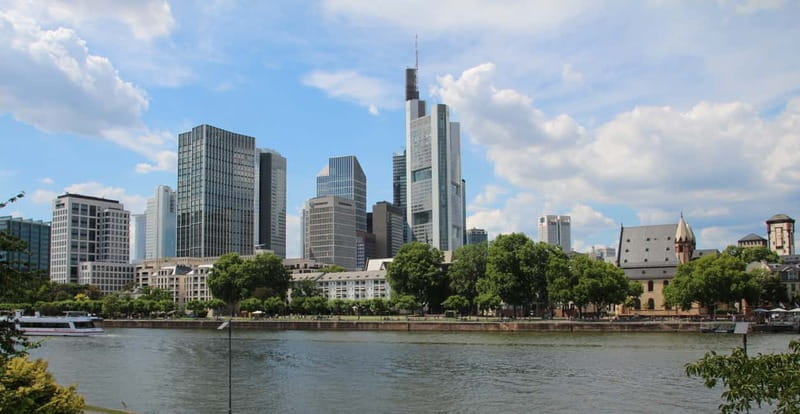
Frankfurt’s story is easiest to grasp when you see its old monuments beside its glass towers. This walk starts at the Justitia-Brunnen in Römerberg and links the Eiserner Steg, Römer, Paulskirche, and Neue Altstadt in a compact route. I like that it gives you both medieval Frankfurt and the modern financial city in one outing.
I especially like the focus on the rebuilt old town, which lets you think about what was destroyed in World War II and what Frankfurt chose to recreate. I also like the tour’s human scale: 90 minutes is enough to get your bearings without turning your first day into a march. The main consideration is that the tour is offered in German, so you need enough German to follow the explanations.
Key points
- Römerberg meeting point: Begin beside the Justitia-Brunnen, in the heart of Frankfurt’s old center.
- Eiserner Steg history: See the iron footbridge built in 1868 and hear how the city changed around it.
- War and reconstruction: Learn why much of the old center had to be rebuilt after World War II.
- Paulskirche connection: Visit the church linked with Germany’s first national assembly.
- Neue Altstadt contrast: Compare reconstructed historic façades with Frankfurt’s modern towers.
- Private option: A private group can offer more flexibility, as shown by Sanel’s ability to adjust timing for one group.
From Justitia-Brunnen into Frankfurt’s old center
The tour begins at the Justitia-Brunnen, the fountain beside the Römer in Römerberg. This is a useful starting point because you are already in the part of Frankfurt most first-time visitors want to understand: the old civic center, with its historic buildings, public squares, and major landmarks packed close together.
Your guide introduces the city here before leading you toward the Eiserner Steg. That opening matters. Frankfurt can seem like two different cities at once, with a traditional square on one side and a cluster of high-rise towers on the other. A good walk helps you connect those pieces instead of treating them as unrelated sights.
I would arrive a few minutes early. The meeting point is specific, but Römerberg can feel busy, especially when several groups gather around the historic center. Look for the Justitia-Brunnen rather than simply heading to the general Römerberg area.
The language is German, and that is the most important booking point. The guide is live and local, but no other language is listed. If you understand German well, the tour should give you useful context that is easy to miss when you simply photograph the buildings. If you do not, this is not the safest choice unless someone in your party can interpret.
A few more walking tours around Germany worth a look
- Discover Berlin Half-Day Walking Tour
★ 5.0 · 9,624 reviews - Berlin City walk Government District and Places of Democracy
★ 4.7 · 8,467 reviews - Berlin: Third Reich & Cold War Guided Walking Tour
★ 4.9 · 8,378 reviews
Eiserner Steg and the city’s changing face
The first named stop is the Eiserner Steg, Frankfurt’s iron footbridge built in 1868. The bridge offers a clear sense of how the old center relates to the wider city, and it is a fitting place to begin thinking about Frankfurt’s past and present.
The value here is not just crossing a bridge. Your guide uses the route to explain how Frankfurt’s grand buildings were affected by World War II and how the city handled the work that followed. That turns a short walk into a lesson about loss, rebuilding, and the choices made during the 2008 and 2009 renovation period.
You should expect a city walk rather than a formal museum presentation. The route is built around outdoor landmarks, street views, and explanations delivered as you move. That makes it easy to keep your bearings, though it also means you will want suitable shoes and clothing for the weather.
One private group found the guide, Sanel, flexible when the available time became shorter than planned. Even with the reduced schedule, the group received useful background on Frankfurt. That suggests a private booking may be worth considering if your day is tight or if you want the guide to shape the walk around your group’s pace.
The Römer, Frankfurt’s civic symbol
The Römer is one of the main visual anchors of the old town. Its distinctive façades make it one of the easiest Frankfurt sights to recognize, but the building means more when you hear how it fits into the city’s civic story.
Your guide provides information about the attraction rather than leaving you with a quick photo stop. You will learn how the historic center developed and how the buildings around Römerberg relate to Frankfurt’s identity.
The nearby square is also where the tour’s contrast becomes clear. You can look from old façades toward modern skyscrapers and see why Frankfurt often feels different from other German cities. The old town is not the whole city. It is one layer of a place shaped by trade, politics, war, reconstruction, and finance.
I like this part of the route for first-time visitors because it helps you decide what deserves a return visit. A short walk cannot replace every museum or interior tour, but it can show you which buildings you want to explore more closely later.
Paulskirche and Germany’s first national assembly
Paulskirche gives the walk a strong political and national connection. This is where the first German national assembly took place, making the church more than another historic building in the old center.
The stop is valuable because it adds modern political meaning to the architectural story. The tour is not only about façades and dates. It also explains how Frankfurt became connected with major events in German history.
You will want to listen carefully here, especially if political history is one of your reasons for booking. The 90-minute format means explanations need to stay focused, and a guide’s spoken account can make the difference between recognizing a church and understanding why it matters.
Paulskirche also helps balance the tour. The Eiserner Steg and Römer show different sides of Frankfurt’s urban past, while this stop places the city in a wider national setting. You get architecture, reconstruction, and politics without having to cross the city.
Same streets, a different route:
- Munich: Third Reich & WWII Walking Tour
★ 4.6 · 6,181 reviews - Berlin: Discover Berlin Walking Tour
★ 4.9 · 5,998 reviews - Berlin’s Best: 2 Hour Walking Tour Third Reich and the Cold War
★ 5.0 · 5,486 reviews - Berlin: Hidden Backyards Guided Walking Tour
★ 4.8 · 5,360 reviews
Walking through the Neue Altstadt
The Neue Altstadt is the city’s major recent old-town project and one of the most interesting parts of this experience. The name itself captures the tension: this is a new district designed to recall the old one.
The guide explains the renovation and reconstruction work connected with Frankfurt’s historic center. You will see how the city has tried to restore an old-town feel while creating a place for present-day use. That gives you a better way to judge the project than simply asking if the façades look old.
This is also where the World War II story becomes more concrete. You hear that many grand buildings were destroyed, then see a rebuilt center shaped by later decisions. The Neue Altstadt is therefore not just a pleasant area to stroll through. It raises a practical question about historic cities: how much should be recreated, and how much should show the present?
I appreciate that the route treats the area as part of Frankfurt’s ongoing story rather than pretending the old town survived unchanged. If you want untouched medieval streets, this will not provide that. If you want to understand how a modern city presents its past, it is a useful stop.
The contrast with Frankfurt’s skyscrapers
The tour promises a comparison between historic monuments and modern skyscrapers, and that comparison is one of its strongest ideas. Frankfurt’s skyline gives the city a profile unlike the traditional image many people have of German old towns.
You can use the walk to see how close the two identities sit together. A historic church, civic building, or reconstructed street can exist within sight of towers associated with business and finance. The guide’s explanations help turn that contrast into a theme rather than a visual oddity.
I would not book this as a dedicated skyline tour. The experience is centered on the Altstadt and its history, not on visiting observation decks or exploring the tower district. Still, the skyscrapers add useful context, especially if Frankfurt is only one stop on a longer trip and you want a quick sense of the city’s character.
The short duration works well here. In 90 minutes, you can see the essential relationship between old and new without spending half a day on a single neighborhood. The trade-off is that you will not get lengthy interior visits or extended time at each landmark.
How the private and shared choices differ
The shared option is the straightforward choice if you want a guided introduction at the lowest listed price. At $17 per person, the cost is modest for a live 1.5-hour walk through several of Frankfurt’s key sights. I see it as good value if you want context quickly and do not need a custom route.
The private option makes more sense for families, friends, or anyone with specific timing needs. One family group included four generations, from age eight to 87, and found the guide able to keep the experience interesting across a wide age range. That is a useful sign for groups that want an outing everyone can follow.
Private guiding can also help if your plans are changeable. Sanel adjusted one private tour when the group had less time than expected. You should not assume every request can be accommodated, but the example shows why a private format can be more forgiving than a fixed group walk.
The price difference between shared and private options is not provided, so compare the final booking totals for your group. If you are alone or traveling as a pair, the shared walk will usually be the simpler value choice. If several people are splitting the private cost, the extra control may make sense.
Who will get the most from this walk
I would recommend this tour to a first-time visitor who wants a clear introduction before exploring Frankfurt alone. The route covers the central sights most closely tied to the city’s old center, and the modern-versus-historic theme gives you a useful framework for the rest of your visit.
It also suits people who like history explained outdoors rather than in a lecture room. You move between landmarks, hear why they matter, and see the city’s rebuilding story as part of the streets around you.
Families may appreciate the short length and the mix of visual sights. The feedback from a group spanning four generations suggests that the guide can handle different ages and energy levels, though young children may still find any history walk demanding if they are not interested in buildings or stories.
This is less suitable if you want a long, highly detailed architectural tour, a museum visit, or guiding in English. It is also not the right pick if your main goal is to climb a tower or spend most of the time photographing the skyline. The focus stays on Frankfurt’s central history and urban changes.
Timing, weather, and what to bring
The walk lasts 1.5 hours, so it fits neatly into a morning, afternoon, or evening plan. One private tour took place on a rainy evening and still worked well for the group, but you should dress for the forecast because the route is outdoors.
Comfortable shoes are sensible. The tour involves walking between central sights and crossing or visiting public urban spaces, not sitting in one location. You may also want a small umbrella or rain jacket if the weather looks uncertain.
The route’s compact length is helpful when you are arriving in Frankfurt by train, fitting in a stopover, or trying to orient yourself before dinner. It also leaves time afterward for your own look around Römerberg, the Neue Altstadt, or other central sights.
Cancellation is free up to 24 hours before the start, and you can reserve now and pay later. Those terms are useful if your schedule is still shifting, but check the available starting times before you build the rest of your day around the walk.
My take on the $17 value
At $17 per person, this is a reasonably priced way to get a guided introduction to Frankfurt’s central story. You are paying for a live guide, not admission to a museum or a long private sightseeing program, so the value depends on how much context you want around the outdoor sights.
I think the strongest value comes from the range of subjects covered in a short time. You get the 1868 Eiserner Steg, the Römer, Paulskirche and its national assembly connection, the Neue Altstadt, wartime destruction, postwar rebuilding, and the nearby skyscrapers. That is a lot of orientation for 90 minutes.
The price is especially fair for a shared booking if you are new to Frankfurt and do not want to spend hours researching each site. A private booking can be worthwhile for a family or group, but you need to compare its total cost rather than assuming the $17 rate applies to every option.
Should you book this Frankfurt walking tour?
Book it if you want a short, German-language introduction to Frankfurt that connects old monuments with the rebuilt Neue Altstadt and the modern skyline. I would choose the shared option for simple value and the private option for a family, a mixed-age group, or a schedule that may need adjusting.
Skip it if you need English guiding, extensive interior access, or a full-day historical tour. For the right audience, this walk offers a smart first look at Frankfurt: compact, practical, and focused on the forces that made the city look the way it does today.
FAQ
Where does the Frankfurt walking tour begin?
The meeting point is the Justitia-Brunnen in Römerberg.
How long does the tour last?
The walking tour lasts 1.5 hours.
What language is the tour conducted in?
The live tour guide speaks German.
Is the tour shared or private?
You can choose a shared tour or a private group, depending on the option selected.
How much does the tour cost?
The listed price is $17 per person.
Which major sights are included?
The route includes the Eiserner Steg, the Römer, Paulskirche, and Frankfurt’s Neue Altstadt.
What is special about the Eiserner Steg?
The Eiserner Steg is an iron footbridge built in 1868.
What is the connection between Paulskirche and German history?
Paulskirche is where the first German national assembly took place.
Does the tour discuss World War II?
Yes. The guide explains how many grand buildings were destroyed during World War II and discusses the later renovation of the historic center, including work carried out in 2008 and 2009.
Can I cancel the booking?
You can cancel up to 24 hours in advance for a full refund. You can also reserve now and pay later.
Just added around Germany
- Private 2-Hour Hamburg Highlights Walking Tour★ 5.0 · 105 reviews
- Sightseeing Tour – Free Tour – Historic Center-Hamburg On Foot★ 5.0 · 112 reviews
- Discover Hamburg Walking Tour★ 5.0 · 77 reviews
- Historic Dresden Small-Group Walking Tour in English★ 5.0 · 160 reviews
- Walking Through Dresden’s Past with Dr. Fraser Macdonald★ 5.0 · 72 reviews
- Guided Brewhouse Walking Tour in Cologne★ 5.0 · 482 reviews
- Walking tour of Cologne: The essential and unmissable★ 5.0 · 121 reviews
- Berlin Walking Tour★ 4.5 · 378 reviews
Walking Tours, compared.

Magical London: Harry Potter Guided Walking Tour
Read our review →
Reykjavik Food Walk – Local Foodie Adventure in Iceland
Read our review →
History and Hauntings of Salem Guided Walking Tour
Read our review →
New Orleans Premier Ghost, Voodoo and Vampire Walking Tour
Read our review →
Amsterdam Anne Frank: Small-Group Walking Tour & Local Guide
Read our review →

Edinburgh Castle: Guided Walking Tour with Entry Ticket
Read our review →
Anne Frank’s Story – Guided Walking Tour through Amsterdam
Read our review →Browse the lists this tour appears in