
REVIEW · SPLIT
Split: History and Heritage Walking Tour
Split’s old town is not a museum sealed behind glass. It is a living city built inside and around Diocletian’s 1,700-year-old palace, where Roman stonework shares walls with medieval churches, Gothic palaces, cafés, and modern shops. This walking tour gives you the basic map and the backstory before you wander off on your own.
I like the way the guides connect Diocletian’s rise from an ordinary soldier to Rome’s most powerful man with the buildings around you. I also like the strong local touch: guides such as Antonella and Nikolas explain the city’s Roman, Croatian, and Venetian chapters in a clear, lively way.
The main thing to consider is group size. It is sold as a small-group tour, but one departure grew to nearly 30 people, making it harder to hear and causing pauses while the group regrouped in crowded lanes.
Key points to know before booking
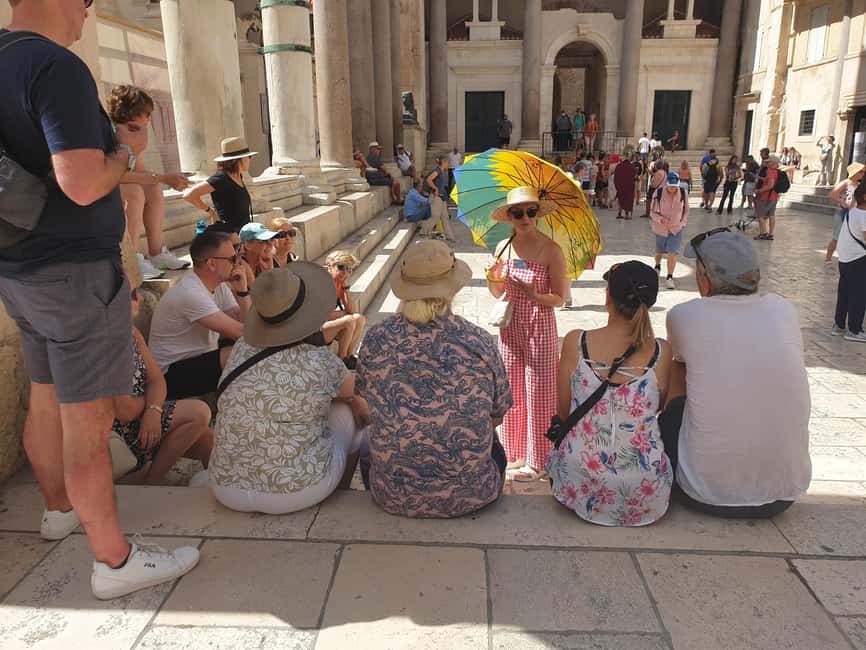
- Begin at Peristil Square: Meet under the old Roman arch beside the Tourist Information Office, marked by a yellow shirt or yellow umbrella.
- Walk through a living Roman palace: Ancient walls, courtyards, churches, shops, and homes all occupy the same compact historic core.
- Expect history with storytelling: The tour covers Diocletian, medieval Split, Venetian influence, the arrival of the Croats, and the city today.
- Guides make the difference: Antonella, Antonia, Nikolas, Doris, and other licensed guides are praised for clear explanations, humor, and local insight.
- Game of Thrones is a bonus: Fans can hear about filming locations, though the main subject remains Split’s long history.
- Plan for changing weather: The walk runs in sun or rain, so wear comfortable shoes and bring a hat or rain protection.
Starting beneath the Roman arch on Peristil Square
The meeting point is easy to identify once you reach Peristil Square. Look for the old Roman arch on the north side of the square, next to the Tourist Information Office, and then find the yellow shirt or yellow umbrella.
This is a smart place to begin. Peristil is one of the key open spaces within Diocletian’s Palace, and the square gives you an immediate sense of the tour’s central idea: Split is made from several periods stacked together. Roman columns and stone sit beside later buildings and the daily life of a modern Croatian city.
Your guide uses the square to set up the story of Emperor Diocletian. You learn how he rose from humble beginnings to become the most powerful man in the Roman world, then chose this part of the Dalmatian coast for his retirement palace. That personal story helps the palace feel less like a pile of old stones and more like the result of one ruler’s very specific plans.
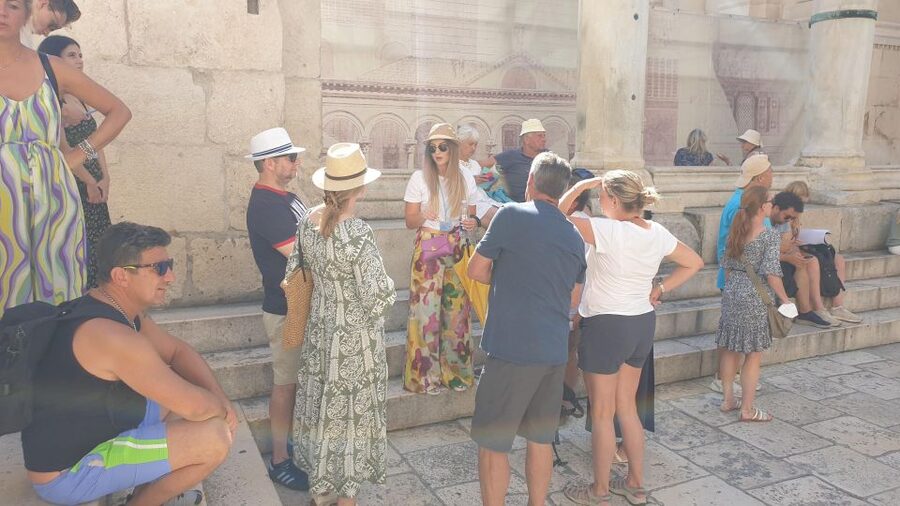
The guides are often the strongest part of the experience. Antonella is repeatedly singled out for her energy, teaching skill, and ability to explain complicated events in simple language. Nikolas is praised for linking the city’s architecture with its Roman and Venetian influences. Other guides, including Doris and Antonia, are described as friendly, clear, and attentive to whether people can hear.
More History Walking Tours in Croatia
- Dubrovnik Old Town History Walking Tour
★ 5.0 · 1,684 reviews - Dubrovnik: Ancient City Walls & Wars Walking Tour
★ 5.0 · 1,270 reviews - Zagreb: City and WWII Tunnels Walking Tour
★ 4.9 · 1,230 reviews
Reading the palace as a city, not a ruin
Diocletian’s Palace is the centerpiece, but it is important to understand what that means. You are not walking through a completely preserved imperial residence with every room intact. Instead, the palace has been absorbed into Split, and its surviving walls and streets form the framework of the old town.
That is precisely what makes the walk useful. Without a guide, you can easily see a Roman arch, a medieval wall, or an old palace façade without understanding how the pieces fit together. Your guide points out what remains from Roman times and explains how later generations changed, reused, and built over the original complex.
The tour covers the main highlights of the palace and its surrounding historic center. You can expect to see Roman architecture alongside Romanesque churches, medieval fortifications, Gothic palaces, and newer shops. The contrasts are not treated as a problem. They are the point.
I especially like this approach for a first visit. Split’s center is compact, but the details come quickly. A Roman feature may be beside a medieval building, while a modern storefront occupies the next doorway. The guide gives you a way to sort the periods without turning the walk into a dry architecture lecture.
The tour also helps you notice the practical side of palace life. Diocletian did not build a remote monument for future archaeologists. He created a huge complex for his retirement, and later residents adapted it for their own needs. The result is a place where ancient structure and ordinary city life remain closely connected.
Romanesque churches, Gothic palaces, and medieval defenses
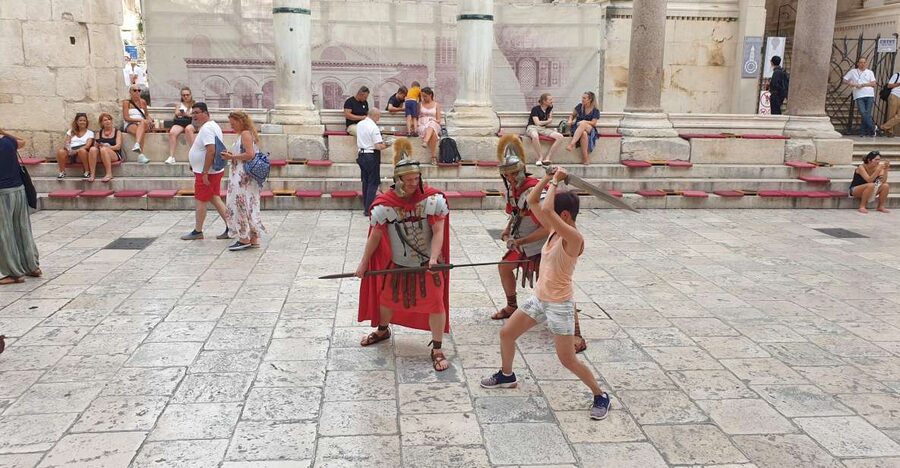
The walk moves beyond the Roman story to explain how Split changed after the empire. Roman rule was only the beginning. Medieval churches, fortifications, and Gothic palaces show how the city developed long after Diocletian was gone.
This section is valuable because it prevents a common mistake: treating every old-looking building as Roman. The guide helps separate the Roman remains from the later work and explains how different powers shaped the town.
The arrival of the Croats and the later influence of Venice form part of the wider story. Venetian architecture and civic influence left a lasting mark on Split, and the tour connects those changes to the streets and buildings you are seeing. You get a broad timeline, from the late Roman period through the Middle Ages and into the modern city.
The churches and palaces are not just decorative stops. They show how power moved from an emperor to local rulers, religious institutions, and wealthy families. Fortifications tell a similar story from another angle, showing how the city had to protect itself and control access.
Your guide may also point out small details that are easy to miss while wandering alone. One of the useful qualities of this tour is its attention to side streets and less obvious corners, not just the most photographed square. That makes it a good choice if you want more than a quick introduction to the palace walls.
Stories that keep the history moving
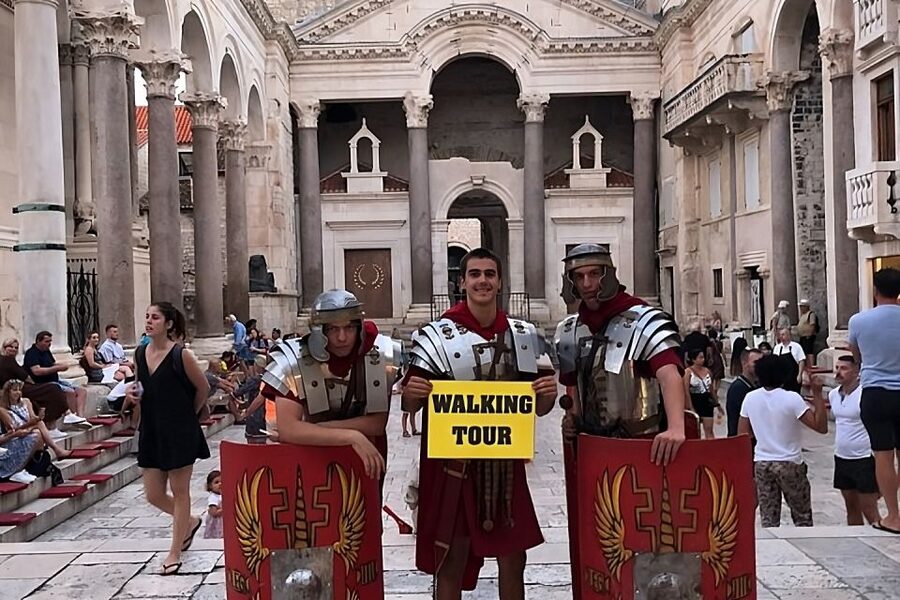
This walk works best when the guide turns dates and rulers into a connected story. The most praised guides do not simply recite facts. They explain the drama of Roman politics, Diocletian’s rise, the changes brought by Croats and Venetians, and the way Split’s past still shapes the city today.
That storytelling approach suits mixed groups. A history enthusiast can enjoy the political and architectural context, while someone who normally avoids history tours can still follow the main thread. One guide was even compared to a teacher, a useful description of the tone to expect: organized, conversational, and built around explanation rather than performance.
The guides also leave room for questions. If you want to understand a particular building or period, you can ask as you go. They are described as friendly and willing to explain things in plain language, which matters in a place with so many overlapping layers.
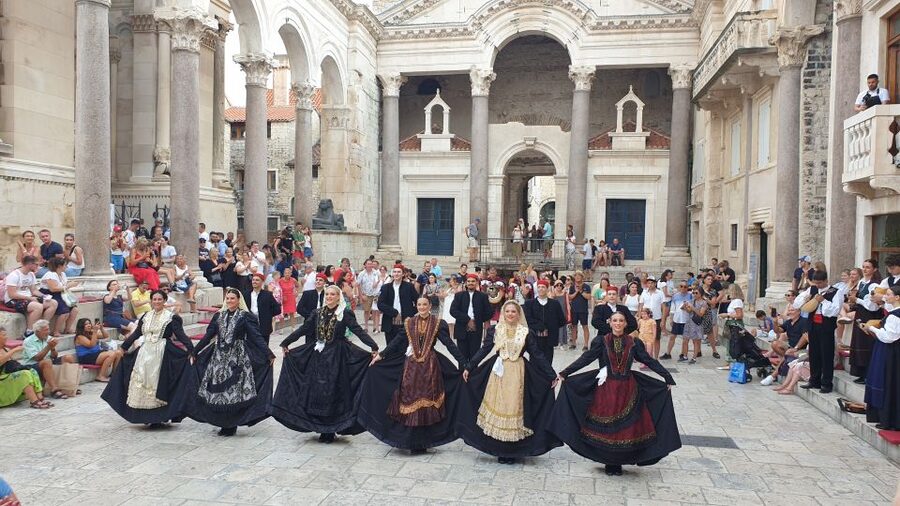
You might also encounter traditional singing during the walk, as one departure did. That is not presented as a scheduled part of the tour, so do not book expecting a musical performance. It is simply the sort of local moment that can make a city walk feel connected to present-day Split rather than locked in the past.
More History Walking Tours in Split:
- Berlin: Third Reich & Cold War Guided Walking Tour
★ 4.9 · 8,378 reviews - Munich: Third Reich & WWII Walking Tour
★ 4.6 · 6,181 reviews - Berlin’s Best: 2 Hour Walking Tour Third Reich and the Cold War
★ 5.0 · 5,486 reviews - Third Reich Berlin: Hitler and WWII Walking Tour
★ 5.0 · 3,301 reviews
Game of Thrones locations as an extra layer
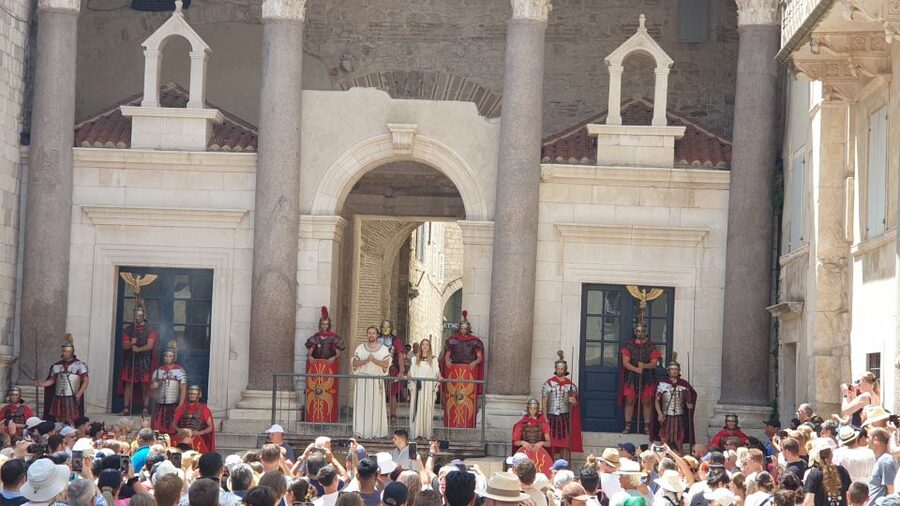
Game of Thrones fans get additional information about filming locations. This can add a playful modern connection to the Roman and medieval setting, especially if you recognize places from the show.
Still, the television references are a bonus, not the main reason to book. The tour’s core content is the history of Diocletian’s Palace and Split. If you are not interested in the show, you can still get full value from the Roman, medieval, and Venetian material.
For fans, the advantage is context. A filming location means more when you understand the real building or street beneath the screen version. The guide can place the popular culture reference inside the longer story of the city.
What the $18 price buys you

At $18 per person, this is a modest-cost way to get oriented in Split’s historic center. You are paying for a guided small-group walk and the time of a licensed guide, not for admission to a separate attraction or a meal.
The value comes from interpretation. The palace and old town are there to walk through for free in many areas, but the experience can be confusing without a clear explanation. A good guide saves you from passing important remains without noticing them and gives you a timeline you can use for the rest of your stay.
The price also makes sense for a short visit. If you have only 48 hours in Split, a well-run history walk can give you a solid base quickly. Afterward, you can return to the corners that interested you, choose a church or museum for a closer look, or simply revisit the streets with better bearings.
Admission tickets are not included. The supplied information does not name specific ticketed stops, so ask your guide what, if anything, requires separate payment before deciding to enter a site. Food, drinks, hotel pickup, and drop-off are also not part of the price.
Group size, pace, and practical comfort
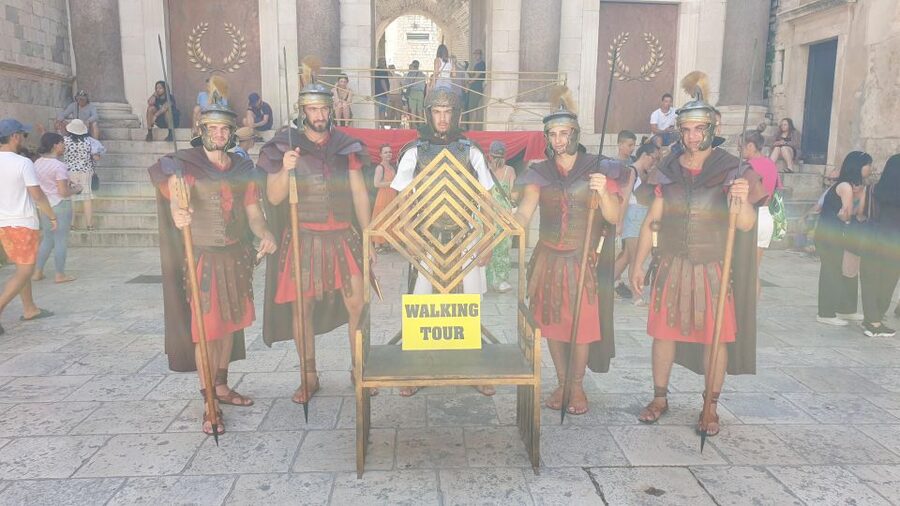
The activity is described as a small-group walk, but group size may vary. One departure reached almost 30 people, and that guide acknowledged the crowd. In narrow, busy streets, a large group can mean waiting for people to catch up and standing farther from the guide than you would like.
That is the main practical weakness. A smaller group should make it easier to ask questions, hear every explanation, and keep a steady pace. If the group is larger, stay near the guide and make sure you can see the yellow meeting marker at the start.
The pace is generally described as comfortable, with enough time to listen without feeling rushed. Still, this is a walking tour through historic streets and squares, so comfortable shoes matter more than stylish ones. Bring a hat for strong sun and clothing that lets you walk easily.
The tour operates in all weather. Rain does not automatically cancel it, so carry a light rain layer or umbrella when the forecast looks uncertain. The meeting point is outdoors, and the old town offers limited shelter if you arrive early in poor weather.
The tour is suitable for all ages, but the information says it is not suitable for people with high blood pressure or for people with hearing impairments. If hearing is difficult for you, a variable group size and outdoor street noise could make following the guide hard.
You may reserve now and pay later, which is useful if your plans are still shifting. Cancellation is allowed up to 24 hours before the tour for a full refund.
Choosing your language and guide
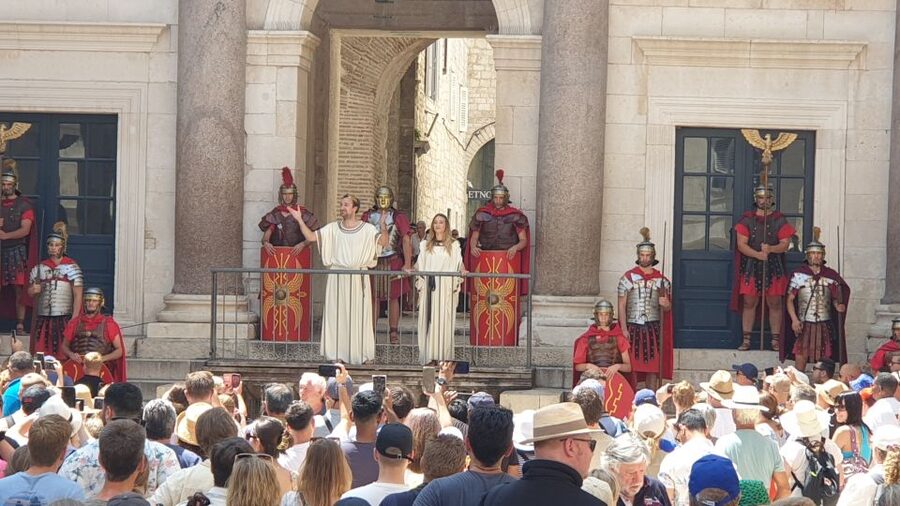
The tour is offered in English, German, French, and Russian. Check your selected language carefully when booking, since the quality of the experience depends heavily on understanding the guide’s explanations.
Several guides receive particularly strong praise for their delivery. Antonella is described as passionate, entertaining, and especially good at making complex history easy to follow. Nikolas is praised for explaining the city’s different cultural influences. Antonia and Doris are also associated with friendly, helpful service.
That does not mean every departure will feel identical. A history walk is shaped by the person leading it, the number of people attending, the weather, and how many questions arise. The consistently positive descriptions of enthusiasm and clarity are encouraging, but you should still expect a live experience rather than a fixed audio script.
Who should book this Split walking tour?
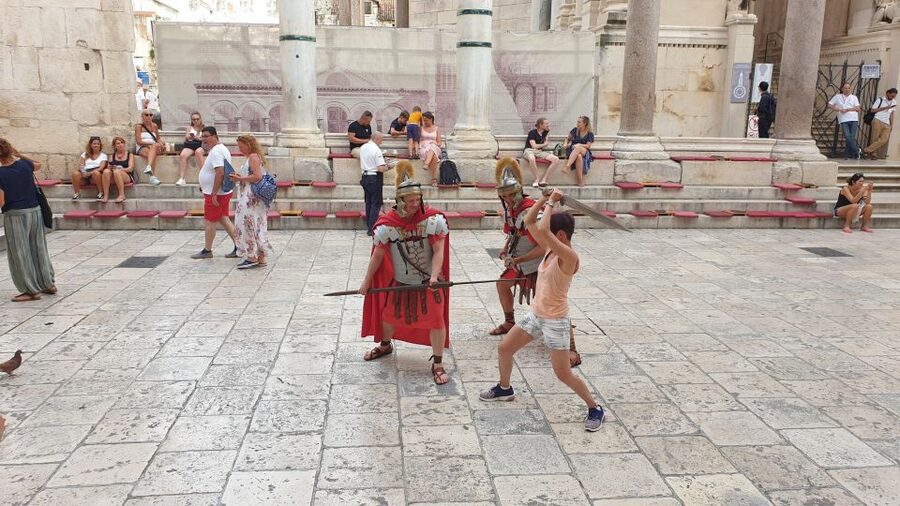
I would book this if you are visiting Split for the first time, want historical context, or prefer to understand a city before exploring it alone. It is especially useful for travelers with limited time, families with older children, and anyone who likes stories more than a list of dates.
It also suits people who want a local guide without paying for a private tour. The $18 price keeps the experience accessible, while the compact route covers the central historical sights.
You may want a different option if you dislike group walks, need guaranteed quiet conditions, or want extensive access to ticketed interiors. The possible group of nearly 30 can reduce the personal feel, and admission fees are separate.
FAQ
Where does the tour start?
It starts on Peristil Square under the old Roman arch on the north side of the square, beside the Tourist Information Office. Look for a yellow T-shirt or yellow umbrella.
Where does the tour end?
The activity ends back at the meeting point.
What languages are available?
The tour is available in English, German, French, and Russian.
Are entrance tickets included?
No. Admission tickets are not included in the tour price.
Does the tour run in bad weather?
Yes. The tour takes place in rain or sunshine. Bring suitable clothing and weather protection.
Can I cancel for a full refund?
Yes. You can cancel up to 24 hours in advance for a full refund.
Should you book it?
Book this Split history walk if you want the old town to make sense, not just look picturesque. For $18, you get a guided introduction to Diocletian’s Palace, medieval Split, Venetian influence, Gothic buildings, and modern city life, with Game of Thrones references added for fans.
The best reason to go is the storytelling. Guides such as Antonella and Nikolas bring the timeline into focus and make the palace easier to read. Just prepare for variable group size, wear good shoes, and confirm your meeting point before setting out.
Just added around Split
- Diocletian’s Palace and Old Town SMALL GROUP Walking Tour★ 5.0 · 502 reviews
- Split: City Walking Tour w/ Game of Thrones Locations★ 4.9 · 318 reviews
- Discover The Old Town Split 1.5h walking Small group tour★ 4.8 · 93 reviews
- SPLIT-PRIVATE Walking Tour of Diocletian’s Palace & Old Town★ 5.0 · 467 reviews
- From Split: Krka Waterfalls Cruise & Trogir Walking Tour★ 4.7 · 681 reviews
- Split: Diocletian Palace & Old Town Guided Walking Tour★ 4.7 · 882 reviews
- Split Walking Tour with Professor of History★ 5.0 · 926 reviews
- Walking Tour of Split with a ‘Magister’ of History★ 5.0 · 1,122 reviews
History Walking Tours, compared.



Berlin’s Best: 2 Hour Walking Tour Third Reich and the Cold War
Read our review →
Third Reich Berlin: Hitler and WWII Walking Tour
Read our review →
New Orleans Garden District History Walking Tour
Read our review →
Cartagena: Historic Center and Getsemaní Shared Walking Tour
Read our review →
Imperial Palace and Shogun Historical Walking Tour
Read our review →Browse the lists this tour appears in