
REVIEW · FLORENCE
Renaissance & Medieval Florence Guided Walking Tour plus mobile App
Florence reveals itself best on foot, and this tour gives you a quick route through the city’s biggest Renaissance landmarks. You’ll trace the Medici story from San Lorenzo to Palazzo Vecchio, see the Duomo from the outside, rub the bronze Porcellino’s nose, and finish at Ponte Vecchio.
I like the strong first-day route and the chance to see both sides of the Arno in only 90 minutes. I also like the elegant cloister at San Lorenzo, a quiet stop that gives the walk a welcome pause from Florence’s crowded streets.
The main drawback is language management. Although the experience is offered in English, some departures combine English with French or Spanish, and the repeated explanations can reduce the amount of time available for each language.
Key points to know before booking
- Medici Florence in one short walk: San Lorenzo, the Medici family’s church, begins the historical thread.
- Outside views, not museum visits: The route passes the Duomo, Uffizi courtyard, Palazzo Vecchio, and Pitti Palace, but attraction entry is not included.
- A quiet cloister amid busy streets: The Brunelleschi-designed cloister at San Lorenzo is one of the walk’s most appealing details.
- Ends on the south side of the Arno: The tour finishes at Ponte Vecchio, near Pitti Palace and the Oltrarno area.
- Useful after-tour app: Vox City adds self-guided routes and audio commentary, but you need your own phone and headphones.
- Small by city-tour standards: The group can include up to 20 people, with smaller groups possible.
A fast way to understand Florence
At $30.04 per person, this is priced as an affordable orientation walk rather than a deep art-history seminar. You are paying for a local guide, a carefully arranged route, meeting-point assistance, and access to a mobile city guide.
That price makes sense if you have only a short stay or want help deciding which sights deserve more of your own time. You will not enter the Uffizi Gallery, Medici Chapels, Palazzo Vecchio, or Pitti Palace, so you should think of this as a city introduction with exterior views and one brief church stop.
The route also crosses a lot of ground. In roughly an hour and a half, you move from San Lorenzo to the Duomo, through the civic center, across the Arno, and to Ponte Vecchio. The pace is useful, but it leaves little room for long conversations or detailed examination of every monument.
Several guides have received especially warm praise for making the past easy to follow. Marta, Helena, Larisa, Sylvia, and Maximilian were each singled out for clear explanations, local detail, or an engaging manner. The quality can depend on the guide assigned to your departure, but the strongest reports point to a tour that brings Florence’s politics, buildings, and personalities together well.
More History Walking Tours in Florence:
- Florence: Renaissance and Medici Tales Guided Walking Tour
★ 4.8 · 1,549 reviews - Medici Legends & Renaissance Wonders: Florence Small Group Tour
★ 5.0 · 205 reviews - Florence: LGBTQ Renaissance Walking Tour with Mila
★ 4.9 · 85 reviews
San Lorenzo and the Medici family
The meeting point is on Via de’ Martelli, close to the Duomo. From there, the walk heads toward San Lorenzo, one of Florence’s key districts for understanding the Medici family.
San Lorenzo was not simply a church stop. It was closely tied to the Medici banking dynasty, whose power shaped Florence’s government, art, and building projects. A good guide can use this area to explain how one family moved from financial influence to political control and then became one of Europe’s great patrons of art.
The tour includes the Basilica of San Lorenzo and its elegant cloister, designed by Brunelleschi. The cloister offers a peaceful green space in the middle of the Medici district, and it gives you a chance to see a more restrained side of Renaissance design.
The itinerary also points out the Medici Chapels, associated with Michelangelo and Matteo Nigetti, and Palazzo Medici Riccardi, designed by Michelozzo for Cosimo de’ Medici. These are important buildings, but the experience does not include paid entry to them. If the chapels are high on your list, save them for a separate visit.
The San Lorenzo section is one of the tour’s best history lessons because the buildings are not presented as isolated sights. You begin to see Florence as a city shaped by family rivalries, money, religion, and artistic ambition.
The Duomo from Piazza del Duomo
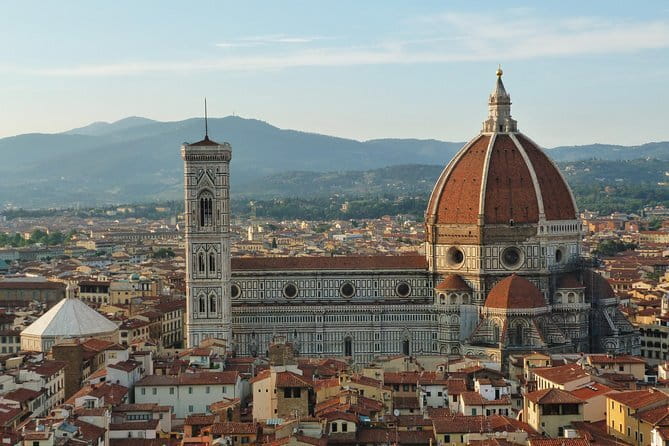
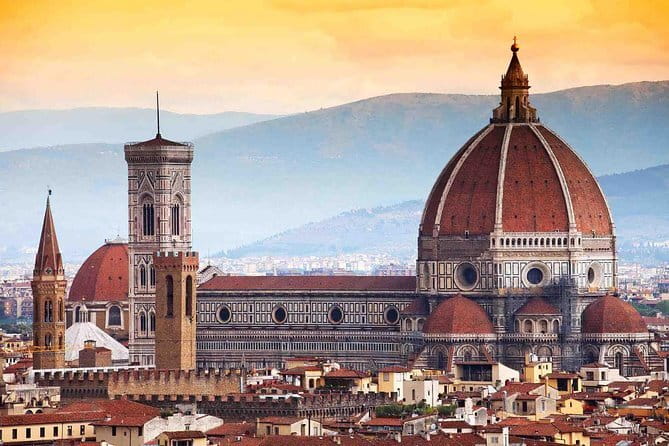
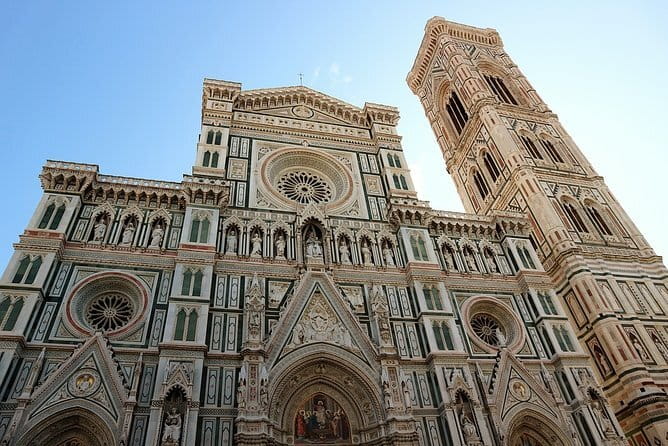
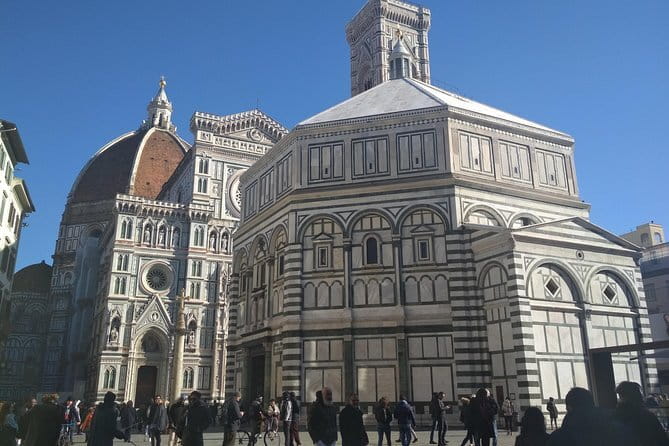
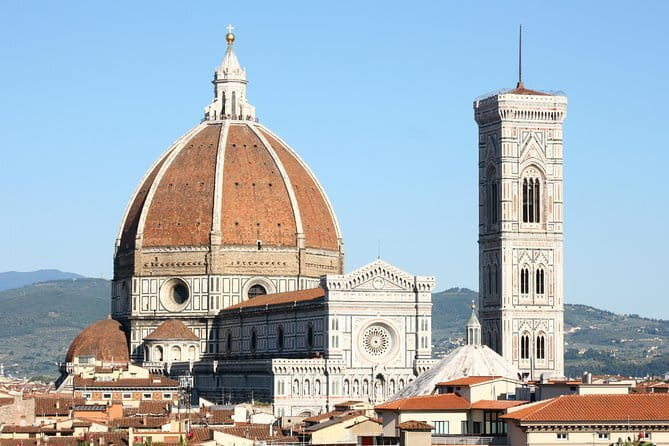
From San Lorenzo, the route continues to Piazza del Duomo. Here you see the Cathedral of Santa Maria del Fiore, Brunelleschi’s famous dome, Giotto’s Bell Tower, and the Baptistery of Saint John.
The square can feel crowded, so a guide is useful for orienting you among the marble facades and towering structures. You’ll hear how the cathedral complex developed and why Brunelleschi’s cupola became such a defining achievement of Renaissance Florence.
You have about 20 minutes at this stop. That is enough to take in the main views, hear the architectural story, and make a plan for a later visit. It is not enough to climb the dome, enter the cathedral, visit the baptistery, or study the Gates of Paradise at length.
That limitation is important. The tour works well if you want a clear outside introduction, but you should not book it expecting a full Duomo experience. Paid attraction entry is not included, and the route remains primarily a walking tour.
I find this stop most useful early in a Florence visit. After hearing the basic story, you can return later with a better sense of what you are looking at and which parts of the complex deserve your money and time.
A lucky pig and Florence’s civic heart
The next stop is the Fontana del Porcellino at the Mercato della Paglia, or Straw Market. The bronze piglet is tied to a popular local tradition: rub its nose for good luck.
This is a short, lighthearted pause after the heavier Medici and cathedral material. It also shows how Florence’s public spaces mix art, commerce, superstition, and daily life. You may have only about ten minutes here, but that is enough for a photo and a quick look at the market setting.
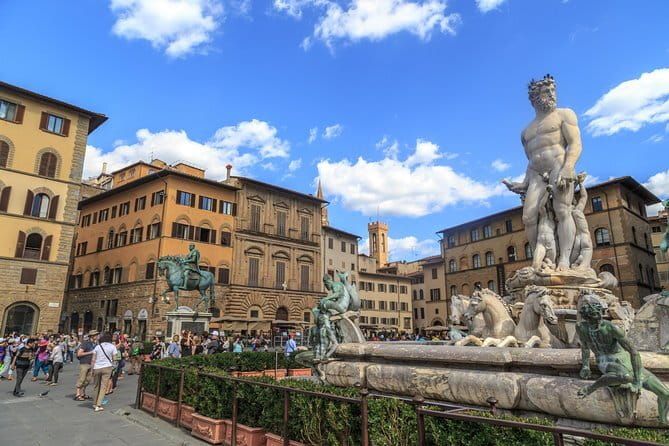
From the Porcellino, the walk moves to Piazza della Signoria. This is Florence’s great civic square, dominated by Palazzo Vecchio. Its outdoor sculptures make it feel like an open-air museum, though the square remains a working public place filled with cafes, foot traffic, and people heading toward nearby sights.
Giambologna’s Rape of the Sabine Women is one of the major works you see here. The sculpture’s twisting form rewards a close look, even during a short stop. Your guide can help you notice the way the figures spiral upward, something easy to miss when you are simply crossing the square.
Piazza della Signoria is also where Florence’s political story comes into sharper focus. San Lorenzo introduces the Medici family’s roots and influence. Palazzo Vecchio shows how power was displayed and exercised in the city center.
More Guided Tours in Florence:
- Florence: Highlights Walking Tour with Expert Guide
★ 4.6 · 4,662 reviews - Florence: Duomo Complex with Tickets & City Walk Guided Tour
★ 4.7 · 2,057 reviews - David & Accademia Guided Tour with Time Entry Ticket
★ 4.5 · 1,705 reviews - Florence: Guided Walking Tour
★ 4.6 · 1,602 reviews
Following the Vasari Corridor toward the Arno
After Piazza della Signoria, the route passes through the courtyard of the Uffizi Gallery. This gives you an exterior look at one of the world’s most important art museums, associated with works by Botticelli, Leonardo da Vinci, Michelangelo, and Raphael.
You will not enter the Uffizi on this tour. That is both a limit and a practical advantage. A proper museum visit takes far longer than the walking tour, and trying to combine the two would make the schedule unwieldy. If you plan to visit the Uffizi, reserve separate time for it.
The walk then follows the path of the celebrated Vasari Corridor from the outside. The corridor links Palazzo Vecchio with Pitti Palace and crosses the Arno above the shops of Ponte Vecchio. It was built as a private passage for the ruling family, allowing the Medici to move between homes and offices without mixing with street crowds.
The route does not provide entry to the corridor, but following its course helps explain how Florence’s political center connected with the Medici residence across the river. This is one of the more unusual threads in the tour because it ties together several places that can otherwise seem unrelated.
Ponte Vecchio and the south side of Florence
Ponte Vecchio is the final main stop and the endpoint at 50125 Florence. The bridge is famous for its jewelry shops and is described as Florence’s oldest bridge. It is also one of the city’s best places to understand the relationship between the Arno and the neighborhoods on either bank.
The bridge can be crowded, especially around the shopfronts and central viewpoints. The walk gives you a useful first look, but it is worth returning at a quieter time if you want photos or a slower crossing.
Ending here is convenient. You can continue toward Pitti Palace, explore the south side of the river, or simply use the bridge as a clear landmark for the rest of your day. One particularly useful point from the experience is that it exposes you to more than the streets around the Duomo. One person who had limited time found the south side worth seeing and later wished to stay there on a return visit.
The route also reaches Florence’s medieval quarters, including the area associated with Dante Alighieri, along with Badia Fiorentina and the Bargello Palace. The exact order can change, so these stops may appear at a different point in your walk.
What the guide adds to the buildings
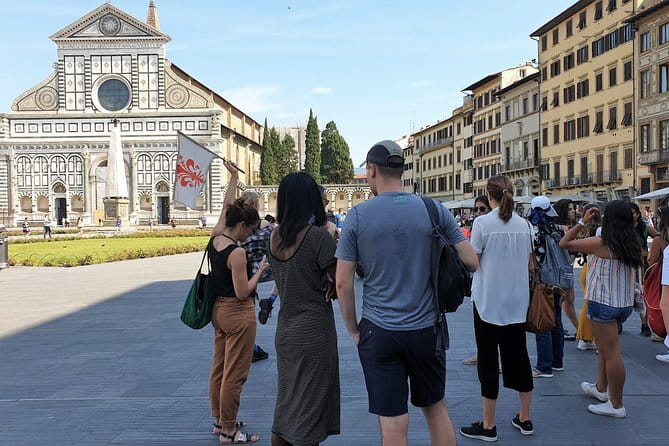
The best part of a guided walk is not the act of reaching each monument. You can find the Duomo and Ponte Vecchio on any map. The value comes from having someone connect the sites.
The strongest guides on this experience have been praised for explaining Florence’s history, architecture, and local life with energy. Maximilian was noted for anecdotes, while Helena, Larisa, and Sylvia were appreciated for making the city easy to understand. Marta was especially effective at explaining the Medici family and the city’s major sights.
You should also know that the experience can include two languages. Some English departures have been combined with French or Spanish groups. In those cases, the guide repeats each explanation, which can make the walk feel slower and reduce the amount of detail you hear in English.
This is the biggest practical risk in booking. Some people found the bilingual format manageable, while others felt they received only half the useful talk because so much time went to translation. If an English-only format matters to you, confirm the language arrangement before setting out.
A few other details affect the experience. Some guides stop for extended explanations, which can feel chilly on a cold day. Others keep the group moving at a comfortable pace. Wear comfortable shoes, and bring layers if the forecast is cool.
Getting value from the Vox City app
The mobile app is a useful extra, but it should not be the main reason you book this tour. You receive access to Vox City, which offers self-guided city routes, multilingual audio commentary, and information about points of interest.
You need your own smartphone and headphones. Download the app from the App Store or Google Play, and the meeting-point assistant provides your credentials before the walk begins.
The app matters because the guided portion is short. After the group finishes at Ponte Vecchio, you can continue exploring with recorded commentary instead of paying for another guided walk. It can also help you revisit an area you passed too quickly, though the supplied details do not specify the exact number or length of app routes.
Bring charged phones and headphones that work with your device. Headphones are not provided. If you prefer to stay fully present with the guide, you can treat the app as a later planning tool rather than listening during the walk.
Group size, meeting point, and walking demands
The maximum group size is 20 people. That is not a private tour, but it is still manageable for a city walk. Smaller departures are possible, and a small group makes it easier to ask questions and hear the guide in crowded squares.
The start on Via de’ Martelli is near public transportation and close to the Duomo area. The endpoint at Ponte Vecchio means you do not return to the starting point, so plan the rest of your day from the south side of the Arno.
The route includes about 90 minutes of city walking, with several stops for explanations. Comfortable shoes are strongly recommended. Most people can take part, but you should expect busy streets, uneven walking surfaces, and periods of standing in open squares.
The order of visits may change. That is normal in central Florence, where crowds, ceremonies, and street conditions can affect the route. The important point is that the main areas remain the same: San Lorenzo, the Duomo, central Florence, the Arno, and Ponte Vecchio.
Who should book this Florence walk?
I would choose this tour for a first morning or first afternoon in Florence, especially if you have only a day or two. It gives you a useful mental map and helps you choose between the many museums, churches, palaces, and viewpoints competing for your time.
It also suits anyone who wants a history-led introduction rather than a shopping walk or a single-museum tour. The Medici connection gives the route a clear storyline, and the cross-river finish adds more range than a simple Duomo loop.
I would be more cautious if you already know Florence well, have taken another general city tour, or want long stops inside major attractions. One person who had already taken a night tour found that some historical material overlapped. If you book both, expect repeated background about the city.
The tour is also less appealing if you dislike bilingual guiding or standing still while a guide translates. Ask about the language mix before booking, since this issue has made a major difference to the experience for some participants.
Should you book it?
Book this walk if you want a low-cost introduction to Florence’s main sights, a clear Medici storyline, and a route that reaches both the historic center and Ponte Vecchio. The cloister at San Lorenzo, the sculpture-filled Piazza della Signoria, and the cross-river finish give it more substance than a simple landmark checklist.
Skip it if you want paid museum entry, an English-only guarantee, or detailed time inside the Duomo complex and Medici Chapels. At $30.04, it offers solid value as an orientation tour, not as a substitute for Florence’s major museums.
The best plan is to take it early in your stay, keep the rest of the day flexible, and use the Vox City app afterward to revisit the places that catch your interest.
FAQ
How long does the Renaissance and Medieval Florence walking tour last?
The guided walk lasts approximately 1 hour and 30 minutes.
What is the price of the tour?
The listed price is $30.04 per person.
What language is the tour offered in?
The tour is offered in English. Some departures may combine English with French or Spanish, so language arrangements can affect the amount of time spent hearing English explanations.
Where does the tour begin?
The meeting point is Via de’ Martelli, 50, 50122 Florence, Italy.
Where does the tour end?
The tour ends at Ponte Vecchio, 50125 Florence, Italy.
Does the tour include entry to the Duomo or other attractions?
No. Entry to attractions is not included. The tour provides outside views of places such as the Duomo, Uffizi Gallery, Palazzo Vecchio, and Pitti Palace, along with the listed stop at the Basilica of San Lorenzo cloister.
Do I need a smartphone and headphones?
Yes. You need your own smartphone and headphones to use the Vox City self-guided app after the walking tour. Headphones are not included.
How large is the group?
The tour can have a maximum of 20 participants.
Can I cancel for a full refund?
Yes. You can cancel at least 24 hours before the experience start time for a full refund. Changes or cancellations made less than 24 hours before the start time are not accepted for a refund.
Just added around Florence
- Tasty Florence Street Food with Guided Walking of the City★ 5.0 · 174 reviews
- Medici Legends & Renaissance Wonders: Florence Small Group Tour★ 5.0 · 205 reviews
- Florence Food Tour of 10+ Authentic Tastings with Cheeses & Wines★ 5.0 · 155 reviews
- Florence Private Walking tour with Skip-the-line to Accademia★ 4.5 · 236 reviews
- Florence: Whispers of the Renaissance walking tour★ 4.5 · 78 reviews
- Private Florence Tour: 3-Hour Walking Tour with a Licenced Guide★ 5.0 · 233 reviews
- The Best of Florence Walking Tour in a Small Group★ 5.0 · 503 reviews
- Private Skip-the-Line Florence Highlights and David Walking Tour★ 4.5 · 78 reviews
History Walking Tours, compared.



Berlin’s Best: 2 Hour Walking Tour Third Reich and the Cold War
Read our review →
Third Reich Berlin: Hitler and WWII Walking Tour
Read our review →
New Orleans Garden District History Walking Tour
Read our review →
Cartagena: Historic Center and Getsemaní Shared Walking Tour
Read our review →
Imperial Palace and Shogun Historical Walking Tour
Read our review →Browse the lists this tour appears in