
REVIEW · NUREMBERG
Nuremberg Old Town and Nazi Rally Grounds Walking Tour
Nuremberg’s past comes in two sharply different chapters: the imperial medieval city and the vast Nazi Rally Grounds. This tour links them in one thoughtful day, beginning with castle courtyards, Gothic churches, and old fortifications before turning to the difficult story of Hitler’s propaganda machine.
I like the strong mix of old and modern history, and I like that the bus ride to the Rally Grounds and tram ride back are included in the $43 price. The lunch break in the Hauptmarkt also gives you time for sausages, coffee, or a seasonal Glühwein instead of forcing four straight hours of walking.
The main drawback is physical: this is a rain-or-shine walking tour, and it is not suitable for people with mobility problems. The Rally Grounds section is also outdoors and can feel stark, especially in cold or wet weather, so comfortable shoes and suitable clothing matter.
Key points to know before booking
- Two very different sides of Nuremberg: Medieval streets and imperial courtyards lead into the enormous remains of the Nazi Rally Grounds.
- A useful four-hour introduction: You get orientation, history, food tips, and transport help in one morning or afternoon.
- The lunch break is not included: Set aside money for food, though the location makes it easy to find sausages, coffee, beer, or Glühwein.
- The Nazi history is handled directly: Guides explain the propaganda purpose of the sites and how Nuremberg addresses this past today.
- Included transport adds real value: Public transportation to the Rally Grounds and back to the Hauptbahnhof is covered.
- Guide quality is central: Hannes, Natasha, Nick, Nic, Dimitri, Paul, Jax, and Nickolai have all led tours, with strong praise for clear English, humor, sensitivity, and detailed storytelling.
Why this Nuremberg tour works so well
I like tours that help you understand a city before you start wandering on your own. This one does exactly that. It begins outside Nuremberg’s main train station, covers the central sights on foot, pauses for lunch, then carries you out to the former Nazi Party Rally Grounds.
That structure gives you a useful sense of scale. The Old Town is compact and human in size, with narrow streets, churches, market stalls, and walls. The Rally Grounds are the opposite: broad, formal, and built to make individuals feel small beneath the Nazi state.
The tour is priced at $43 per person. For four hours, that is fair value, especially since public transportation is included. You are paying not only for a guide but also for the connection between two parts of the city that are spread apart. Lunch is extra, and admission to the Documentation Center is not included.
The rating is 4.7 from 377 ratings, and the most consistent strength is the guides. Hannes is often singled out for combining humor with detail, while Natasha, Nick, Nic, and Dimitri are praised for clear explanations and engaging delivery. That matters here. Nuremberg’s past can become a dry list of dates, or it can become a clear story about power, art, faith, propaganda, war, and memory.
More Old Town Walking Tours in Germany
- Nuremberg: Old Town Guided Walking Tour
★ 4.6 · 2,416 reviews - Munich: Old Town & Viktualienmarkt City Walk in German
★ 4.7 · 2,304 reviews - Heidelberg: Walking Tour of the Old Town
★ 4.6 · 1,742 reviews
Starting at the Hauptbahnhof and entering Handwerkerhof
Meet your guide outside the large arched entrance of Nuremberg Hauptbahnhof. Look for the red and white Nuremberg Tours in English sign, and arrive a few minutes early so the group can check in without a rushed start.
The first stop is Handwerkerhof, also called the Craftsmen’s Court. This small area near the station is a pleasant introduction to local traditions, with artisans working with traditional materials and methods. The guided visit lasts about 10 minutes, so think of it as a quick orientation rather than a full shopping stop.
From here, the tour moves toward the Old Town and the Mauthalle. The former customs hall is one of the city’s notable historic buildings, and it helps set up the story of Nuremberg as a trading and imperial center. Your guide also begins pointing out places to eat and drink, including the city’s famous sausages and amber lager.
This early section is useful if you have just arrived by train. You get your bearings quickly, and you begin to see how close the main Old Town sights are to one another.
Gothic churches, market traditions, and the Hauptmarkt
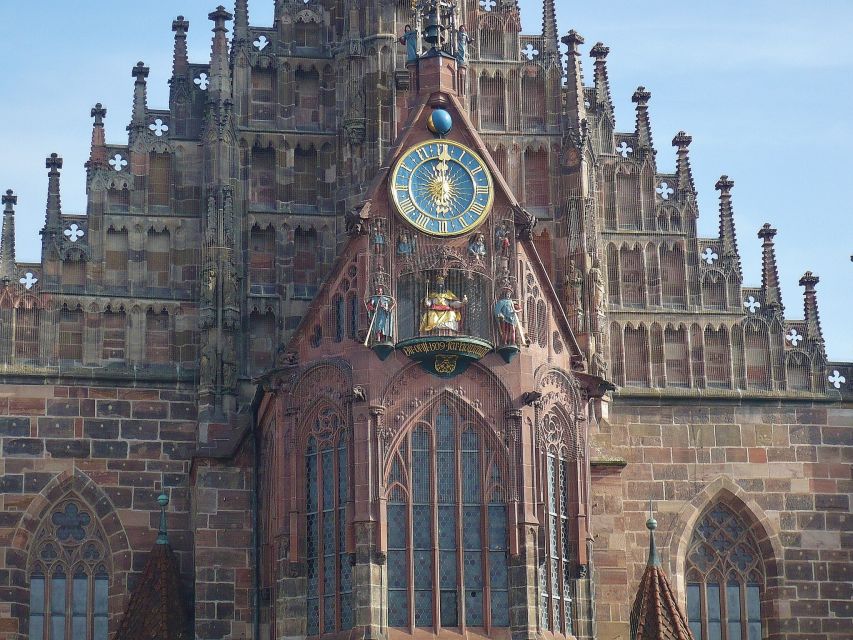
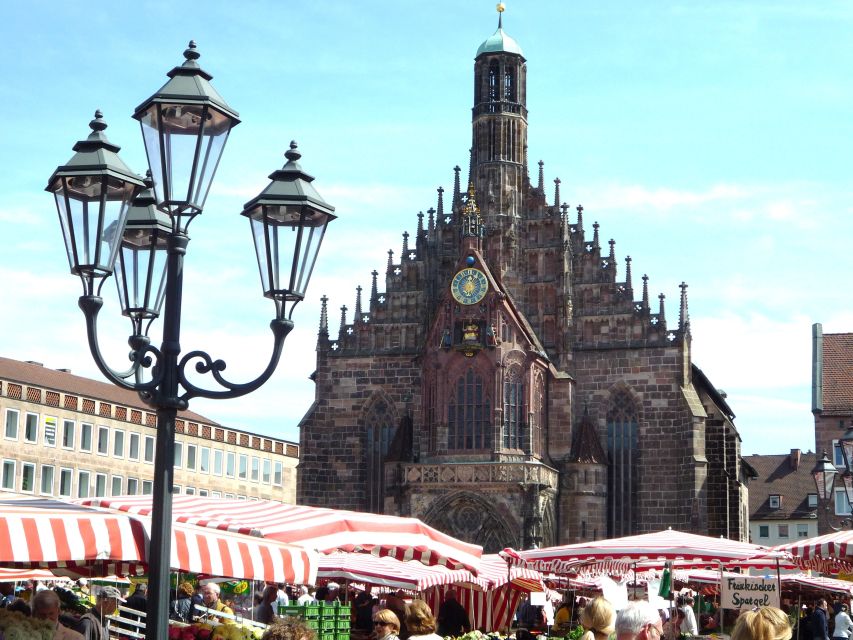
The route passes St. Lorenz Church, one of the city’s major Gothic landmarks. You do not go inside as part of the listed guided stops, but the exterior still gives you a sense of the scale and skill behind Nuremberg’s medieval religious buildings.
The tour then reaches the Hauptmarkt, the large central marketplace. Markets have been held here for nearly 700 years, and it remains one of the best places to understand Nuremberg’s public life. In December, this is the setting for the famous Christmas market, with seasonal stalls, food, decorations, and Glühwein.
Your guide can also point you toward practical food choices. The break later takes place here, so you will already know where you are and what sort of lunch suits you. If you want a fast local bite, the city’s sausage culture is an obvious choice. If you prefer a slower meal, the pause gives you time to find a café or restaurant.
The timing works well, but remember that lunch is not included. The stop is about 30 minutes, so it is best for a quick meal rather than a long sit-down lunch. In December, you might spend the break with a hot drink and a small market snack instead.
Old City Hall and the road to the Imperial Castle
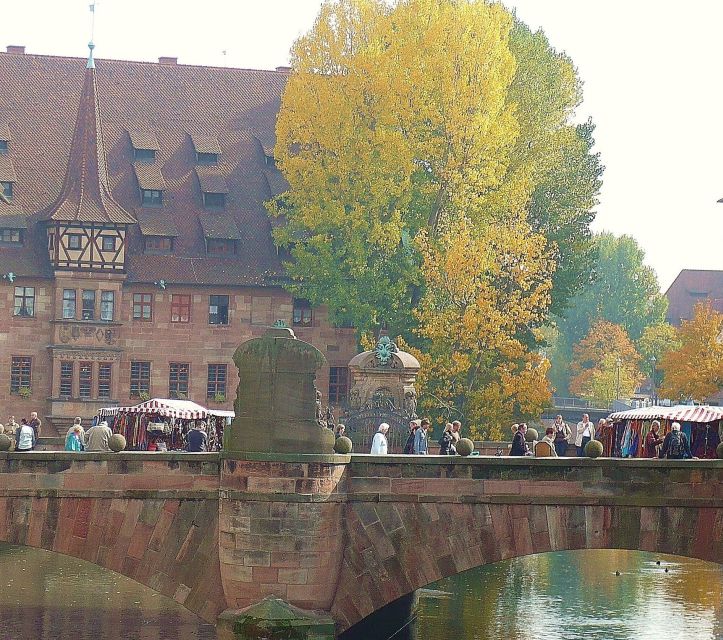
From the Hauptmarkt, the walk continues to Old City Hall and then toward St. Sebaldus Church. Again, St. Sebaldus is passed rather than treated as a full interior visit, but its presence helps show how the Old Town’s religious and civic landmarks sit close together.
The climb toward Nuremberg’s Imperial Castle is one of the most rewarding parts of the morning. The tour focuses on the castle courtyards, not a full admission visit through every interior room. From these courtyards, you get broad views over the city and a clear idea of why this high point mattered.
Holy Roman Emperors ruled from Nuremberg for more than 500 years, and the castle gives that story a physical setting. It is easier to understand the city’s importance when you can look across its walls, rooftops, churches, and streets from above.
The climb and uneven historic surfaces are also where the walking requirement becomes more obvious. Wear shoes you can trust, and expect the pace to include stops for explanation rather than a nonstop march. If you have trouble walking, this tour is not a good fit.
Same streets, a different route:
- Discover Berlin Half-Day Walking Tour
★ 5.0 · 9,624 reviews - Berlin City walk Government District and Places of Democracy
★ 4.7 · 8,467 reviews - Berlin: Third Reich & Cold War Guided Walking Tour
★ 4.9 · 8,378 reviews - Munich: Third Reich & WWII Walking Tour
★ 4.6 · 6,181 reviews
Albrecht Dürer’s House and the medieval city walls
The route includes Albrecht Dürer’s House, linked to one of Germany’s best-known artists. The stop adds a cultural layer to the tour, showing that Nuremberg was not only a place of rulers, markets, and military walls. It was also a center for art and craft.
The guide’s job here is to connect individual people to the wider city story. Medieval legends, Renaissance life, local customs, and present-day Nuremberg all enter the conversation. Several guides, including Hannes, Natasha, Nick, and Dimitri, are praised for using stories and anecdotes rather than simply reciting dates.
You will also see some of Europe’s best-preserved medieval fortifications during the Old Town walk. These walls are not just decorative remnants. They help explain the city’s defensive shape and make the transition to the later Rally Grounds more striking. One part of Nuremberg grew over centuries through trade, faith, and civic life. The other was designed in a short period to stage mass political theater.
The Hauptmarkt break: plan it realistically
After the Old Town section, you return to the Hauptmarkt for roughly 30 minutes of free time. This is your chance to eat, use the restroom, buy a drink, or take a breather before the outdoor history at the Rally Grounds.
The break is practical, but it is not generous. A three-sausage roll, a quick coffee, or a Glühwein can fit comfortably. A full restaurant meal may feel rushed, especially if the group needs to meet for public transportation on time.
This pause is one of the tour’s best design choices. The subject changes from medieval Nuremberg to the Nazi period, and a short break gives you room to reset. It also prevents the entire experience from becoming four hours of continuous commentary.
Reaching the Nazi Rally Grounds by public transport
The group then uses public transportation for about 15 minutes to reach the Rally Grounds. The fare is included, which is helpful if you are unfamiliar with Nuremberg’s transport system. You do not need to arrange a separate taxi or work out the route yourself.
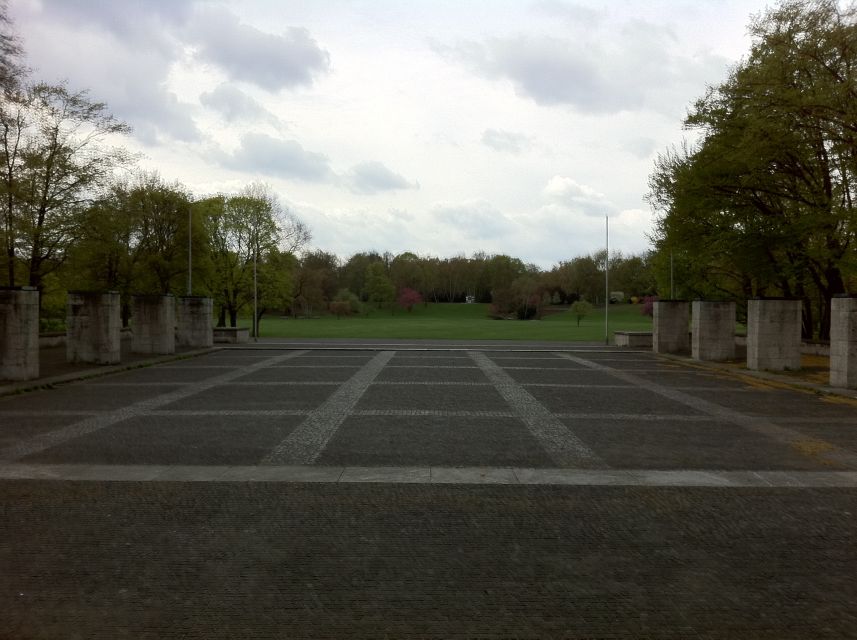
The former Nazi Party Rally Grounds are among the largest surviving Nazi-era sites in the world. Their scale was deliberate. The open parade areas, long sightlines, and monumental structures were built to support mass rallies and create an image of total unity around Hitler.
At Luitpoldhain and the Luitpold Arena, your guide explains how these spaces were used for political ceremonies and propaganda. The discussion is not simply about architecture. It is about how physical settings, symbols, crowds, uniforms, speeches, and staged rituals were combined to influence public feeling.
The outdoor nature of the visit is important. This is not a polished museum route. You are looking at large remains in open space, and the weather can change the experience. In winter, you may need gloves and warm layers. In rain, the ground and long walks can be tiring. In summer, bring water and sun protection.
Zeppelin Field and the machinery of spectacle
Zeppelin Field is one of the tour’s key stops. This is where Adolf Hitler inspected columns of SS men and appeared before massed crowds as part of the Nazi propaganda machine.
Seeing the field in person helps explain why the Nazis invested so heavily in architecture and ceremony. The space was designed for control, order, and spectacle. Your guide can show how the layout directed attention toward the speaker and transformed a political event into a performance of power.
The site can feel unsettling, and that is part of its value. The remains do not turn the Nazi past into something glamorous. Instead, they provide a place to ask how ordinary people were drawn into a system built around racism, dictatorship, militarism, and mass violence.
The guides are expected to address this section with care. Natasha, Nick, Nic, and Dimitri have been particularly praised for handling the subject sensitively while still speaking plainly. That balance is important. You need honesty without theatrical shock, and context without softening what happened.
Congress Hall and the unfinished Roman comparison
The tour continues to the remains of the Congress Hall of the Nazi Party. The building was intended to echo a Roman Colosseum, but it was never completed. Even unfinished, its size is hard to ignore.
This stop gives you a clear look at the grand architectural ambitions of the Third Reich. The building was meant to hold enormous crowds and project permanence. Today, the incomplete structure tells a different story, one about failed plans, war, and the danger of treating architecture as a tool for political worship.
The tour takes you into the remains of Congress Hall, but admission to the Documentation Center after the tour is not included. That distinction matters. The guided visit gives you an outdoor and architectural introduction, while the Documentation Center offers a more extensive museum experience for those who want to continue.
One useful feature is the way guides may use photographs on an iPad to show how the Rally Grounds looked during the Nazi period. That visual comparison helps you connect the present-day remains with the mass events once staged there.
Returning by tram and finishing at the train station
After the Rally Grounds, you take a tram for about 10 minutes back to Nuremberg Hauptbahnhof, where the tour ends. Public transportation for this return trip is also included.
Finishing at the station is convenient. You can continue exploring the Old Town, catch a train, visit the Documentation Center if you choose, or head back to your hotel. The end point also makes the tour easy to fit into a day trip.
The full experience lasts about four hours, including the lunch break and transport. It is long enough to give you a real introduction, but not long enough to replace a full visit to every church, museum, or castle room.
The guide makes the difference
This tour depends heavily on the person leading it. The available guides include Hannes, Natasha, Nick, Nic, Dimitri, Paul, Jax, and Nickolai. The strongest pattern in the feedback is not one particular scripted feature, but the guides’ ability to make a large amount of information easy to follow.
Hannes is often praised for humor, pace, and thorough explanations. Natasha is noted for linking the Old Town to the Nazi period and for giving useful recommendations. Nick and Nic are praised for fluent English, careful attention to the group, and clear storytelling. Dimitri is frequently associated with strong historical explanations and an engaging manner.
You should expect differences in style because several guides lead the tour. That is normal, and no guide can be guaranteed from the information provided. Still, the repeated praise for different members of the team suggests that the experience does not depend on a single personality.
Who should book this experience?
I would choose this tour if you have one day in Nuremberg and want a clear introduction before exploring alone. It works especially well for first-time visitors, history-minded travelers, families with older children, and anyone arriving by train.
It is also a good fit if you want to understand how Nuremberg handles its past today. The tour does not stop with medieval charm or Christmas-market atmosphere. It asks you to look directly at the city’s role in Nazi propaganda and at the physical remains left behind.
You should skip it if you want a relaxed sightseeing walk with little serious history. The second half is emotionally heavy and physically exposed. You should also avoid it if four hours of walking, stairs, historic surfaces, and outdoor sites would be difficult.
Is the Nuremberg Old Town and Nazi Rally Grounds tour worth $43?
Yes, for most first-time visitors, the price is reasonable. You get four hours with an English-speaking guide, a carefully connected route through two major periods of Nuremberg’s past, and public transportation to and from the Rally Grounds.
The value is strongest when you use the tour as an introduction rather than a complete visit. Afterward, you can return to the places that interested you most, spend more time in the Old Town, or visit the Documentation Center independently.
Book it if you want strong orientation, direct historical context, and practical local suggestions in one half-day. Wear comfortable shoes, dress for the weather, bring lunch money, and arrive ready for both beautiful medieval streets and an unsettling but necessary look at the twentieth century.
FAQ
How long does the Nuremberg Old Town and Nazi Rally Grounds tour last?
The tour lasts about four hours, including the lunch break and public transportation between the Old Town, the Rally Grounds, and the Hauptbahnhof.
Where does the tour begin?
It begins outside the large arched entrance of Nuremberg Hauptbahnhof. Look for the guide holding a red and white Nuremberg Tours in English sign.
Where does the tour end?
The tour ends back at Nuremberg Hauptbahnhof after the group returns by tram.
Is lunch included in the price?
No. Lunch is not included. The tour pauses for about 30 minutes in the Hauptmarkt, where you can buy food and drinks.
Are public transportation costs included?
Yes. Public transportation to the former Nazi Rally Grounds and the return trip to the Hauptbahnhof are included.
Does the tour include admission to the Documentation Center?
No. Admission to the Documentation Center after the tour is not included.
Is the tour suitable for people with mobility impairments?
No. The tour is not suitable for people who have trouble walking. It takes place rain or shine, so comfortable shoes and weather-appropriate clothing are important.
Just added around Germany
- Hamburg: Guided Port Walk for Families★ 4.6 · 191 reviews
- East Berlin and the Wall: Walking Tour★ 4.9 · 407 reviews
- Dresden: Shared Small Group Walking Tour in English★ 4.8 · 172 reviews
- Dresden: Taste of Dresden Food Walk★ 4.6 · 397 reviews
- Dresden: Private Guided Walking Tour★ 4.5 · 81 reviews
- Dresden: Guided City Walk and Panometer Entrance Ticket★ 4.5 · 176 reviews
- Dresden Old Town – Guided Walking Tour in English★ 4.8 · 135 reviews
- Dresden: Neustadt District Street Art Guided Walking Tour★ 4.3 · 333 reviews
Old Town Walking Tours, compared.
Underground Vaults Walking Tour in Edinburgh Old Town
Read our review →
3-Hour Walking Tour of Old Town & Prague Castle
Read our review →

Old Town and Jewish Quarter Guided Walking Tour
Read our review →
Marrakech: Ben Youssef, Secret Garden, & Souks Walking Tour
Read our review →Browse the lists this tour appears in