
REVIEW · ROME
Alternative Walking Tour of Rome’s City Center & Hidden Gems
Rome reveals its best stories when you connect the grand monuments with the people who paid for them, fought over them, and used them to gain power. This 2.5-hour walk links Trajan’s Column, Trevi Fountain, the Pantheon, Piazza Navona, and lesser-known corners through tales of popes, dynasties, crime, betrayal, and artistic ambition.
I like the focus on powerful Roman families and the way guides such as Simone, Jacopo, Iris, and Jacob turn art and architecture into human stories. I also like the chance to enter churches and see details you could easily miss alone, including the remarkable ceiling at Sant’Ignazio. The main consideration is the tip-based price: the booking may show $3.77, but you should budget for a tip of about €10 to $50.
Key points to know before you book
- Trajan’s Column begins the story: The meeting point places you beside one of Rome’s clearest monuments to imperial power.
- Famous sights get a different treatment: Trevi Fountain, the Pantheon, and Piazza Navona are included, but the emphasis is on politics, families, symbols, and surprising stories.
- Church interiors add real value: Sant’Ignazio di Loyola and a monastery stop bring art, religion, and Roman ambition into the walk.
- The guide makes or breaks the experience: Simone, Jacopo, Iris, Jacob, and other guides are praised for clear English, humor, energy, and careful answers.
- It is a pay-what-you-want tour: You pay the guide at the end, with typical tips listed as €10 to $50.
- The pace is made for orientation: You cover a lot of central Rome without spending the whole afternoon inside one monument.
Rome through families, scandals, and power
Many Rome walks give you dates, names, and architectural labels. This one tries to explain who wanted a church built, why a fountain became a political statement, and how family influence shaped the city around you.
That approach suits Rome. The city can feel like a pile of unrelated sights until someone explains the links. An ancient column, a Baroque church, an Egyptian obelisk, and a grand family palace may sit within a few minutes of one another, yet each belongs to a different stage of Roman ambition.
The guide’s main theme is the city’s ruling families and dynasties. You hear how emperors, popes, artists, invaders, and political operators left their mark. The stories include corruption, murder, war, betrayal, and scandal, so this is not a dry march through dates.
The humor matters, too. The tour advertises dark humor and politically incorrect jokes, and the strongest guide reports describe a lively style rather than a formal lecture. That can make complicated Roman politics easier to follow, but it also means the tone will not suit everyone. If you prefer solemn presentation and quiet reflection, some jokes may feel too sharp.
More Hidden Gems Walks in Rome:
- Dublin Highlights and Hidden Gems Guided Walking Tour
★ 5.0 · 6,020 reviews - Explore Berlin: See All The Iconic Sights & Some Hidden Gems
★ 5.0 · 4,429 reviews - Venice: San Marco to Rialto Walk & Spritz Like a Local
★ 4.2 · 3,651 reviews
Starting beside Trajan’s Column
The meeting point is on the steps of Chiesa del Santissimo Nome di Maria al Foro Traiano, beside Trajan’s Column and Trajan’s Forum. Look for the guide holding a sign with the tour name.
This is a smart place to begin. Trajan’s Column is not just a photo stop. Its carved spiral tells a military story through images, showing how an emperor presented conquest as order, glory, and public achievement. The nearby forum helps you picture the scale of imperial Rome, even though the modern city now presses tightly around the ruins.
Allow a little extra time before the start to find the church steps. The area around Piazza Venezia can be busy, and the meeting point is described by its church and column rather than by a broad plaza entrance.
The tour spends about 15 minutes here, enough for an introduction to Roman imperial power and the way monuments worked as public messaging. You will not receive the same sort of extended archaeological visit as you would on a dedicated Roman Forum tour, so think of this as a strong orientation rather than a full ancient-site tour.
Piazza Venezia and the city’s political stage
The short stop at Piazza Venezia provides a bridge between ancient Rome and the modern center. You have time for photographs and a brief explanation before moving into the smaller streets.
Piazza Venezia is a useful place to understand how Rome’s major roads, monuments, and political spaces were rearranged over time. The tour uses it as part of a larger story about changing power, rather than treating it as a stand-alone attraction.
This is one reason the walk works well early in a Rome visit. You see the city center as a connected map. Later, when you return to the area alone, you are more likely to notice how the grand public spaces contrast with narrow lanes, church courtyards, and quieter corners.
The secret stop and monastery visit
The itinerary includes a short secret stop, followed by about 25 minutes at a monastery. The exact details of the secret stop can vary, and that is part of the appeal. You may see a detail, room, view, or religious site that is easy to pass without a guide.
The monastery portion is one of the more unusual elements. The tour includes admission to papal private gardens, although the supplied schedule does not clearly identify that admission with a specific named stop. Confirm the exact access details when booking, since religious sites and private spaces can have changing opening arrangements.
A particularly useful part of the experience is the guide’s ability to open doors that are not always obvious to an independent walker. One account describes a guide persuading a priest to allow the group to see a space not normally open to the public. That should not be treated as a guaranteed feature, but it shows the sort of personal connection that can add value to a tip-based walk.
The monastery stop also slows the pace. After the outdoor streets and traffic around central Rome, a quieter religious interior gives you time to look at architecture, art, and symbols without rushing past them.
A few more walking tours around Rome worth a look
- Rome: Guided Food Walking Tour with Wine in Trastevere
★ 4.9 · 3,105 reviews - Rome: Trastevere & Campo de Fiori Street Food Walking Tour
★ 4.9 · 2,768 reviews - Rome: Paranormal Night Walking Tour & Secret Backstreets
★ 4.9 · 1,921 reviews - Rome: Trastevere Street Food Walking Tour with Local Expert
★ 4.8 · 1,784 reviews
Trevi Fountain beyond the postcard
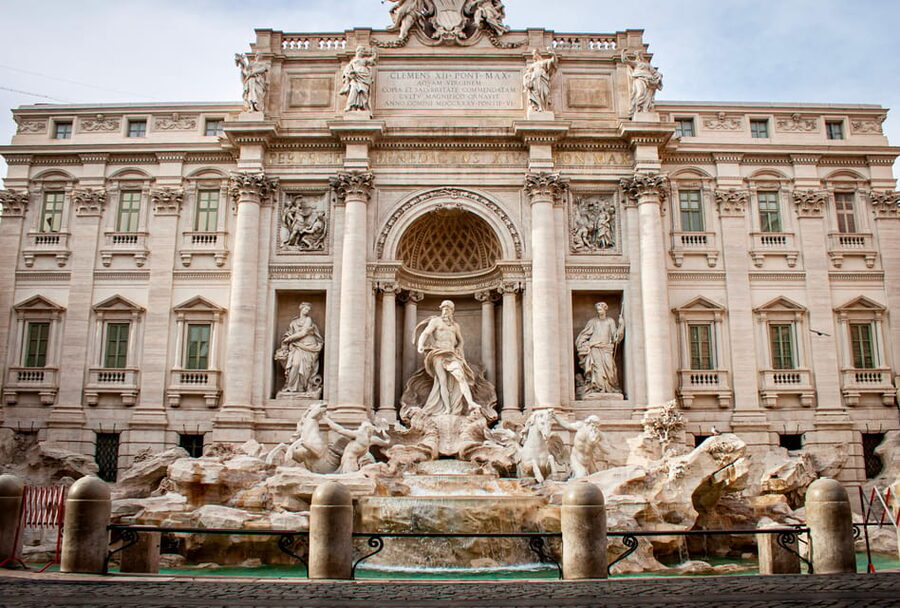
The Trevi Fountain gets about 15 minutes, including a short break, guided commentary, photographs, and free time. That is enough to see the fountain and hear its main story, but not enough for a long, unhurried visit during busy hours.
Trevi is one of Rome’s most crowded sights. A guide can help you understand why the fountain was designed as a display of papal authority and how water, sculpture, and public space became tools of prestige. The setting is more than a place to toss a coin. It shows how Rome turned practical infrastructure into theatrical civic art.
You should expect a crowded stop and limited personal space. If you want your own quiet photos, return early in the morning or later in the evening. On the tour, listen first and photograph second. The guide’s explanation is the part that adds something beyond a standard snapshot.
Sant’Ignazio and the art of illusion
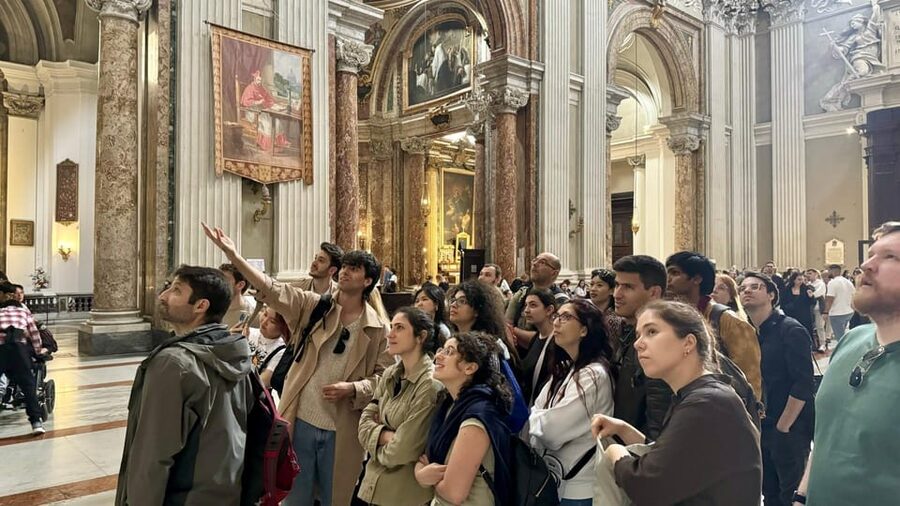
The Church of Sant’Ignazio di Loyola receives about 10 minutes, but it may become one of the walk’s most memorable stops. The church is known for its painted ceiling, including an illusion that makes the architecture appear to open into the heavens.
The church also fits the tour’s larger theme. Religious art in Rome was not decoration alone. It taught, persuaded, impressed, and competed for attention. A guide can point out how the building communicates faith and institutional power at the same time.
This is a stop where clear explanation helps. One guide was praised for reading Latin and Ancient Greek inscriptions, allowing the group to understand old marble text rather than simply admire it. That level of skill may depend on the individual guide, but the tour clearly attracts guides who enjoy language, art, and historical detail.
The Pantheon in five minutes
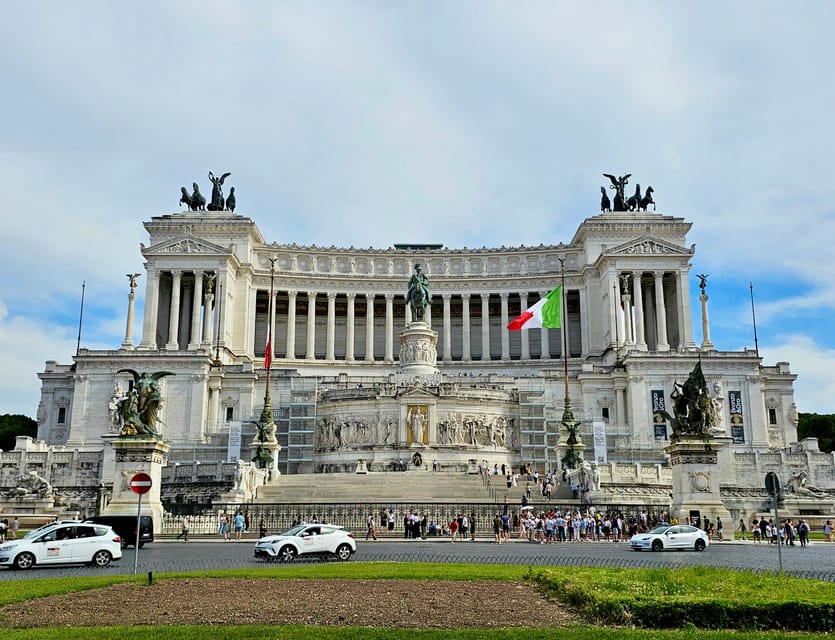
The Pantheon stop is listed at about five minutes. That sounds brief, and it is. You get a guided introduction and time for photographs, but this is not a full interior visit with extended discussion.
The Pantheon rewards a short explanation because its design connects engineering, religion, imperial identity, and later Christian use. The open central oculus, massive columns, and unusual sense of proportion make more sense when someone explains how the building’s purpose changed across centuries.
If entering the Pantheon is a major priority, plan a separate visit. The walking tour gives you context and a look at the site, but the schedule does not promise a long, detailed examination inside.
Piazza Navona and the Baroque finish
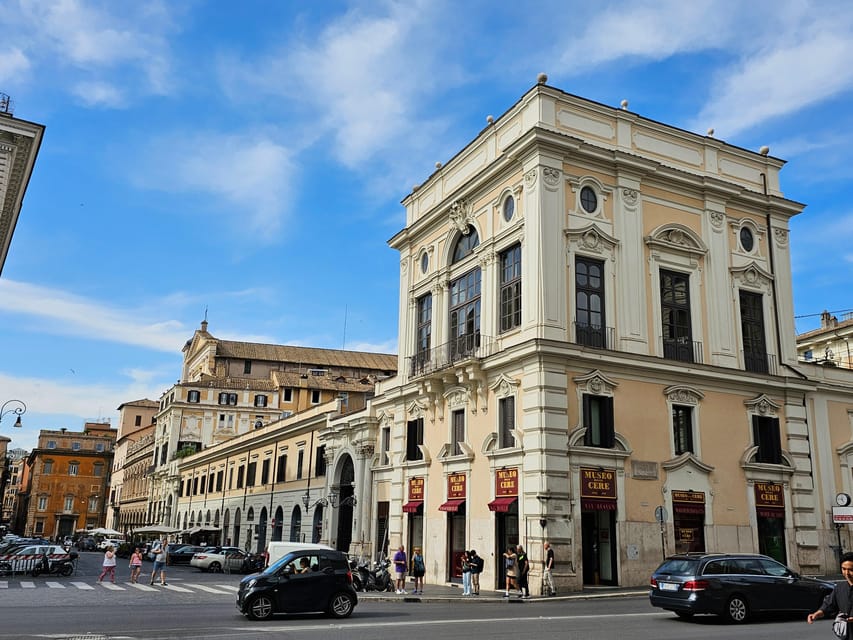
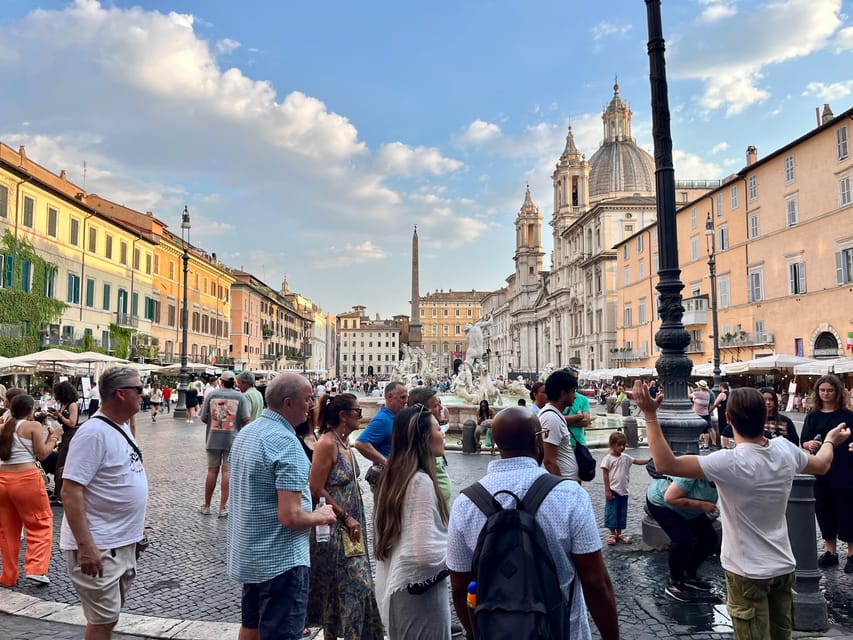
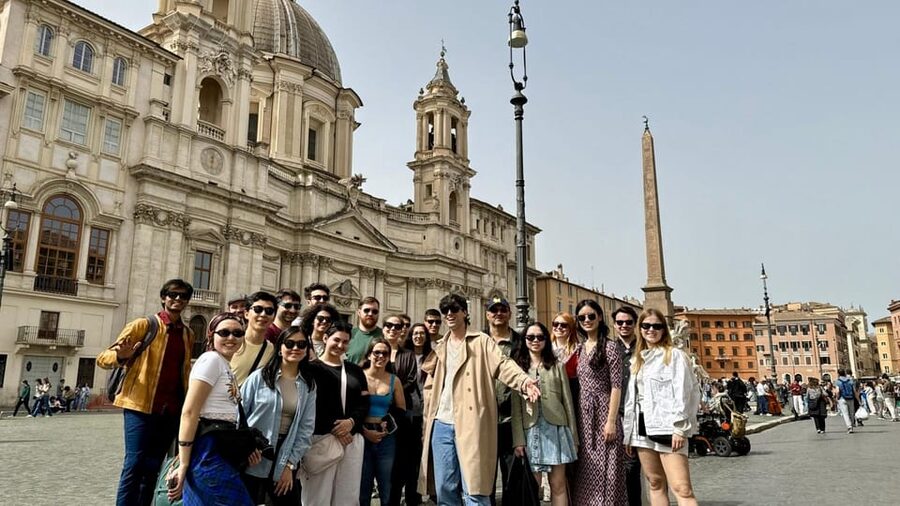
The tour ends at Piazza Navona after about 15 minutes of guided sightseeing. This is a fitting finish because the square gathers many of the themes introduced earlier: ancient foundations, church influence, public spectacle, artistic rivalry, and family power.
Piazza Navona’s long shape reflects its ancient origin as a stadium, while its fountains and churches belong to a later period when Rome’s ruling families used public art to shape the city’s image. Here, the guide can connect architecture to rivalry and propaganda in a way that makes the square feel less like a decorative plaza.
Ending here is practical. You are in a central part of Rome with restaurants, cafés, and easy access to other sights. The guide may also offer suggestions for what to see next. Several tour accounts describe useful recommendations for later visits, including places beyond the standard circuit.
The guides are the main attraction
The strongest part of this experience is the guide’s delivery. The names most often associated with positive experiences include Simone, Jacopo, Iris, Jacob, and Simon, with other guides also leading the walk. Their styles differ, but the common strengths are clear: strong command of Roman history, easy-to-follow English, humor, enthusiasm, and patience with questions.
Simone is described as energetic, passionate, and especially good at bringing family politics and lesser-known stories to life. Jacopo is praised for his focus on ancient Rome and family history, along with a friendly, charismatic approach. Iris is noted for mixing useful information with humor, while Jacob is praised for a comfortable pace and clear English.
You may get a guide whose specialty leans toward art, ancient Rome, political history, or local culture. That variation can be a benefit, but it also means the experience may not feel identical every time.
The tour has also been conducted without headphones. That allows a more direct conversation with the guide, though it can make listening harder beside traffic or a crowded fountain. A guide who speaks loudly and clearly helps, and this has been a repeated strength of the experience.
What the 2.5-hour format means
Two and a half hours is long enough to cover a strong central route, but short enough to fit around a museum booking or evening meal. You walk between stops, so wear comfortable shoes and expect uneven pavement, steps, and pauses in busy public spaces.
The pace has been described as comfortable, with attention to late arrivals and group cohesion. Some departures may be small and intimate, but group size is not fixed in the information provided. You should be ready for a mix of participants and a route that adjusts slightly to questions, crowds, and access.
The schedule is dense. Trajan’s Column, Piazza Venezia, a secret stop, a monastery, Trevi Fountain, Sant’Ignazio, the Pantheon, and Piazza Navona make for a full morning or afternoon. If you want long interior visits, this will feel too quick. If you want a smart first look at central Rome, the format works well.
Is the tip-based price good value?
The advertised booking price is about $3.77 per person, but that is not the full expected cost. This is a pay-what-you-want tour, and the guide works for tips. The stated usual tip is between €10 and $50, depending on what you feel the experience was worth.
That model can be good value if you want a story-led introduction without paying a high fixed tour price. It also puts more responsibility on you. Budget the tip before you reserve, and do not treat the low booking price as the final cost.
Payment may be made in cash or by card, based on the information supplied, but it is sensible to confirm the current method before the tour begins. A tip around the lower end may suit a basic introduction, while a higher amount makes more sense if your guide gives you strong historical context, handles questions well, and helps you see places you would have missed.
The tour also includes the local guide, walking route, city highlights, lesser-known stops, and papal private gardens admission. The value is strongest for someone who wants interpretation rather than tickets to a major archaeological site.
Who should choose this Rome walk?
I would choose this tour for a first visit if you want to understand the city center before exploring it on your own. It gives you the main names, the main squares, and a useful framework for seeing Rome as a story of competing institutions and families.
It also suits repeat visitors. One person who had already seen Rome’s major sights used the walk to find new places and left with ideas for a future visit. The route still includes Trevi, the Pantheon, and Piazza Navona, but the emphasis moves beyond the usual postcard view.
This may not suit young children who need constant movement or visitors who dislike dark jokes. It is also not the right choice if your main goal is extended time inside the Pantheon, a full Roman Forum tour, or a detailed art-history lecture in one church.
Book it if you enjoy questions, stories, and a guide who can connect one monument to another. Skip it if you want a fixed-price tour with a guaranteed script and long visits at each major sight.
FAQ
Where does the Rome walking tour start?
It starts on the steps of Chiesa del Santissimo Nome di Maria al Foro Traiano, beside Trajan’s Column and Trajan’s Forum. The guide will hold a sign with the tour name.
Where does the tour finish?
The walk ends at Piazza Navona.
How long is the tour?
The tour lasts 2.5 hours.
Which languages are available?
Live tours are offered in English and Spanish.
Is the tour free?
It uses a pay-what-you-want model. The booking price may be listed at about $3.77 per person, but the guide works for tips. The usual tip is stated as €10 to $50.
Can I cancel or pay later?
You can cancel up to 24 hours in advance for a full refund. A reserve-now, pay-later option is also available.
Just added around Rome
- Dark Heart of Rome – Facts, Legend & Mystery Walking Tour★ 4.5 · 329 reviews
- Rome: Colosseum, Palatine Hill, & Roman Forum Walking Tour★ 4.7 · 423 reviews
- Rome: Haunted City Night Walking Tour★ 4.9 · 616 reviews
- Rome Walking Tour with Piazza Navona, Trevi Fountain and Pantheon★ 4.5 · 676 reviews
- Rome: Guided Small Group Walking Tour of City Highlights★ 5.0 · 682 reviews
- Rome: Forbidden History Walking Tour & Pub Crawl with Drinks★ 4.9 · 688 reviews
- Best of Rome Walking Tour including Trevi Fountain★ 4.5 · 923 reviews
- Rome: Guided City Center Evening Sightseeing Walking Tour★ 4.4 · 953 reviews
Hidden Gems Walking Tours, compared.
Dublin Highlights and Hidden Gems Guided Walking Tour
Read our review →
Explore Berlin: See All The Iconic Sights & Some Hidden Gems
Read our review →
San Marco to Rialto Walk & Spritz Like a Local
Read our review →
Kyoto Geisha Walking Tour: Gion District & Hidden Gems
Read our review →
Eat Like a Local: Venice 3-Hour Small-Group Food Tasting Tour
Read our review →
Montmartre Hidden Gems and Scenic Highlights Walking Tour
Read our review →
Guided Walking Tour of City Highlights & Hidden Gems
Read our review →
Browse the lists this tour appears in