
REVIEW · SPLIT
Split Walking Tour with Professor of History
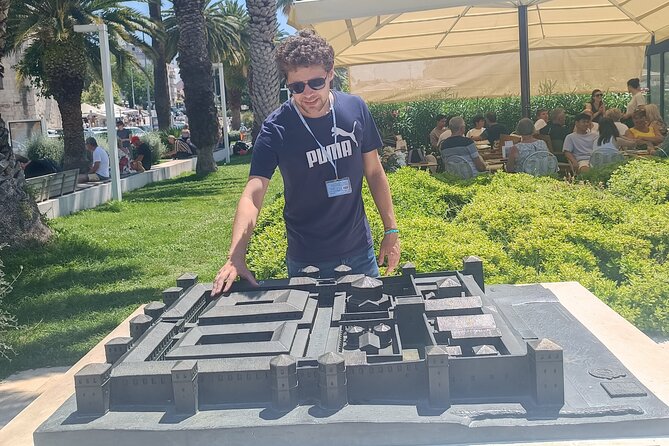
Diocletian’s Palace is not a fenced-off ruin. It is Split’s old town, with cafés, homes, shops, churches, and daily life fitted into a Roman imperial plan. This tour helps you read that jumble, starting at the Riva and moving through the palace’s substructures, Peristyle, Golden Gate, and nearby squares with a history professor at the lead.
I like the small-group format, capped at 17 people, and the way the walk links ancient Rome to modern Croatian life. I also like the guide’s practical side: Mario is praised for food, ATM, and onward-travel tips, while Anita is noted for her warm care of the group. The main drawback is pace: the advertised time is about 2 hours 20 minutes, but a detailed tour can run closer to three hours.
Key points to know before you book

- A history professor leads the walk: Mario is often named as the guide, with Anita also receiving strong praise for her clear, friendly approach.
- You see Split’s main historic core: The route covers the Riva, Diocletian’s Palace, Golden Gate, Marmontova Street, Prokurative, and Fruit’s Square.
- The palace is still a living neighborhood: You learn how Roman remains sit beside medieval buildings, churches, shops, and cafés.
- Paid interiors are not part of the walk: The Cathedral of Saint Domnius and Temple of Jupiter are viewed from outside.
- The group stays fairly small: No more than 17 people are allowed, so questions are more practical than on a large coach tour.
- Plan for a possible overrun: The official duration is approximately 2 hours 20 minutes, but the guide may continue toward three hours.
Why this Split walking tour is useful
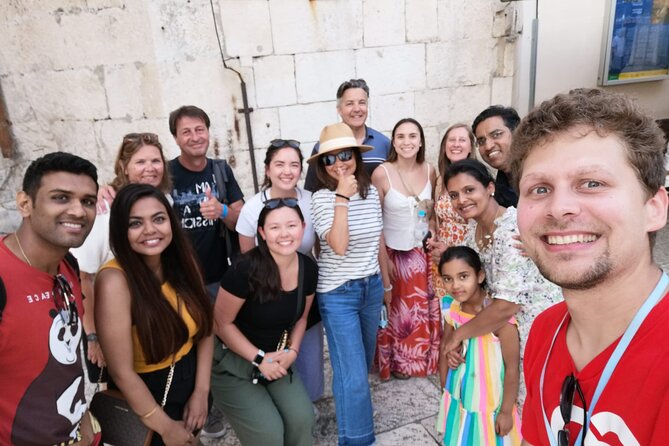
The best reason to book this walk is that Split can be confusing at first. Diocletian’s Palace is not one tidy monument with a clear entrance and exit. It is woven into the center of town, and its Roman walls now frame alleys, apartments, restaurants, and public squares.
A good guide gives you the missing map. You learn which spaces belonged to the emperor, which parts changed under later rulers, and why Split became a city inside an ancient palace. The history professor angle also suits you if you want dates, context, and competing interpretations rather than a quick list of names.
The tour has a top rating of 5 from 926 reviews, with 100 percent recommending it. That is a strong sign of consistent satisfaction, especially since the praise is not limited to one narrow feature. Mario is repeatedly described as funny, well prepared, and able to connect serious history with everyday details. Anita is praised for being attentive and proud of her Croatian background.
Still, this is an outdoor walking tour, not a museum visit. You will not enter the cathedral or Jupiter’s Temple as part of the price. If you want to climb, see interiors, or spend time examining artifacts, you will need to return later and pay the separate admission fee where applicable.
A few more walking tours around Split worth a look
- Split: Old Town and Diocletian Palace Walking Tour
★ 4.9 · 4,727 reviews - Walking Tour of Split and Diocletian’s Palace
★ 5.0 · 2,588 reviews - Krka Waterfalls tour with Trogir Walking tour and Krka panoramic boat cruise
★ 5.0 · 1,659 reviews
Starting at Riva Harbor and the Brass Gate
The meeting point is the Brass Gate, also called Porta Aenea, at Obala Hrvatskog narodnog preporoda 22. This puts you beside the Riva, Split’s broad waterfront promenade and one of the easiest places in town to get oriented.
The Riva is more than a scenic opening. It is where local life gathers for coffee, sunshine, and conversation. Your guide uses this setting to explain how the waterfront fits into the city’s public life before leading you toward the palace model and old center.
The first stop lasts about 15 minutes. That is enough time to get the basic layout without spending the whole tour on an introduction. The start is also practical if you have just arrived by ferry or are staying near the harbor.
From here, you move into the palace through the Brass Gate. The walk is in English, and confirmation is provided when you book. Public transportation is nearby, though the tour itself is on foot.
Beneath Diocletian’s Palace
The substructures are one of the strongest parts of the tour. These underground halls are unusually well preserved and help explain why Split’s historic center received UNESCO World Heritage status in 1979.
You spend about 15 minutes here. The value is not only the Roman age of the space. The substructures mirror the layout of the imperial residence above, so they help you picture how the palace was organized.
This is where a guide can make a major difference. Without context, underground stone rooms can blur together. With an explanation of their role, construction, and relationship to the palace above, the space becomes a clue to the entire city.
Admission is listed as free for this stop. You should still expect a working historic area rather than a polished museum. The appeal is the scale and survival of the Roman structure, not a long display of objects.
Peristyle, the palace’s ceremonial heart
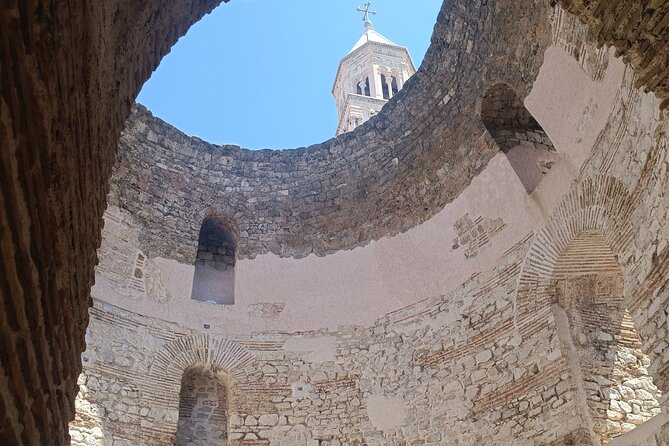
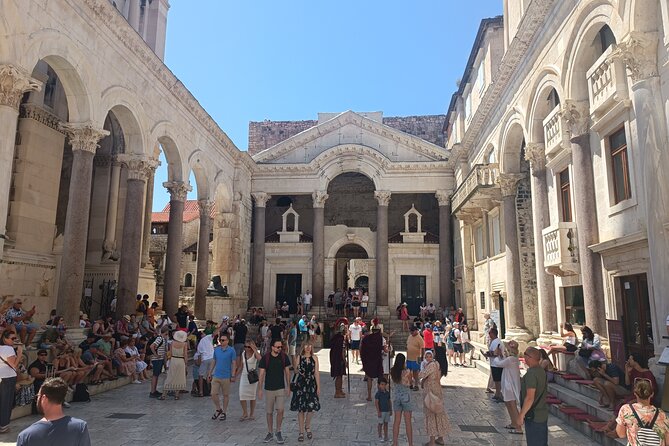
The Peristyle is the central square of Diocletian’s Palace and one of the most memorable spaces on the route. You spend around 10 minutes here, learning how the emperor presented himself as the living son of Jupiter.
The guide explains the ceremony of approaching Diocletian beneath the central architrave. Subjects might kneel, kiss the hem of his scarlet cloak, or fall fully to the ground. Those details make the square feel less like an empty courtyard and more like a stage built for imperial power.
The Peristyle is compact, so the stop is mostly about interpretation rather than a long walk. You may also find it busy, and the group must share the space with people crossing through the old town. The guide’s ability to position the group and speak clearly matters here.
Same streets, a different route:
- Split & Diocletian’s Palace Walking Tour
★ 5.0 · 1,125 reviews - Walking Tour of Split with a ‘Magister’ of History
★ 5.0 · 1,122 reviews - Split: Diocletian Palace & Old Town Guided Walking Tour
★ 4.7 · 882 reviews - From Split: Krka Waterfalls Cruise & Trogir Walking Tour
★ 4.7 · 681 reviews
The Vestibule and Saint Domnius Cathedral
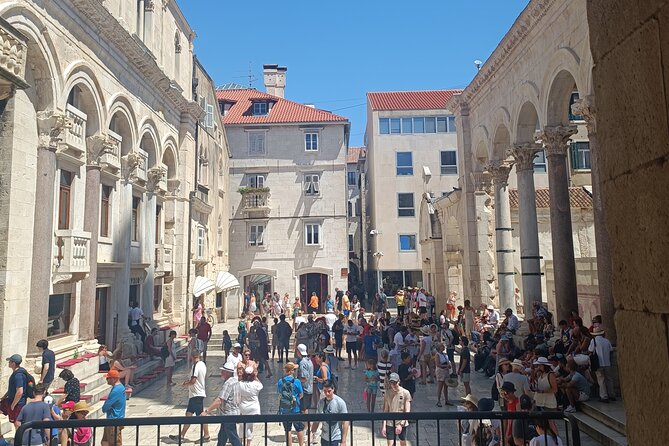
Next comes the Vestibule, a circular hall that once formed part of the formal route to the emperor’s apartments. Built by the beginning of the fourth century, it was about 17 meters high and 12 meters wide, with a dome that no longer survives in its original form.
You spend about 10 minutes here. The key point is its purpose. This was not a casual hallway. It was a grand meeting space used for selected audiences, including ambassadors.
The Cathedral of Saint Domnius follows, with about 20 minutes devoted to the exterior and its history. The building has had several lives: Roman temple, mausoleum, and church. That layering captures the larger story of Split, where ancient structures were reused rather than simply abandoned.
The tour does not include entry to the cathedral. Your guide provides detailed information if you want to visit inside later. This arrangement works well if you prefer an overview first, then want to decide how much time and money to spend on the interior.
Jupiter’s Temple and the narrowest street
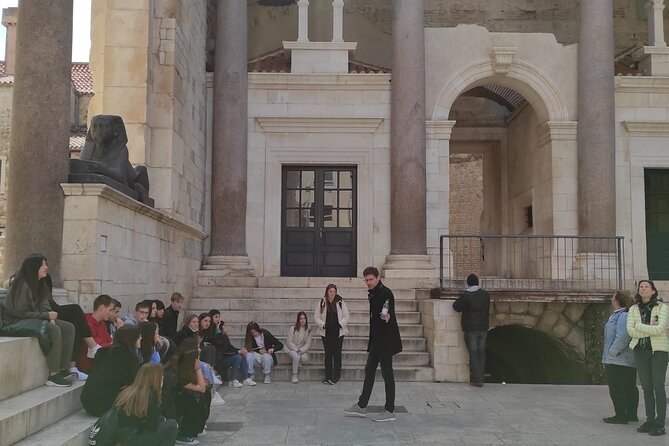
The Temple of Jupiter receives about 10 minutes, again from outside. Jupiter was the Roman sky and thunder god, and the temple was later converted into a baptistery dedicated to Saint John the Baptist.
That change is worth noticing. It shows how religious and political shifts altered the palace without wiping away its earlier structure. A Roman temple became part of a Christian city, and its meaning changed while its stone remained.
On the way to the Golden Gate, you pass a narrow lane called Let me pass street. Local people regard it as the narrowest street in the world. The tour presents this as a local belief, so you can enjoy the odd little detail without needing to treat it as a measured world record.
The lane also helps you see how close the city’s time periods sit together. An ancient temple, a medieval building, and a modern walking route occupy the same few steps.
Golden Gate and Gregory of Nin
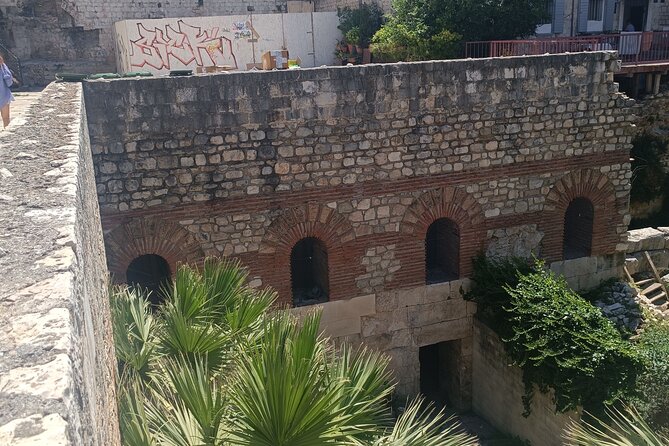
The Golden Gate, or Northern Gate, was one of the four main Roman entrances into the palace. It was the gate used by Diocletian to enter the complex and was decorated to mark its importance.
The stop lasts about 15 minutes. You learn how the gate was sealed during the Middle Ages, lost columns and statuary, and later reopened and repaired. It is a useful place to discuss the way old monuments are altered, forgotten, and restored rather than preserved in one untouched state.
Nearby is the 8.5-meter statue of Gregory of Nin by Croatian sculptor Ivan Meštrović. The stop takes about 10 minutes, and the famous ritual is simple: rub the statue’s toe for good luck. Thousands of hands have polished it smooth.
Gregory of Nin was a medieval bishop, and the statue is one of Split’s most popular meeting points. You get a quick lesson in Croatian cultural memory, plus a lighthearted photo opportunity. The statue also gives the tour a break from Roman architecture before moving into later parts of the city.
Marmontova Street and French-era city planning
Marmontova Ulica takes about 10 minutes. The street is named for Napoleon’s marshal Marmont, who helped shape the urban development of Dalmatian cities during the French period.
You do not need to be an expert in Napoleonic Europe to appreciate this stop. It shows that Split’s story did not end with Rome or the Middle Ages. Later rulers changed the streets, public spaces, and civic identity.
This part of the route is also a reminder that Split is a real city, not only an archaeological site. Shops and daily movement continue around the historic center. Keep your attention on the guide, but take a moment to notice how old walls and later urban planning meet.
Prokurative and Fruit’s Square
The walk continues to Prokurative, officially Republic Square. This open space is bordered on three sides by elaborate neo-Renaissance buildings. The stop lasts about 10 minutes and adds a more formal, nineteenth-century character to the route.
The final stop is Fruit’s Square, or Trg Braće Radić, with about 15 minutes for stories and landmarks. Its name recalls the women who once sold fruit there. You also hear about the statue of Marko Marulić, often called the father of Croatian literature.
Fruit’s Square is a fitting finish because it ties architecture to ordinary life. The guide uses the square to discuss Croatian history, local food, and gastronomy. If you ask for suggestions, this is likely the point where the walk becomes especially useful for planning the rest of your stay.
The tour ends back at the meeting point. That makes it easy to return to the Riva, continue exploring, or revisit one of the paid interiors with a better sense of what you are seeing.
How the guides shape the experience
Mario is the name most often associated with this walk. His strongest qualities are his command of historical detail, clear English, humor, and ability to involve the group with questions. He is also praised for covering current issues, local food, restaurants, banks, ATMs, shops, and onward travel.
That practical information can be worth as much as the Roman dates. A guide who tells you where to eat or which ATM habits to avoid helps you use the rest of your time in Split with fewer mistakes.
Anita is also praised for her strong local knowledge, warmth, and care with a group of 14 people. That matters if you prefer a guide who notices the group’s comfort and keeps everyone together.
The experience is not a silent lecture. Expect stories, trivia, questions, and some humor, including the occasional earthy detail. If you want only dates and architectural terms, the style may feel lively. If you like history presented as a conversation, it should suit you well.
Price, length, and who gets the best value
At $24.19 per person, the tour is reasonably priced for a guided introduction to Split’s old center. You are paying for an English-speaking guide, a route through the main historic sights, and the ability to ask questions as you go.
The value is highest on a first visit. You cover the palace and several later city landmarks in one sitting, then can choose which places deserve a second look. The tour also helps prevent a common Split problem: seeing impressive stones without understanding how they fit together.
The advertised duration is about 2 hours 20 minutes. One important planning note is that the guide may continue for close to three hours, especially when the group is engaged. I would not schedule a ferry, meal reservation, or timed admission immediately after the finish.
A maximum of 17 people keeps the group manageable, though it is not a private tour. You can upgrade to a private option if you want a more personal pace and more room for individual questions.
The walk is offered in English and requires good weather. Most people can participate, and service animals are allowed. Since the route passes through the old center, wear shoes suited to walking on historic streets and allow enough time for the full route.
Should you book this Split history walk?
Book it if you want a strong first look at Diocletian’s Palace, prefer context over a quick photo stop, and enjoy a guide who mixes scholarship with humor. It is particularly useful for first-time visitors, history fans, cruise or ferry arrivals, and anyone who wants restaurant and practical city advice along with Roman history.
Think twice if you want extensive interior visits included, a short 60-minute overview, or a fully private experience. The cathedral and Jupiter’s Temple are outside-only, and the detailed storytelling may push the walk toward three hours.
For most visitors, the price is fair and the route is well chosen. I would take the tour early in a Split stay, then return to the cathedral, substructures, or other paid sights with the guide’s explanations fresh in mind.
FAQ
Where does the tour start?
It starts at the Brass Gate, also called Porta Aenea, at Obala Hrvatskog narodnog preporoda 22 in Split.
Where does the tour end?
The tour ends back at the meeting point.
How long does the walking tour last?
The stated duration is approximately 2 hours 20 minutes. It may run closer to three hours if the guide continues with extra information and questions.
What language is the tour offered in?
The tour is offered in English.
How large is the group?
The maximum group size is 17 people.
Is the tour private?
The standard experience is a small-group tour. A private upgrade is available for a more personalized experience.
Are the Cathedral of Saint Domnius and Jupiter’s Temple entered?
No. Both are visited from outside, and admission is not included. The guide provides information for anyone who wants to visit later.
Are the palace substructures included?
The substructures are part of the walking route, and admission is listed as free.
Is the tour suitable for most people?
Most people can participate. Service animals are allowed, and the meeting point is near public transportation.
Can I cancel for a full refund?
Yes, if you cancel at least 24 hours before the local start time. Cancellations made less than 24 hours in advance are not refunded. If poor weather causes the tour to be canceled, you will be offered another date or a full refund.
Just added around Split
- Diocletian’s Palace and Old Town SMALL GROUP Walking Tour★ 5.0 · 502 reviews
- Split: City Walking Tour w/ Game of Thrones Locations★ 4.9 · 318 reviews
- Discover The Old Town Split 1.5h walking Small group tour★ 4.8 · 93 reviews
- SPLIT-PRIVATE Walking Tour of Diocletian’s Palace & Old Town★ 5.0 · 467 reviews
- Split: History and Heritage Walking Tour★ 4.9 · 650 reviews
- From Split: Krka Waterfalls Cruise & Trogir Walking Tour★ 4.7 · 681 reviews
- Split: Diocletian Palace & Old Town Guided Walking Tour★ 4.7 · 882 reviews
- Walking Tour of Split with a ‘Magister’ of History★ 5.0 · 1,122 reviews
Walking Tours, compared.

Magical London: Harry Potter Guided Walking Tour
Read our review →
Reykjavik Food Walk – Local Foodie Adventure in Iceland
Read our review →
History and Hauntings of Salem Guided Walking Tour
Read our review →
New Orleans Premier Ghost, Voodoo and Vampire Walking Tour
Read our review →
Amsterdam Anne Frank: Small-Group Walking Tour & Local Guide
Read our review →

Edinburgh Castle: Guided Walking Tour with Entry Ticket
Read our review →
Anne Frank’s Story – Guided Walking Tour through Amsterdam
Read our review →Browse the lists this tour appears in