
REVIEW · SPLIT
Walking Tour of Split with a ‘Magister’ of History
Split’s old center makes far more sense when you understand that people have lived inside Diocletian’s Palace for centuries. This walking tour puts that story together with 3D reconstructions of the Roman palace, then follows its later life through medieval, Venetian, and modern Croatian times.
I like two things in particular: Toni Šare brings both academic training and local experience, and the route includes small details that are easy to miss on your own. I also like that you can see the main Roman sights without paying for museum admission. The main consideration is that you do not enter the cathedral, Temple of Jupiter, or any museum, so you’ll need a separate visit if you want to see their interiors.
Key points to know before booking
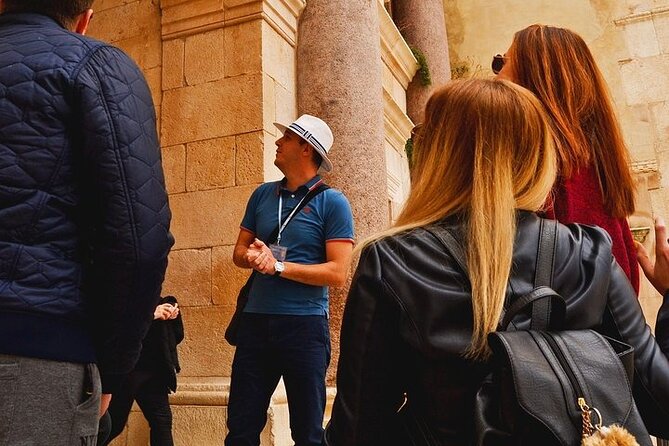
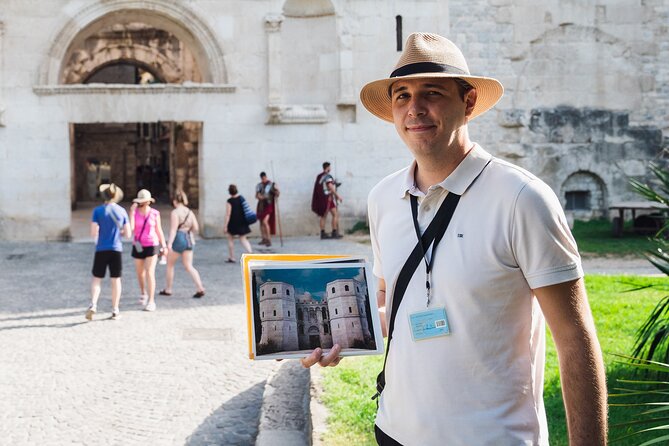
- Toni Šare leads the walk: He is the owner of DiocleSpot Tours, was born and raised in Split, and studied and taught history.
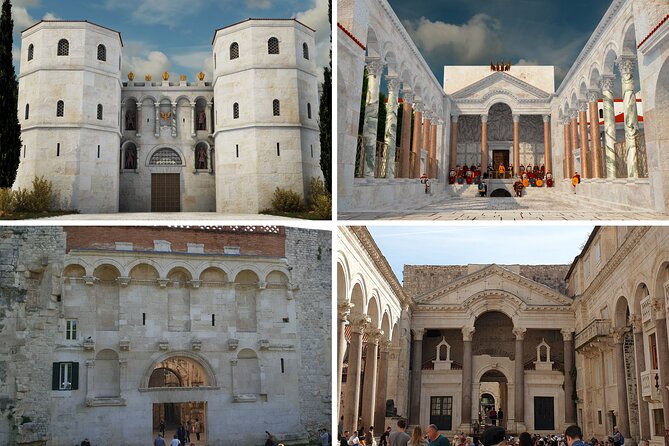
- 3D images make the ruins clearer: Toni uses his own reconstructions to show how Diocletian’s Palace looked in its prime.
- The route covers more than Roman ruins: You’ll also see medieval, Renaissance, Venetian, and early modern features.
- The walk lasts about 1 hour 40 minutes to 1 hour 50 minutes: It begins at the Brass Gate and ends at Pjaca, Split’s main medieval square.
- The group can include up to 18 people: Group pricing keeps the cost at $34.83 per person, while a private option is also available.
- The tour is in English: Mobile tickets, group discounts, free cancellation up to 24 hours ahead, and weather-related changes are provided.
Why Toni’s 3D palace images matter
Diocletian’s Palace is not a single preserved monument sitting apart from city life. It is the heart of Split, filled with homes, shops, squares, churches, cafes, and narrow passages. That is part of its charm, but it can also make the Roman plan hard to read.
Toni’s 3D reconstructions help solve that problem. You see the surviving stones in front of you, then compare them with an image of the palace during the emperor’s time. This gives you a much better sense of the original decoration, the private residence, the ceremonial route, and the parts later generations altered or removed.
That visual aid is one of the strongest reasons to take this walk. A guide can point to a worn wall and explain its date, but an image showing the original building gives you a clearer mental picture. The tour is not just a list of emperors and dates. It explains how the palace changed from a Roman retirement residence into a living medieval and modern city.
Toni’s style also brings in local and personal context. His background in history gives the tour structure, while growing up in Split gives him a direct connection to the city. He is especially praised for answering questions, mixing older events with modern local life, and keeping the talk lively rather than turning it into a lecture.
A few more walking tours around Split worth a look
- Split: Old Town and Diocletian Palace Walking Tour
★ 4.9 · 4,727 reviews - Walking Tour of Split and Diocletian’s Palace
★ 5.0 · 2,588 reviews - Krka Waterfalls tour with Trogir Walking tour and Krka panoramic boat cruise
★ 5.0 · 1,659 reviews
Starting at Riva Harbor and the southern wall
The walk begins at Brass Gate, also called Porta Aenea, beside Riva Harbor. This waterfront promenade is one of the most important public spaces in Split. It is where local life, harbor views, and the southern side of Diocletian’s Palace meet.
This opening stop is useful because Toni first gives you the basic plan of the palace. Graphic displays and models help explain what you are about to see, while the southern wall gives you a fine first view of the Roman complex. Allow about 15 minutes here.
I like starting outside the palace rather than rushing straight into the tight old lanes. You get your bearings first. You also begin to see the palace as a carefully planned residence with strong walls, not simply as a collection of ruins.
From here, the walk moves through the old center. Along the way, Toni points out noble palaces and smaller architectural details. The Roman period gets the most attention, but the route also follows the city through the medieval period, the Renaissance, Venetian rule, and later changes.
Reading the Peristyle as a Roman ceremonial square
The Peristyle is the central square of Diocletian’s Palace and one of the key places in Split. It is also where the contrast between the ancient plan and the modern city is easiest to see.
Toni explains the surviving Roman structures and uses his reconstructions to show how much more decorated the square once was. You can look at the columns, stonework, and surrounding buildings while imagining the original ceremonies and imperial setting.
The stop lasts about 10 minutes, though the exact pace may depend on questions and the size of the group. With as many as 18 people, listening space can matter in a tight square. Toni’s route is designed to move into smaller areas where possible, which helps keep the talk audible.
The Peristyle is one of the places where a guide adds real value. You can photograph it without help, but the building history is harder to read. The explanation turns a handsome square into a place with a purpose and a sequence of events.
The cathedral and Diocletian’s former mausoleum
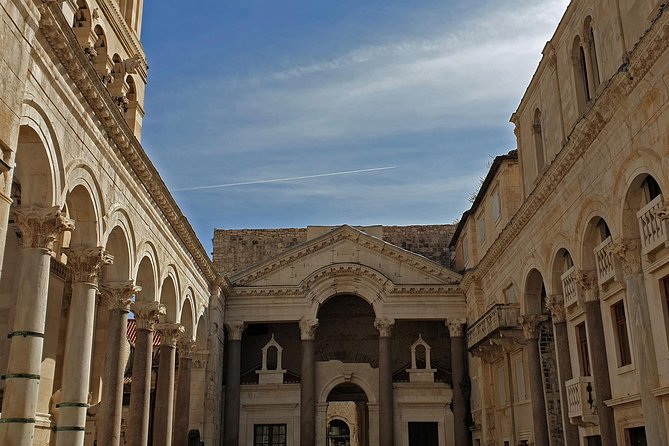
The Cathedral of Saint Domnius was originally the mausoleum of Emperor Diocletian. It remains one of the best-preserved Roman structures in Split and is still used as a cathedral today.
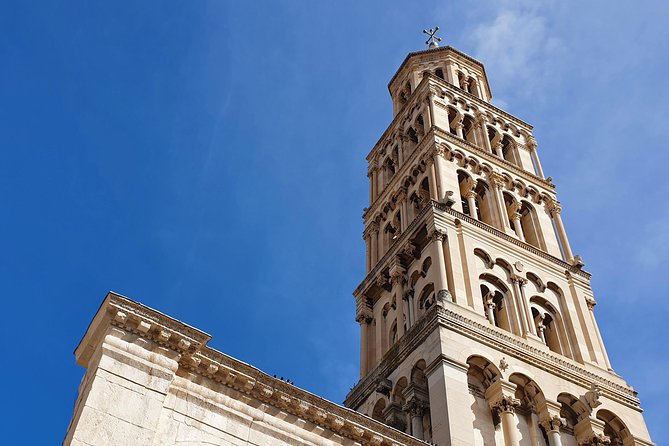
Toni explains the original purpose of the building, the bell tower, and the way Christians changed the mausoleum into a church. This is an important part of the tour because it shows how religious and political change reshaped the palace.
You do not enter the cathedral on this tour, and admission is not included. That keeps the walking tour focused and helps hold down the price, but you should plan another visit if you want to examine the interior or climb the bell tower.
For many people, this exterior explanation will be enough for an introduction. If Roman architecture, church interiors, or bell towers are high on your list, set aside extra time after the walk.
Same streets, a different route:
- Split & Diocletian’s Palace Walking Tour
★ 5.0 · 1,125 reviews - Split Walking Tour with Professor of History
★ 5.0 · 926 reviews - Split: Diocletian Palace & Old Town Guided Walking Tour
★ 4.7 · 882 reviews - From Split: Krka Waterfalls Cruise & Trogir Walking Tour
★ 4.7 · 681 reviews
The Temple of Jupiter and its building mistakes
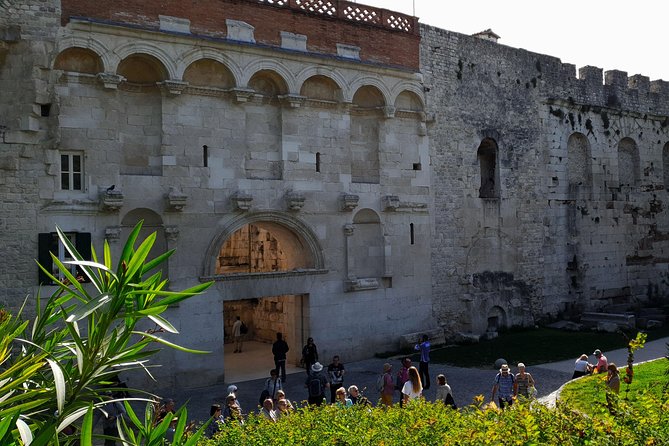
The Temple of Jupiter is described as one of the best-preserved late Roman temples in the world. Toni points out unusual features, including construction errors and odd details left by the Roman builders.
That is a welcome change from the usual polished story of Roman engineering. Ancient buildings were made by people working under pressure, and the visible flaws help make the monument feel more real. You get to look closely at the structure while hearing what was planned, what changed, and what the builders got wrong.
The temple is viewed from outside, with no admission included. The stop lasts about 15 minutes. This is a good place to ask questions, since small architectural details can be easy to overlook without guidance.
The Silver Gate, the old road, and the Grgur Ninski statue

At the Eastern, or Silver, Gate, you get one of the clearest views of the palace’s relationship with the cathedral and the old road below. The stop is brief, about five minutes, but it brings several parts of the complex together in one view.
Toni points out the only preserved section of the original Roman road. From this position, you can see the cathedral on one side and the Silver Gate on the other. It is a useful reminder that the palace was built as a complete fortified residence with planned entrances and routes.
The walk then reaches the statue of Grgur Ninski, a large and recognizable Split landmark. Toni explains its connection to the Croatian language and to early medieval culture. The stop lasts about five minutes.
This section adds an important national and cultural layer. Without context, the statue is simply a giant figure in bronze. With an explanation, you begin to understand why it matters to Croatian identity and language.
Entering the emperor’s private residence through the Vestibulum
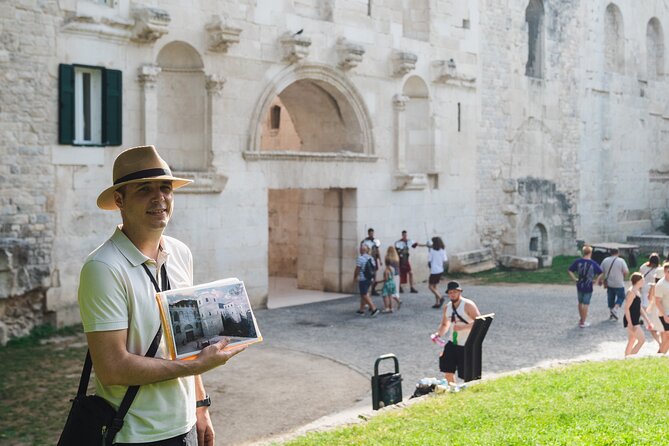
The Vestibulum was the ancient entrance to Diocletian’s private residence. From here, Toni leads you around the remains of the emperor’s living quarters and explains the difference between the public, ceremonial parts of the palace and the private areas.
This distinction is central to understanding the complex. Diocletian did not build an ordinary town house. He created a fortified residence with formal approaches, grand public spaces, religious buildings, and private rooms.
The stop takes about 10 minutes. You will not be entering a preserved private apartment in the modern sense, but you will see the remains and learn how the residence was arranged.
The route also passes several noble family palaces. These later buildings show how medieval and early modern residents reused the Roman setting rather than abandoning it. Split’s old center is interesting precisely because the periods overlap. Roman walls became part of a medieval city, while Renaissance and Venetian families added their own courtyards and facades.
The Golden Gate and the medieval reuse of Roman walls
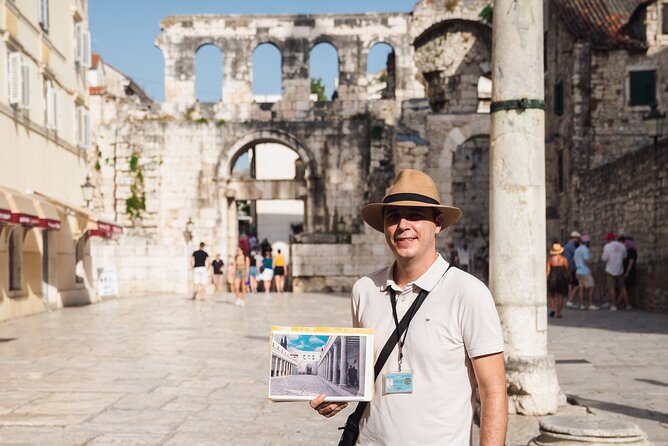
The Golden Gate is the main northern entrance to Diocletian’s Palace and the most decorated of the four gates. It is also among the best-preserved, making it one of the strongest stops for photographs and orientation.
From here, Toni explains the northern wall and how the medieval city used Roman defensive structures. He also points out what later residents removed because it no longer served a purpose.
That explanation helps you see the palace as a working city, not a frozen archaeological site. Every generation made choices. Some Roman features survived because they were useful, while others disappeared because later residents needed space, access, or different defenses.
The stop lasts about 15 minutes. The gate is an especially good place to connect Roman construction with medieval adaptation. You can see the layers in the stonework and then follow them through the nearby streets.
The route may also pass filming locations connected with Game of Thrones, along with a fan shop. Toni includes these locations if the group is interested. This is a nice extra for fans, but it does not replace the main historical focus of the walk.
Renaissance courtyards, Venetian influence, and Pjaca
Near the City Museum of Split, Toni shows you the courtyard of a Renaissance noble palace. You do not enter the museum, but the courtyard lets you see how a later aristocratic residence fit into the old city.
This is where the Venetian period receives more attention. Noble palaces of this kind help explain how Split’s architecture changed after the Roman period. The courtyard setting also offers a quieter look at the city than the main squares and gates.
The tour ends at Narodni trg, known as Pjaca or Piazza Square. This has been the main city square since medieval times. You can see the 14th-century Old Town Hall and other historic buildings before heading off to explore on your own.
Ending here is practical. Pjaca is easy to recognize, and the old center is close by. From this point, you can continue toward other parts of the palace, return to the waterfront, or stop for food and a drink.
How much is the tour worth?
At $34.83 per person, this is fairly priced for a focused English-language history walk lasting close to two hours. The value comes from the guide’s interpretation, not from paid admissions, since you do not enter museums or other ticketed sites.
That arrangement suits you if you want a strong introduction before deciding which interiors deserve more of your time and money. It is less suitable if you want a ticket-inclusive tour with access to the cathedral, Temple of Jupiter, or museum collections.
A group can include up to 18 people, which is large enough to keep the group price manageable but small enough to move through the old center without becoming unwieldy. A private upgrade is available if you want more control over the pace or questions.
The tour is booked an average of 31 days ahead, so popular dates may fill early. If your schedule is open, an evening start can be a smart choice in summer. One booking at 6 p.m. was specifically praised as a way to avoid the strongest heat, and the cooler light can also make the walk more pleasant.
Who will get the most from this walk?
I would choose this tour for a first visit to Split, especially if you want to understand the old center before exploring it alone. It is also a strong choice for anyone who enjoys architecture, archaeology, religion, politics, or the way cities change over time.
Families and mixed-interest groups may appreciate the varied subjects. The route includes Roman engineering, Croatian culture, medieval defense, noble palaces, Venetian influence, and optional filming locations. That gives Toni several ways to hold your attention.
You should be comfortable walking for nearly two hours through historic streets and squares. The tour is offered in English, service animals are allowed, and most people can participate. Because the experience requires good weather, a rainy-day backup plan is sensible.
What to know before you go
Meet at the Brass Gate, Porta Aenea, at Obala Hrvatskog narodnog preporoda 22. The walk ends at Narodni trg, Pjaca Square. A mobile ticket is accepted, and confirmation is provided when you book.
Wear shoes suited to old stone streets. The route is outdoors and includes several standing explanations, with no museum entry built in. If you want to enter the cathedral, Temple of Jupiter, or City Museum, plan those visits separately.
Free cancellation is available up to 24 hours before the start time. Changes or cancellations inside that window are not refunded, and poor weather may lead to another date or a full refund.
Should you book Toni’s Split history walk?
Book it if you want the old center to make sense instead of simply looking attractive. Toni’s strongest qualities are his command of local history, his enthusiasm for Split, and his 3D images of the palace. Those tools give you a clearer picture than a casual stroll can provide.
Skip it if you mainly want interior access, long free time for photographs, or a sightseeing bus. This is an explanation-led walking tour with a clear historical focus. For most first-time visitors who want context at a reasonable price, it is one of the better ways to begin a stay in Split.
FAQ
How long does the Walking Tour of Split with a Magister of History last?
The tour lasts approximately 1 hour 40 minutes to 1 hour 50 minutes.
Who leads the tour?
Toni Šare leads the tour. He is the owner of DiocleSpot Tours and is described as a historian who was born and raised in Split.
What language is the tour offered in?
The tour is offered in English.
Where does the tour begin?
It begins at the Brass Gate, also called Porta Aenea, at Obala Hrvatskog narodnog preporoda 22 in Split.
Where does the tour end?
It ends at Narodni trg, also called Pjaca or Piazza Square, the main square of Split.
Does the tour enter the cathedral or Temple of Jupiter?
No. The tour explains both sites from outside, but admission to their interiors is not included.
Are museum tickets included?
No. The tour does not enter museums or other paid sites.
How large can the group be?
The maximum group size is 18 people. A private tour option is also available.
Can I cancel for a full refund?
Yes, if you cancel at least 24 hours before the experience start time. Cancellations or changes made less than 24 hours ahead are not refunded. If poor weather cancels the experience, you are offered another date or a full refund.
Just added around Split
- Diocletian’s Palace and Old Town SMALL GROUP Walking Tour★ 5.0 · 502 reviews
- Split: City Walking Tour w/ Game of Thrones Locations★ 4.9 · 318 reviews
- Discover The Old Town Split 1.5h walking Small group tour★ 4.8 · 93 reviews
- SPLIT-PRIVATE Walking Tour of Diocletian’s Palace & Old Town★ 5.0 · 467 reviews
- Split: History and Heritage Walking Tour★ 4.9 · 650 reviews
- From Split: Krka Waterfalls Cruise & Trogir Walking Tour★ 4.7 · 681 reviews
- Split: Diocletian Palace & Old Town Guided Walking Tour★ 4.7 · 882 reviews
- Split Walking Tour with Professor of History★ 5.0 · 926 reviews
Walking Tours, compared.

Magical London: Harry Potter Guided Walking Tour
Read our review →
Reykjavik Food Walk – Local Foodie Adventure in Iceland
Read our review →
History and Hauntings of Salem Guided Walking Tour
Read our review →
New Orleans Premier Ghost, Voodoo and Vampire Walking Tour
Read our review →
Amsterdam Anne Frank: Small-Group Walking Tour & Local Guide
Read our review →

Edinburgh Castle: Guided Walking Tour with Entry Ticket
Read our review →
Anne Frank’s Story – Guided Walking Tour through Amsterdam
Read our review →Browse the lists this tour appears in