
REVIEW · BOSTON
Boston: Full Revolution Story Epic Small Group Walking Tour
Boston’s Revolution story makes far more sense when you follow the chain of events instead of simply ticking off stops along the Freedom Trail. This small-group tour of about 16 people connects Boston’s neighborhoods, burial grounds, meetinghouses, harbor views, and famous revolutionary figures into one clear story.
I like two things right away: the guides use maps, photographs, name tags, and even Lego pieces to make troop movements and political arguments easier to follow, and the route reaches beyond the usual downtown trail to the North End, Charlestown waterfront, USS Constitution, and Bunker Hill. The main caution is simple: three and a half hours and roughly 2.5 miles of walking can be tiring, especially for older visitors or anyone who prefers a slow stroll.
Key points to know before booking
- Story order, not just stop order: The tour explains events from Boston’s founding through the Declaration of Independence in a logical sequence.
- A genuinely small group: With around 16 participants, you can hear the guide and take part without being lost in a crowd.
- Guides who teach, not perform: Mike, Tyler, Rob, Tom, and Chris are among the guides praised for clear explanations, humor, and strong command of the subject.
- More than the Freedom Trail: You’ll see major landmarks plus Boston’s North End, harbor paths, USS Constitution, and Bunker Hill.
- Useful local advice: The tour ends near Little Italy and Lewis Wharf, with restaurant suggestions and practical ideas for exploring Boston afterward.
- A serious walk: Wear comfortable shoes. There is one uphill section and a flight of stairs near the end, so this is not suitable for people with mobility impairments.
Why the chronological story works better than a standard Freedom Trail walk

Many Boston tours move from one landmark to the next and attach a short anecdote to each. That approach can show you the right buildings while leaving the larger story scattered.
This tour takes another route. It begins with the growth of Boston and follows the causes, personalities, and turning points that led to rebellion. You hear about people such as Benjamin Franklin, Paul Revere, Samuel Adams, John Hancock, and John Adams as connected figures, not as isolated names on plaques.
I like this approach because it gives you the why behind the Revolution. The Boston Massacre, Boston Tea Party, battles at Lexington and Concord, and Battle of Bunker Hill are treated as parts of a growing conflict. You get political motives, local tensions, and the choices that pushed events forward.
The presentation is aimed mainly at adults and serious history fans, though maps and visual aids help younger participants follow along. The guides also invite people in the group to play historical roles. That small bit of participation can make a complicated cast of characters easier to remember without turning the tour into a costume show or a forced reenactment.
More Small-Group Walking Tours in Boston:
- Boston: Freedom Trail History Small Group Walking Tour
★ 5.0 · 6,450 reviews - Boston: Freedom Trail History Small Group Walking Tour
★ 4.9 · 1,590 reviews - Amsterdam Anne Frank: Small-Group Walking Tour & Local Guide
★ 4.8 · 12,789 reviews
Starting at City Hall Plaza and entering old Boston
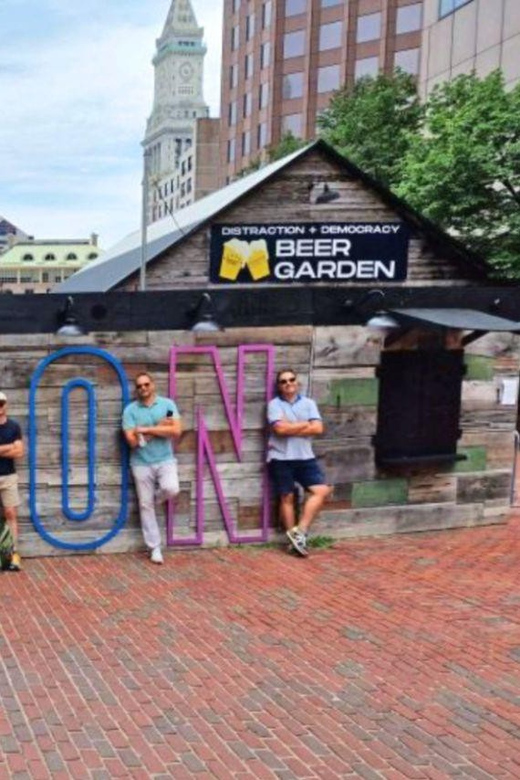
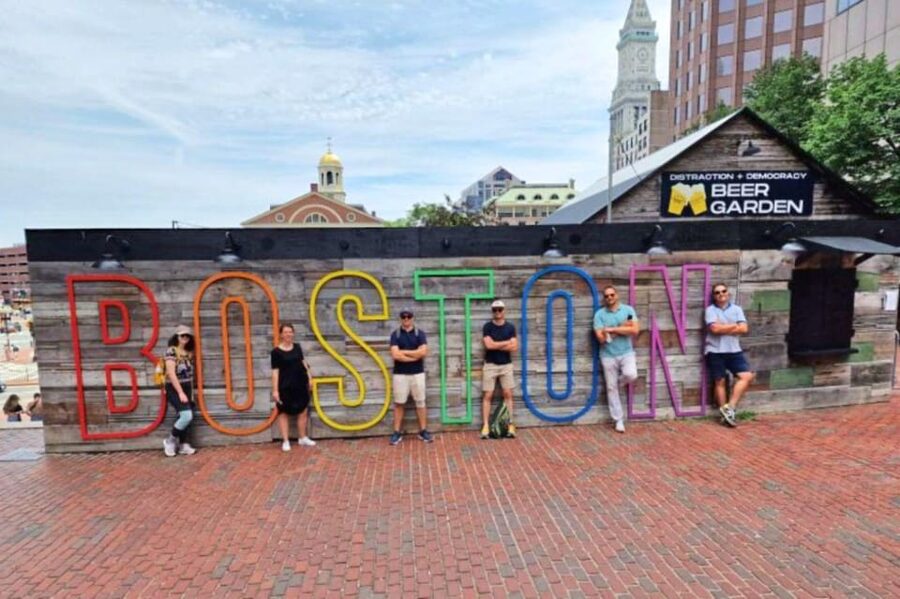
Meet your guide at City Hall Plaza, across from Faneuil Hall. The meeting point is in front of Five Iron Golf, near the Bill Russell statue and seasonal beer garden, between Staples Connect and City Hall.
The walk begins with a short stretch along the Freedom Trail before reaching King’s Chapel Burying Ground. This first cemetery stop helps set the tone. Rather than rushing past gravestones, your guide uses the site to explain the people and institutions that shaped early Boston.
Granary Burying Ground follows, with more time to connect the city’s political and religious life to the coming conflict. The cemetery includes the graves of major colonial-era figures, and it gives the story a human scale. You are not just hearing about policies and protests. You are standing among the people who lived through them.
You pass Park Street Church, then reach Old City Hall. The route mixes major sights with smaller street-level details, so you get a sense of how Boston’s old core fits into the present-day city.
Boston Latin School, Franklin, and the city’s political center

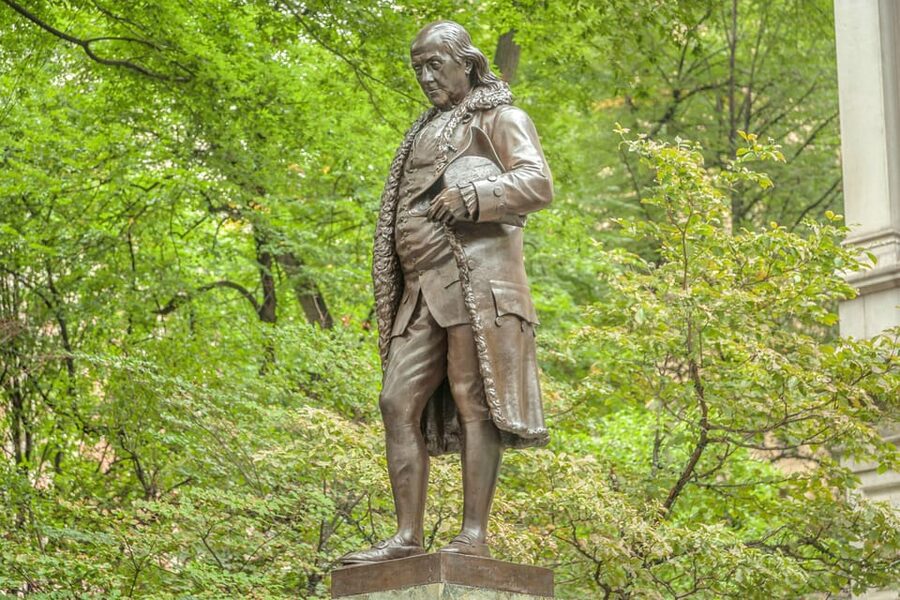
At Boston Latin School and the Benjamin Franklin statue, the guide shifts toward education, public life, and the people who helped form the political culture of the colonies. The stop is brief, but it adds useful context to Franklin’s place in Boston and the wider Atlantic world.
Old State House is one of the strongest stops on the route. Its balcony, facade, and position at the center of old Boston make it an ideal place to discuss colonial government and the growing clash between local authority and British rule.
Nearby, the Boston Massacre site shows how one violent confrontation could become a powerful political tool. The guide explains the event and the way competing sides presented it to the public. This is where the tour’s emphasis on motives and communication pays off. You learn not only what happened, but why the story mattered so much afterward.
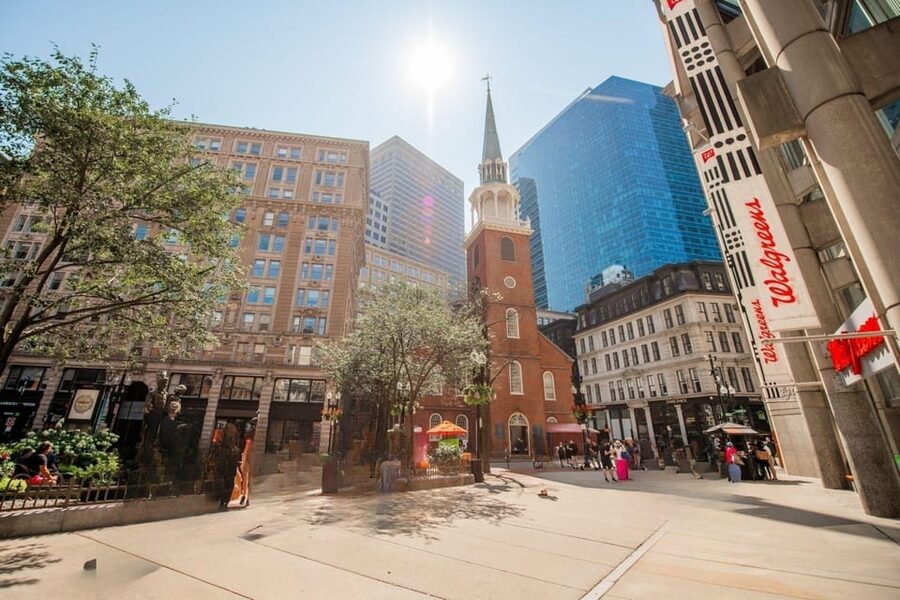
The walk then passes Old Corner Book Store and reaches Old South Meeting House. Old South was a crucial gathering place before the Boston Tea Party. Here, the group can consider how public meetings, speeches, and organized protest turned anger into action.
Faneuil Hall and Quincy Market: the useful halfway pause
Post Office Square and Liberty Square provide short transitions through the older downtown. These brief stops matter because the tour is not built as a series of disconnected lectures. Your guide keeps linking one location to the next, showing how Boston’s streets formed the setting for political pressure and public debate.
At Faneuil Hall, you receive a guided explanation and, when the building is open, an entrance inside. The hall is closely tied to Boston’s public meetings and political identity, so this is more than a quick photograph stop.
Quincy Market provides a 15-minute restroom and refreshment break. You can look around, shop, or simply catch your breath. The pause is welcome because the tour packs a lot into the afternoon, though it is not a full meal break.
The $57 price looks fair here because the tour is longer than a standard Freedom Trail walk and includes a guide for more than three hours, a small group, a chronological teaching plan, and a much wider route. It does not include food, hotel pickup, or entry to paid attractions, so you should judge the value mainly by the amount of guided interpretation rather than by included admissions.
A few more walking tours around Boston worth a look
- Harvard University Campus Guided Walking Tour
★ 4.5 · 3,632 reviews - Boston Freedom Trail Walking Tour with Costumed Guide
★ 4.5 · 2,531 reviews - The Full Revolutionary Story Epic Small Group Boston Walking Tour
★ 5.0 · 2,356 reviews - Boston’s Freedom Trail: A Revolutionary Walking Tour
★ 4.9 · 1,748 reviews
The North End and Paul Revere’s neighborhood
After Quincy Market, the route follows the Rose Kennedy Greenway toward the North End. This change of scenery is one of the pleasures of the tour. You move from government buildings and formal public spaces into a neighborhood known today for Italian restaurants, bakeries, and narrow streets.
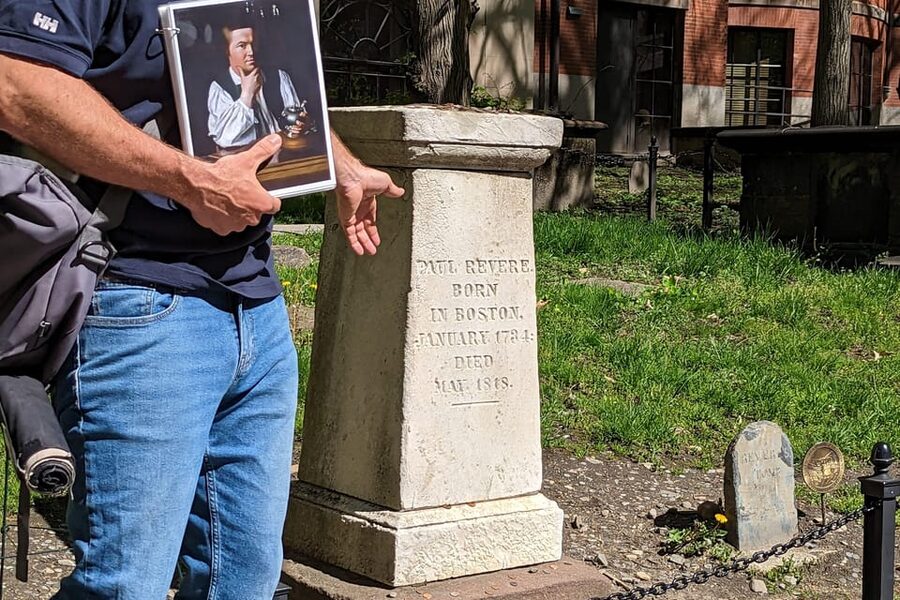
Paul Revere House anchors the next section. The guide places Revere within the larger revolutionary network rather than presenting him as a lone midnight rider. You then walk through the North End to Paul Revere Mall, where there is time for photographs and more explanation.
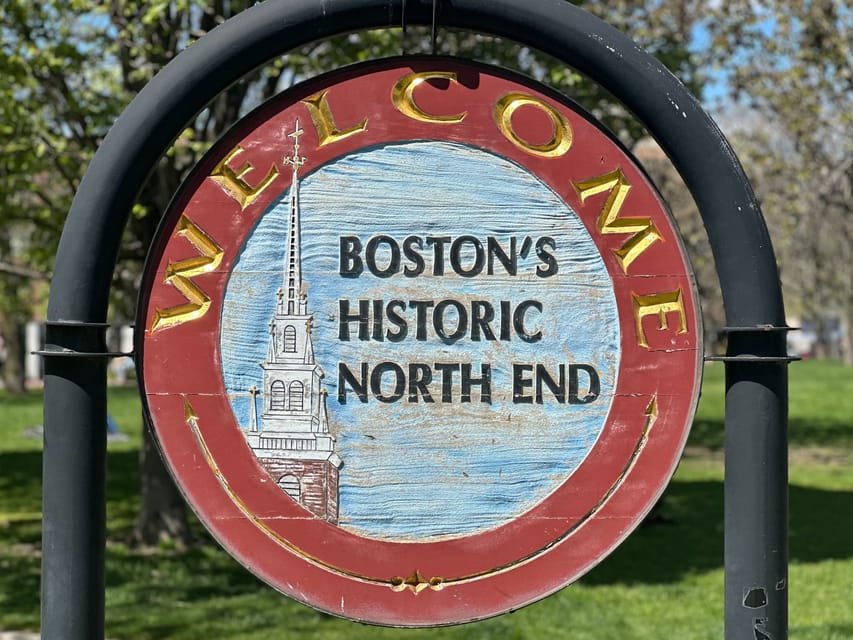
Old North Church is central to the familiar story of the lantern signals. The guide also uses the stop to show how communication, warning systems, and local connections helped shape the events around Lexington and Concord.
This part can feel crowded at busy times, and the North End’s narrow streets are not built for large groups. The small group helps. You can usually stay close enough to hear without forming a huge block in the street.
Copp’s Hill, Charlestown, and the Battle of Bunker Hill
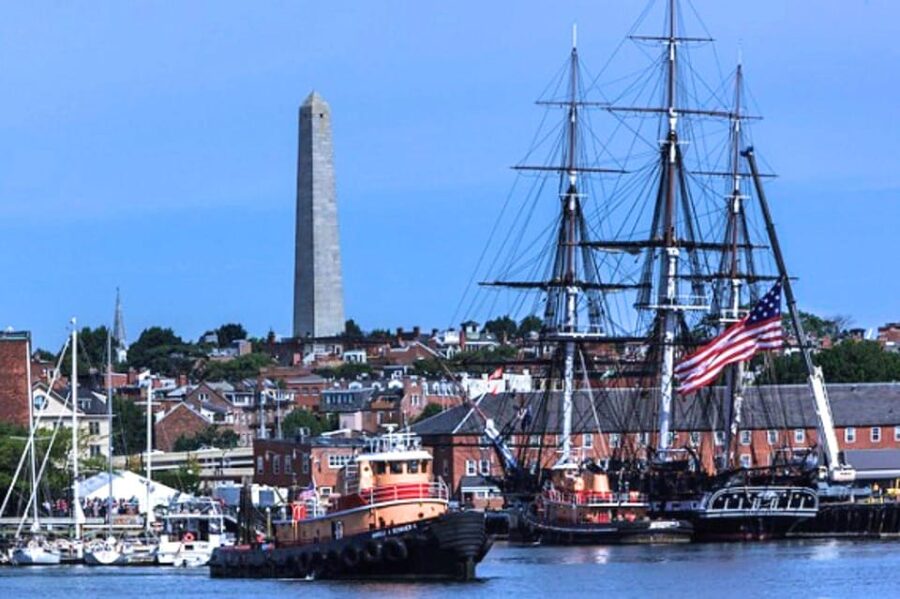
At Copp’s Hill, the tour gains both historical and scenic value. The burial ground and nearby views help explain Boston’s relationship with the harbor and Charlestown. The stop also prepares you for the military story that follows.
The route passes the USS Constitution before continuing toward Bunker Hill Monument. You do not receive a full ship visit on this walk, but seeing the vessel from the route adds useful context to Boston’s maritime setting and military history.
Bunker Hill Monument is a major payoff. The guide explains the battle and its place in the early war, using maps and visual aids to make troop movements easier to understand. Several people who took the tour praised the way these tools clarified events that can otherwise become a blur of names and arrows.
The route includes one hill and a flight of stairs down near the end. The guide may keep a fairly quick pace to cover the distance and stay on schedule. If you have knee, balance, or stamina concerns, this is the part to think about carefully. The walk is mostly flat, but it is not effortless.
Finishing by the harbor at Lewis Wharf
After Bunker Hill, the tour continues through Charter Street Park and along the Harborwalk, with scenic views around Pilot House Park. The waterfront gives the final section a different mood from the crowded downtown streets.
The finish is at Lewis Wharf. You are also near the North End and its restaurants, making the end point practical for lunch or dinner plans. Guides offer food recommendations and can suggest additional places to visit. Several guides also provide ideas for continuing your Boston history lesson, including ways to explore Charlestown and the waterfront on your own.
This ending is less convenient if your hotel is elsewhere in Boston and you expected to return to City Hall Plaza. Still, the route makes sense as a city crossing. You start in the civic center, pass through old downtown, enter the North End, and finish by the harbor.
The guide makes or breaks this experience
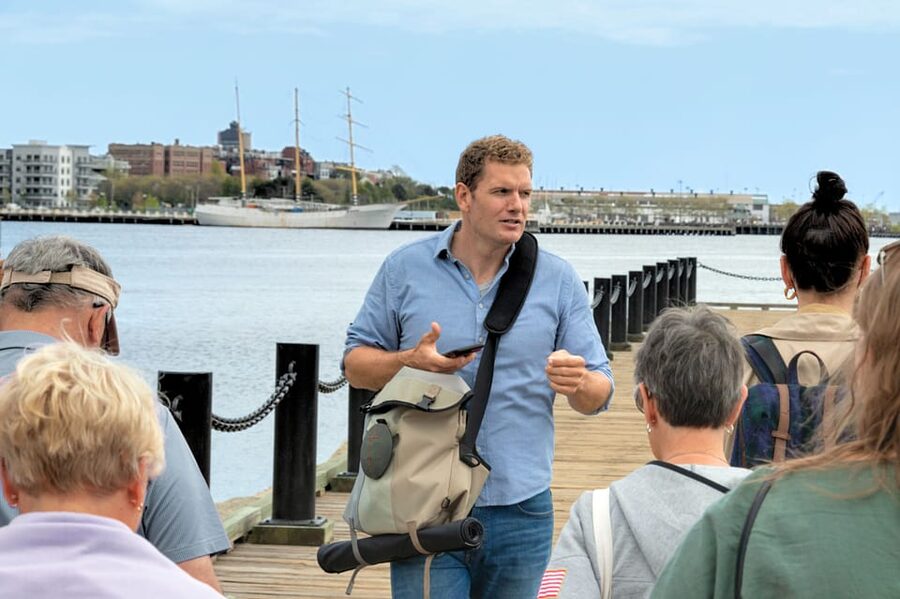
The strongest part of the tour is the teaching style. Mike and Tyler receive repeated praise for energy, clarity, and passion. Rob is noted for involving the group and using assigned historical roles. Tom is described as especially strong on lesser-known figures and events, while Chris is also mentioned as an excellent source of Boston history.
Guides use visual material rather than relying on a long stream of spoken facts. Maps show where events happened. Photographs help you picture earlier Boston. Clip-on name tags and simple role assignments give the group a way to keep track of the many Adamses, Adams supporters, British officials, merchants, and military leaders.
The style is lively, but it is not a theatrical costume performance. There are no costumes and no staged reenactments. If you enjoy a lecture with humor, audience participation, and frequent movement, this should suit you. If you want a quiet, private walk with only occasional commentary, it may feel too full.
The English presentation is clear and structured, but the subject is substantial. International visitors can follow the narrative without having grown up with American history, yet you need solid English and a real interest in the topic to get the most from the tour.
Who should book this Boston walking tour?
I would choose this tour on the first full day of a Boston visit if American history is one of your main interests. The route gives you a useful map of the city and points out places you may want to revisit later.
It suits adults, history fans, teachers, students, and visitors who have already seen a basic Freedom Trail tour and want more context. It can also work for families with older teenagers, though younger children may lose interest during the political explanations and long transitions.
You should also consider it if you have been to Boston before. The route adds neighborhoods and connections that a short downtown walk can miss. It is especially useful for people who want to understand how the Revolution developed rather than simply collect photographs of famous buildings.
I would be cautious if you have limited stamina, mobility concerns, or only a short time in Boston. A shorter and simpler tour may be a better fit. The guide may move briskly, and the route covers a lot of ground.
Practical details that affect your decision
The tour lasts 210 minutes and costs $57 per person. For a three-and-a-half-hour guided walk with a group of about 16, that is a reasonable price, especially if you value explanation over quick sightseeing.
Wear comfortable walking shoes and dress for changing weather. The tour is outdoors for most of its length, with only the stated Faneuil Hall entrance when open and the Quincy Market break. Bring water, and plan food separately.
Cancellation is free up to 24 hours before the start time, and you can reserve now and pay later. The tour is offered in English with a live guide. Hotel pickup and drop-off are not included, so use the Green Line to Government Center, or the Orange or Blue Line to State Street, then walk to City Hall Plaza.
Should you book it?
Book this tour if you want Boston’s revolutionary story explained as one connected sequence, with skilled guides, visual aids, and a route that reaches beyond the standard Freedom Trail. The combination of historic sites, North End streets, harbor views, and local advice gives you more than a checklist of landmarks.
Skip it if you dislike long walks, detailed history, or audience participation. For everyone else, $57 is good value for a serious, entertaining lesson in Boston’s role in the American Revolution, especially when you take it early in your stay and use the guide’s neighborhood advice to plan the days that follow.
FAQ
How long does the Boston Revolution walking tour last?
The tour lasts 210 minutes, or about three and a half hours.
How much does the tour cost?
The listed price is $57 per person.
How large is the group?
The group is small, with approximately 16 participants.
Where does the tour begin?
It begins at City Hall Plaza, at 1 Washington Mall in Boston, directly across from Faneuil Hall.
How do I find the meeting point?
Meet in front of Five Iron Golf, between Staples Connect and City Hall. The guide will be near the Bill Russell statue and seasonal beer garden.
Which subway exits are closest to the meeting point?
Use the Government Center exit for Green Line trains. Use the State Street exit for Orange and Blue Line trains.
Where does the tour finish?
The tour finishes at Lewis Wharf after visiting the harbor area and Pilot House Park.
Is a break included?
Yes. A 15-minute break is included at Quincy Market for restrooms, shopping, or a short pause.
Is the tour suitable for people with mobility impairments?
No. The tour requires moderate physical activity and includes one hill plus a flight of stairs near the end.
Is hotel pickup included?
No. You are responsible for reaching City Hall Plaza and arranging your own transportation after the tour.
What language is the tour offered in?
The tour is conducted in English with a live guide.
Can I cancel for a refund?
Yes. You can cancel up to 24 hours in advance for a full refund.
Just added around Boston
- Boston: North End Pizza Walking Tour with 3 Slices & Cannoli★ 4.8 · 162 reviews
- Boston: Freedom Trail Guided Walking Tour in French★ 4.9 · 106 reviews
- Boston: Salem by Boat – Witch Trials & Walking Tour★ 4.3 · 263 reviews
- Boston: 2-Hour Historic Walking Tour★ 4.7 · 88 reviews
- Self Guided Classic Freedom Trail Location Aware (GPS) Walking Audio Tour★ 4.5 · 258 reviews
- Boston History Tour: Scenic Walk Through Time & Landmarks★ 5.0 · 627 reviews
- Entire Freedom Trail Walking Tour: Includes Bunker Hill and USS Constitution★ 5.0 · 732 reviews
- Boston Pizza Lovers Food and History Walking Food Tour★ 4.5 · 1,082 reviews
Small-Group Walking Tours, compared.

Amsterdam Anne Frank: Small-Group Walking Tour & Local Guide
Read our review →
Freedom Trail History Small Group Walking Tour
Read our review →
Barcelona Tapas and Wine Experience Small-Group Walking Tour
Read our review →
Reykjavík Small group Walking Tour – by CityWalk
Read our review →

Hidden Alleyways and Historic Sites Small-Group Walking Tour
Read our review →
Old Montreal Small-Group Walking Tour | Max 10 | by MTL Detours
Read our review →Browse the lists this tour appears in