
REVIEW · COPENHAGEN
Copenhagen Highlights: Small Group Walking Tour – Max 10 people
Copenhagen’s best-known sights are spread across its waterfront and old center, and this tour links them in one useful walk. You’ll begin near Toldboden, pass the Citadel and Little Mermaid, then move through the royal quarter, Nyhavn, and central Copenhagen before finishing beside Christiansborg Palace. The route gives you a quick sense of how the city fits together.
I like the small maximum of 10 people, which makes it easier to ask questions and hear the guide on busy streets. I also like the mix of major sights and local explanation, from royal guards and Danish politics to the strange story behind the Little Mermaid. The main drawback is the brisk pace: cobblestones, stairs, and about two and a half hours on foot demand decent shoes and reasonable fitness.
What makes this Copenhagen walk useful
- A waterfront-to-old-town route: Start at Toldboden and finish at Højbro Plads, right beside Copenhagen’s main pedestrian shopping area.
- The city’s classic sights in one outing: See the Little Mermaid, Amalienborg Palace, Marble Church, Nyhavn, Christiansborg, and more.
- A genuinely small group: The tour accepts no more than 10 people, allowing more direct conversation with your guide.
- History with a Danish point of view: Expect stories about kings, war, religion, politics, welfare, and local habits, not just dates and building names.
- Guides with personality: Kenneth, Oskar, Liva, Peter, Nathan, Sandra, and Lukas are among the guides praised for humor, clear explanations, and practical advice.
- Good first-day timing: In roughly 2 to 2.5 hours, you get a city orientation that can help you plan the rest of your stay.
From Toldboden to Copenhagen’s northern waterfront
Meet at ZinkGlobal by Kim Michael at Nordre Toldbod 12. The guide arrives 10 minutes early, and you should do the same. Toldboden is a pleasant place to begin, with the option to buy a coffee before setting off, though that drink is not included.
This start point places you near Copenhagen’s northern waterfront rather than in the thick of the old center. That is useful because the route gradually leads you toward the historic core instead of making you spend the whole walk circling the same central blocks.
The exact tour length is flexible, usually around two to two and a half hours. You will be moving for most of that time, with short stops for stories, photographs, and questions. That format works well if you want an overview on your first day, but it is not a slow photographic walk with long periods inside museums.
All listed admission costs are free because the tour is designed around outdoor views. You will not go inside Amalienborg Palace Museum, Christiansborg, the church, or other attractions as part of the walk. Think of it as a guided introduction, followed by independent visits if a particular site catches your interest.
More Small-Group Walking Tours in Copenhagen:
- 3h walking tour, small group max 10 people Copenhagen
★ 5.0 · 686 reviews - Amsterdam Anne Frank: Small-Group Walking Tour & Local Guide
★ 4.8 · 12,789 reviews - Boston: Freedom Trail History Small Group Walking Tour
★ 5.0 · 6,450 reviews
Gefion Fountain, Churchill Park, and St. Alban’s Church
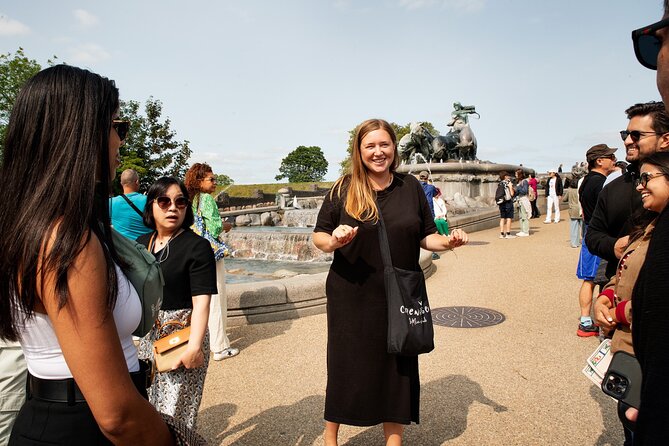
The first proper stop is Gefion Fountain, one of Copenhagen’s most dramatic outdoor monuments. Your guide uses it to explain the old story of how the land connected with Copenhagen was formed. The tale involves Gefion, a figure from Norse mythology, and a famously unpleasant destination that Danish storytelling treats with a dark wink.
This is a good example of the tour’s approach. You are not simply told what a sculpture is called. You get a short story that connects mythology with the city’s sense of place. Ten minutes is enough to understand the fountain and take photographs without turning the stop into a lecture.
From there, you look across Churchill Park, which honors the heroes of the Second World War. The park also gives you a change of pace after the waterfront. Your guide can connect the memorial setting with Denmark’s wartime experience and the country’s complicated place in European history.
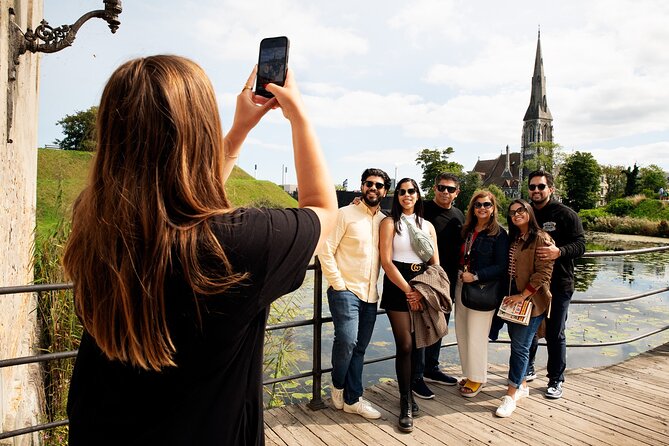
St. Alban’s Church is viewed from outside. It is notable because its style differs from the churches you will see elsewhere in Copenhagen. The stop is short, only about five minutes, so do not expect an architectural study. Instead, it is a quick visual contrast and another marker on the route.
The Citadel and a thousand years of Denmark
The route continues to Kastellet, Copenhagen’s star-shaped citadel. From outside, its earthworks and military character can look like something from a historical film. The tour does not promise an extended walk through every part of the fortress, but the view gives your guide a strong setting for stories about Denmark’s rise, setbacks, and changing power over more than 1,000 years.
This section helps you understand that Copenhagen is not only a city of palaces and colorful harbor houses. It was also a strategic military port. The citadel, Churchill Park, and the waterfront all point to that larger story.
The route description includes an unusual reference to Hørsholm Chapel, but the main experience described here is the outdoor view of Kastellet. If you are especially interested in military architecture, treat this as an introduction rather than a full fortress visit. You can return later at your own pace.
Meeting the Little Mermaid
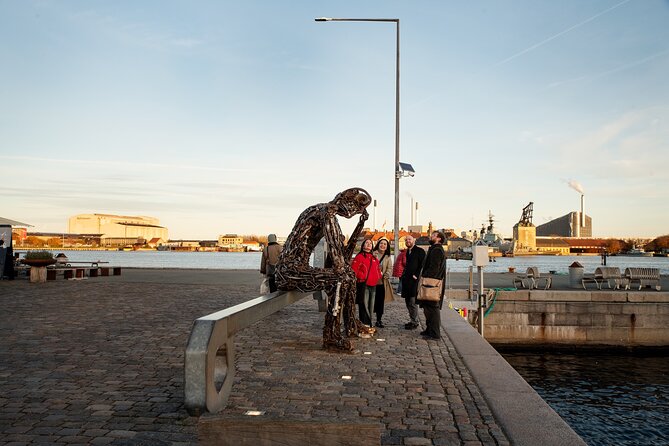
The Little Mermaid is the first major stop that many people have been waiting for. You get about 15 minutes here, enough for photographs and an explanation of why the statue is not quite the simple fairy-tale symbol it first appears to be.
The setting is scenic, but the statue itself is smaller than some first-time visitors expect. That is worth knowing before you arrive. The value of the stop comes from the combination of the waterfront view, the famous name, and the story behind Hans Christian Andersen’s creation.
The small group is especially helpful here. A guide can help position you for a photograph and answer questions without the confusion of a large crowd. The walk also gives you context before you see the statue, so it feels less like a quick photo stop and more like part of Copenhagen’s cultural story.
A few more walking tours around Copenhagen worth a look
- Private Walking Grand Tour of Copenhagen
★ 5.0 · 3,953 reviews - Copenhagen Highlights Walking Tour
★ 5.0 · 2,324 reviews - Politically Incorrect Private Highlights Walking Tour
★ 5.0 · 1,244 reviews - Copenhagen: Group Walking Tour – City Highlights – 2 Hours
★ 4.7 · 1,088 reviews
Amalienborg, the Marble Church, and royal life
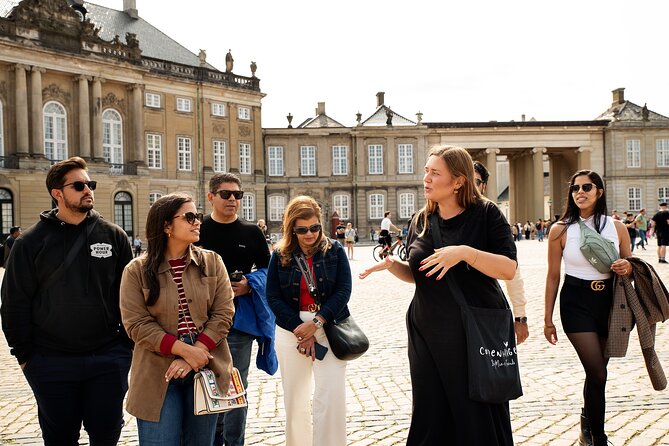
From the Little Mermaid, you head toward Amalienborg, the home of the Danish royal family. The guide explains the palace square, the Royal Guards, and royal life, including stories connected with people who have served in the guard.
The tour also includes a light game about where the current head of the royal family, known by the nickname Daisy, lives. That playful touch keeps the royal material from becoming a list of names and dates. You hear about the institution while also getting a sense of how Danes view their monarchy.
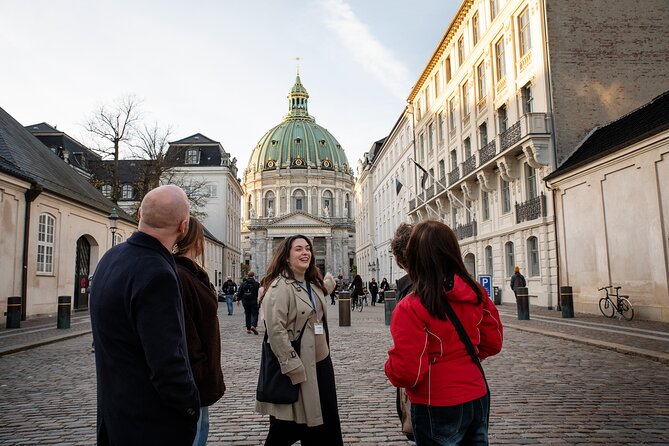
The palace stop lasts about 15 minutes and takes place outside. If you want to enter the Amalienborg Palace Museum, you will need to return separately. Still, an exterior visit is enough to understand the square’s layout and the palace’s place in the city.
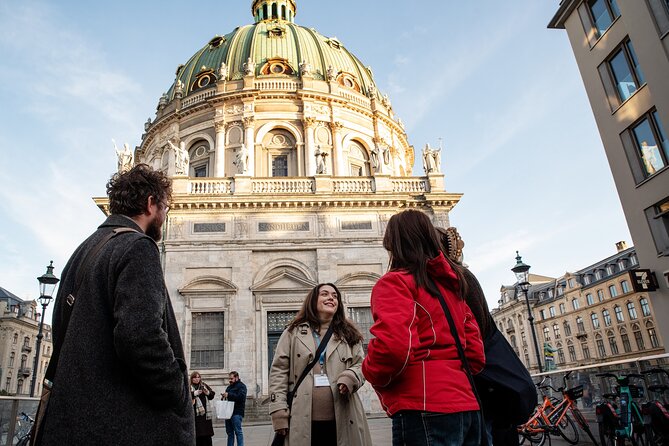
From Amalienborg, you get a clear view toward Frederiks Kirke, better known as the Marble Church. The church and palace are carefully aligned, creating one of Copenhagen’s most memorable urban views. You will not spend long here, but the five-minute stop gives you time to look up at the dome and appreciate the relationship between the buildings.
Across the harbor to the Opera House
The walk then turns toward the Copenhagen Opera House. From the royal gardens and waterfront, you can look across the harbor toward its large modern form.
This is a useful contrast with Amalienborg and the Marble Church. Copenhagen’s identity is not frozen in royal history. The city also has modern public buildings, active waterfront spaces, and strong visual links across the water.
The Opera House stop is brief, around five minutes. The guide’s role here is mainly to point out the building and explain its place in the city rather than take you inside. You may want to note the view for later, especially if you plan to explore the harbor on your own.
The Playhouse and Amaliehaven
Next comes the Royal Danish Playhouse, viewed from its harbor-facing side. The route gives you time to see how this modern theater fits along the water and to enjoy the open views around it.
You then pass through Amaliehaven, a small garden beside the canals. Your guide explains why these public spaces were not immediately popular with Copenhageners, adding a local angle that you would probably miss while walking through on your own.
These stops are not headline attractions in the same way as the Little Mermaid or Nyhavn. That is part of their value. They break up the major sights and show you how Copenhagen’s public spaces developed, including the fact that locals do not automatically love every new improvement when it first appears.
Nyhavn’s colorful harbor and its less-polished past
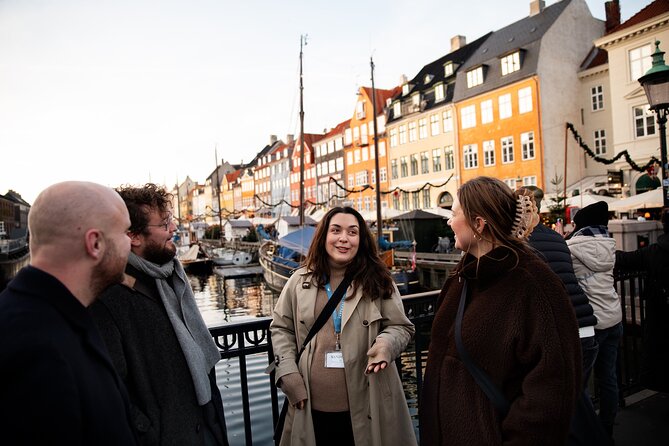
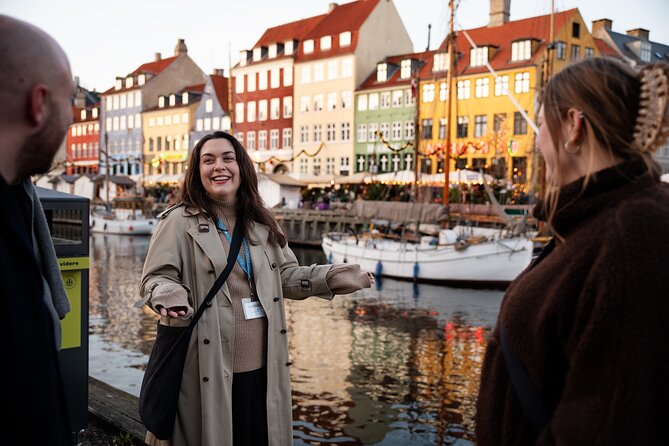
Nyhavn is the tour’s most instantly recognizable setting. The colorful buildings, boats, and narrow canal make it one of the easiest places in Copenhagen for a memorable photograph. Your guide takes you to a useful viewpoint and can help with the picture if needed.
You also hear about the harbor’s older character. Nyhavn’s bright facades now suggest a cheerful postcard, but its past was more complicated and less respectable. That contrast makes the stop more interesting than simply admiring the paintwork.
Allow about 15 minutes here. The time is enough to enjoy the view, hear the main story, and take photographs. It is not enough for a leisurely meal or drink, so plan to return later if you want to sit by the canal.
Nyhavn can be crowded, which is another reason the group limit matters. A group of 10 is easier to keep together than a large walking party, and your guide can speak to everyone without needing to gather the crowd in a wide circle.
Kongens Nytorv and the old city streets
From Nyhavn, the route crosses Kongens Nytorv, or King’s New Square. This important square brings together several signs of Copenhagen’s past: the old Royal Theatre, a historic hotel, and what is described as Denmark’s first shopping mall.
It is a good place to see how royal power, theater, hospitality, and commerce developed side by side. The stop is short, but it helps you read the city rather than simply photograph it.
You then move through smaller streets toward Nikolaj Kunsthal. Look up for the spire of one of Copenhagen’s oldest churches. The building is now connected with an art center, so this stop also shows how old religious structures can take on new civic uses.
The lanes here may be quieter and more intimate than the major squares. They also bring more uneven walking surfaces, so watch your step. The tour’s pace and route favor seeing a lot rather than lingering at every doorway.
Christiansborg and the Danish political story
The walk ends at Højbro Plads, where you have a fine view of Christiansborg Palace. The palace now houses the Danish Parliament, and this final stop shifts the subject from monarchy to modern government.
Your guide explains Danish politics and the welfare system, giving the tour a useful present-day finish. After stories about kings, guards, myths, and wartime history, you get a brief sense of how Denmark works now.
The tour ends beside the main pedestrian street, which is practical. You can continue shopping, look for lunch, visit Christiansborg independently, or use the guide’s one-on-one recommendations to plan the next part of your day.
That final conversation is one of the better features of the experience. Guides such as Kenneth, Oskar, Liva, Peter, and Nathan are praised for answering questions and offering suggestions for food and shopping. One particularly useful recommendation was Maven, a restaurant easy to miss because of its setting near a church. Ask directly for help based on your interests rather than accepting only a general list.
How the guides shape the experience
The guide roster is not fixed, so you may meet Kenneth, Oskar, Liva, Peter, Nathan, Sandra, Lukas, or another member of the team. The recurring strengths are clear: friendly delivery, dry humor, local stories, and the ability to explain history without making the walk feel like a classroom.
Kenneth is especially associated with smooth pacing, jokes, personal interaction, and a strong grasp of Copenhagen. Oskar brings dry humor and an easy willingness to answer questions. Liva is described as warm, funny, and helpful with food and shopping suggestions, while Peter is especially attentive when children are in the group.
You should still expect some variation because this is a live walking tour, not a recorded presentation. A guide may spend more time on royal stories, politics, architecture, or daily Danish life depending on the group’s questions. That flexibility is a plus if you enjoy conversation, but less useful if you want a fixed script or highly specialized architectural detail.
The tour is offered in English and includes a native English-speaking guide. Tips are not included. Carrying cash is not required for booking, but you may want to plan for a gratuity if you feel the guide gave you a good start to the city.
Price, pace, and who should book
At $50.81 per person, this is not the cheapest way to see Copenhagen’s outdoor sights. You can walk through many of the same districts for free with a map. The price makes more sense if you value the guide’s stories, local orientation, small group, and the time saved planning a route between distant sights.
The 97 percent recommendation rate and 4.9 rating from 361 ratings point to a consistently well-received experience, especially for the guides’ humor, personal attention, and ability to mix history with current Danish life. No tour suits everyone, but this one has a clear purpose: give you a useful first look at Copenhagen in under three hours.
I would choose it early in a Copenhagen stay. Afterward, you will know where the Little Mermaid, Amalienborg, Nyhavn, and Christiansborg are, and you can decide which places deserve a longer visit. It also works well for a short stop in the city because the route covers many of the main outdoor sights without requiring public transport between them.
Wear shoes suited to cobblestones and stairs. Bring an umbrella or rain jacket, since the walk continues outdoors in changing weather. The pace is brisk, though guides have adjusted to rain, cold, and different walking speeds. You should have moderate physical fitness and be comfortable standing and walking for most of the 2 to 2.5 hours.
Free cancellation is available until 24 hours before the start time. Changes or cancellations inside that window are not accepted for a refund. Service animals are allowed, and the meeting point is near public transport.
Should you book this Copenhagen walking tour?
Book it if you want a small, social orientation walk with Copenhagen’s headline sights, royal stories, mythology, politics, and practical food advice in one outing. It is particularly useful for first-time visitors, couples, families with older children, and anyone who likes asking questions along the way.
Skip it if you want to enter several attractions, spend a long time at each monument, or walk at a slow photography pace. The route is active and the outdoor stops are short.
For most people, the strongest plan is to take this tour near the start of your visit, then return on your own to Amalienborg, Kastellet, Christiansborg, or Nyhavn. At $50.81, you are paying less for admission and more for a well-planned route, a local voice, and a fast way to get your bearings in Copenhagen.
FAQ
How long does the Copenhagen Highlights walking tour last?
The tour lasts approximately 2 to 2.5 hours. The advertised duration is about 2 hours and 30 minutes, but the timing can be flexible.
Where does the tour begin and end?
It begins at ZinkGlobal by Kim Michael, Nordre Toldbod 12, 1259 Copenhagen. It ends at Højbro Plads, beside Copenhagen’s main pedestrian street and close to Christiansborg Palace.
How many people can join the tour?
The maximum group size is 10 people. This keeps the experience relatively personal and makes it easier to ask the guide questions.
Is the tour conducted in English?
Yes. The tour is offered in English and includes a native English-speaking guide.
Should I bring anything for the walk?
Wear suitable walking shoes and bring an umbrella or rain jacket in case of rain. The route includes cobblestones and stairs, moves at a brisk pace, and requires moderate physical fitness.
Are entry tickets included?
The listed stops are outdoor visits with free admission. Coffee and guide gratuities are not included. If you want to enter a palace, museum, church, or other attraction, that would be separate from this walking experience.
Just added around Copenhagen
- Politically Incorrect Beer Walk★ 5.0 · 516 reviews
- Politically Incorrect Private Hidden Gems Walking Tour★ 5.0 · 270 reviews
- Copenhagen Walking Tour: Highlights and Hygge w/Lunch★ 5.0 · 272 reviews
- Private Walking Classical Tour of Copenhagen★ 5.0 · 273 reviews
- Private Walking Tour of Christianshavn★ 5.0 · 122 reviews
- Copenhagen Private Walking Tour With A Guide (Private Tour)★ 5.0 · 153 reviews
- Hippies & Christianshavn Walking Tour★ 5.0 · 249 reviews
- Highlights and Secrets of Copenhagen Private Walking Tour★ 5.0 · 103 reviews
Small-Group Walking Tours, compared.

Amsterdam Anne Frank: Small-Group Walking Tour & Local Guide
Read our review →
Freedom Trail History Small Group Walking Tour
Read our review →
Barcelona Tapas and Wine Experience Small-Group Walking Tour
Read our review →
Reykjavík Small group Walking Tour – by CityWalk
Read our review →

Hidden Alleyways and Historic Sites Small-Group Walking Tour
Read our review →
Old Montreal Small-Group Walking Tour | Max 10 | by MTL Detours
Read our review →Browse the lists this tour appears in