
REVIEW · BUCHAREST
Walking Tour- Delightful Bucharest (Highlights, Stories, Sights)
Bucharest reveals itself best through its buildings and the stories behind them, and this two-hour walking tour puts those stories in a tight, useful route. You move from the quiet courtyard of Stavropoleos Monastery to Revolution Square, finishing at the grand Romanian Athenaeum.
I like the clear start-to-finish route and the local angle from Adrian, whose style is funny, personal, and fast-moving. I also like the value: for $22.99, you get a strong first look at Old Bucharest and several central landmarks without spending half a day on a bus.
The main thing to consider is pace and weather. This is an outdoor walk over old cobblestones, and one person found the guide too quick during rain. The tour ends at the Athenaeum rather than returning to the start, so check the route before you book.
Key points to know before you book
- See seven central sights in about two hours, including Stavropoleos Monastery, CEC Palace, Revolution Square, and the Romanian Athenaeum.
- Hear local stories from Adrian, including personal memories and observations about Bucharest’s communist past and modern life.
- Start in the Old Town and finish in a different central district, giving you a useful sense of how Bucharest’s historic core connects with its grander boulevards.
- Expect exterior visits at several major buildings, including CEC Palace, the National Military Club, the Palace of Telephones, and the Athenaeum.
- Plan for uneven paving and outdoor conditions, especially around Old Town, where cobblestones can be awkward for strollers or anyone with unsteady footing.
- Keep the group size in mind, as the tour can include up to 25 people.
Why this walk works well as a first Bucharest experience
Bucharest can feel scattered at first. Its Old Town has churches, cafés, grand banks, damaged façades, and Communist-era traces packed into a small area, while the city’s major cultural buildings sit farther along broad streets. This walk links those pieces in a sensible line.
You start at The Marmorosch Bucharest, Autograph Collection, at Strada Doamnei 2. From there, the route moves through the old center before heading toward Revolution Square and the Romanian Athenaeum. That progression matters. You are not just checking off monuments. You are watching Bucharest shift from medieval and Orthodox roots to Belle Époque ambition, military power, communications, monarchy, communism, revolution, and national culture.
Adrian is the guide named throughout the experience, and his approach is not stiff or scripted. He uses humor, personal observations, and stories to keep the walk moving. The strongest part of the tour is likely to be the commentary around the buildings rather than the chance to enter them.
At 4.9 out of 5 from 145 ratings, with 99 percent of participants recommending it, the experience has a strong record. Still, you should treat the high score as a guide to the general experience, not a guarantee that every joke or detail will suit everyone. One piece of feedback raised concerns about pace, humor, and overly nationalistic commentary. That is worth keeping in mind if you prefer a very formal guide or a slower walk.
A few more walking tours around Bucharest worth a look
- Bucharest: City Highlights Guided Walking Tour
★ 4.9 · 1,482 reviews - Bucharest: Communism and History Guided City Walking Tour
★ 4.9 · 918 reviews - Bucharest Highlights Walking Tour
★ 5.0 · 469 reviews
Stavropoleos Monastery: a quiet start in the Old Town
The first stop is Stavropoleos Monastery, scheduled for about 15 minutes with admission included. This is one of the most rewarding places on the route because it gives you a calm, intimate setting before the louder streets of central Bucharest take over.
The monastery represents late Romanian Renaissance style and Orthodox Christian tradition. Its scale is modest compared with the city’s later palaces, which is part of its appeal. You get a closer look at carved details and a sense of Bucharest before grand boulevards and monumental public buildings reshaped the center.
Allow yourself to listen closely here. Adrian’s stories about Romanian religious life and local customs help explain why this small church matters. One personal story connected to exorcisms and a church tradition was especially memorable for one visitor, though the tone may not suit everyone.
This stop is also a good reason to wear practical shoes. Old Town surfaces can be uneven, and the walk does not take place on smooth museum floors.
CEC Palace: Belle Époque ambition in one façade
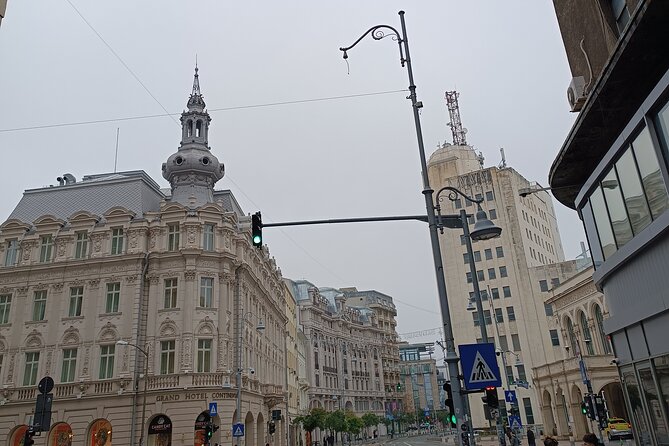
From the monastery, the route continues to Palatul CEC, or CEC Palace. You spend about 15 minutes here, but the building is viewed from outside because the interior cannot be visited on this tour.
CEC Palace is tied to the period when Bucharest was often called Little Paris. Its ornate design reflects the city’s late 19th and early 20th century desire to look modern, prosperous, and European. The building makes more sense when you understand that Bucharest was trying to announce its ambitions through architecture.
This is a stop where a guide adds real value. A photograph can show you the dome and decorative façade, but it cannot explain why a financial institution received such a grand setting or how the building fits into the city’s Belle Époque identity.
Do not expect an indoor tour or a long architectural lecture. You will see the exterior, hear the story, and continue. That is the pattern for much of this experience.
Macca-Villacrosse Passage: a small place with a big personality
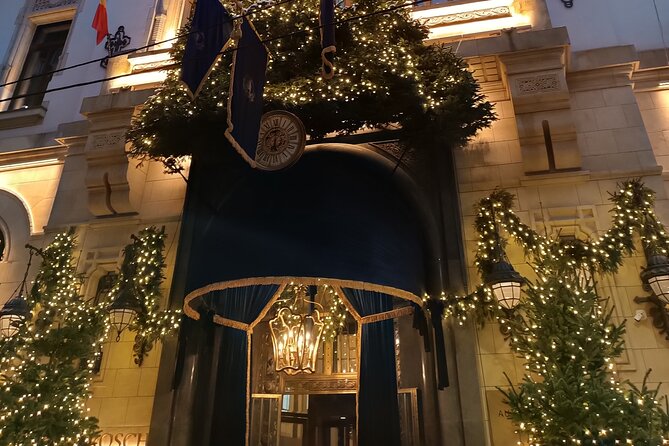
Macca-Villacrosse Passage is one of the shorter stops, at about 10 minutes, and admission is included. It is a covered arcaded street with cafés and a distinctive atmosphere. Compared with the formal façades of CEC Palace or the military club, this passage feels more intimate and playful.
The value here is scale. Bucharest is not only about grand public buildings. Passages like this show the city as a place of commerce, social life, and urban movement. The covered design gives you a break from sun or rain, which is useful on a walking route with little indoor time.
You might find this one of the most photogenic stops. It is also the kind of place that is easy to pass without understanding its history. Adrian’s explanation turns a quick look into a proper part of the city story.
Same streets, a different route:
- Bucharest: Hidden Markets Walking Tour with Tastings
★ 4.9 · 329 reviews - Bucharest: Ghost Stories & Romanian Mythology Walking Tour
★ 4.9 · 287 reviews - Bucharest: Guided Walking Tour with Romanian Snack
★ 4.9 · 228 reviews - Best of Bucharest | Private Walking Tour
★ 5.0 · 199 reviews
National Military Club: power in a monumental form
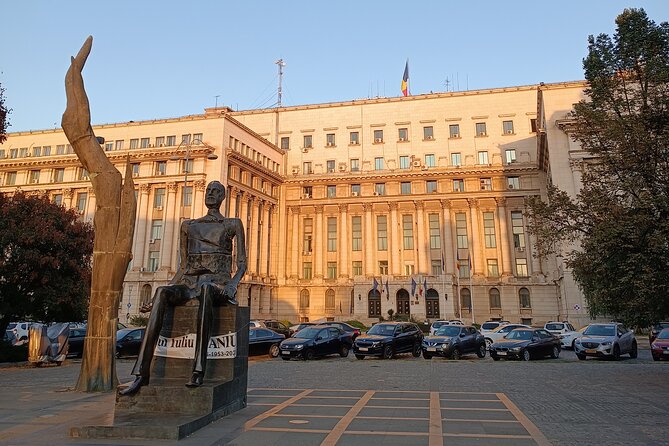
The National Military Club receives about 10 minutes. It cannot be visited inside, so the stop focuses on the exterior and on the building’s role in Romania’s public life.
The structure represents the power and ambitions of the Romanian Army. That makes it a useful counterpoint to the monastery and commercial buildings earlier in the walk. You are seeing how different institutions used architecture to project authority.
The guide’s central question here is why the building took this form and what it was intended to communicate. That question helps you read the façade rather than simply photograph it. If you enjoy political and architectural context, this should be one of the more useful short stops.
If your main goal is entering historic interiors, however, you should adjust your expectations. This is an exterior explanation, not a museum visit.
Palace of Telephones: a modern chapter in the city story
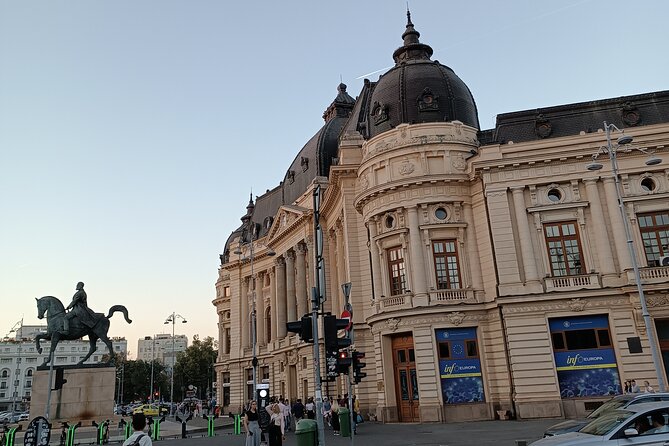
The Palace of Telephones is another exterior stop, lasting about 15 minutes. Its story brings the tour into a more modern period and shows how communications shaped Bucharest.
The building has a twisted history, and Adrian uses it as an opening for a local story. The tour does not provide interior admission, so the interest comes from the explanation and the building’s place in the city.
This stop helps prevent the route from becoming a parade of old churches and 19th-century palaces. Bucharest’s identity also comes from technology, state systems, political change, and the way the city kept adapting. You will get more from the stop if you listen for that larger connection.
The Palace of Telephones is also a reminder that the tour is designed as an overview. Each place receives enough time to make it meaningful, but not enough for a detailed architectural study.
Revolution Square: where Bucharest’s political story turns
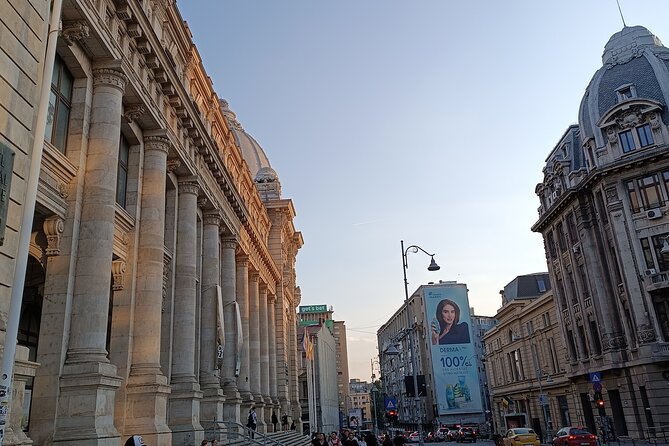
Revolution Square is the longest stop, at around 20 minutes, and admission is free. It is one of the most important places on the route because several political eras meet here.
The square became a symbol of Romania’s modern history, with major events tied to the country’s changing political regimes. Adrian explains how power was displayed here, how different periods began and ended, and why the square still matters to Romanian society.
This is likely the point where the tour feels most substantial. You are not only looking at monuments. You are connecting architecture and public space with protest, authority, memory, and political change.
The square also gives you a useful counterweight to Old Town. Earlier stops show the city’s older religious and commercial center. Revolution Square shows a more formal Bucharest, shaped by government, national identity, and major public events.
Expect outdoor commentary rather than entry into a building. On a rainy day, the guide has used covered places when possible, but you should still dress for the forecast. On a very cold evening, even a good guide cannot remove the chill.
The Romanian Athenaeum: a grand finish
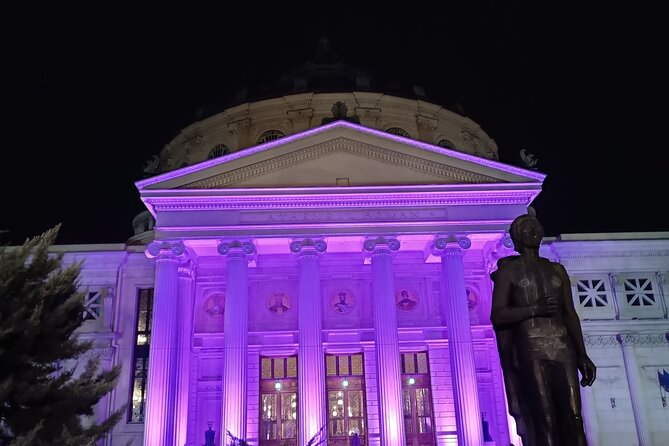
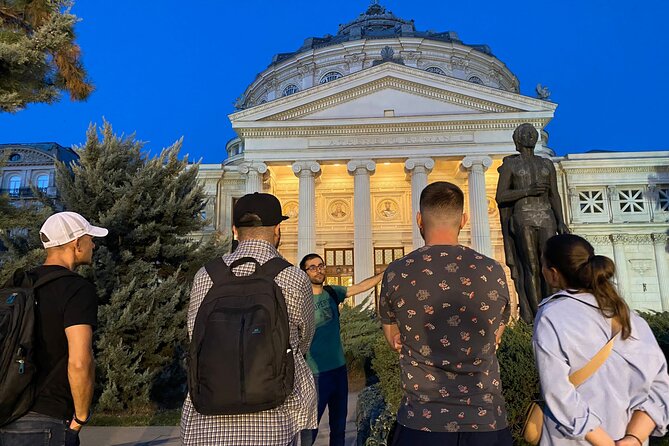
The walk ends at the Romanian Athenaeum on Strada Benjamin Franklin 1-3, after about 15 minutes focused on the building. The Athenaeum is described as a temple of the Romanian nation, and the comparison makes sense once you see its grand exterior.
This 19th-century masterpiece brings the route to a fitting close. After the small Orthodox monastery, commercial passage, military building, telephone palace, and political square, you arrive at a building devoted to national culture and public pride.
The Athenaeum cannot be visited inside because this is a walking tour, not an interior cultural visit. That is the clearest limitation of the final stop. You can admire the outside and hear the story, but you will need a separate visit if you want to see the auditorium or interior decoration.
The ending point is central and useful for continuing your day, but it is not the starting point. If you are unsure of Bucharest’s layout, save the address or open a map before the tour ends. The distance back to The Marmorosch Bucharest is not described as far, but the route is intentionally one-way.
Adrian’s style: lively, personal, and not formal
Adrian’s greatest strength is his energy. He is described as funny, friendly, cheerful, and willing to answer questions. Several comments praise his ability to make history feel approachable rather than academic.
He also adds personal details. You may hear about family experiences, memories of the communist period, local customs, or small observations that would not appear in a standard guidebook. That personal layer is valuable in Bucharest, where many buildings carry political stories that are easier to understand through lived experience.
The humor is part of the appeal, but it will not work for everyone. One person found some jokes unclear and felt the commentary was too nationalistic. I would choose this tour if you like a guide with a strong personality and informal delivery. If you want a neutral, restrained presentation with no jokes, you may prefer a different format.
The pace also deserves attention. Most comments describe a comfortable or fast but manageable walk. One person asked the guide to slow down during wet conditions and felt unsafe on slippery streets. If you have mobility concerns, tell the guide clearly at the beginning and consider the condition of the pavement before booking.
Price, group size, and practical value
At $22.99 per person, this is an affordable way to get oriented in central Bucharest. You receive about two hours of guided sightseeing, a route covering seven notable stops, and local commentary from a guide who can answer questions.
The tour can have up to 25 people. That is not a private experience, and a group of that size may make it harder to hear if you drift toward the back. On the other hand, the price is far below what you would expect from a private guide, and the route covers more ground than a short stroll around one small section of Old Town.
The usual duration is about two hours, though some comments describe two to two and a half hours. Allow a little flexibility if the group asks questions or the route moves slowly.
The tour is offered in English and uses a mobile ticket. Confirmation arrives when you book. It is near public transportation, service animals are allowed, and most people can participate. Free cancellation is available up to 24 hours before the start time. Changes or cancellations inside that window are not accepted for a refund.
The experience is booked, on average, 14 days ahead. That does not mean you must reserve exactly two weeks early, but it is sensible to book ahead if your Bucharest dates are fixed.
Who should book this Bucharest walk
I would choose it for a first visit, a short stay, or the first morning of a longer trip. It gives you the basic city map quickly and helps you decide which buildings or neighborhoods deserve a second look.
It is also a good fit if you enjoy stories more than formal museum interpretation. Adrian’s approach appears strongest when he connects a building to politics, family memories, local habits, or the way Bucharest changed over time.
You should think twice if you need a slow, fully accessible route, dislike uneven pavement, or want to enter every major building. Several stops are exterior-only, and the walk covers old streets where a stroller or unstable footing can be a problem.
The one-way route is a benefit for some people and a nuisance for others. Ending at the Athenaeum puts you near another important part of central Bucharest, but you must make your own way afterward.
Should you book Walking Tour: Delightful Bucharest?
Yes, if you want a low-cost orientation tour with a lively local guide and a clear look at Bucharest’s Old Town, political center, and cultural landmarks. The mix of Stavropoleos Monastery, CEC Palace, Revolution Square, and the Athenaeum gives you a useful first picture of the city.
Book it early in your stay so you can use Adrian’s suggestions for restaurants and later sightseeing. Wear comfortable shoes, check the weather, and expect exterior commentary rather than indoor visits.
I would not choose it for a private, slow, highly formal tour. For most first-time visitors with two hours to spare, though, it offers a strong introduction at a sensible price.
FAQ
How long is the Walking Tour: Delightful Bucharest?
The tour lasts approximately two hours. Some groups may take closer to two and a half hours depending on questions and pace.
What language is the tour offered in?
The tour is offered in English.
Where does the tour start?
It starts at The Marmorosch Bucharest, Autograph Collection, at Strada Doamnei 2, Bucharest.
Where does the tour end?
It ends at the Romanian Athenaeum, at Strada Benjamin Franklin 1-3, Bucharest.
Does the tour return to the starting point?
No. The tour ends at the Romanian Athenaeum rather than returning to The Marmorosch Bucharest.
Which sights are included?
The route includes Stavropoleos Monastery, Palatul CEC, Macca-Villacrosse Passage, the National Military Club, the Palace of Telephones, Revolution Square, and the Romanian Athenaeum.
Can you visit the buildings inside?
Stavropoleos Monastery and Macca-Villacrosse Passage include admission. The National Military Club, Palace of Telephones, and Romanian Athenaeum cannot be visited inside during the walking tour. Palatul CEC is also viewed from outside.
How much does the tour cost?
The listed price is $22.99 per person.
How many people can join the tour?
The maximum group size is 25 people.
Is free cancellation available?
Yes. You can cancel up to 24 hours before the experience starts for a full refund. Cancellations or changes made less than 24 hours before the start time are not accepted for a refund.
Just added around Bucharest
- Bucharest Under Communism: Life, Terror & Hope★ 5.0 · 76 reviews
- Guided Walking Tour of Historical Bucharest★ 5.0 · 84 reviews
- Bucharest 3-hours Walking Tour (Small Groups)★ 5.0 · 85 reviews
- 4h Bucharest Private Tour (2h by Car and 2h Walking in Old Town)★ 5.0 · 90 reviews
- Best of Bucharest | Private Walking Tour★ 5.0 · 199 reviews
- Bucharest: Relics of Communism 3-Hour Walking Tour★ 4.9 · 77 reviews
- Bucharest: Ghost Stories & Romanian Mythology Walking Tour★ 4.9 · 287 reviews
- Bucharest: Guided Walking Tour with Romanian Snack★ 4.9 · 228 reviews
Walking Tours, compared.

Magical London: Harry Potter Guided Walking Tour
Read our review →
Reykjavik Food Walk – Local Foodie Adventure in Iceland
Read our review →
History and Hauntings of Salem Guided Walking Tour
Read our review →
New Orleans Premier Ghost, Voodoo and Vampire Walking Tour
Read our review →
Amsterdam Anne Frank: Small-Group Walking Tour & Local Guide
Read our review →

Edinburgh Castle: Guided Walking Tour with Entry Ticket
Read our review →
Anne Frank’s Story – Guided Walking Tour through Amsterdam
Read our review →Browse the lists this tour appears in