
REVIEW · BERLIN
Private Berlin: Iconic Sights and Hidden Gems Walking Tour
Berlin’s past is not tucked away in one museum. It is written into ordinary streets, empty lots, surviving wall sections, grand squares, and the odd parking area. This private walk connects those pieces, from the Brandenburg Gate and Reichstag to the Führerbunker site and the Berlin Wall. Your guide gives the places their meaning.
I like the hotel pickup and drop-off, which removes the usual first-day nuisance of finding a meeting point. I also like the private format: you can ask blunt questions, slow down for a history buff, or steer the route toward architecture, WWII, the Cold War, or local neighborhoods. Guides such as Tina, Xavier, Ariel, and Daniel have been singled out for clear explanations and friendly, flexible teaching.
The main drawback is time. Three or four hours is enough for a strong introduction, but not for a leisurely visit to every place listed. Several major sites are spread across Berlin, and the route may involve more than simple strolling. Tell the company your top priorities before booking.
Key points to know before you book
- A private route shaped around you: Choose a broad first look at Berlin or focus on Nazi history, the Cold War, architecture, or lesser-known corners.
- Hotel-to-hotel convenience: The guide meets you in your central Berlin hotel lobby and returns you there at the end.
- Serious history, explained clearly: Expect discussion of Hitler, the Third Reich, wartime Berlin, the Wall, and the division between East and West.
- Three hours versus four: The shorter option works for the main story. The extra hour gives your guide more room for questions and added stops.
- A strong first-day choice: You get a city framework that helps you plan museums and neighborhoods for the rest of your stay.
- A few practical limits: Food and drinks are not included, and the tour generally visits sites from the outside rather than providing entry to every building.
Berlin’s story begins on your hotel doorstep
Your guide meets you in the lobby of your central Berlin hotel. That small detail matters more than it may sound. Berlin is easy to navigate once you know its districts, but the major historical sites are spread across a large area. Starting at your hotel saves time and keeps your first morning simple.
You can choose from several departure times. The tour is offered in English and is private, so only your group takes part. That gives you room to ask questions without holding up a coach full of strangers.
The guide’s style is likely to shape the day. Ariel has been praised for bringing historic buildings and major landmarks to life. Tina is known for an animated, friendly approach and for suggesting places to see later. Xavier has a knack for explaining difficult subjects to both children and adults. Daniel, Will, Ronja, Ruben, Artie, and others have also been praised for patience, humor, clear English, and careful attention to individual needs.
That range matters because Berlin’s story can become a blur of dates. A good guide keeps it tied to the ground beneath your feet. You learn not only what happened, but why this street, square, bunker site, or wall fragment matters.
More Hidden Gems Walks in Berlin:
- Explore Berlin: See All The Iconic Sights & Some Hidden Gems
★ 5.0 · 4,429 reviews - Kreuzberg Berlin: Off the Beaten Track PRIVATE Walking Tour
★ 5.0 · 128 reviews - Dublin Highlights and Hidden Gems Guided Walking Tour
★ 5.0 · 6,020 reviews
Brandenburg Gate and the center of modern Germany
The Brandenburg Gate is the natural opening scene. Its neoclassical columns and Quadriga chariot make it instantly recognizable, but the monument carries more weight than its elegant shape suggests.
During the Cold War, the gate sat in a restricted zone near the division between East and West Berlin. Today it represents German unity and peace. Your guide can help you see the change in meaning: once a symbol of separation, now a national meeting point and one of the city’s best-known photo stops.
You get about ten minutes here in the suggested route. That is enough for a quick explanation and photographs, but not a long architectural study. Pariser Platz has cafés, shops, and plenty of activity, so your guide’s historical framing is especially useful. Without it, you may simply take a picture and move on.
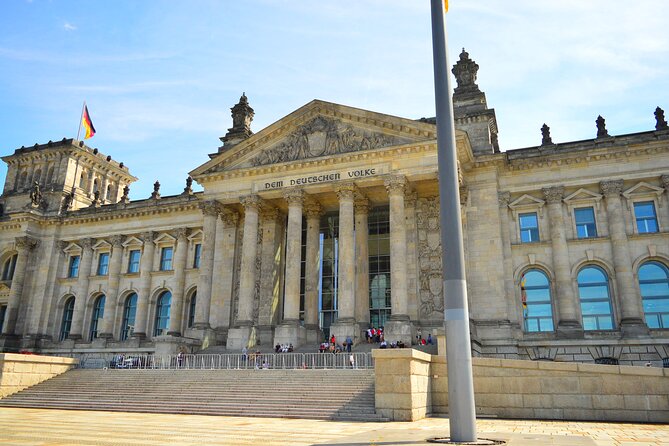
Nearby, the Reichstag provides another lesson in Germany’s political transformation. The building dates from the German Empire, witnessed the political crisis that helped the Nazi regime rise, and became the home of the Bundestag after restoration.
The glass dome is one of its most memorable features. It symbolizes openness in government and gives you views across Berlin. The walking tour allows about ten minutes at the building and does not list dome admission as included. If you want to go inside, ask about it when you book. A short outdoor stop should not be confused with a full Reichstag visit.
The Führerbunker site and the danger of empty ground
The former Führerbunker site is one of the tour’s most unsettling stops because almost nothing remains to see. The bunker itself is underground and largely gone from public view. A small sign marks the area, now an otherwise ordinary part of the city.
That absence is the point. Hitler spent his final days there as the war closed in on Berlin. Standing above the site, you are not touring a preserved room or dramatic ruin. You are confronting how a place tied to one of the twentieth century’s darkest regimes can become anonymous.
The stop takes about nine minutes. That may sound brief, but it is enough when the guide supplies the wider setting: the final phase of World War II, the Nazi command structure, and the physical destruction around the Reich Chancellery. This is best for you if you want context rather than spectacle.
The tour also covers the Memorial to the Murdered Jews of Europe. The supplied route does not assign it a separate timed stop, so confirm whether your chosen version includes it. Its location near the Brandenburg Gate and the former bunker area makes it a logical part of a central Berlin route, but private tours can vary.
Bebelplatz and the cost of censorship
Bebelplatz is one of the most important stops for understanding how Nazi control reached beyond government and policing. On May 10, 1933, Nazi supporters and students burned thousands of books here, targeting works considered politically or culturally unacceptable.
The square is framed by the State Opera House, St. Hedwig’s Cathedral, and Humboldt University. That setting makes the story more powerful. This was not an isolated back lot. It happened in the heart of Berlin’s academic and cultural life.
Look through the glass panel in the pavement for the Empty Library memorial. The underground shelves are bare, a quiet reminder of the books and ideas that were destroyed or suppressed. The stop lasts about twelve minutes, but you will want your guide to pause here long enough to explain the event and its meaning.
I find this kind of stop more valuable than a quick roll call of famous buildings. It connects Berlin’s architecture with the choices made by people who lived and worked around it. You come away with a sharper sense of how intolerance becomes public policy.
A few more walking tours around Berlin worth a look
- Discover Berlin Half-Day Walking Tour
★ 5.0 · 9,624 reviews - Berlin City walk Government District and Places of Democracy
★ 4.7 · 8,467 reviews - Berlin: Third Reich & Cold War Guided Walking Tour
★ 4.9 · 8,378 reviews - Berlin: Discover Berlin Walking Tour
★ 4.9 · 5,998 reviews
Checkpoint Charlie and the divided city
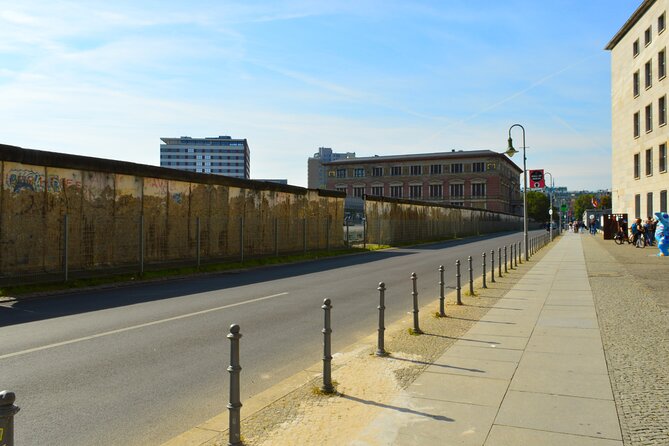
Checkpoint Charlie is Berlin’s best-known Cold War crossing point. It once marked a tense passage between East and West Berlin, especially for foreign diplomats and military personnel. Today, the replica guardhouse and surrounding displays make it easy to recognize, though the modern setting can feel commercial and crowded.
You spend about fifteen minutes here. Your guide explains the Wall, escape attempts, and the political standoff that made Berlin a central point in the Cold War. The value is not the booth itself. It is the explanation of how an ordinary city street became a heavily guarded border.
This is also a useful place to ask how daily life differed on either side. The walking route later adds the Berlin Wall Memorial and East Side Gallery, giving you two very different views of the same divided past.
The Berlin Wall Memorial at Bernauer Strasse
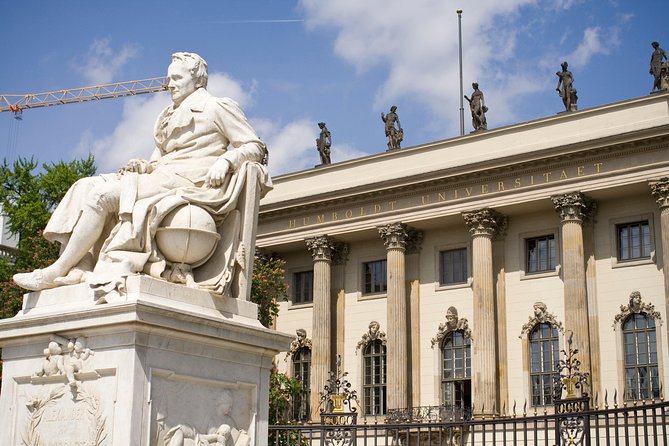
The Wall Memorial on Bernauer Strasse gives you a stronger sense of the border than Checkpoint Charlie. A preserved section of wall and border fortifications shows how the system worked physically. Exhibits, photographs, and personal accounts explain the risks faced by people who tried to escape from East Berlin.
The suggested stop lasts thirty minutes, making it one of the most substantial portions of the route. That is appropriate. The Wall was not simply a concrete barrier. It cut through streets, divided families, and reshaped daily life.
This stop is especially useful if you have limited time in Berlin and want more than a photo beside a painted wall. The memorial gives structure to the story. You see how the border was built and why escape was so dangerous.
A practical point: Bernauer Strasse and the East Side Gallery are not next door to each other. Since the tour is private, your guide can decide how much time to assign to each, but you should name your priorities in advance. If the Wall is your main interest, ask for enough time at both sites or choose one as the focus.
East Side Gallery: history turned into public art
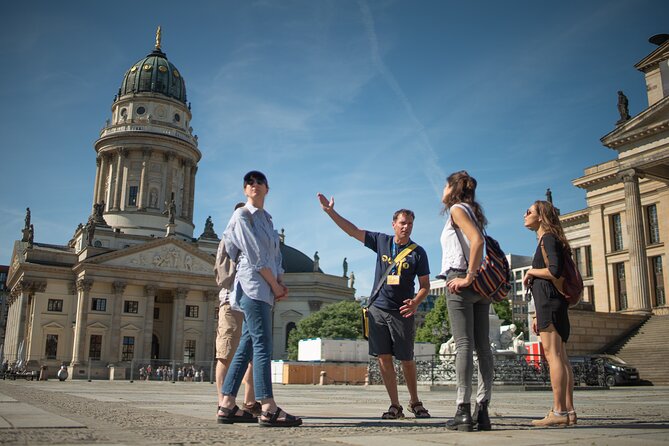
The East Side Gallery stretches along a remaining section of the Berlin Wall and displays more than one hundred murals. Artists painted the works after the Wall fell in 1989, turning a barrier into an outdoor art space.
The famous Fraternal Kiss mural, showing Soviet leader Leonid Brezhnev kissing East German leader Erich Honecker, is the image most people recognize. Other paintings express hope, unity, protest, and the excitement of a city changing direction.
The stop lasts about twenty minutes. That is enough to see several major works and understand the site, but not enough to study every mural along the 1.3-kilometer stretch. Treat it as an introduction rather than a complete art walk.
The contrast with Bernauer Strasse is valuable. At the memorial, the Wall is presented as a tool of control. At the East Side Gallery, it becomes a canvas. Your guide can connect those two meanings without pretending that the artwork replaces the painful history.
Gendarmenmarkt, Unter den Linden, and central Berlin architecture
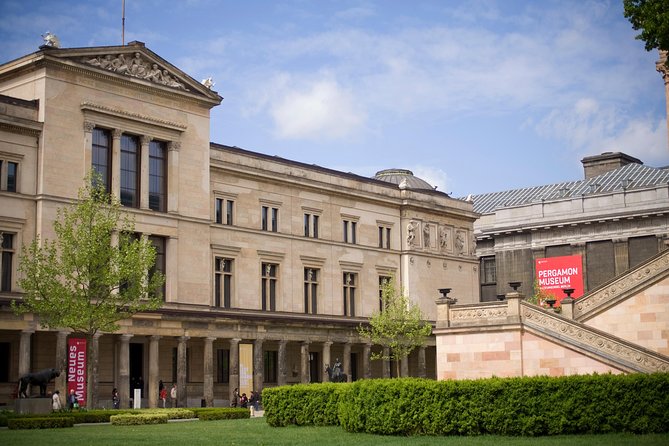
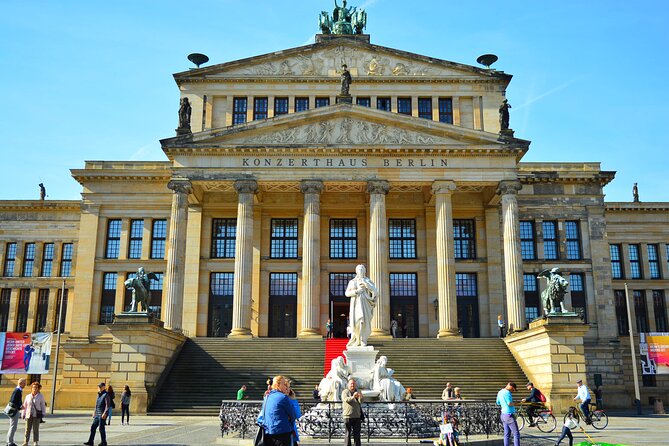
Gendarmenmarkt offers a change of tone. The square is framed by the French Cathedral, the German Cathedral, and the Konzerthaus. Its formal design and neoclassical buildings show a more polished side of Berlin than the Wall sites.
You have about ten minutes here in the suggested schedule. That is enough to take in the layout and hear how the square developed as a cultural and civic center. If architecture interests you, tell your guide. You may be able to shift time from a stop that matters less to you.
Unter den Linden, the grand boulevard through Mitte, may also appear on the route. It links several central landmarks and helps you understand how Berlin’s old royal center, government district, museums, and modern public spaces fit together.
The East German Government Quarter is another possible addition. Since this is a customized tour, no two routes need to be identical. That flexibility is useful, but it also means you should not assume every listed site will receive equal attention.
Museum Island, Berliner Dom, and the city’s cultural core
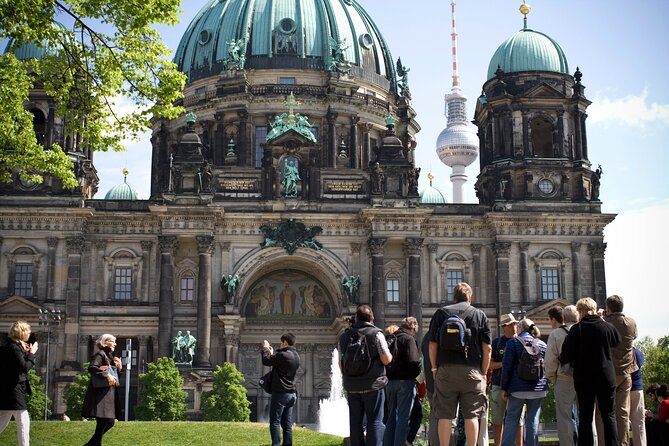
Museum Island is one of Berlin’s best areas for seeing how culture and power were displayed in stone. The museums line the Spree, with grand façades, open spaces, and strong views toward the Berliner Dom.
The stop is listed at about fifteen minutes. You will get orientation and photographs, not a museum visit. Admission to the collections is not included, and food and drinks are also outside the tour price.
The Berliner Dom, or Berlin Cathedral, rises beside the island with its large Baroque dome. The interior contains mosaics, ornate decoration, and a major organ. You can also climb toward the dome for city views, but the walking tour’s ten-minute stop is an exterior introduction unless separate entry is arranged.
This is a good example of the tour’s role. It helps you decide what deserves a longer visit later. If the cathedral or museums are high on your list, ask your guide for practical advice and plan a separate block of time.
Hackescher Höfe and a look beyond official monuments
Hackescher Höfe brings the tour into a more everyday, creative part of Mitte. The interconnected courtyards date from 1906 and mix apartments, shops, galleries, restaurants, theaters, and decorative Art Nouveau details.
The twenty-minute stop gives you time to see the courtyards and understand their original mixed-use design. This is one of the better choices for anyone who wants more than military and political history. You get architecture, city life, and a sense of how Berlin reuses older spaces.
The area can also work well for a break after the tour. Food is not included, but the courtyards and nearby Hackescher Markt offer places to continue on your own. Your guide may also point you toward other local spots, as Tina and several other guides have done for people who wanted ideas for the rest of their stay.
How much value do you get for $192.97?
At $192.97 per person, this is not a budget walk. The value depends heavily on group size. For one or two people, the cost is high, but you are paying for a private guide, hotel pickup and drop-off, a flexible route, and direct answers throughout the experience. For a larger private group, the per-person cost may feel more reasonable, especially compared with booking several separate activities.
The tour is also efficient for a first visit. Berlin’s key sites are not gathered in one compact old town. A guide who can connect Brandenburg Gate, the Wall, Checkpoint Charlie, the former Nazi government center, and Museum Island may save you time and confusion.
The 3-hour option is the better value if you want orientation and a short list of places to revisit. Choose 4 hours if you care about historical explanation, have a specialist interest, or want more room for questions. Several people have found that a private guide can adapt the pace to limited walking ability, though you should state your needs at booking.
The 4.9 rating from 292 reviews and 99 percent recommendation point to a consistently strong service. Still, one poor experience involved a last-minute booking and a flight cancellation, followed by a dispute over rescheduling. The practical lesson is simple: book early when possible, and read the 24-hour cancellation rule carefully. Cancel at least 24 hours before the start for a full refund. Changes or cancellations inside that window are not accepted or refunded.
Who should book this Berlin walking tour?
I would choose this tour for a first visit, a short stay, or a family group with different interests. It also suits anyone who wants WWII and Cold War history explained at the actual places where events unfolded.
It is a particularly good fit for you if you value conversation over a fixed script. Guides have adjusted routes for limited walking ability, added visuals, changed emphasis for WWII enthusiasts, and kept children involved. The private setting makes those changes possible.
I would look elsewhere if you want long interior visits to museums, the Reichstag dome, or Berlin Cathedral. This experience is mainly an outdoor orientation walk. You will see many places, but entry tickets, meals, and extended time inside buildings are not part of the package.
Should you book it?
Book it if you want Berlin to make sense quickly. The strongest feature is not the number of landmarks. It is the way a private guide can connect Nazi Berlin, the divided city, reunification, architecture, and present-day neighborhoods in one conversation.
Before paying, send a short priority list: for example, Nazi history, the Berlin Wall, Museum Island, or local architecture. Choose four hours if those subjects matter to you. With a good match, guides such as Tina, Xavier, Ariel, Daniel, or Rebecca can turn a first day in Berlin into a useful map for the rest of your trip.
FAQ
How long is the private Berlin walking tour?
You can choose a tour lasting approximately three or four hours. The three-hour option gives you a solid introduction, while the four-hour option allows a more detailed route.
Where does the tour begin and end?
The guide meets you in the lobby of your central Berlin hotel and returns you to your hotel at the end.
Is the tour private?
Yes. Only your group participates, so the guide can adjust the pace and focus to your interests and needs.
Is the tour offered in English?
Yes. The experience is offered in English.
Are food, drinks, and attraction admission included?
No. Food and drinks are not included. The listed walking stops have free admission, but the tour does not include entry to interiors such as museums, the Reichstag dome, or Berlin Cathedral.
Can I cancel for a full refund?
Yes, if you cancel at least 24 hours before the experience start time. Cancellations or changes made less than 24 hours in advance are not refunded or accepted.
Just added around Berlin
- Berlin Walking Tour★ 4.5 · 378 reviews
- East Meets West: Berlin Food Culture & Street Art★ 5.0 · 157 reviews
- Small Group Walking Tour of East Berlin with a French Guide★ 5.0 · 176 reviews
- Berlin Street Art Walking Tour – Off The Grid★ 5.0 · 270 reviews
- Berlin Highlights Private Guided Walking Tour★ 4.5 · 89 reviews
- Gruseltour Berlin Haunted Ghost Walk 90-minute at Berlin Mitte city center★ 5.0 · 75 reviews
- Berlin Private Complete History All Day Walking Tour★ 5.0 · 474 reviews
- Berlin Private Walking Food Tour With Locals: the 10 Tastings★ 4.5 · 139 reviews
Hidden Gems Walking Tours, compared.
Dublin Highlights and Hidden Gems Guided Walking Tour
Read our review →
Explore Berlin: See All The Iconic Sights & Some Hidden Gems
Read our review →
San Marco to Rialto Walk & Spritz Like a Local
Read our review →
Kyoto Geisha Walking Tour: Gion District & Hidden Gems
Read our review →
Eat Like a Local: Venice 3-Hour Small-Group Food Tasting Tour
Read our review →
Montmartre Hidden Gems and Scenic Highlights Walking Tour
Read our review →
Guided Walking Tour of City Highlights & Hidden Gems
Read our review →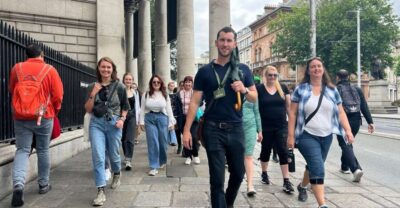
Browse the lists this tour appears in