
REVIEW · ATHENS
Athens Highlights: Myths & Philosophers Walking Tour
Athens makes a strong case for learning while walking. On this private four-hour tour, Socrates, Plato, Aristotle, and the Greek gods become companions as you move from the Academy of Athens through gardens, old lanes, the Ancient Agora, and the foot of the Acropolis.
I like two things right away: you can ask questions instead of listening to a fixed speech, and the route connects ideas to real places. The changing of the Presidential Guard, the Tower of the Winds, and the Areopagus give the discussion a physical setting. The possible drawback is the length. Four hours on Athens streets can feel like a lot, especially in warm weather.
Key points to know before booking
- Private conversation: Only your group takes part, so the guide can adjust the pace and subject matter.
- Philosophy in real places: The route links Stoicism, Cynicism, democracy, astronomy, ethics, and mythology to Athens landmarks.
- Strong guides: Bianca receives especially high praise for her storytelling and thoughtful discussions. John, Gianni, and Effrosyni are also named as guides in the tour feedback.
- A full city walk: You finish on Areopagus Hill, with views toward the Acropolis, after covering central Athens and Plaka.
- Good for mixed ages: Guides have engaged adults, university-age visitors, and teenagers with different levels of interest.
- Bring walking shoes and water: Coffee, tea, and bottled water are included, but entrance fees and personal expenses are not.
Why this Athens walk feels different
Many Athens tours put the Acropolis first and treat philosophy as a brief footnote. This experience reverses the order. It begins with the intellectual life of the city and uses Athens itself as the classroom.
You are not simply shown a statue of a famous person and given three dates to remember. The guide can explain how different thinkers approached ethics, physics, astronomy, democracy, and the question of how a person should live. The myths add another layer, showing how gods and heroes helped ancient Greeks make sense of the world.
The private format matters. If you already know Plato but want help with the pre-Socratics, you can spend more time there. If the word Stoicism sounds familiar but vague, you can ask for a plain explanation. A family with teens can keep the conversation moving, while two philosophy students can stay with a harder question.
Bianca is the guide most often singled out, with John, Gianni, and Effrosyni also praised for their approach. The strongest pattern is clear: these guides do more than recite information. They invite discussion, tell stories, and connect old ideas to daily life. That style will suit you if you want an active conversation. It may be less suitable if you prefer a quiet sightseeing walk with only short explanations.
A few more walking tours around Athens worth a look
- Athens: Acropolis and Parthenon Guided Walking Tour
★ 4.6 · 5,882 reviews - Acropolis and Parthenon Guided Walking Tour
★ 5.0 · 4,755 reviews - Greek Food Walking Tour in Athens
★ 5.0 · 4,740 reviews
Starting at the Academy of Athens
The tour begins at Panepistimiou in central Athens, near the Academy of Athens. The opening stop lasts about 15 minutes, with admission not included.
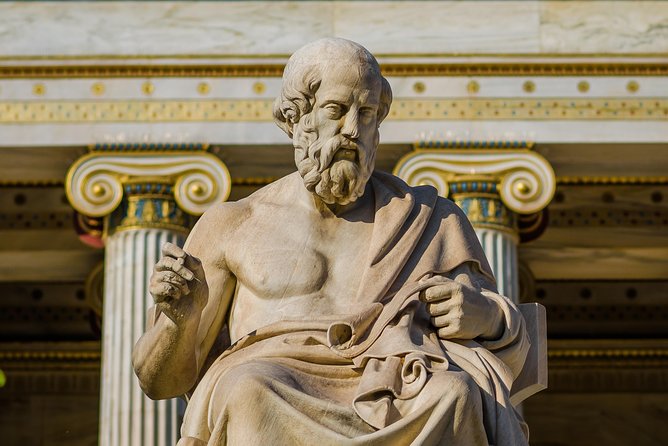
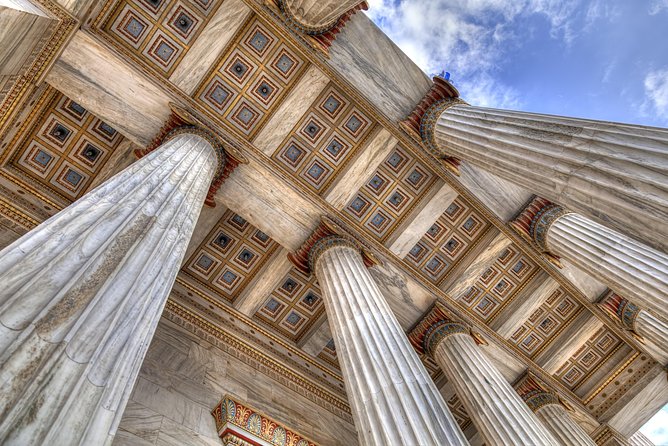
Here you see the Trilogy of Athens, the group of neoclassical buildings that includes the Academy. The setting gives the guide a natural way to introduce the major movements of ancient Greek thought. You begin with the people who asked basic questions about nature, knowledge, justice, and human conduct.
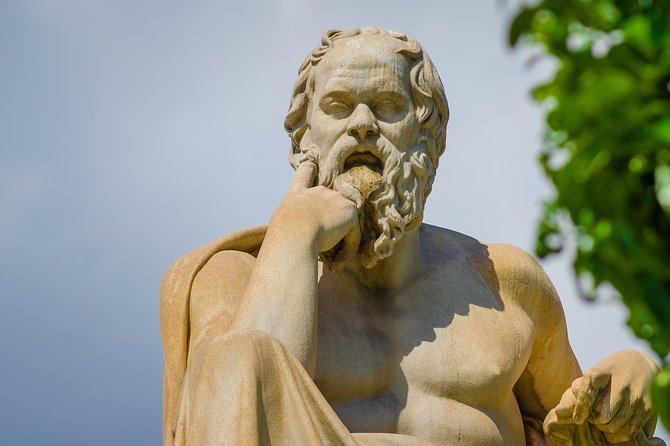
This is a useful opening because it sets up the rest of the walk. Instead of meeting Socrates, Plato, or Thales as isolated names, you can place them in a long chain of questioning and argument. Thales of Miletus receives particular attention, along with Socrates and Plato.
The stop itself is short, so do not expect a long interior visit. The Academy is mainly a starting point for the discussion, and the entrance fee is not included. If your main goal is to see museum collections, this tour is not a substitute for a dedicated museum visit.
The route also includes a brief reference to a museum with a major collection of ancient and modern coins. The supplied details do not identify a separate timed visit or admission arrangement for this stop, so you should not assume that a museum entry is part of the experience.
The Hellenic Parliament and the guard ceremony
At the Hellenic Parliament, the group pauses for about 15 minutes. Admission is free, and the guide discusses the Changing of the Presidential Guard, one of Greece’s oldest continuing traditions.
This is one of the tour’s best changes of pace. After discussing abstract ideas, you are watching a formal public ceremony in front of an important modern building. The guide can use the moment to connect ancient civic life with the way Athens functions today.
The exact timing of the guard change can matter, so ask when booking or at the start of the tour how the stop fits the day’s schedule. The description promises that you will witness the ceremony, but it does not give a detailed timetable.
The parliament stop is also practical for first-time visitors. It gives you a clear central landmark and helps you understand how the tour moves between modern Athens and ancient sites. You are not confined to an archaeological zone. The city around you remains part of the lesson.
National Garden: democracy, science, and ethics
The National Garden provides a quieter 15-minute stretch. Entry is free, and the walk through the garden becomes a setting for discussing democracy, physics, astronomy, ethics, and other fields linked to Greek philosophy.
I like this stop because it gives the group a chance to slow down. Four hours of city walking can become tiring when every minute is spent beside traffic or crowds. A garden pause also makes philosophical discussion feel less like a lecture hall exercise.
The guide can show how ancient thinkers worked across subjects that we now divide into separate school departments. Questions about the stars could lead to questions about order and knowledge. Questions about government could lead to questions about fairness and civic duty.
Do not expect a detailed botanical tour or a long garden visit. The scheduled time is about 15 minutes. Its value is the conversation and the pause, not a major sightseeing claim.
Same streets, a different route:
- Acropolis: Acropolis and Parthenon Guided Walking Tour
★ 4.7 · 3,442 reviews - Athens: Guided Greek Food Walking Tour with Tastings
★ 4.9 · 2,859 reviews - Acropolis monuments & Parthenon Walking Tour with Optional Acropolis Museum
★ 5.0 · 2,678 reviews - Athens Acropolis and Parthenon Walking Tour
★ 4.5 · 1,355 reviews
Following Hermes along Ermou Street

Ermou Street is the route’s most urban stop. Here, the guide talks about Hermes, the mischievous god associated with the street’s name.
This short section adds humor and myth to a tour that might otherwise lean heavily toward philosophy. Hermes gives the guide a chance to explain how Greek mythology shaped names, places, stories, and ideas. It also keeps the route grounded in ordinary city life rather than only grand monuments.
The walk through Ermou is not described as a shopping excursion, and the visit lasts about 15 minutes. You should treat it as a storytelling stop. If you want time to browse shops, take photos, or make purchases, personal time may be limited because the tour continues on a planned route.
The route also passes a square named for the Church of the Pantanassa. The supplied details do not list a separate stop duration or admission arrangement there, so consider it part of the walking connection rather than a major scheduled visit.
The Ancient Agora and the roots of Stoicism
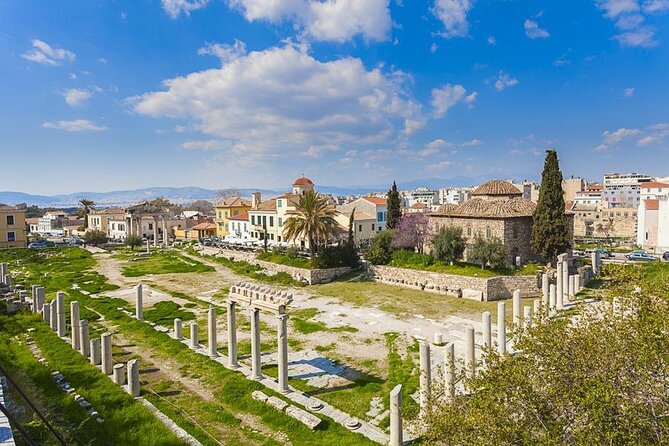
The Ancient Agora is one of the most important stops for understanding how philosophy developed in public spaces. The tour discusses the Poikile Stoa, associated with the birth of Stoic philosophy. The visit lasts about 15 minutes, and entrance fees are not included.
The Agora was more than a collection of ruins. It was a place where civic, commercial, political, and intellectual life met. That makes it a fitting place to discuss Stoicism, a school concerned with judgment, self-control, duty, and how to respond to circumstances.
This is where the tour’s main idea becomes especially clear: philosophy was not always a private activity carried out in a study. It happened in shared public spaces, through conversation and argument. A private guide can make the stop more personal by asking what you think rather than simply explaining what the Stoics believed.
The short timing is the main limitation. Fifteen minutes is enough for an introduction and discussion, but not for a thorough archaeological visit. Since entry is not included, check the current admission details if you hope to go inside the site. The tour may explain its importance without providing a full guided tour of every ruin.
The Tower of the Winds and the world of Aiolos
The Tower of the Winds is another compact stop, lasting about 15 minutes, with admission not included. The guide introduces Aiolos, keeper of the winds, while you admire the famous monument.
This stop brings together myth, weather, astronomy, and practical ancient science. The Tower of the Winds is a fitting place to talk about how people observed and explained the natural world. The myth of Aiolos gives the subject a memorable character, while the monument points toward measurement and organized knowledge.
For you, the appeal is the blend. One minute you are hearing about a figure from Greek myth. The next, the conversation turns toward the way ancient people studied wind and time. That movement between story and reason is central to the tour.
Again, admission is not included. The stop is designed around viewing and discussion, not a long interior visit. If you want extended time at the monument, ask how the guide handles the entrance option before the walk begins.
Anafiotika and the Cynic philosophers
The route then reaches Anafiotika in Plaka, beneath the Acropolis. This section lasts about 20 minutes and is free to enter.
Anafiotika gives the tour a more intimate setting, with narrow lanes and a strong sense of place. Here, the guide discusses the Cynic philosophers. The subject fits the setting: Cynic thinkers questioned social convention and placed unusual emphasis on simplicity, independence, and living according to nature.
This is also one of the places where the private format pays off. The guide can ask how you define a good life, what you really need, or how much of modern life is shaped by social pressure. You can keep the discussion light, or ask for more detail about the ancient thinkers.
The uneven streets and long walking route make practical footwear important. The tour information says most people can participate, but it does not provide a detailed mobility assessment. If anyone in your group has walking concerns, contact the provider before booking.
Ending on Areopagus Hill
The tour concludes on Areopagus Hill, also called the Areopagus, at the foot of the Acropolis area. The final stop lasts about 15 minutes and is free.
You finish with views toward the Acropolis and stories about the Olympian gods. It is a strong closing point because the tour ends with both scenery and myth. After following philosophers through public squares and city streets, you look across one of Athens’s most recognizable views while hearing stories about the gods who shaped Greek imagination.
The hill can be rocky and uneven. The route’s final setting is rewarding, but it is not a polished indoor venue. Wear shoes with a firm grip, especially if the ground is dry or slick.
The end point is useful for planning the rest of your day. You are near major Plaka and Acropolis sights, though the tour does not include entrance to the Acropolis or any other attraction. It ends at Areopagus Hill rather than returning you to the starting point.
What the four-hour private format gives you
The tour lasts about four hours and is offered in English. Only your group takes part, which lets the guide shape the experience around your interests. That is a major advantage over a large group walk, particularly for philosophy.
Guides have adjusted the level for groups with one person new to the subject and another with more background. Families with teenagers have also found the discussion accessible. The guide can spend more time on pre-Socratic thinkers, Socrates, Plato, Aristotle, mythology, or the practical meaning of Stoicism and Cynicism.
The tradeoff is pace. You cover a substantial stretch of central Athens, and the planned stops are short. If you want a relaxed day with long café breaks and extended time inside monuments, this may feel busy. One drink stop is part of the experience, and coffee or tea plus bottled water are included, but do not expect a long lunch break.
The weather also matters. This is an outdoor walking tour, and poor weather can lead to a different date or a full refund. Athens sun can be strong, so a hat, comfortable shoes, and your own sun protection are sensible choices even though the tour includes drinks.
Is $102.80 a fair price?
At $102.80 per person, this is not a bargain-priced orientation walk. You are paying for a private guide, a specialized subject, and the chance to ask questions throughout the experience. Group discounts are available, though the exact discount depends on the booking.
The value is strongest for two or more people who genuinely want discussion. If you are curious about philosophy but dislike academic lectures, the conversational style can make the price worthwhile. If you mainly want to enter monuments, take photos, or cover the biggest archaeological sites, you may get better value from a standard sightseeing tour or individual attraction tickets.
Entrance fees are not included. That keeps the base price clear, but you should budget separately if you choose to enter the Ancient Agora, Tower of the Winds, or other points of interest. Personal expenses are also extra.
The included coffee, tea, and bottled water are useful touches, but they are not the reason to book. The real value is the guide’s ability to connect Athens places with ideas and to tailor the conversation to your group.
Who should book this experience?
I would choose this tour for:
- A philosophy student or anyone curious about Socrates, Plato, Aristotle, or the pre-Socratics
- Families with older children or teenagers who enjoy discussion
- Repeat visitors who have already seen the main Athens sights and want a different angle
- Couples who prefer a private walk to a large group tour
- Visitors who want mythology, history, and philosophy in one experience
- People who enjoy asking questions rather than simply following a script
I would think twice if you want an archaeological tour with long visits inside monuments. I would also reconsider if four hours of walking sounds tiring, or if your group is not interested in discussion. The guide can make philosophy approachable, but the subject remains central.
Should you book the Athens Myths and Philosophers Walking Tour?
Book it if you want Athens to be more than a list of ruins. The strongest part is the link between place and thought: Stoicism at the Ancient Agora, mythology at the Tower of the Winds, Cynicism in Anafiotika, and civic tradition outside Parliament.
You should also book it if you value a guide who listens. Bianca is especially noted for warm storytelling and thoughtful questions, while John, Gianni, and Effrosyni are also named as capable guides. Guide assignment may vary, so do not assume a particular person will lead your tour.
Skip it if your priority is included admission, a short route, or a standard overview of Athens. For the right group, though, this is a memorable way to walk through the city and leave with more questions than you started with, which is a very Greek way to spend a morning.
FAQ
Where does the tour start?
It starts at Panepistimio, Athens 106 79, Greece.
Where does the tour end?
It ends at Areopagus Hill, Theorias 21, Athens 105 55, Greece.
How long does the tour last?
The tour lasts approximately four hours.
Is this a private tour?
Yes. Only your group participates in the activity.
Is the tour offered in English?
Yes. English is the listed tour language.
Are entrance fees included?
No. Entrance fees to points of interest are not included. Several outdoor stops are free, while admission is not included for places such as the Academy of Athens, Ancient Agora, and Tower of the Winds.
Are drinks included?
Yes. Coffee and/or tea and bottled water are included.
Can service animals participate?
Yes. Service animals are allowed.
What happens if the weather is poor?
The experience requires good weather. If it is canceled because of poor weather, you will be offered another date or a full refund. You can cancel for a full refund up to 24 hours before the experience start time.
Just added around Athens
- Athens Street Art Walk★ 5.0 · 309 reviews
- The Acropolis, Athens Walking City Tour and Acropolis Museum★ 5.0 · 442 reviews
- Athens Street Food Walk★ 5.0 · 385 reviews
- Athens at Night Small-Group Walking Tour with Dinner★ 5.0 · 230 reviews
- Acropolis monuments, Parthenon and Plaka, Monastiraki walking tour★ 5.0 · 182 reviews
- Athens Shore Excursion: Acropolis Walking Tour★ 4.5 · 131 reviews
- Athens Gourmet Food Small Group Walking Tour★ 5.0 · 213 reviews
- Athens: Acropolis, Parthenon Guided Walking Tour★ 5.0 · 319 reviews
Walking Tours, compared.

Magical London: Harry Potter Guided Walking Tour
Read our review →
Reykjavik Food Walk – Local Foodie Adventure in Iceland
Read our review →
History and Hauntings of Salem Guided Walking Tour
Read our review →
New Orleans Premier Ghost, Voodoo and Vampire Walking Tour
Read our review →
Amsterdam Anne Frank: Small-Group Walking Tour & Local Guide
Read our review →

Edinburgh Castle: Guided Walking Tour with Entry Ticket
Read our review →
Anne Frank’s Story – Guided Walking Tour through Amsterdam
Read our review →Browse the lists this tour appears in