
REVIEW · STRASBOURG
Strasbourg: Private Walking Tour of the Historical Center
Strasbourg’s old center gives you a lot in a small area: a soaring cathedral, medieval churches, canals, and the famous covered bridges. This private two-hour walk is a quick way to get your bearings while hearing how French and German culture meet in this border city.
I like the flexible language choice, with tours offered in English, French, German, Italian, Spanish, Portuguese, and Japanese. I also like the chance to focus on Strasbourg’s Grand Île, the historic island center, without spending time on transportation. The main tradeoff is the price: at $235 per person, this costs far more than a group walk, and two hours can feel short if your guide spends too much time on one subject.
Key points to know
- The tour begins at Place du Quartier Blanc, in front of the black building at 9 Place du Quartier Blanc.
- Notre-Dame Cathedral is viewed from the outside, with no interior commentary permitted.
- The 13th-century covered bridges offer one of the tour’s clearest links to medieval Strasbourg.
- Place Broglie and the Grand Île bring together civic history, French style, and the city’s German connections.
- You get a private guide, not a shared group, with eight language options.
- The tour is wheelchair accessible if arranged in advance, but the operator must be told beforehand.
A fast introduction to Strasbourg’s Grand Île
Strasbourg sits close to the German border, and its identity reflects that position. French and German influences appear in the language, architecture, food traditions, and public life. The city also houses the European Parliament, the Council of Europe, and the European Ombudsman, giving it a modern European role beyond its medieval center.
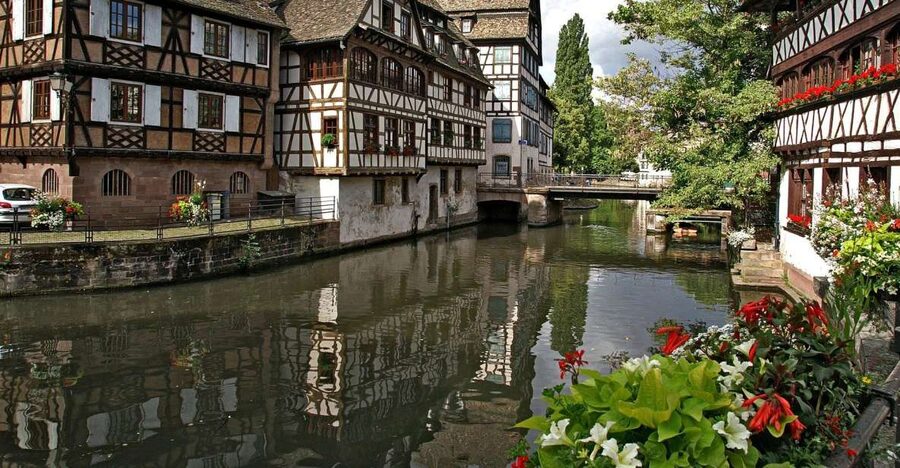
The historic core is the Grand Île, an island surrounded by branches of the Ill River. It is the natural setting for a first walk because several major sights sit close together. You can move from a quiet square to a cathedral façade, then along canals and old defensive structures without needing a bus or taxi.
A private guide helps connect these places. Without context, the cathedral, bridges, and churches can look like separate photo stops. A good guide explains how they fit together, and can adjust the pace or language to your group.
The two-hour limit matters. This is an orientation walk, not a full-day study of Strasbourg. You will see important sights and gain a framework for exploring later, but you should not expect extended interior visits or long stops at every church.
More Private Walking Tours in France
- Lyon: Private Walking Tour of “Traboules” in the Old Town
★ 5.0 · 866 reviews - Paris: Private Walking Tour with a Local
★ 4.6 · 506 reviews - Paris Private Walking Tour with a Personal Photographer
★ 5.0 · 262 reviews
Starting at Place du Quartier Blanc
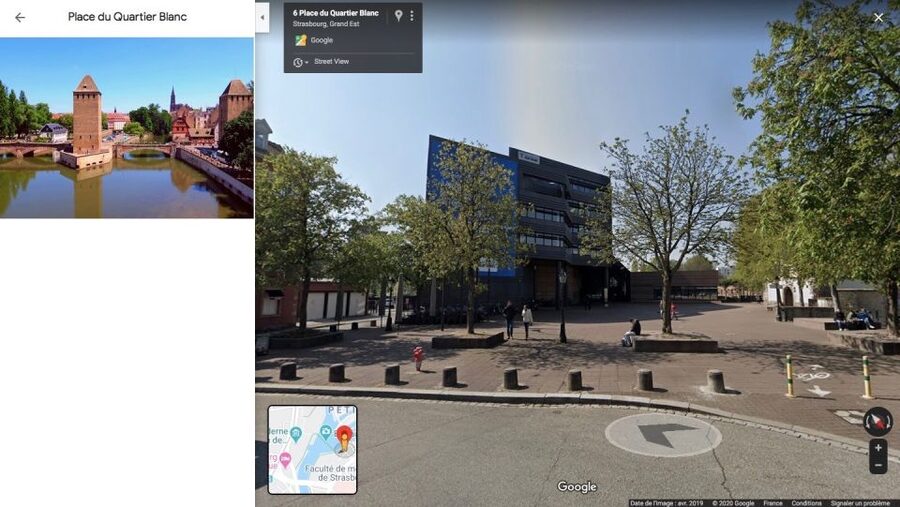
Your meeting point is in front of the black building at 9 Place du Quartier Blanc, listed as Place du Quartier Blanc. It is worth allowing a little extra time to find the exact spot, especially if you are unfamiliar with Strasbourg’s old streets and the wording of the square’s name varies slightly.
From here, your guide leads the private group into the historic center. Since transportation is not included, you make your own way to the starting point. That is a minor issue for most people staying near central Strasbourg, but it matters if you are arriving from outside the center or carrying luggage.
The opening reference to the white district square introduces one of the city’s smaller public spaces before the walk moves toward the major landmarks. This is a useful arrangement. You begin with a sense of place instead of stepping straight into a crowded postcard scene.
I would use the first few minutes to tell the guide what matters to you. If you care most about architecture, medieval history, French-German culture, or photography, say so early. A private tour has value only when the guide responds to the people in front of them.
Notre-Dame Cathedral from the outside
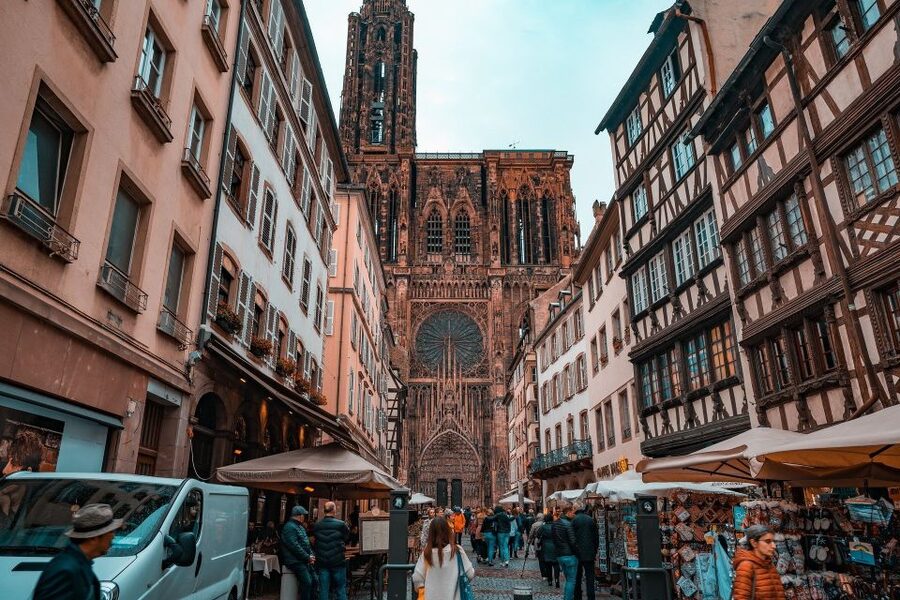
Strasbourg’s Cathedral of Notre-Dame is the visual center of the walk. The exterior gives you plenty to examine, from its immense scale to its detailed Gothic stonework. You can admire the façade, towers, and sculptural decoration while your guide explains the cathedral’s place in the city.
This experience does not include an interior visit or spoken commentary inside the cathedral. Talking in the cathedral is prohibited, so the tour keeps its explanation outside. If entering the building is important to you, you will need to arrange that separately and check the cathedral’s own access conditions.
That limitation should be clear before you book. The cathedral exterior is still a major sight, but this is not a cathedral tour in the full sense. You are paying for the private walk and the guide’s interpretation of Strasbourg, not for an extended look at the interior.
The cathedral stop can also become the moment when your guide explains the city’s layered identity. Strasbourg has changed hands between France and Germany over the centuries, and the cathedral sits at the heart of that story. The exact amount of detail depends on your guide, so ask questions if you want more than a quick architectural explanation.
The covered bridges and medieval defenses

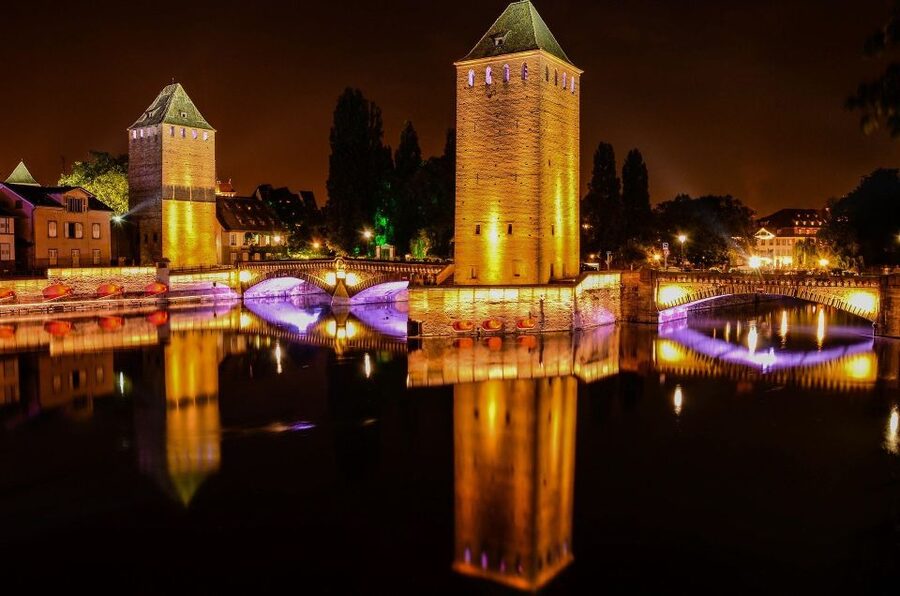
The covered bridges are among the most distinctive sights on the route. These structures date from the 13th century and preserve the defensive character of medieval Strasbourg. Their name comes from the covered passageways that once protected guards as they watched the waterways and approaches to the city.
Today, the bridges offer a different experience. You see stone towers, water, canals, and old fortifications in one view. They make Strasbourg feel unlike a standard cathedral-centered city break. The canals also give the walk a calmer rhythm after the busy streets around Notre-Dame.
This is one of the places where a guide adds real value. The structures are attractive on their own, but their purpose is easier to understand when you know they belonged to a defensive system. Look for the relationship between the bridges, towers, and water rather than treating them as separate monuments.
The route does not include transportation, and it does not need it for these sights. Walking is the point. You experience the changing scale of Strasbourg, from broad squares to narrow historic passages, at a pace that lets you look up and around.
More History Walking Tours in France:
- Vieux Lyon Cultural & Historical Walking Guided Tour (English)
★ 5.0 · 942 reviews - Strasbourg on Foot: Historic Center and Petite France with a Local Guide
★ 4.7 · 223 reviews - Paris: Le Marais & Montmartre Jewish History Walking Tour
★ 4.8 · 170 reviews - Strasbourg: Historic Center Walking Tour
★ 4.7 · 88 reviews
Place Broglie and the city’s public face
Place Broglie gives the walk a change of mood. Instead of medieval water defenses, you see a grand historic square tied to Strasbourg’s civic and social life. Its broad setting helps show how the city grew beyond its older fortifications.
Your guide may use the square to explain Strasbourg’s French character, its public institutions, or the way the city’s historic center developed. Because the tour is private, you can ask for more detail on the square rather than simply passing through.
I like this stop because it prevents the walk from becoming a string of old religious buildings. Strasbourg is not only a medieval city. Its squares also show the city as a place of government, public life, and modern European identity.
The tour description gives Place Broglie a clear place on the route, but it does not promise a long stop or any special event there. Think of it as an important visual and historical part of the walk, not a separate attraction with admission or a scheduled performance.
Medieval churches beyond the cathedral
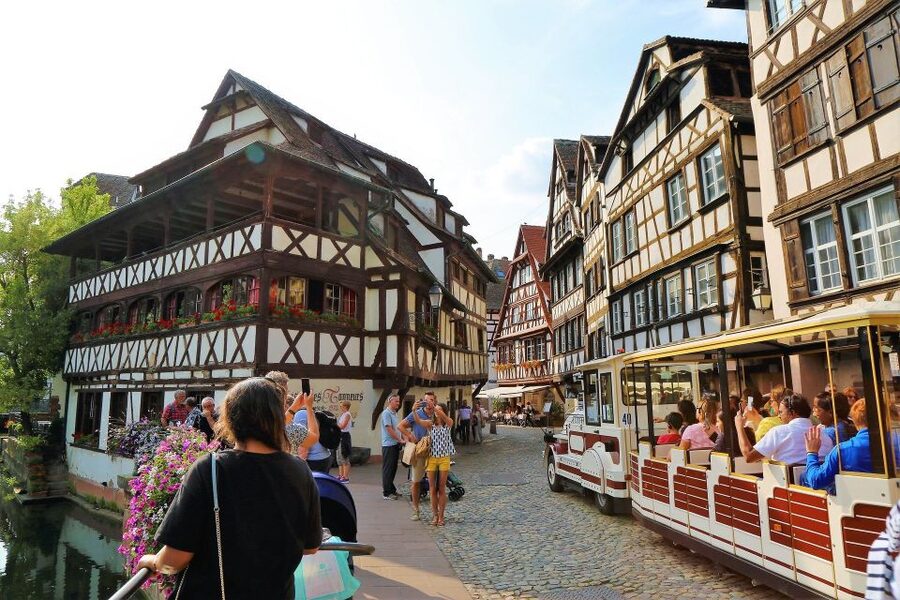
Strasbourg preserves several medieval churches, including Église Saint-Thomas and Église Saint-Guillaume. They add useful contrast to Notre-Dame. The cathedral is the grand landmark, while these churches help you see how religious life shaped different parts of the city.
You should not assume that the tour includes an interior visit to these churches. The stated experience focuses on walking through the historic center, and the only specific cathedral instruction is that talking inside is prohibited. Your guide can point out the churches and explain their place in Strasbourg, but entry details are not included.
Église Saint-Thomas and Église Saint-Guillaume also give you a reason to watch the route closely. The best part of a private walk is often not the headline sight, but the smaller building that would be easy to pass without context.
The guide’s style matters here. One guide, Regine, is specifically praised for making the walk informative and lively. Another guide received credit for finding pleasant lesser-known corners, though the same experience was judged to include too little explanation overall. That tells you what to ask for: request both the major landmarks and the smaller details.
A private tour works best when you shape it
The private format is the main reason to consider this experience at its price. You are not waiting for a large group, and you can ask questions without competing for the guide’s attention. The available languages are unusually broad, which is useful for families or mixed-language groups.
The format also creates a responsibility for you. A private guide cannot guess what every person wants. Tell the guide if children are present, if someone walks slowly, or if you prefer architecture over political history.
One family experience showed why this matters. A German-speaking guide focused heavily on Alsatian culture and language and did not engage much with a ten-year-old in the group. The guide spoke German well and had solid subject knowledge, but the family felt the private format should have included more attention to the child.
For families, I would ask at the start for explanations suitable for children and frequent chances to look at something rather than listen for long stretches. The tour is not automatically family-focused simply because it is private.
The positive side is clear in other cases. The walk has been described as amusing, easy to follow, and informative, and Regine was singled out for making the time pass quickly. Those are useful qualities on a short city walk, especially when your guide balances facts with stories.
What the guide quality means for the price
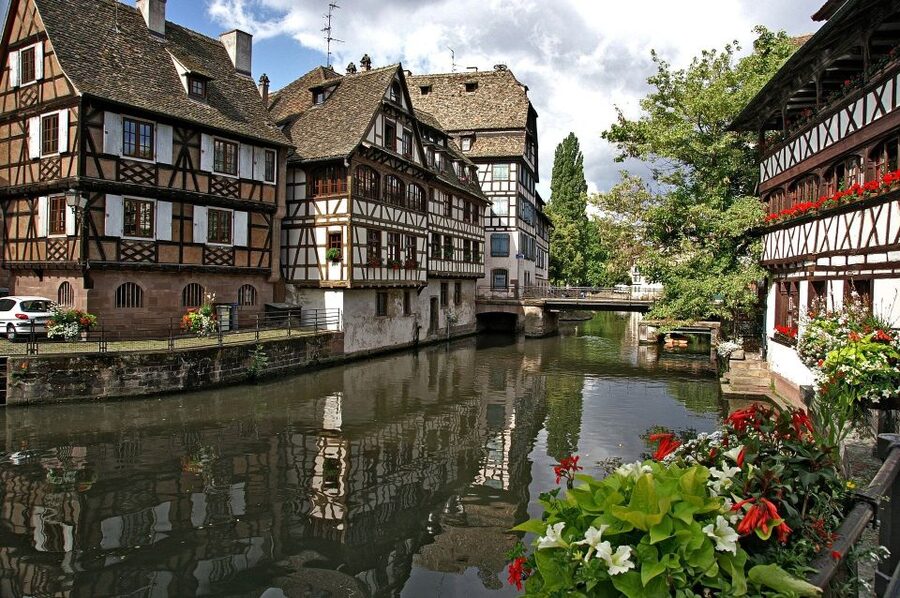
At $235 per person, the cost is high for two hours. The value depends heavily on group size and on how actively you use the private format. For one or two people, the price may feel difficult to justify unless having your own language, pace, and questions matters a great deal.
For a larger family or a small group of friends, the calculation changes. You are paying for a private guide rather than individual tickets or transportation, and the group can share the cost of one service. Still, compare the total price with a standard group walk before booking.
The overall rating of 4.2 from 107 ratings suggests a generally positive experience with some unevenness. The strongest praise centers on guides who are lively, friendly, and informative. The weaker experiences point to a guide giving too little explanation or focusing too narrowly on one topic.
That pattern gives you a practical test. If the guide spends the opening minutes asking about your interests, that is a good sign. If you want detailed history, ask for it. If you want a lighter walk, say that too. The private format gives you a chance to improve the experience, but you need to speak up.
Timing, language, and practical details
The tour lasts two hours and returns to the starting point at Place du Quartier Blanc. It is long enough to see several central sights, but short enough to fit into a morning or afternoon between other plans.
The guide can conduct the tour in English, French, German, Italian, Spanish, Portuguese, or Japanese. Choose the language that lets your group ask natural questions. For a bilingual family, you should confirm the preferred language when booking.
No entrance tickets or transportation are included. The cathedral is visited from outside, and the walk itself connects the listed sights on foot. Plan separately for any attraction you want to enter.
Wheelchair users can be accommodated if you inform the operator beforehand. This is important because a historic center can include older paving and tight streets, even when the tour is generally walkable. The provided information confirms that accommodation is possible, but it does not describe a specific accessible route, so make your needs clear in advance.
You can cancel up to 24 hours before the tour for a full refund, and you can reserve now while paying later. Those terms make the booking less risky if your Strasbourg plans may change.
Who should book this Strasbourg walk?
I would recommend this tour to a first-time visitor who wants a private introduction to the historic center and values a choice of language. It also suits a small group that wants to ask questions, set its own pace, or focus on French-German history.
It works well as an opening activity on your first day. After two hours, you will know the main areas to revisit on your own, including the cathedral, covered bridges, Place Broglie, and the medieval churches.
I would be more cautious if you want extensive cathedral access, detailed interior art history, or a full day of historical explanation. You will not get that here. The cathedral is an exterior stop, and the short duration leaves little room for long visits.
Families should book only after setting expectations with the guide. The walk can be enjoyable for children, but the private format does not guarantee child-focused storytelling. Tell the guide about the children in your group and ask for an interactive pace.
Should you book it?
Book this private walk if you want a short, personal introduction to Strasbourg and are willing to pay for a guide who can speak your language and respond to your interests. The covered bridges, cathedral exterior, Place Broglie, and medieval churches create a strong first look at the city.
Skip it if $235 per person feels too high for a two-hour orientation, or if your main goal is to enter Notre-Dame and study its interior. For the best value, book it early in your stay, tell the guide exactly what you want, and treat the walk as a foundation for exploring Strasbourg on your own afterward.
FAQ
How long is the Strasbourg walking tour?
The tour lasts two hours.
Is the tour private?
Yes. It is offered for a private group with a private tour guide.
Where does the tour begin?
You meet the guide at 9 Place du Quartier Blanc, in front of the black building at Place du Quartier Blanc, 67000 Strasbourg, France.
Where does the tour finish?
The tour returns to the starting point at 9 Place du Quartier Blanc.
Is Strasbourg Cathedral visited inside?
No. The experience specifically highlights the exterior of Strasbourg Cathedral. Talking inside the cathedral is prohibited.
Are entrance tickets included?
No. Entrance tickets are not included.
Is transportation included?
No. Transportation is not included. The experience is a walking tour.
Which languages are available?
The tour can be provided in English, French, German, Italian, Spanish, Portuguese, or Japanese.
Can wheelchair users join?
Yes, wheelchair users can be accommodated if you inform the operator beforehand.
Can I cancel the booking?
Yes. You can cancel up to 24 hours in advance for a full refund. You can also reserve now and pay later.
Just added around France
- Giverny Monet House and Gardens Skip the line Walking tour★ 4.0 · 217 reviews
- [Walking Tour] Discover the Best of Brest in 2 hours★ 5.0 · 102 reviews
- Bordeaux Historic and Gourmet Food Walking Tour★ 4.5 · 82 reviews
- 2-Hour Walking Tour of the City’s Iconic Sights and History★ 4.0 · 207 reviews
- Bordeaux Walking Tour with a Local Private Guide★ 5.0 · 97 reviews
- Traditional Gourmet Food & Wine Tour in Bordeaux★ 5.0 · 81 reviews
- Free Walking Bordeaux Tour ENG + 1 glass of wine (Tip based)★ 5.0 · 90 reviews
- Bordeaux City – Private Guided Walking Tour with Local Sophia★ 5.0 · 164 reviews
History Walking Tours, compared.

Berlin’s Best: 2 Hour Walking Tour Third Reich and the Cold War
Read our review →
Third Reich Berlin: Hitler and WWII Walking Tour
Read our review →
New Orleans Garden District History Walking Tour
Read our review →
Cartagena: Historic Center and Getsemaní Shared Walking Tour
Read our review →
Imperial Palace and Shogun Historical Walking Tour
Read our review →Browse the lists this tour appears in