
REVIEW · CHARLESTON
Small-Group Tour: Charleston Old Walled City Historical Walking Tour
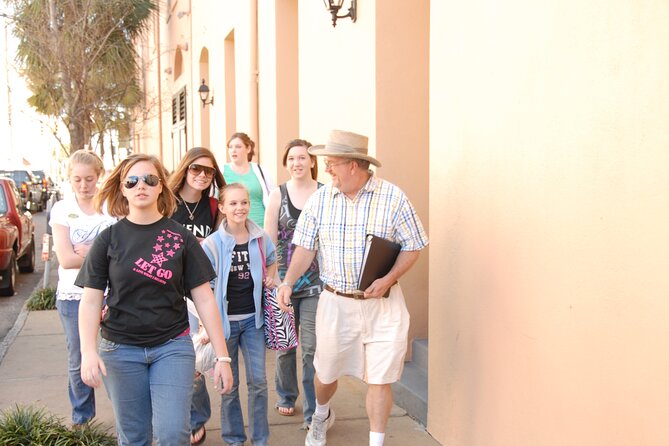
Charleston’s past comes at you in layers on this walk: colonial churches, Revolutionary-era buildings, slavery, Civil War sites, pastel row houses, and grand waterfront homes. I like the way the route connects major sights with quieter streets, and I like that guides such as Al, Bruce, Eric, and Linda add local stories to the formal history. The biggest catch is that the pace and delivery can vary by guide, and a few guests found fast speech hard to follow.
I especially like the small maximum of 15 people, which gives you a better chance to ask questions than on a large city tour. The mostly flat peninsula also makes this a practical way to get oriented on your first day. Wear good shoes, expect all-weather conditions, and remember that most stops are viewed from outside rather than entered.
Key points at a glance

- A serious two-hour look at Charleston’s past: The route covers colonial religion, the Revolutionary War, slavery, the Civil War, and Charleston architecture.
- Thirteen stops in the old peninsula: You see the French Quarter, Rainbow Row, the Battery, Fort Sumter from the seawall, and the Nathaniel Russell House garden.
- Local guides shape the experience: Al is often praised for architecture and local stories, while Bruce, Eric, and Linda have also led well-received tours.
- A flat, manageable walk: Charleston’s old center is easy to cover on foot, but the tour may run longer than two hours with a talkative guide.
- Important limits to know: This is mainly an exterior walking tour. The Russell House visit includes the garden, not the house interior.
- A strong but not perfect record: The tour has a 4.7 rating from 283 reviews, with 93 percent recommending it, but there are complaints about late or missing guides and unclear speech.
Why this walk works as a first look at Charleston
This tour gives you a useful map of Charleston before you spend time exploring on your own. It begins near 108 Meeting Street and threads through the old center, moving from churches and civic buildings toward the waterfront. You finish in a different place from where you start, so think of it as an orientation walk rather than a loop back to your hotel.
The route is especially good if you want the city’s story tied to actual streets and buildings. You are not simply hearing dates in a room. You are standing beside graveyards, looking toward Fort Sumter, and seeing the old commercial quarter where Charleston’s wealth and power took shape.
I also like the mix of big-name sights and smaller details. The Four Corners of Law is a famous intersection, while the Nathaniel Russell House garden brings the tour down to the scale of a Charleston property, including the local oddity of the joggling board.
The tour has a maximum of 15 people, though one past departure reportedly had a larger group. If your group is kept small, the format should make questions easier and help you hear the guide in busy streets. The overall rating is strong, but you should treat the guide as a major part of the experience. Al has received especially warm praise for architecture, history, restaurant advice, and local connections. Bruce, Eric, and Linda have also been singled out for friendly and engaging tours.
More History Walking Tours in the USA
- Charleston historical walking tour with a Professor of History at The Citadel
★ 5.0 · 1,284 reviews - Charleston: Old Walled City Historical Walking Tour
★ 4.7 · 705 reviews - Charleston History and Hops Tour: Bar and History Walk
★ 5.0 · 316 reviews
Churches, graveyards, and Charleston’s colonial roots
The first stop is Circular Congregational Church, where worship has taken place since 1681. The graveyard is the real point of interest. Its eighteenth-century slate tombstones are unusually clear, and the guide uses them to talk about the people of colonial Charleston.
This is a good early stop because it shows how much history sits in plain sight here. You get a short talk in the graveyard, not a long indoor visit, so the quality of the explanation matters more than the length of the stop.
A brief look at the Powder Magazine follows. Built by 1713 for a city under threat, it is described as the oldest surviving public structure between St. Augustine and Williamsburg. You spend only about five minutes here, with narration from the sidewalk, so treat it as a sharp historical pause rather than a museum visit.
St. Philip’s Church brings the story into the world of planters and politicians. Founded in 1680, it is tied to some of the earliest colonial power in the Carolinas. The graveyard includes national figures, including signers of the Declaration of Independence and the Constitution.
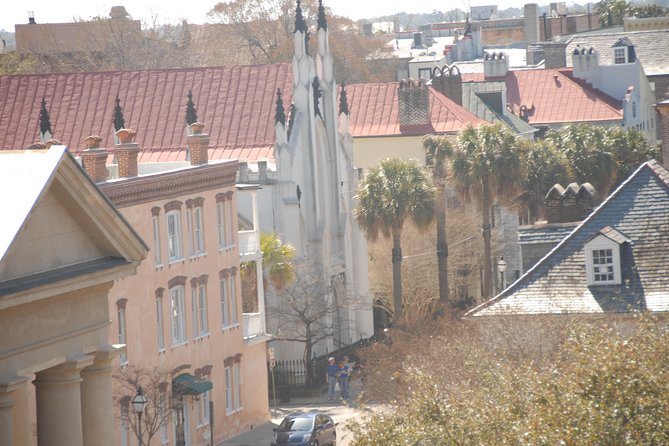
The French Huguenot Church adds another thread. The congregation has worshipped on this site since 1706, and the present Gothic Revival building is home to the only active French Calvinist congregation in North America. The stop is short, but it helps explain Charleston’s links to European religious refugees and the variety of communities that shaped the city.
The French Quarter’s theaters, laws, and slave trade
The Dock Street Theater is a quick exterior stop with an interesting twist. The present building was created as a Works Progress Administration project in 1937, but it occupies the site of the first playhouse built in British North America, dating to 1736.
I find this kind of layered site useful because it prevents you from seeing Charleston as a collection of old houses only. The city also had entertainment, public debate, and civic life, all of which left marks on the streets.
At the Four Corners of Law, the guide explains the meeting of local, state, federal, and religious authority. The intersection has been used for public purposes since 1680. The claim that it is the only place in the world where four governing laws meet comes from Ripley’s Believe It or Not, so enjoy it as a colorful piece of Charleston lore rather than a legal term.
The Old Slave Mart Museum is one of the most important stops on the route. The building is described as the only surviving structure in Charleston used as a showroom for slave sales. The museum addresses slavery in the South Carolina Lowcountry, a subject that must be part of any honest account of Charleston.
The scheduled stop here is brief, about five minutes, and the route does not include a listed museum admission. You should not expect a full museum visit during the walk. Instead, the guide provides context from outside and helps place Charleston’s wealth, architecture, and political power within the brutal system that supported them.
Revolutionary Charleston at the Old Exchange
The Old Exchange and Provost Dungeon takes you to the Revolution. The building was tied to events that helped form the United States, and George Washington was entertained there four times in 1791.
Again, this is presented as a sidewalk narrative rather than a listed interior visit. That distinction matters if you want to tour the museum or dungeon in detail. The walking tour gives you the setting and the story, while a separate visit would be needed for a longer look inside.
St. Michael’s Church is another major landmark. Dating to 1761, it is described as Charleston’s oldest surviving church. It endured the British siege of 1780 and the Federal siege during the Civil War from 1863 to 1865. Two signers of the Constitution are buried in the graveyard.
The church stop lasts about seven minutes, enough for a focused explanation and a look at the surrounding grounds. If you enjoy architecture, listen for the guide’s comments here. Several strong experiences on this tour have been led by guides who explain building styles as well as dates and battles.
More History Walking Tours in Charleston:
- Semi-private SMALL group Historic Walking Tours w/certified guide
★ 5.0 · 224 reviews - Berlin: Third Reich & Cold War Guided Walking Tour
★ 4.9 · 8,378 reviews - Munich: Third Reich & WWII Walking Tour
★ 4.6 · 6,181 reviews - Berlin’s Best: 2 Hour Walking Tour Third Reich and the Cold War
★ 5.0 · 5,486 reviews
Rainbow Row and the walk toward the water
Rainbow Row is the most instantly photogenic part of the route. These eighteenth-century commercial buildings are painted in soft pastels, with colors linked to Charleston’s early connections to Barbados, Antigua, and Nevis.
The stop is short, so you will mainly hear the story from the sidewalk and have time to look up and down the row. I would not count on a long photography break if the group is moving on schedule. Still, this is one place where the guide’s explanation gives the view more meaning than a quick snapshot alone.
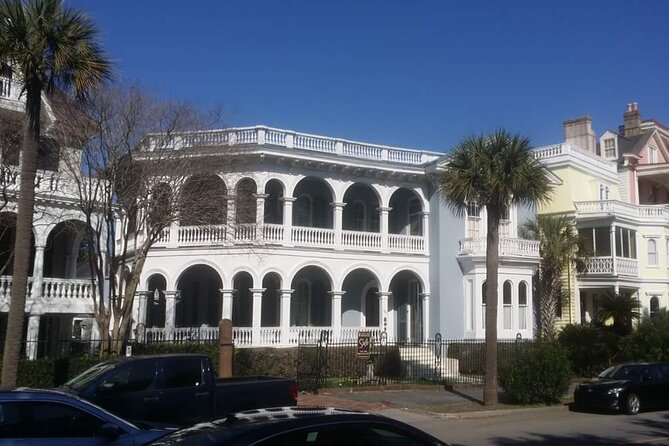
From here, the route reaches the Battery, where Charleston’s old defensive edge meets the harbor. Grand waterfront mansions line the area, many built in the first half of the nineteenth century as winter party houses for wealthy residents.
The Battery also connects the city’s social history to the Civil War. From one of these houses, General Pierre Beauregard gave the order to fire on Fort Sumter, beginning the first battle of the war. The tour uses this waterfront setting to discuss both the city’s elegant public face and the conflict that shattered the nation.
Fort Sumter from the High Battery

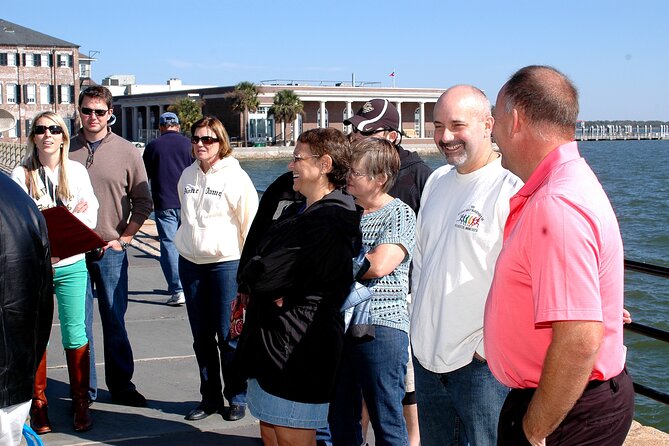
You do not take a boat to Fort Sumter on this tour. Instead, you view the national monument from the High Battery seawall and hear about the siege and bombardment of both the fort and Charleston’s civilian population.
This is a useful distinction when planning your day. If you want to walk through Fort Sumter, you need a separate visit. If you want the story without adding a boat trip, the Battery viewpoint gives you a practical introduction.
The guide also discusses the dramatic fall of Charleston after 587 days. That detail makes the Civil War section more than a single famous opening shot. You get a sense of the prolonged pressure on the city and the people living through the siege.
The harbor view is likely to be one of the tour’s most memorable moments, but weather can affect it. The tour operates in all conditions, so bring clothing suited to the forecast. Comfortable walking shoes are strongly advised, and you should be ready for sun, rain, or wind rather than assuming a mild day.
The Nathaniel Russell House garden and a local finish

The final stop is the Nathaniel Russell House, built in 1808. The tour enters the garden, where the guide discusses horticulture, garden design, and the layout of an eighteenth-century Charleston property.
The house interior is not included. That is easy to miss, and it may disappoint you if the building itself is your main reason for booking. The garden visit still gives you a helpful look at how a Charleston property was arranged, especially after seeing churches, commercial buildings, and waterfront mansions.
The joggling board is a particularly local detail. This long, flexible seat is part of Charleston’s domestic culture, and the guide uses it to bring the tour down from national events to everyday life.
Several guides have been praised for adding personal connections to the city. Al has been described as a local historian with strong architecture knowledge and a gift for restaurant suggestions. Bruce has taken small groups through less obvious alleys and places tied to his upbringing. Eric has been praised for an easy pace and interesting background stories, while Linda has been noted for answering questions and adding entertaining anecdotes.
That personal layer can make the walk feel more like a conversation than a lecture. It can also vary. One past experience found the guide focused on buildings rather than the group, and another found the narration too fast or difficult to understand. Stay near the guide, speak up if you miss a point, and do not hesitate to ask for a slower explanation.
Timing, group size, and value
The advertised duration is about two hours, though one well-received tour ran longer. That extra time can be welcome if you enjoy stories, but it can affect lunch plans or a later reservation. Leave a little space in your schedule rather than booking something immediately afterward.
All taxes, fees, handling charges, and a local guide are included. Transportation to and from attractions is not included, and hotel pickup and drop-off are not provided. Since the route is a walking tour of the peninsula, you need to make your own way to the Meeting Street starting point.
The listed stops are free of admission charges, but the tour mainly uses outdoor narration. You are paying for the guide’s route, interpretation, local knowledge, and time, not for entry to a series of museums. I consider that a fair format if you want orientation and context, especially on a first Charleston visit. It is less suitable if you want extended indoor access at the Old Slave Mart Museum, Old Exchange, St. Michael’s, or the Nathaniel Russell House.
The city is described as hill-free, which makes the two-hour distance easier for active visitors. Most people can take part, service animals are allowed, and children must be accompanied by an adult. The small-group limit is a real advantage, though you should be aware that the group size may not always match the advertised maximum.
Free cancellation is available up to 24 hours before the start time. Within that window, changes and refunds are not accepted. A more serious practical concern is guide reliability: there have been isolated reports of a late or missing guide and unanswered calls or messages. Most experiences appear to run normally, but confirm your meeting details and allow a few minutes to locate the group.
Who should book this Charleston walk?
I would book this tour if you are visiting Charleston for the first time and want a clear introduction before exploring on your own. It suits history fans, architecture lovers, couples, families with older children, and anyone who prefers a human guide to a phone app.
It is also a good choice if you have only one day in the city. In two hours, you cover a broad sweep of the peninsula and can mark places to revisit later, such as Rainbow Row, the Battery, or the Old Slave Mart Museum.
I would choose something else if you need full museum access, guaranteed indoor stops, or a tightly timed departure. The guide’s speaking style matters here, and the reports of rushed or hard-to-hear narration are worth considering alongside the many strong reports of lively, clear storytelling.
Should you book it?
Yes, if you want an efficient first walk through Charleston’s old center and care about the stories behind the buildings. The route covers more than pretty streets: it addresses religion, slavery, revolution, the Civil War, architecture, and local life.
Book it with realistic expectations. You will mostly hear exterior commentary, not tour every interior, and the exact feel depends heavily on the guide. With Al, Bruce, Eric, or Linda, the walk may include useful local stories and a relaxed pace. If you value orientation and context over extensive admissions, this is a good use of two hours.
FAQ
How long does the Charleston Old Walled City Historical Walking Tour last?
The tour lasts approximately two hours. Some departures may run longer, so avoid scheduling another activity immediately afterward.
Where does the tour begin?
The meeting point is 108 Meeting Street, Charleston, South Carolina 29401.
Does the tour finish where it starts?
No. The activity ends at a different location from the starting point.
Is transportation included?
No. Transportation to and from the attractions, as well as hotel pickup and drop-off, is not included.
Is the tour offered in English?
Yes. The tour is offered in English, with a mobile ticket.
How many people can join the tour?
The stated maximum is 15 travelers.
Are the attractions included with admission?
The listed stops have no admission ticket charge as part of the walking route. The tour mainly provides exterior narration, and the Nathaniel Russell House visit includes the garden but not admission to the house.
Is the walk suitable for children?
Most travelers can participate, but children must be accompanied by an adult.
What happens if the weather changes?
The tour operates in all weather conditions. Wear comfortable walking shoes and dress appropriately for the forecast.
Just added around Charleston
- Charleston Ghosts of Liberty Guided Walking Tour★ 4.5 · 473 reviews
- Private Charleston Walking Food Tour at the French Quarter★ 5.0 · 201 reviews
- Charleston Chicora 2 Hours Walking Tour★ 5.0 · 264 reviews
- Behind the Scenes of Shem Creek Shrimp Walking Tour★ 5.0 · 171 reviews
- Lost Stories of Black Charleston Walking Tour★ 5.0 · 412 reviews
- Charleston’s Savor the Flavors of Upper King Street Walking Food Tour★ 4.5 · 130 reviews
- Charleston Haunted Jail Night-Time Walking Tour with Admission to Old City Jail★ 4.5 · 570 reviews
- Charleston History, Homes, and Architecture Guided Walking Tour★ 5.0 · 267 reviews
History Walking Tours, compared.



Berlin’s Best: 2 Hour Walking Tour Third Reich and the Cold War
Read our review →
Third Reich Berlin: Hitler and WWII Walking Tour
Read our review →
New Orleans Garden District History Walking Tour
Read our review →
Cartagena: Historic Center and Getsemaní Shared Walking Tour
Read our review →
Imperial Palace and Shogun Historical Walking Tour
Read our review →Browse the lists this tour appears in