
REVIEW · DUBLIN
North Quay Ghost Walk Tour
Dublin’s North Quay Ghost Walk is less a haunted-house scare show than a nighttime walk through the city’s grim past. You’ll follow old Viking-era streets, pause beside a mass grave, and hear tales of hanging judges, rebels, murderers, and ghosts who may still be watching from ruined buildings. The setting does much of the work.
I like the mix of dark folklore and solid Irish history, especially the stops at St. Mary’s Abbey and Croppie’s Acre. I also like the guides’ storytelling style. Calum, Darragh, Dara, Aisling, and others are praised for making the walk funny, clear, and personal. The main drawback is that the ghost content can feel lighter than expected, and the walk may last up to two hours.
Key points to know before you go
- Start at 8pm outside the Church Bar: Meet on Jervis Street in Dublin 1, then walk toward the Brazen Head.
- Follow Dublin’s old Northside: The route passes through former Oxmantown, once a Viking enclave and one of the city’s oldest areas.
- Hear stories at real historic sites: St. Mary’s Abbey, Croppie’s Acre, Hendrick Street, and the Brazen Head anchor the tales.
- Expect dark history as well as ghosts: Treason, executions, torture, murder, and medieval crime receive plenty of attention.
- Plan for a long walk: The listed duration ranges from 1 hour 20 minutes to about 2 hours, with several people finding it longer than expected.
- Best for ages 10 and up: Children must be accompanied by an adult, and the tour can accept up to 55 people.
A nighttime route through Dublin’s old Northside
The walk begins at 8pm outside the Church Bar on Jervis Street. This is a practical meeting point in central Dublin, close to public transportation and easy to reach before sunset gives way to the darker part of the evening.
Your guide starts with an introduction to Dublin’s haunted past, then leads you into the area once known as Oxmantown. The name recalls the Scandinavian presence that helped shape medieval Dublin. That background matters because the tour is not simply a series of spooky tales. The streets themselves connect Viking settlement, monastic power, rebellion, punishment, and urban crime.
I like this approach. A ghost story has more weight when you know why a place mattered in the first place. You get a sense of how Dublin grew, how people were punished, and how old buildings and alleys picked up their frightening reputations.
The pace is designed for walking and listening rather than rushing from one attraction to another. You may stop several times, but this is still a city walk, not a theatrical production with elaborate sets or staged effects. The atmosphere comes from the streets, the guide’s delivery, and what happened in these places.
More Ghost and Haunted Walks in Dublin:
- Haunted Dublin Walking Tour
★ 5.0 · 550 reviews - Dublin’s Haunted History Walking Tour
★ 4.3 · 345 reviews - Hidden Dublin: Haunted History Walking Tour v2.0 2026
★ 4.5 · 188 reviews
St. Mary’s Abbey and the city beneath your feet
One of the most interesting early stops is the site of St. Mary’s Abbey. In medieval Ireland, it was one of the country’s most powerful monastic settlements. Today, only a small remnant remains, tucked down an alleyway and passed by many people who do not realize what they are walking beside.
That contrast gives the stop its appeal. You are not looking at a grand, fully preserved ruin. You are standing near a fragment of Dublin that has been swallowed by the modern city. The guide uses the site to explain the power of the abbey and the long succession of people who lived, worked, worshipped, and died in this part of town.
The stories then turn toward Scaldbrother, an infamous medieval thief. According to the legend, his stolen treasure may still lie somewhere in a maze of chambers and tunnels beneath Smithfield. You should treat this as folklore, but it is the kind of tale that works well on foot, when narrow streets and old masonry let your imagination fill in the unseen spaces below.
The underground theme returns in the story of Billy the Bowl, an 18th-century murderer born without legs who terrorized Stoneybatter and Grangegorman. It is a harsh story, and the guide’s presentation matters. The best part of this tour is not simply hearing that a bad person once lived nearby. It is hearing how the story fits into Dublin’s older neighborhoods and their changing reputation.
Croppie’s Acre, a disturbing stop with real weight
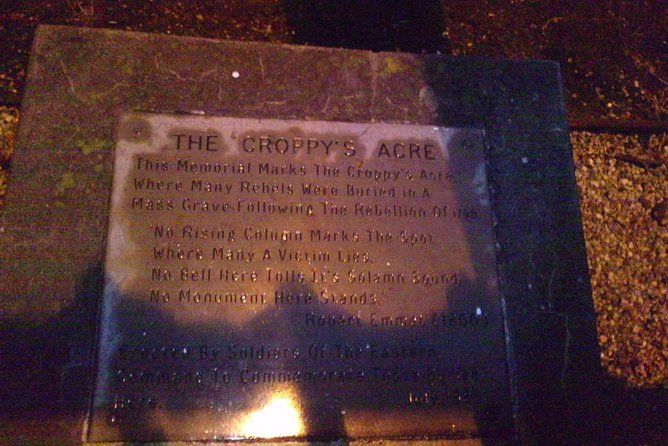
Croppie’s Acre is likely to be one of the most sobering parts of the walk. The site was used as a football pitch in the 20th century, despite being a mass grave for hundreds of rebels executed after the 1798 rebellion.
That detail gives the tour a different tone. The stop is not spooky merely because it is dark. It is disturbing because ordinary modern life took place over a place of mass death. The story connects the supernatural with political violence and the harsh punishment handed down after rebellion.
If you are sensitive to stories about executions or mass graves, prepare yourself. The tour specifically warns that this stop can be upsetting. The guide may also describe reports of spirits attempting to communicate, but the emotional force comes from the documented suffering beneath the ground.
I appreciate that Croppie’s Acre is included because it prevents the tour from becoming a parade of haunted-house legends. You are asked to think about memory, neglected places, and how a city can build over painful events. That gives the evening more substance than a collection of jump scares.
Lord Norbury, Robert Emmet, and the Brazen Head
The route brings in two of Dublin’s best-known dark figures: Lord Norbury and Robert Emmet. Norbury was the notorious hanging judge who presided over Emmet’s trial. He was hated during his lifetime, and the tale says that death did not end his reign of terror.
The story of Robert Emmet brings politics and rebellion into the walk. At the Brazen Head, where the tour ends, you may hear that Emmet still appears at a window, watching those who approach and deciding if they are friend or foe.
The Brazen Head is a fitting finish because it links the supernatural tale to a well-known Dublin pub. The tour ends around 10pm at 20 Bridge Street Lower, near Usher’s Quay. Food and drinks are not included, but the location gives you an easy option for continuing the evening on your own.
One useful tip: do not think of the ending as a scheduled pub visit with a reserved meal. The pub is the endpoint, not an included dining stop. If you want to eat or have a drink afterward, you will need to arrange and pay for that separately.
A few more walking tours around Dublin worth a look
- Dublin Highlights and Hidden Gems Guided Walking Tour
★ 5.0 · 6,020 reviews - Dublin: Highlights and Hidden Gems Walking Tour
★ 4.9 · 2,140 reviews - 1916 Rebellion Walking Tour
★ 5.0 · 1,605 reviews - 90 Minute Dublin Walking tour and Sightseeing tips
★ 5.0 · 916 reviews
Hendrick Street and Dublin’s most haunted houses
Late in the walk, you head down Hendrick Street, once home to two of Dublin’s most haunted houses. Numbers 7 and 8 were said to contain at least six ghosts between them. The houses were demolished in the 1960s, but the stories claim that the spirits may have remained.
This is a classic example of the tour’s method. You are not visiting a preserved haunted building. You are standing at the former site and using the guide’s account to picture what once occupied the street. Some people will find that atmospheric. Others may prefer a tour with intact rooms, candlelight, or more obvious supernatural activity.
The missing buildings also raise an interesting question: does a ghost belong to a structure, or to the memory attached to a place? Hendrick Street works best if you enjoy that kind of historical imagination. It is less effective if you are expecting physical evidence or repeated apparitions.
What the guides add to the evening
The guide can make or break a walking tour, and this one receives its strongest praise for storytelling. Calum is repeatedly singled out for little-known facts, local tales, humor, and a lively pace. Darragh is praised for his enthusiasm and clear explanations, while Dara and Aisling are also noted for making the material approachable.
One guide is described as holding a master’s degree in history, but the important point is not the qualification itself. The useful quality is the ability to connect a ghost tale with the political, social, and architectural setting around you.
You should expect a conversational style rather than a formal lecture. Guides answer questions, add comparisons between past and present, and explain parts of Dublin that you might otherwise walk past. Several people found the tour educational even when they arrived mainly for the supernatural angle.
The mood can also be funny. That helps during a long walk through grim subjects. If you want an intense, silent, horror-focused experience, the humor may soften the effect. If you prefer a night that mixes serious stories with personality, it is a strength.
Ghost tour or dark-history walk?
This is the key decision. The tour is clearly marketed around ghosts, but much of its appeal comes from Dublin’s darker history. You will hear about ghost sightings, haunted houses, spirits, and supernatural legends. You will also spend plenty of time with executions, rebellion, murder, medieval crime, and political punishment.
That balance suits me because the historical material gives the ghost stories context. Still, you should set your expectations carefully. One person found that the tour lacked the punch of a stronger ghost walk and wanted more banshee, fairy, and traditional Irish supernatural material.
If your ideal evening includes constant ghost stories, eerie sound effects, or a frightening performance, this may feel too restrained. If you like the idea of walking through real neighborhoods while hearing how violence and folklore shaped them, it is a better fit.
The tour’s supernatural claims are presented as legends and reported sightings rather than proven fact. That leaves room for you to decide how seriously to take them. A skeptical listener can enjoy the atmosphere and history, while a believer can focus on the stories of lingering spirits.
How much walking is involved?
Plan for a substantial walk. The advertised duration ranges from 1 hour 20 minutes to two hours, and the route runs from Jervis Street through the Northside to the Brazen Head. Several comments point out that it is a long walk, especially if you have already spent the day on your feet.
Wear comfortable shoes and avoid booking this as the final activity after a full day of sightseeing unless you still have energy. The route takes place outdoors at night, so weather can affect your comfort. The supplied information does not specify a rest schedule, so do not assume there will be frequent places to sit.
The route is part of the value. You see areas of Dublin that you might overlook during a standard daytime visit, and the darkness changes how familiar streets feel. But the walk also means you should not expect a compact loop around one small landmark.
The maximum group size is 55 people. That is not a tiny private walk, and a larger group may make it harder to hear if you drift toward the back. On the other hand, the experience can still feel personal when the guide stops and tells a story clearly.
Price, timing, and practical value
The supplied price is listed as $0 per person. Because that figure is unusual for a guided Dublin activity, check the final booking page carefully before making plans and confirm what amount, if any, is charged at checkout.
If the listed price is accurate, the value is very strong for a guided evening lasting up to two hours. You receive a local guide, a planned route, and access to stories tied to several distinct parts of Dublin. Even at a paid rate, the experience would appeal to anyone who values context and storytelling more than formal entry tickets.
The tour is offered in English and uses a mobile ticket. Hotel pickup and drop-off are not included, so you must make your own way to Jervis Street and arrange your return from the Brazen Head.
Children must be accompanied by an adult, and the minimum age is 10. Service animals are allowed, and the activity is described as suitable for most people. Free cancellation is available up to 24 hours before the start time. Changes or cancellations inside that window are not accepted for a refund, and the tour requires a minimum number of people to operate.
Who will enjoy this walk most?
I would choose this tour if you like:
- Irish political and social history with a supernatural edge
- Local legends tied to real streets and former buildings
- Guides who tell stories with humor and answer questions
- Nighttime sightseeing in central Dublin
- A walking route that introduces overlooked corners of the Northside
I would think twice if you want a short, frightening attraction with frequent scares. I would also reconsider if long walks are difficult for you or if you have already spent the day walking across Dublin.
The tour works particularly well near the start of your stay. It can help you recognize places and names later, and the guides may offer suggestions for other parts of the city. It also gives you a different view of Dublin than a standard daytime walk.
Should you book the North Quay Ghost Walk?
Book it if you want dark Dublin history first and ghost stories second. The strongest material involves Croppie’s Acre, St. Mary’s Abbey, Lord Norbury, Robert Emmet, Scaldbrother, and Hendrick Street. The guides, especially Calum and Darragh, add warmth, humor, and local detail.
Skip it if you need a heavily theatrical scare tour or a route with little walking. The supernatural material is present, but it shares the evening with politics, crime, executions, and urban history.
For the right audience, this is a memorable way to see Dublin after dark. Wear good shoes, arrive ready for serious subjects, and allow extra time for the full walk to the Brazen Head.
FAQ
Where does the North Quay Ghost Walk begin?
The tour begins at 8pm outside the Church Bar on Jervis Street in North City, Dublin 1, County Dublin, D01 YX64.
Where does the tour end?
The walk ends at the Brazen Head, 20 Bridge Street Lower, Usher’s Quay, Dublin, D08 WC64.
How long does the ghost walk last?
The stated duration is approximately 1 hour 20 minutes to two hours. The tour begins at 8pm and is expected to finish around 10pm.
What places are included on the route?
The walk includes parts of former Oxmantown, the site of St. Mary’s Abbey, Croppie’s Acre, Hendrick Street, and the Brazen Head area.
Is the tour suitable for children?
The minimum age is 10. Children must be accompanied by an adult.
What is included in the tour price?
A local guide is included. Hotel pickup and drop-off, food, and drinks are not included.
Just added around Dublin
- Dublin (Dun Laoghaire) Top-Rated Coastal Walking Tour★ 5.0 · 80 reviews
- Food on Foot: Dublin Street Food Tour with Local Guide★ 5.0 · 490 reviews
- Dublin to Wicklow, Glendalough Small Group Tour with Guided Walk★ 4.5 · 282 reviews
- DayTripper Dublin: A Guided City Walking Tour★ 5.0 · 90 reviews
- Private Fantastic Tour of Dublin (Walking Tour)★ 5.0 · 141 reviews
- Walking Tour of Dublin’s Viking/Medieval Quarter with a Viking★ 5.0 · 171 reviews
- A Silent Disco Walking Tour★ 5.0 · 118 reviews
- Trinity Trails: Guided Walking Tour of Trinity College★ 4.5 · 203 reviews
Ghost and Haunted Walking Tours, compared.

New Orleans Premier Ghost, Voodoo and Vampire Walking Tour
Read our review →
Ghost Walking Tour Where Legends Come To Life
Read our review →
St. Louis Cemetery No. 1 Official Walking Tour
Read our review →

Savannah History and Haunts Candlelit Ghost Walking Tour
Read our review →
Browse the lists this tour appears in