
REVIEW · DUBLIN
1916 Rebellion Walking Tour
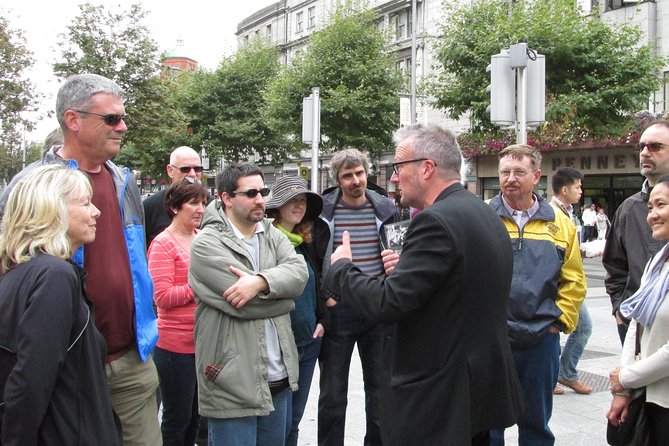
The most striking part of this tour is the way Dublin itself becomes the classroom. You stand beside bullet-scarred monuments, look across the Liffey toward the Four Courts, and finish at the GPO, where P. H. Pearse read the Proclamation in 1916. I like the clear build-up from the Great Hunger to the Rising, and I like the lively guides who mix history with songs and personal stories. The main drawback is that the advertised two hours may stretch longer, especially with a large group.
I also like that you do not need to arrive as an Irish history expert. The opening talk gives you the political and social background, while guides such as Lorcan Collins, Phelim, Liz, Donal, Phil, and Elaina have brought different strengths, from poetry and singing to the role of women in Irish history. The route changes from day to day, so you may not see every listed stop.
Key points to know before you book

- The International Bar sets the scene: You begin at 23 Wicklow Street, with time to arrive early for a drink and introductory reading.
- The GPO is the emotional center: Allow extra attention here, as the guide explains the Proclamation and the final stages of the Rising.
- The route covers more than 1916: Dublin Castle, the Four Courts, and other stops connect the Rising with the War of Independence and Civil War.
- The route can change: City Hall, Moore Street, the Old Parliament, and Trinity College may be included depending on the guide and available time.
- The storytelling is part of the appeal: Guides may use songs, poetry, humor, and personal stories to make the politics easier to follow.
- Plan for a walking tour, not a museum visit: The sites are viewed from the streets, bridges, and public spaces, with no admission fees included or required.
Starting at the International Bar on Wicklow Street
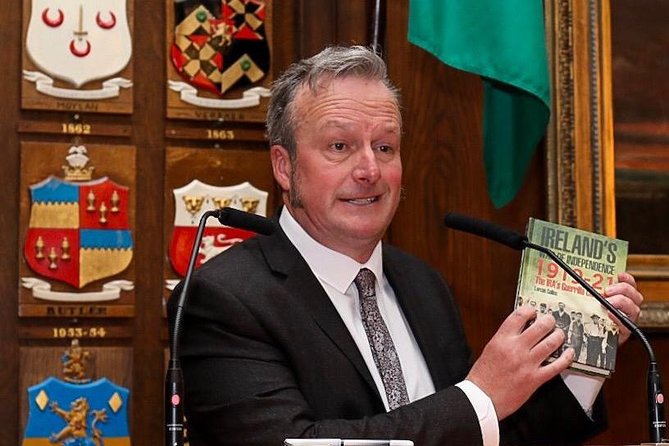
The tour begins at the International Bar, at 23 Wicklow Street in central Dublin. This is more than a practical meeting point. It gives the tour a pub setting that suits the subject, and you can arrive early for a drink and a look through introductory material supplied by the guide.
Lorcan Collins has run the 1916 tour since 1996, and he is closely associated with its long-running format. You may be led by Lorcan himself or by another guide. Names associated with the tour include Phelim, Liz, Donal, Phil, Adam, Elaina, and Fallon. Their styles differ, but the common thread is a strong command of the period and an easy way with questions.
The opening talk matters. Instead of dropping you beside a monument and throwing dates at you, the guide starts with the Great Hunger of the 1840s and moves through the political and social pressures that shaped the revolutionary period. That background helps you understand why the Rising happened, why public feeling shifted after the executions, and how the events of 1916 fed into the later struggle.
You can ask questions at the start, which is useful if your knowledge of Irish history begins and ends with a few names and a film. The setting also gives the group a chance to settle in before heading outdoors.
A few more walking tours around Dublin worth a look
- Dublin Highlights and Hidden Gems Guided Walking Tour
★ 5.0 · 6,020 reviews - Dublin: Highlights and Hidden Gems Walking Tour
★ 4.9 · 2,140 reviews - 90 Minute Dublin Walking tour and Sightseeing tips
★ 5.0 · 916 reviews
City Hall and Dublin Castle: power in the old city
City Hall is usually one of the early stops. During the 1916 Rising, the Irish Citizen Army occupied the building, so the guide uses this site to explain the role of James Connolly and the working-class movement within the rebellion.
That is an important correction to the simple version of the Rising. The story is not only about poets, nationalists, and military leaders. Workers, trade unionists, social reformers, and women all played roles in the events leading up to Easter Week. Guides may give special attention to figures such as Jim Larkin and Connolly, helping you see the Rising as both a national and social revolt.
From City Hall, the tour moves toward Dublin Castle. The castle was the center of British administration in Ireland, making it a natural place to discuss the government the rebels sought to challenge. It also connects the Rising with the War of Independence that followed.
You may recognize Dublin Castle from the film Michael Collins, but the tour does more than point out a familiar screen location. The guide explains how control of Dublin worked and why certain buildings mattered to both sides. This stop is mainly about setting and explanation rather than entering a grand interior, so do not expect an indoor castle tour.
The Four Courts and the road toward civil war
The Four Courts adds an important later chapter. Revolutionaries occupied it during the 1916 period, and the building became central again during the tensions that led to the Irish Civil War in 1922.
The building is best viewed from a bridge over the River Liffey. That viewpoint gives you a useful sense of the river as a dividing line through the city, while the guide explains what happened at the courts and how the independence movement fractured after the Anglo-Irish Treaty.
This is one of the tour’s most valuable stops if you know only the broad outline of Irish independence. The 1916 Rising did not lead directly to a united victory. The story moved through repression, political change, the War of Independence, the Treaty, and then conflict between former allies.
The drawback is that the stop is viewed from outside rather than through a visit to the Four Courts. Still, the location works well for an explanation, and the guide can connect the building to events several years apart.
Bullet holes at O’Connell Monument
At the O’Connell Monument, you will see bullet holes left from the fighting. They are a small physical detail, but they make the Rising feel immediate. A discussion of the positions held by British forces and Irish rebels turns the monument into a map of the battle.
Daniel O’Connell himself belongs to an earlier generation of Irish politics, but his monument provides a useful link to the long road toward independence. The guide may point out the practical geography of the fighting, not just the names of the leaders.
This is where the walking format earns its price. A book can tell you that streets and monuments were caught in crossfire. Standing beside the damaged stone gives you a direct connection to the event without needing a museum display.
Same streets, a different route:
- Dublin Historical Centre Food Tour with 8 Food Tastings & Drinks
★ 5.0 · 1,718 reviews - 2-Hour Historical Walking Tour from Dublin
★ 5.0 · 875 reviews - Historical 2-Hour Guided Walking Tour of Dublin
★ 4.7 · 865 reviews - Dublin Traditional Irish 3 Course Meal Walking Tour with Local
★ 5.0 · 755 reviews
Jim Larkin, James Connolly, and the workers’ movement
The stop at the Jim Larkin statue widens the story again. Larkin, a union leader from Liverpool, became a major figure in Dublin’s labor movement and a close ally of James Connolly.
The guide explains Larkin’s contribution to the revolutionary period and his connection with Dublin’s working class. This is especially helpful if you have previously encountered the Rising as a purely nationalist event.
The tour’s treatment of social history is one of its strongest features. One guide, Elaina, has placed particular focus on women and Irish social history. Other guides use stories, songs, and short portraits of leading figures to give the period a human scale.
You should expect the emphasis to vary by guide. The route and presentation are not identical every day, which keeps the tour from becoming a fixed script but also means you cannot guarantee a particular speaker or exact sequence.
The General Post Office, the heart of the walk
The GPO is the main stop and the place where the whole story comes together. It served as headquarters for the revolutionaries in Dublin, and P. H. Pearse read the Proclamation of the Irish Republic here.
The guide explains the opening of the Rising, the occupation of the building, the fighting around O’Connell Street, and the final stages of the GPO garrison’s resistance. You are not simply looking at a post office. You are standing at the center of the event that shaped modern Irish national identity.
The outside setting has an advantage. You can look at the building in relation to the surrounding street, monuments, and routes taken during the fighting. The guide may also point out how the building fits into the wider story of Easter Week.
If you want a quiet museum experience, this may feel busy. The GPO is on an active city street, and a group of up to 30 people can gather around the guide. Pay attention to where you stand, and keep close enough to hear clearly.
Moore Street and the final stand
Depending on the route and the time available, the group may continue to Moore Street. This is linked with the final stand of the GPO garrison during Easter Week.
Moore Street helps you picture the closing phase of the Rising, when the rebels had to move through the city under pressure. It also adds another layer to the changing character of the area and the practical problems faced by the men and women inside the GPO garrison.
This stop is not guaranteed. The guide varies the route, and the GPO usually receives the greatest amount of attention. If Moore Street is a priority for you, ask at the beginning if it is likely to be included that day.
The Old Parliament and Trinity College
The Bank of Ireland, commonly called the Old Parliament, may also appear on the route. Its connection with Irish political history gives the guide another chance to explain the structures of government that existed before independence.
The building is next to Trinity College, so this section may connect older political institutions with the later revolutionary movement. It is a useful contrast to the GPO. One building represents established government, while the other became the headquarters of a rebellion.
Again, this stop depends on the route selected. The tour is designed to change its path rather than march through the same list every time. That keeps repeat visits interesting, but you should treat the itinerary as a guide to the places commonly covered, not a guarantee.
How the guides bring the story to life
The strongest part of the experience is the delivery. The guides are not limited to dates and formal speeches. Some use poetry, some sing rebel songs, and some add humor at the right moments without turning a serious subject into a joke.
Phil has been praised for clear speaking, poetry, and singing. Phelim is known for confident delivery and songs tied to the period. Donal has been described as both passionate and human in his treatment of the Rising. Liz has offered a welcoming, detailed presentation, while other guides have added personal stories and links between Irish and American history.
The singing is not a gimmick for everyone. If you prefer a quiet academic lecture, it may feel theatrical. I find it useful because songs show how historical events were remembered and emotionally understood. The format also helps break up a large amount of information.
The tour works for beginners because the guide builds the story from the beginning. It also works for history fans because questions can lead into political details, individual leaders, the Civil War, or the role of women.
Walking time, group size, and practical comfort
The listed duration is about two hours. In practice, you should leave extra room in your schedule. A full group, questions, street crossings, and additional stops can push the experience closer to three hours.
The maximum group size is 30. That is not a tiny walking seminar, and you may need to position yourself near the guide to hear every detail. The guides generally keep an eye on the group and maintain a steady pace, but this is still a public-street tour rather than a private walk.
Most people can take part, and the meeting point is near public transport. Children must be accompanied by an adult. Since this is an outdoor walk, wear comfortable shoes and allow for Dublin’s changeable weather. The tour requires good weather and may be rescheduled or refunded if conditions force a cancellation.
Alcoholic drinks are not included, but you can buy one at the International Bar. Arriving early for a drink is part of the setting, not a requirement. You can enjoy the tour without drinking.
Is $27.81 a fair price?
At $27.81 per person, the tour offers good value if you want a guided introduction to Irish political history rather than a quick photo walk. Every main site is viewed without a separate admission fee, and the cost goes toward the guide’s time, research, storytelling, and ability to connect scattered locations into one clear narrative.
The value is greatest for first-time visitors who want Dublin to make more sense. After two hours, you will have seen the GPO, Dublin Castle, City Hall, the Four Courts, O’Connell Monument, and possibly Moore Street and the Old Parliament. You also gain a framework for understanding the War of Independence and Civil War.
It is less attractive if you want to enter museums or buildings, travel beyond central Dublin, or focus only on military tactics. This is a street-based history walk. Its strength is the connection between place and story.
The experience has a 4.9 rating from 1,604 reviews, with 99 percent recommending it. Those numbers fit the tour’s strongest qualities: clear explanations, strong personal delivery, and a sense that the guide cares about the subject.
Who should book the 1916 Rebellion Walking Tour?
You should book it if you want to understand why 1916 matters and how it fits into the wider story of Ireland. It is especially useful early in a Dublin visit, since later stops at the GPO, Dublin Castle, or other historic sites will have more meaning.
It suits history fans, but you do not need prior study. It also works for families with older children, provided an adult accompanies them and they are comfortable walking and listening outdoors.
I would choose another activity if you want a short, tightly timed tour with a guaranteed route. The changing itinerary and possible three-hour duration require some flexibility. But if you enjoy questions, strong storytelling, songs, and seeing historic marks on the actual city streets, this is an excellent use of part of a Dublin day.
Book it for the human story, not just the monuments. The bullet holes, the GPO, the river view of the Four Courts, and the voices of the guides give the Rising a physical presence that a guidebook alone cannot provide.
FAQ
Where does the 1916 Rebellion Walking Tour begin?
The tour begins at the International Bar, 23 Wicklow Street, Dublin, D02 VH59, Ireland.
Where does the tour end?
The activity ends back at the meeting point.
How long does the tour last?
The stated duration is approximately two hours. You should allow extra time, since the walk can take longer with a large group, questions, and additional stops.
Is the tour offered in English?
Yes. The tour is offered in English.
Does the price include drinks?
No. Alcoholic drinks are available to purchase, but they are not included in the tour price.
Which places are visited?
Common stops include City Hall, Dublin Castle, the Four Courts, O’Connell Monument, the Jim Larkin statue, the GPO, Moore Street, and the Bank of Ireland. The route varies, so not every stop is guaranteed.
Is the GPO included?
The GPO is one of the main stops, where the guide explains its role as the headquarters of the revolutionaries and the reading of the Proclamation.
How many people can join the tour?
The maximum group size is 30 people.
Can I cancel for a full refund?
Yes. You can cancel at least 24 hours before the local start time for a full refund. Cancellations or changes made less than 24 hours before the start time are not refunded, and poor weather may lead to a different date or a full refund.
Just added around Dublin
- Dublin: Traditional Pub Walking Tour★ 4.6 · 295 reviews
- Dublin: Traditional Pubs Walking Tour with Local Guide★ 4.9 · 112 reviews
- Dublin: Macabre History Walking Tour★ 4.9 · 95 reviews
- Dublin’s Haunted History Walking Tour★ 4.3 · 345 reviews
- Dublin: Irish Music Walking Tour with Live Performance★ 4.8 · 137 reviews
- Dublin: Highlights and Hidden Corners Walking Tour★ 4.8 · 79 reviews
- Dublin: Delicious Walking Food Tour★ 4.9 · 137 reviews
- Dublin Highlights: 2.45-Hour Walking Tour in Italian★ 4.7 · 460 reviews
Walking Tours, compared.

Magical London: Harry Potter Guided Walking Tour
Read our review →
Reykjavik Food Walk – Local Foodie Adventure in Iceland
Read our review →
History and Hauntings of Salem Guided Walking Tour
Read our review →
New Orleans Premier Ghost, Voodoo and Vampire Walking Tour
Read our review →
Amsterdam Anne Frank: Small-Group Walking Tour & Local Guide
Read our review →
Edinburgh Castle: Guided Walking Tour with Entry Ticket
Read our review →
Anne Frank’s Story – Guided Walking Tour through Amsterdam
Read our review →Browse the lists this tour appears in