
REVIEW · KRAKOW
Krakow: Jewish Ghetto Walking Tour
Kraków’s former Jewish Ghetto is not a museum set apart from daily life. It is a real neighborhood, with trams, shops, apartments, and quiet streets built around places where more than 15,000 people were confined during World War II. This tour gives those ordinary-looking streets their painful context.
I like the small price and the sharp one-hour format. I also like the way guides such as Olga, Joanna, Helen, Phil, and Ewa have used photographs, personal stories, and clear explanations to help you picture a place that has changed greatly since the war. The main drawback is that one hour can feel rushed, especially if you want detailed time at the pharmacy or a fuller account of the ghetto’s final days.
Key points to know before you book
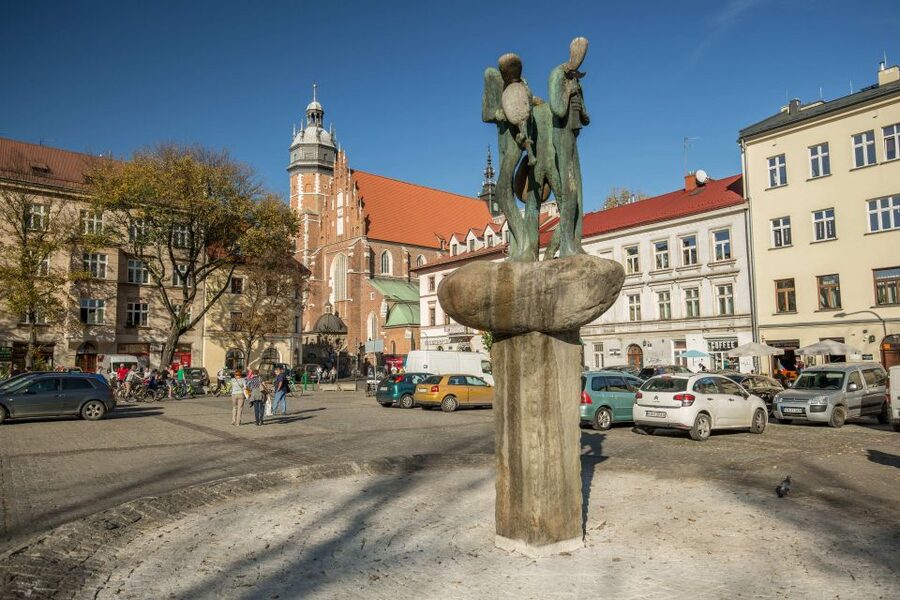
- The original wall survives in fragments: See one of the few remaining pieces of the barrier that enclosed the Kraków Ghetto.
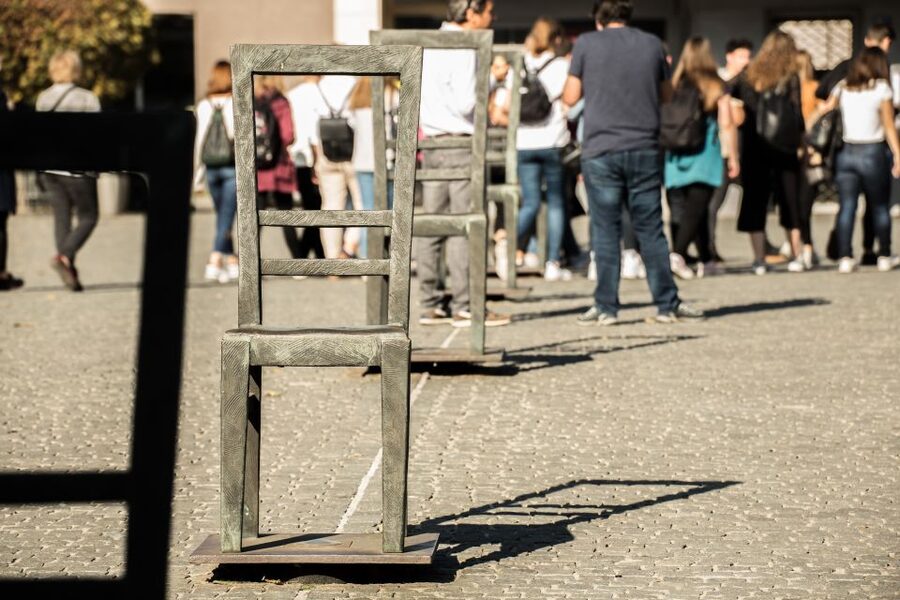
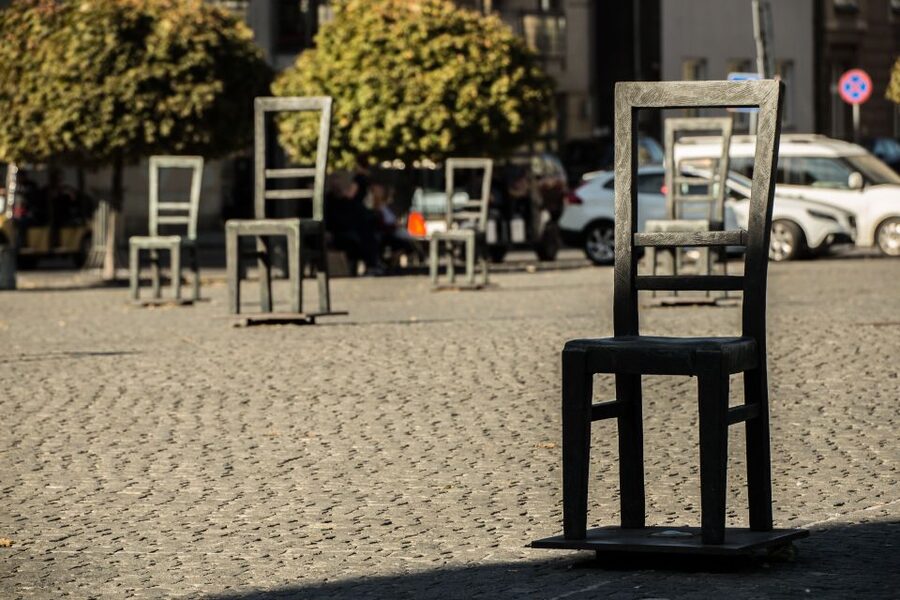
- Ghetto Heroes Square is the emotional center: Empty metal chairs mark the square where deportations took place.
- The route uses real streets, not a recreated set: Daily life continues around wartime buildings and surviving street lines.
- The guide adds the missing context: Photos and personal stories can make the altered neighborhood easier to understand.
- The tour ends near Under the Eagle Pharmacy: Learn how Tadeusz Pankiewicz and his staff helped people trapped inside the ghetto.
- At $11, it is a strong value: You get a live licensed guide, a focused route, and a useful introduction to Podgórze’s wartime past.
Why Podgórze makes this history feel immediate
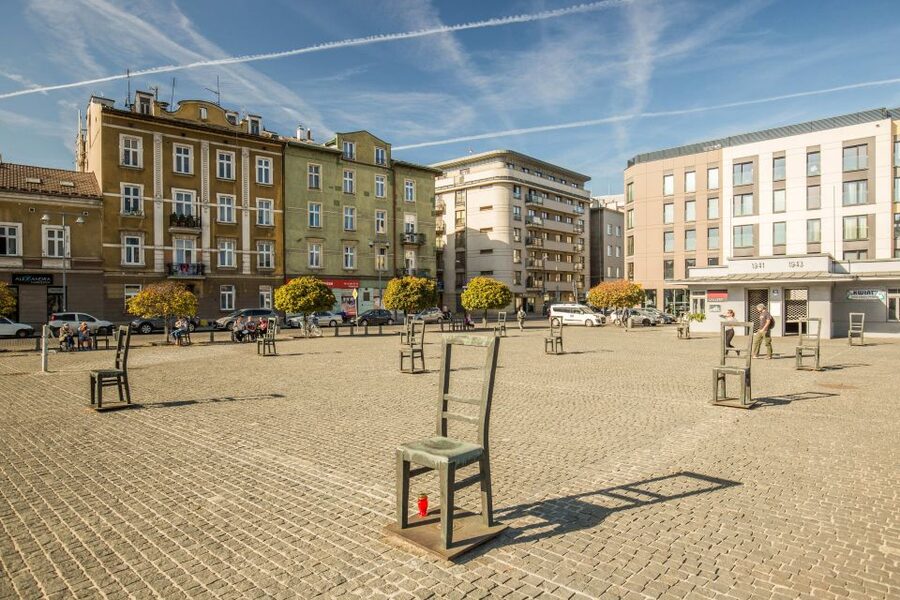
The tour takes place in Podgórze, on the south side of the Vistula River. During the German occupation, this district became the Kraków Ghetto, where Jewish residents were forced into a restricted area under brutal conditions.
I find the setting important because the neighborhood does not look like a memorial site at every turn. People live and work here. Cars pass. Sidewalks carry on. That contrast can be unsettling, but it also helps you grasp the scale of what happened. The ghetto was not an isolated camp far from ordinary life. It was imposed on an existing urban district and filled with families, workers, children, elderly people, and people trying to survive from one day to the next.
Your guide supplies the historical frame as you walk. You will hear about forced relocation, overcrowding, hunger, fear, restrictions, deportations, and the small acts of courage that took place inside the ghetto. The focus is not only on Nazi policy. It is also on daily choices made by people who had very little control over their own lives.
The route is generally flat, and the walking distance is manageable. Still, you are on your feet for the full hour, and the tour runs in rain, cold, or heat. Wear shoes that can handle ordinary city pavement and check the forecast before leaving.
More Jewish Heritage Walks in Krakow:
- Krakow: Kazimierz Jewish Quarter Walking Tour
★ 4.8 · 571 reviews - Krakow: Jewish Quarter Guided Walking Tour
★ 4.8 · 119 reviews - Jewish Krakow Walking Tour in English
★ 4.8 · 102 reviews
Starting near Schindler’s Factory
Meeting points vary by booking option, but several departures have begun outside Oskar Schindler’s Factory. This is a practical place to start because the factory is closely linked with Kraków’s wartime story, even though the walking tour itself focuses on the former ghetto in Podgórze.
Check your booking details carefully rather than assuming every departure begins there. Arrive at least 10 minutes early. Once the group leaves, late arrivals cannot join and the ticket cannot be refunded.
The meeting process has generally been straightforward. Signage can identify the company, language, and start time, and a group coordinator may help gather people before the guide arrives. On a freezing day, one group was invited to wait indoors, a small kindness that matters when the temperature drops well below freezing.
Some guides provide headsets or microphones, which help when the group is walking near traffic or spread along a pavement. Equipment can vary, so do not count on it for every departure. If hearing the guide clearly matters to you, stay close and ask at the start where to stand.
Following the surviving ghetto wall
One of the first major stops is a remaining section of the original ghetto wall. The fragment is valuable precisely because so little of the physical boundary remains. It gives you something solid to look at while the guide explains how the barrier controlled movement and compressed thousands of people into a few city blocks.
The wall also corrects a common misunderstanding. A ghetto was not simply a neighborhood where people chose to live together. It was a controlled enclosure created by the occupying authorities. The guide explains how residents were forced into the area and how the boundary shaped every part of daily life.
You will not find a complete preserved wall stretching through the district. This is one of the tour’s limitations. Much of the original setting has changed, and some buildings are gone or altered. Without explanation, you might walk past the surviving fragment without understanding its purpose or scale.
That is why the guide matters here. Photographs brought by some guides, including Phil, have helped visitors compare the present street with wartime images. The visual comparison makes the missing sections easier to imagine without pretending the neighborhood is unchanged.
Reading the empty chairs at Ghetto Heroes Square
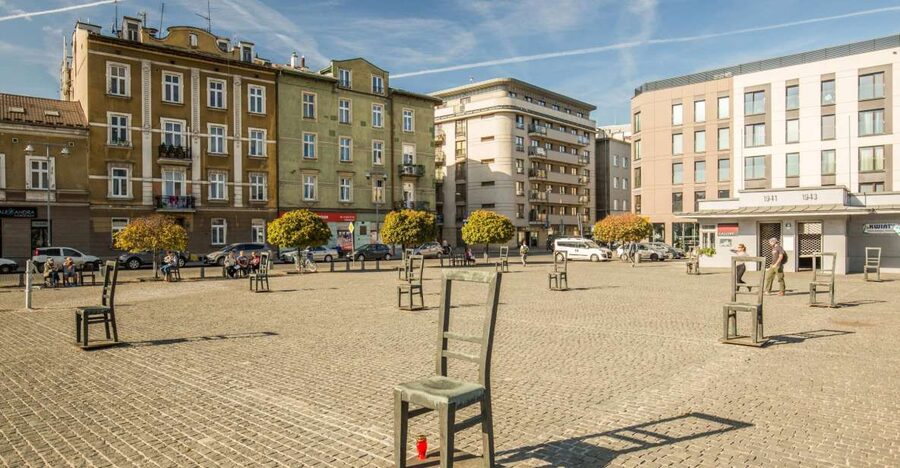
Ghetto Heroes Square is the tour’s most recognizable stop. During the war, it was connected with the forced removal and deportation of Jewish residents. Today, rows of empty metal chairs occupy the square.
The chairs are a restrained memorial. They suggest belongings left behind, families torn apart, and lives suddenly removed from the neighborhood. You do not need a long speech to understand the image, but the guide’s explanation gives the memorial its setting and meaning.
This is usually the point where the tour becomes most reflective. Your guide may discuss deportations to concentration camps, the confusion surrounding the removals, and the impossible decisions faced by people trying to protect relatives or find a way out.
Give yourself room to listen. The square can be busy, and the group may need to keep moving so it does not block public paths. The tour is respectful, but it is still a scheduled walk, not an extended memorial service. If you want several quiet minutes alone, consider returning to the square later.
A few more walking tours around Krakow worth a look
- Old Town Krakow & Wawel Castle Walking Tour
★ 5.0 · 1,508 reviews - Creepy Krakow: 2-Hour City Walking Tour
★ 4.7 · 1,131 reviews - Krakow: The Old Town Walking Tour
★ 4.8 · 794 reviews - Kraków: Old Town & Wawel Castle Walking Tour in English
★ 4.8 · 532 reviews
Under the Eagle Pharmacy and a story of courage
The historic Under the Eagle Pharmacy is another central stop. It was operated by Tadeusz Pankiewicz, a Polish pharmacist who remained in the ghetto and, with his staff, helped Jewish residents with medicine, information, and shelter.
The pharmacy story brings the history down to human scale. Instead of hearing only about orders and statistics, you learn how a place of work could become a source of aid. Medicine was essential, but so were trust, discretion, and the willingness to take serious risks.
The tour may finish at or near the pharmacy. This does not necessarily mean entry to the museum is included. One departure found the pharmacy closed, so check opening arrangements if seeing the interior is important to you. The walking tour can still explain its role from outside, but the museum requires separate attention if it is available.
I consider the pharmacy a strong ending because it shifts the final note from destruction to human action. It does not soften what happened. It shows that people still made moral choices under a system designed to strip them of choice.
Original buildings, changed streets, and what is missing
The route includes wartime buildings and street layouts that remain part of the present neighborhood. Your guide points out what survived and explains how the area functioned during the occupation.
The physical remains are uneven. Some original features are easy to identify, while other places require photographs and narration. One visitor found there was not much left of the old building fabric, although the information added useful context. That is a fair expectation to set: you are not walking through a preserved ghetto.
Instead, the tour works through layers. You see a wall fragment, a square, a pharmacy, and ordinary streets. Then the guide connects them with stories about housing, restrictions, work, fear, family life, and deportation. The value comes from the connection between these points.
This also explains why walking alone can leave gaps. The visible remains do not explain themselves. A self-guided stroll may show you the chairs and wall, but it is much harder to understand how the places fitted together or what happened there at different stages of the war.
The guide makes or breaks the hour
The strongest part of this experience is the quality of the live guide. Recent departures have been led by people including Olga, Aga, Joanna, Ewa, Helen, Kris, Krzysztof, Phil, and Bartolome. Names and assignments can change, but the important point is that the guide is licensed and the presentation is live.
The best guides combine facts with restraint. Helen has been praised for clear delivery and compassion. Joanna has kept a steady pace while answering questions. Phil has used photographs and a touch of wit without losing sight of the subject. Ewa has been described as particularly sensitive in telling individual stories.
Aga’s approach has connected the occupation’s history with present-day questions about hatred and responsibility. That can add value if you want the tour to ask what this past means now, though it may feel more reflective than a purely factual walk.
The language choice matters. Group tours operate in one language only, selected when you book. Options include English, French, German, Italian, Spanish, Russian, Portuguese, Swedish, and Slovak. Clear speech is especially important on a short tour, so stay near the guide and raise your hand if you miss a point.
Is one hour enough for the Kraków Ghetto?
One hour is enough for an introduction and a brisk sequence of major places. It works well if you want a focused activity before or after visiting Schindler’s Factory, or if your Kraków schedule is tight.
It is not enough for every layer of the subject. A guide may know far more than can fit into 60 minutes. One guide was said to have enough material for several additional hours, which points to the central tradeoff: the short format keeps the walk manageable, but it limits questions, pauses, and time inside each site.
The pace is usually steady rather than strenuous. It is suitable for people who prefer a compact walk, and the route is largely flat. You will still cover several locations, so this is not a sit-down talk with brief outdoor stops.
If you have already visited Auschwitz, the ghetto tour gives you a different scale of understanding. Auschwitz presents a major camp complex and its machinery of murder. Podgórze shows how persecution affected an urban population before deportation, including the streets, housing, pharmacy, and public spaces of forced confinement.
Value at $11 per person
At $11 per person, this is one of the easier Kraków history experiences to justify. The price includes a live expert guide and the walking tour. Food, drinks, and any separate museum admission are not included.
The value is not based on the number of attractions. You see only a handful of key places, and several are viewed from public streets. The value comes from having those places explained by someone who can connect the surviving evidence with what has disappeared.
I would not book it expecting a long museum visit or a full study of Kraków’s Jewish history. I would book it as a compact orientation to the former ghetto. The low cost also makes it sensible for visitors who want context before deciding whether to spend more time at Schindler’s Factory or Under the Eagle Pharmacy.
Private groups are available if you want a more personal pace or room for questions. For the standard group option, select the language carefully and confirm the meeting point for your chosen departure.
Weather, timing, and respectful preparation
The tour operates in all weather. Rain, snow, and bitter cold can change how much you enjoy standing at each stop, even when the guide keeps the walk moving.
Wear warm layers in winter, waterproof clothing in wet weather, and comfortable shoes in every season. A compact umbrella may help, but it can make it harder to see or hear the guide in a group. Arriving early also prevents a stressful start and protects you from the strict no-late-entry rule.
This is a serious subject. You do not need specialist background, but I recommend leaving space in your schedule afterward. The tour can be emotionally heavy, especially at Ghetto Heroes Square, and you may want time to sit, walk quietly, or visit another part of Kraków at a slower pace.
Who should book this walking tour?
I recommend it to you if you want a short, affordable introduction to Kraków’s wartime Jewish history, especially if you are already visiting Podgórze or Schindler’s Factory.
It suits first-time visitors because the guide explains the basic sequence clearly. It also suits returning visitors who walked through the district before and felt they were missing the context. The route is short enough for a warm afternoon or as part of a fuller day.
You may want something longer if you prefer extended museum time, detailed architectural study, or a slower discussion of individual lives. You should also allow extra time if the pharmacy interior is a priority, since admission is not listed as part of the walk and one departure found it closed.
Should you book the Krakow Jewish Ghetto Walking Tour?
Book it if you want the streets of Podgórze to make sense. The surviving wall, empty chairs, pharmacy, and ordinary buildings are meaningful, but they need a guide to connect them.
At $11 and one hour, the tour offers strong value, clear landmarks, and a respectful introduction. Its weakness is the tight schedule and the fact that little of the original ghetto remains intact. Go with realistic expectations, arrive early, dress for the weather, and treat the hour as a starting point rather than the final word on Kraków’s wartime past.
FAQ
Where does the Krakow Jewish Ghetto Walking Tour take place?
The tour takes place in Podgórze, the district that became the Kraków Ghetto during World War II.
How long is the walking tour?
The tour lasts one hour.
How much does the tour cost?
The listed price is $11 per person.
What places will I see?
You will see remains of the original ghetto wall, Ghetto Heroes Square, the empty-chair memorial, wartime buildings and street layouts, and Under the Eagle Pharmacy.
Is entry to Under the Eagle Pharmacy included?
The included services list the walking tour and guide, but it does not list museum admission or entry to the pharmacy.
What languages are available?
The tour is available in French, German, Italian, English, Spanish, Russian, Portuguese, Swedish, and Slovak.
Can I book a private group?
Yes. A private group option is available.
Do I need to arrive early?
Yes. You should arrive 10 minutes before the scheduled start. Late arrivals cannot join once the group has departed, and their tickets cannot be refunded.
Does the tour operate in bad weather?
Yes. The tour operates in all weather, so you should bring suitable clothing and footwear.
Can I cancel for a refund?
You can cancel up to 24 hours before the tour for a full refund. Reserve now and pay later is also available.
Just added around Krakow
- Krakow: Jewish Quarter Guided Walking Tour★ 4.8 · 119 reviews
- Krakow: Old Town Guided Walking Tour★ 4.6 · 94 reviews
- Krakow: Old Town Highlights Walking Tour★ 4.5 · 173 reviews
- Krakow: 2h Kazimierz (Jewish Quarter) Walking Tour★ 4.5 · 75 reviews
- Krakow: Street Food Walking Tour★ 4.8 · 285 reviews
- Kraków: Old Town & Wawel Castle Walking Tour in English★ 4.8 · 532 reviews
- Krakow: Legends and Tales of Old Town Walking Tour★ 4.8 · 227 reviews
- Krakow: Old Town Highlights Private Walking Tour★ 4.9 · 79 reviews
Jewish Heritage Walking Tours, compared.

Amsterdam Anne Frank: Small-Group Walking Tour & Local Guide
Read our review →
Anne Frank’s Story – Guided Walking Tour through Amsterdam
Read our review →
Jewish Quarter Walking Tour with Admission Tickets
Read our review →
Anne Frank Guided Walking Tour in DE/EN/IT/ES
Read our review →
Old Town and Jewish Quarter Guided Walking Tour
Read our review →
Anne Frank Walking Tour Amsterdam Including Jewish Cultural Quarter
Read our review →
Anne Frank’s Last Walk & See Anne Frank House in Virtual Reality
Read our review →Browse the lists this tour appears in