
REVIEW · PARIS
Historic Paris Walking Tour in English
Paris reveals its character best on foot, and this 150-minute walk gives you a lively first look at the city’s grandest monuments and most dramatic stories. You move from Hôtel de Ville toward Notre-Dame, the Louvre, Pont des Arts, and the Tuileries Gardens, with Parisian revolution, royal power, art, and daily life woven into the route.
I like the clear historical sweep and the strong storytelling. Guides such as Tom, Harry, Thomas, Yazid, and Francesca have been praised for making art, architecture, and revolution easy to follow. I also like the timing: two and a half hours is long enough to get your bearings without taking your whole day.
The main thing to consider is the amount of ground covered. You see many major sights from outside, but this is not an inside tour of the Louvre, Notre-Dame, or Sainte-Chapelle. The meeting point is easy to find, though you should arrive early and be ready for steady walking.
Key Points To Know Before You Go
- A strong first-day introduction: The route links Parisian history, architecture, art, revolution, and modern city life.
- Major sights from the street: Expect the Louvre, Notre-Dame, Pont des Arts, Tuileries Gardens, Sainte-Chapelle, bridges, and grand boulevards.
- Story-led guiding: The tour brings in Quasimodo, Napoleon, Hitler, the Mona Lisa theft, love, revenge, and the French Revolution.
- English throughout: Guides have included Tom, Harry, Thomas, Yazid, Francesca, and others.
- Two and a half hours on foot: The walk is described as good exercise without being strenuous, but comfortable shoes still matter.
- $31 for a reserved place: The fee covers the booking and guide payment, so you do not need to work out a separate tip afterward.
Starting At Hôtel de Ville In The Heart Of Paris
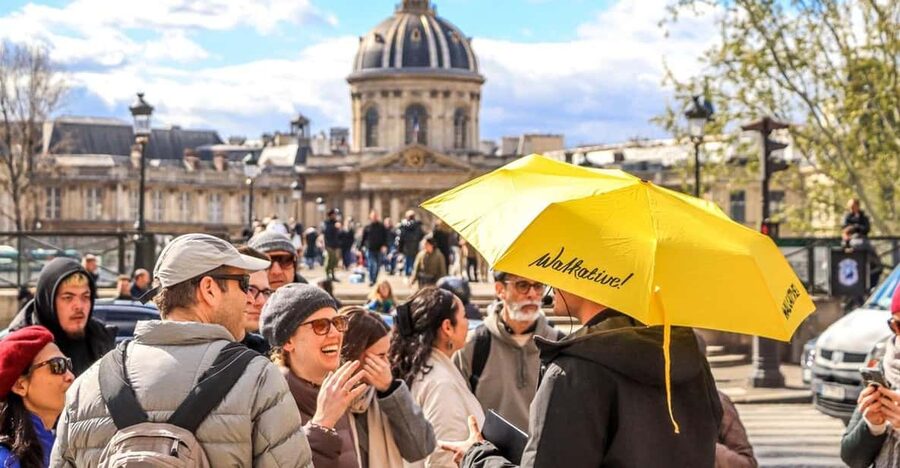
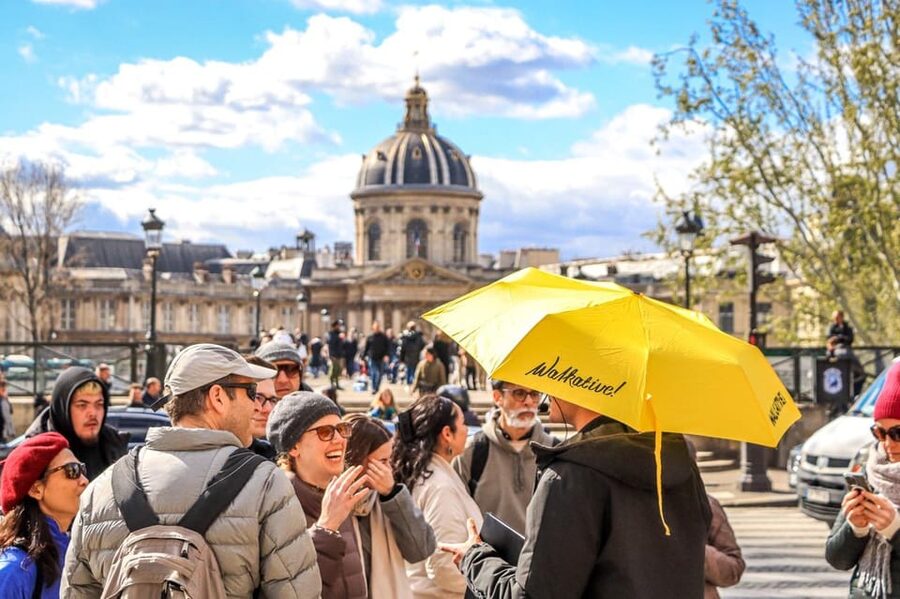
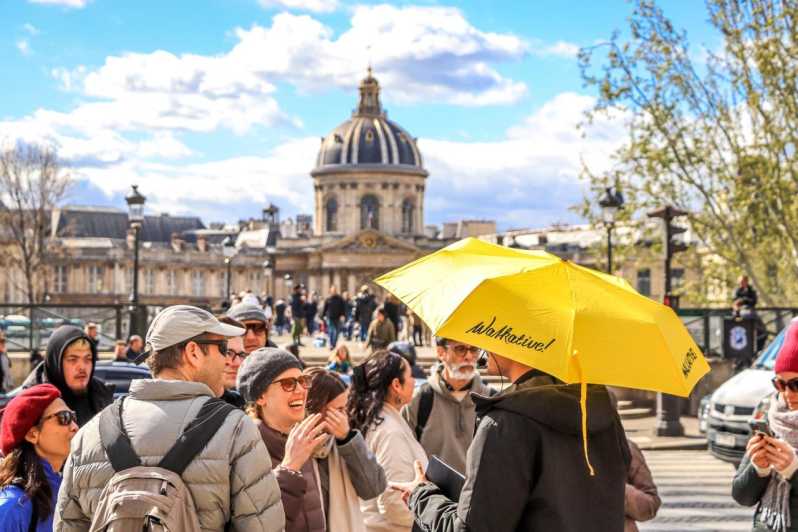
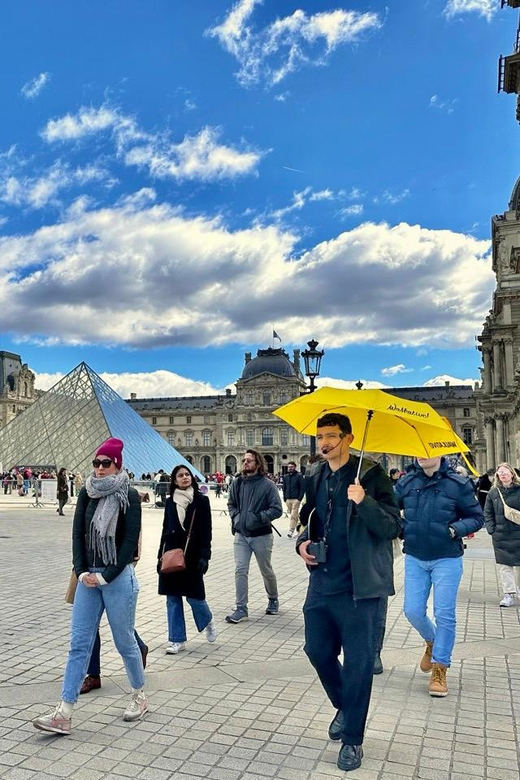
The tour begins outside the Hôtel de Ville metro station at exit 5. Look for the yellow umbrella, and arrive 10 minutes before the start time.
This is a useful starting point. Hôtel de Ville places you close to the Seine, Île de la Cité, historic bridges, and the old center of Paris. You are not beginning in an anonymous neighborhood or at a distant coach stop. You start in the middle of the city’s story, where medieval Paris, royal Paris, revolutionary Paris, and modern Paris overlap.
The guide sets the tone here. This is not meant to be a silent procession from monument to monument. The format is built around a carefully prepared narrative, with room for questions and a bit of humor. Guides have been praised for keeping different ages and levels of historical interest involved, which matters when one person in your group wants dates and dynasties while another mainly wants a good feel for the city.
The meeting point is simple, but Paris metro exits can still cause confusion. Exit numbers matter, so use exit 5 rather than relying only on Hôtel de Ville as a general location. If you arrive early, you have time to find the yellow umbrella without rushing.
A few more walking tours around Paris worth a look
- Paris Top Sights Half Day Walking Tour with a Fun Guide
★ 5.0 · 2,893 reviews - Montmartre Hidden Gems and Scenic Highlights Walking Tour
★ 5.0 · 2,684 reviews - Montmartre Hill French Gourmet Food and Wine Tasting Walking Tour
★ 5.0 · 2,588 reviews
Notre-Dame, Sainte-Chapelle, And The Medieval City
The walk brings you toward the oldest heart of Paris, including Notre-Dame Cathedral and Sainte-Chapelle. These buildings help explain why the Seine islands mattered long before Paris became a center of fashion and luxury.
Notre-Dame is more than a famous church on a postcard. It represents the medieval city’s religious and political importance, and it gives the guide a natural opening to discuss how Paris grew from a settlement of the Parisii into a major capital. You hear about the Gallic beginnings, Roman conquest, the rise of the Franks, and the city’s role as France’s religious and intellectual center.
Sainte-Chapelle adds another layer. Its presence points to the power of medieval kings and the close ties between royal authority and faith. Even if the walk does not include interior visits, learning what the chapel was built to represent helps you look at the building with more purpose later.
The Quasimodo stories fit naturally here. Expect the guide to connect Victor Hugo’s famous character with Notre-Dame and with the way literature shaped public feeling about old Paris. This is one of the tour’s strengths: a building is not treated as a pile of stones. It becomes part of a story about belief, identity, art, and memory.
You should keep your expectations clear. This experience is an outdoor walking tour, not a ticketed cathedral visit. If you want to examine stained glass, climb towers, or spend time inside Notre-Dame or Sainte-Chapelle, plan a separate visit.
The Louvre As Palace, Museum, And Crime Scene
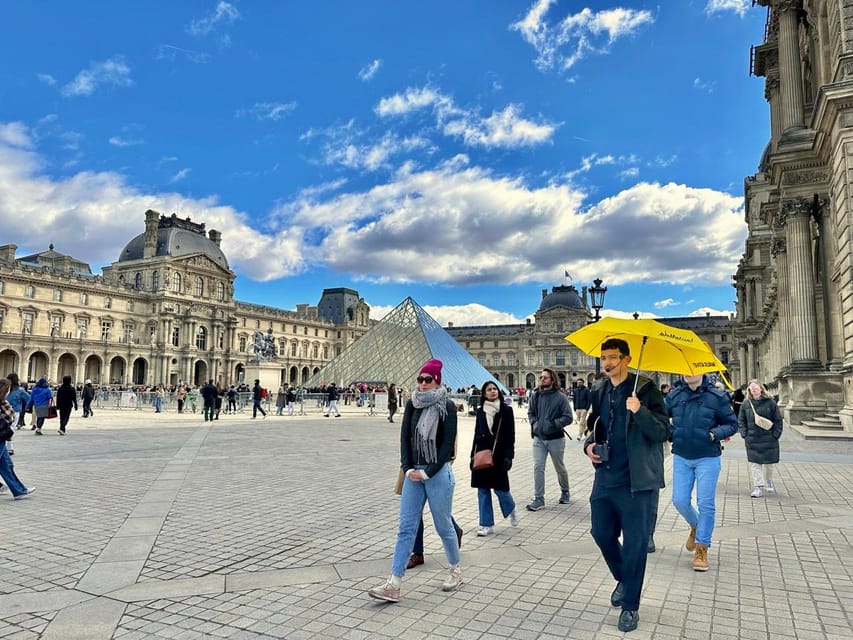
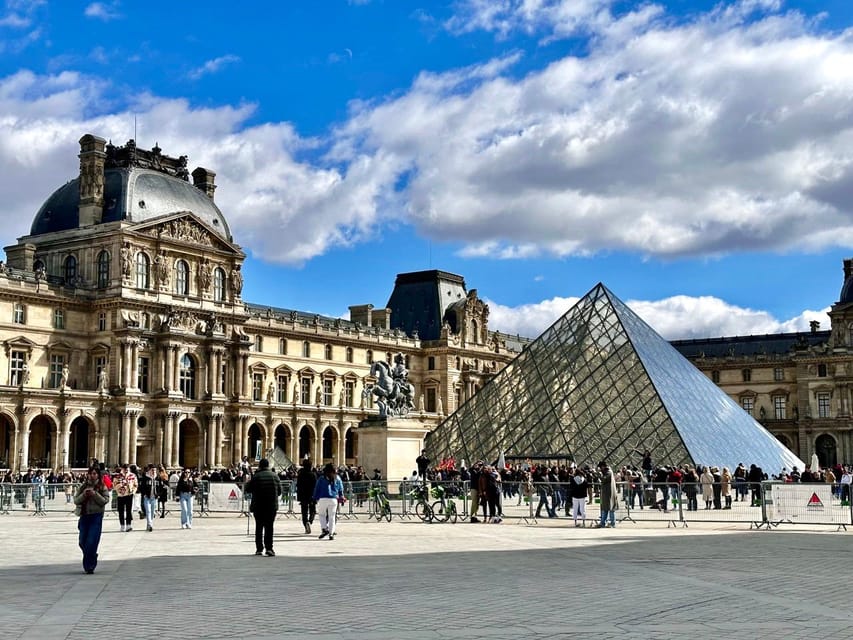
The Louvre is one of the main stops, and the tour focuses on both sides of its identity. Before it became one of the world’s great art museums, it was a royal palace shaped by centuries of French power.
That palace-to-museum change is worth understanding. The Louvre is not simply a large building packed with paintings. Its scale reflects the ambitions of kings, the growth of the French state, and the later idea that major works of art should be available to the public.
The guide also brings in the Mona Lisa theft, described as one of the boldest art thefts in history. This gives the museum a human angle. You are not only hearing about masterpieces and royal collections. You are hearing about desire, risk, fame, and the strange power of a single painting.
Do not expect to tour the galleries during the walk. The Louvre interior can consume several hours on its own, especially if you want to see the Mona Lisa, ancient sculpture, or the French grand rooms. The value here is different. You get a framework that can make a later museum visit more rewarding, or a useful overview if your schedule does not allow an inside visit.
The outdoor view also helps with scale. From the square and surrounding spaces, you can better understand how the Louvre relates to the central city, the gardens, and the ceremonial route toward the west.
Pont des Arts And Paris Along The Seine
Pont des Arts gives the tour a more open, scenic pause. Bridges in Paris are not just ways across the river. They connect important districts and offer views that help you read the city as a whole.
From here, you can appreciate the relationship between the Seine and the monuments along its banks. Paris grew because of the river, and the river still organizes the city’s most famous sights. The guide can place Notre-Dame, the Louvre, historic churches, bridges, and government buildings into one continuous picture rather than treating each as an isolated attraction.
This is also where the tour’s balance of facts and atmosphere matters. Paris can feel grand and formal, but the city’s identity also comes from its people, arguments, romances, artistic ambitions, and habit of challenging authority. The historical story includes wars, religious conflict, social inequality, revolution, and political upheaval, but it is not presented as a dry list of dates.
The walk’s themes include love, desire, and revenge alongside military and political history. That range is useful. You get a more human sense of Paris, not just a parade of kings, generals, and architects.
Bring shoes that can handle pavement and bridges. One person described the walk as good exercise without being strenuous, which is a fair way to think about it. You are not tackling a mountain, but you are walking for 150 minutes and stopping often.
Same streets, a different route:
- Authentic Parisian Gourmet Food Tour with 10 Local Dishes & Wines
★ 5.0 · 4,754 reviews - Paris: Montmartre Highlights Walking Tour with a Local Guide
★ 4.9 · 2,318 reviews - Paris Île de la Cité and Notre-Dame Walking Tour With Crypt
★ 5.0 · 2,272 reviews - Paris: Montmartre Cheese, Wine & Pastry Guided Walking Tour
★ 4.8 · 2,255 reviews
Tuileries Gardens And The Ceremonial City
The Tuileries Gardens offer a change of pace after the dense medieval center and museum district. Their broad paths and formal design show another version of Paris, one built around order, ceremony, and royal display.
The gardens also help explain the long axis running through central Paris. The Louvre, Tuileries, grand avenues, and later monuments form part of a carefully shaped urban scene. Here, the city feels less like a medieval maze and more like a stage for royal processions, national celebrations, public gatherings, and political power.
This is a good place to think about the contrast between old Paris and the city rebuilt in the 19th century. Paris became known for monumental boulevards, parks, sewers, aqueducts, and improved infrastructure. The changes made the city more modern and easier to move through, but they also made street barricades harder to build during uprisings.
That detail captures the practical side of Parisian history. Urban planning was not only about beauty. It was also about control, public health, transport, and fear of revolt.
The gardens are an especially good stop for photographs and a short breather, though the tour remains a moving historical walk rather than a long rest in the park. If you want a picnic with cheese, baguette, and wine, save it for after the tour or another afternoon.
Revolution, Napoleon, And The City That Refused To Behave
The French Revolution is central to this experience. The guide connects poverty, inequality, new political ideas, and the collapse of royal rule. You hear how Paris helped push France into a period that changed the country and influenced politics far beyond its borders.
Napoleon follows naturally. His story adds ambition, military power, public image, and the reshaping of Europe. The tour also includes stories connected to Hitler, giving you a sense of how Paris continued to matter during the 20th century.
The strongest guides make these subjects approachable rather than turning the walk into a lecture. Thomas, for example, was praised for mixing art history with military history and for making the material accessible to people with only a passing interest. Other guides, including Harry and Yazid, were praised for vivid storytelling and enthusiasm.
Guide quality can vary on any scheduled walking tour because you may not know who will lead your departure. That is the one part of the experience you cannot fully control. The good news is that the guide style appears to be a major part of the operation, with several named guides praised for warmth, humor, clear explanations, and the ability to keep a group engaged.
Haussmann’s Boulevards And The Eiffel Tower Connection
The experience also puts Paris’s 19th-century transformation into context. Wide boulevards, parks, sewers, and aqueducts changed how people lived and moved through the city.
The Eiffel Tower belongs to this story. Built for the 1889 Universal Exposition, it was initially disliked by many Parisians and became beloved only later. That reversal says plenty about Paris. The city protects its old beauty fiercely, yet it has repeatedly learned to live with bold new ideas.
The tour includes the Eiffel Tower among the major sights connected to the overall route and narrative. Since the exact walking path and timing can vary, confirm the day’s route with your guide if seeing the tower from the walk is important to you. The central highlights are clearly the Louvre, Notre-Dame, Pont des Arts, and Tuileries Gardens, while the Eiffel Tower is part of the wider introduction to Paris.
This is a useful distinction for planning. Book this tour to understand Paris as a city, not as a guaranteed close-up visit to every landmark named in the description.
How The $31 Price Works
At $31 per person, this is a reasonable price for a live, English-language introduction lasting two and a half hours. The fee covers the reservation and the guide’s payment.
The tour uses a pay-as-you-wish style in its general format, but here the amount paid covers the booking fee and guide payment. That makes the cost clearer than a standard tip-dependent walk. You are not expected to arrive unsure about how much additional money the guide needs.
Value depends on how you use the walk. If you want interior entry, long museum time, or specialist art instruction inside the Louvre, this is not the right product. If you want a structured way to understand the city before exploring on your own, the price is easier to justify.
I would book it early in a Paris stay. One person who took the walk on a first visit found it a useful first activity, and another wished they had not waited until the final day. That advice makes sense. The tour can help you decide where to return, which museums deserve your time, and how the central sights fit together.
The free cancellation policy allows a full refund up to 24 hours before the activity. You can also reserve now and pay later, which helps if your Paris plans are still shifting.
Who Will Enjoy This Walking Tour Most
You are a good match for this experience if you want:
- A broad introduction to Paris before visiting museums on your own
- History explained through buildings, bridges, gardens, and city streets
- A friendly English-speaking guide rather than an audio guide
- Stories about art, theft, revolution, Napoleon, religion, and Parisian life
- A walk that suits both serious history fans and people with a lighter interest
- A useful activity for a solo visit, since the guided format gives you an easy way to connect with the city
Families with mixed interests may also find the storytelling useful. The tour has been described as engaging for different ages, and the blend of humor, famous characters, art, and political drama keeps it from feeling like a school lesson.
You should think twice if long walks are difficult for you, if you want extensive time inside the Louvre, or if your priority is a specialist visit to one monument. The route offers an overview, not a deep examination of one site.
Practical Details For A Smooth Walk
Meet outside the Hôtel de Ville metro station at exit 5 and look for the yellow umbrella. Arrive 10 minutes early, since a central Paris meeting point can be crowded and the group will not want to wait for late arrivals.
Wear comfortable shoes and check the starting time when you book. The activity lasts 150 minutes, but the exact departure time depends on availability.
The tour is in English and includes a live guide plus a prepared narrative. Hotel pickup and drop-off are not included, so you need to make your own way to Hôtel de Ville.
I would also keep your schedule flexible after the walk. You may want to return to the Louvre, spend more time around Notre-Dame, or sit in the Tuileries Gardens with a snack. The tour works best as a foundation for the rest of your Paris sightseeing.
Should You Book This Paris History Walk?
Book it if you want a lively orientation to central Paris, especially early in your stay. The combination of Notre-Dame, the Louvre, Pont des Arts, Tuileries Gardens, bridges, royal power, revolution, art theft, and famous personalities gives you plenty to think about without requiring a full day.
The strongest reason to choose it is the storytelling. Guides such as Tom, Harry, Thomas, Yazid, and Francesca have made the walk appealing to first-time visitors, solo visitors, history fans, and people who simply want to understand what they are seeing.
Skip it if you need inside access to the Louvre or Sainte-Chapelle, a small private tour, or a tightly focused art-history lecture. For most first-time visitors who want context, good exercise, and a clear introduction to the city, $31 is a fair price.
FAQ
How long does the Historic Paris Walking Tour last?
The tour lasts 150 minutes, or two and a half hours.
What language is the tour conducted in?
The tour is conducted in English with a live guide.
Where does the tour meet?
The meeting point is Hôtel de Ville, outside the metro at exit 5. Look for a yellow umbrella.
How early should I arrive?
You should arrive 10 minutes before the activity starts.
What sights are included?
The experience includes the history of the Louvre, Notre-Dame Cathedral, Pont des Arts, and the Tuileries Gardens. The wider route and narrative also include Sainte-Chapelle, the Eiffel Tower, bridges, and elegant boulevards.
Does the tour include entry to the Louvre or Notre-Dame?
The provided information describes a walking tour and does not include admission tickets to those sites. You should plan separate visits if you want to go inside.
Is hotel pickup included?
No. Hotel pickup and drop-off are not included.
How much does the tour cost?
The price is $31 per person. This covers the reservation fee and the guide’s payment.
Can I cancel the booking?
Yes. You can cancel up to 24 hours in advance for a full refund. You can also reserve now and pay later.
Just added around Paris
- The Official Emily in Paris Locations Walking Tour★ 4.9 · 383 reviews
- Paris: Montmartre Food Tasting Walking Tour with Secret Dish★ 4.8 · 107 reviews
- Paris: Emily Inspired Walking Tour★ 4.9 · 312 reviews
- Saint-Germain: Gourmet Chocolate & Pastry Walking Food Tour★ 4.8 · 495 reviews
- Paris: Walking Tour of Montmartre★ 4.7 · 470 reviews
- Paris Uncovered: Unique Guided Walking Tours with a Twist★ 4.8 · 582 reviews
- Paris Top Sights Half Day Walking Tour with a Fun Guide★ 4.9 · 92 reviews
- Paris: Walking Tour with Notre Dame or Ste-Chapelle Access★ 4.4 · 198 reviews
Walking Tours, compared.

Magical London: Harry Potter Guided Walking Tour
Read our review →
Reykjavik Food Walk – Local Foodie Adventure in Iceland
Read our review →
History and Hauntings of Salem Guided Walking Tour
Read our review →
New Orleans Premier Ghost, Voodoo and Vampire Walking Tour
Read our review →
Amsterdam Anne Frank: Small-Group Walking Tour & Local Guide
Read our review →

Edinburgh Castle: Guided Walking Tour with Entry Ticket
Read our review →
Anne Frank’s Story – Guided Walking Tour through Amsterdam
Read our review →Browse the lists this tour appears in