
REVIEW · BERLIN
East Berlin Food & History Tour with Eating Europe
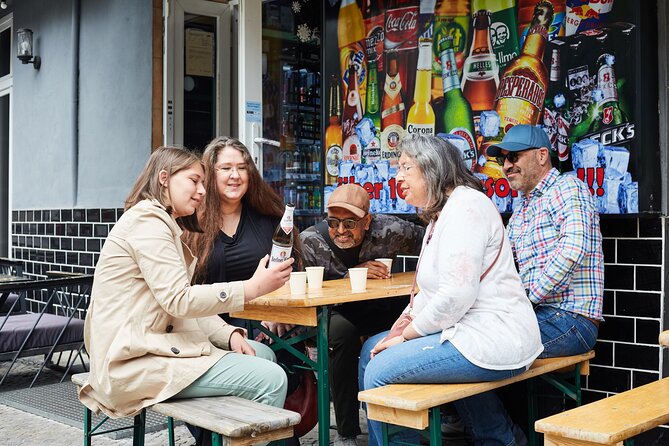
Berlin’s food story is really a people story. On this 3.5-hour walk through Friedrichshain and former East Berlin, you’ll eat your way through Turkish, Vietnamese, Syrian, and local Berlin traditions while learning how migration, division, and reunification shaped the city’s everyday table.
I like the small maximum of 12 people, which gives the guide room to answer questions and keep the tastings relaxed. I also like the way food and history are tied together, from döner and currywurst to the fall of the Berlin Wall. Craft beer is included, too.
The main consideration is that this is not a traditional German food tour. You’ll get some Berlin classics, but much of the meal reflects immigrant communities and modern city life. Tastings and stops can change by season or day, and the pace suits curious eaters more than anyone seeking a formal sit-down meal.
Key points to know before booking
- Seven or more food and drink stops: Expect döner, Vietnamese tacos, currywurst, schnitzel burger, Syrian mezze, beer, and a Turkish sweet, though the exact menu can change.
- East Berlin as the setting: The route connects Friedrichshain, RAW-Gelände, Warschauer Straße, East Side Gallery, and other places shaped by the Cold War and reunification.
- Guides who connect the dots: Clara, Jed, Lily, Eden, Laura, and Benjamin are among the guides associated with the experience.
- Small-group format: The tour accepts no more than 12 people, with a minimum of two required to operate.
- Come hungry: Several tastings add up to a substantial meal, and the food may cover lunch and part of dinner.
- Good value for a full afternoon: At $107.68 per person, the price includes the tastings, beer, guide, and insider tips, but not gratuity or extra drinks.
Why this East Berlin food walk works
The best part of this experience is its clear idea: food explains Berlin better than a string of dates and monuments. A döner tells you about Turkish immigration and street food. Currywurst points to postwar Berlin and the city’s love of quick, cheap meals. Syrian mezze shows how newer communities have added their own flavors to the city.
You also get a useful look at East Berlin beyond the famous museums. Friedrichshain has a mix of old residential streets, food shops, markets, clubs, murals, and former industrial sites. The route does not treat the former East as a frozen museum. Instead, you see how people live, eat, create, and gather there now.
The guides are central to the experience. Clara is often praised for her humor, clear storytelling, and ability to answer questions. Jed has been noted for linking food with Berlin’s past, while Lily and Eden have guided groups through the city’s immigrant food traditions and Cold War background. Your guide may be someone else, but the format depends on a personable English-speaking local who can connect each stop to the city around it.
Other walking tours people book in Berlin:
- Discover Berlin Half-Day Walking Tour
★ 5.0 · 9,624 reviews - Berlin City walk Government District and Places of Democracy
★ 4.7 · 8,467 reviews - Berlin: Third Reich & Cold War Guided Walking Tour
★ 4.9 · 8,378 reviews
Starting with beer and Berlin’s everyday food
The meeting point is Haroun at Neue Bahnhofstraße 28. From there, the tour moves through nearby Friedrichshain, with short walks between stops. You should expect a neighborhood walk rather than a bus ride, so comfortable shoes are a good idea.
The first listed tasting takes place at Boxi Spatshop on Boxhagener Straße. In this small liquor store, you try a Berliner Kindl light beer and hear about its origins. It is a modest start, but that is part of the point. Berlin’s food culture is often found in ordinary places: a corner shop, a train station, a takeout counter, or a neighborhood bar.
The beer also sets the tone for the tour. You are not being shown a polished food district built only for visitors. You are sampling things connected to daily life in Berlin. Craft beer is included at selected stops, though extra drinks are not covered.
Döner at Haroun and the story of migration
At Haroun, you try shawarma döner. This is one of the most useful stops because it links a familiar Berlin meal to the Turkish and Middle Eastern communities that helped shape the city after the war.
Döner is more than a convenient sandwich here. It represents the way immigrant food becomes local food. In Berlin, it is eaten by people from many backgrounds, and it has become one of the city’s signature quick meals. Your guide uses the tasting to explain both the dish and the wider story of immigration.
This stop also gives you a sense of the tour’s food style. You are not receiving a large plate at each restaurant. Instead, you sample smaller portions at several places, building a varied meal over the afternoon. If you skip breakfast, you should have enough appetite for the full route.
Vietnamese tacos at NYOM
NYOM is a neon-lit Vietnamese restaurant where the group tries TyTy Tacos, an inventive street food item with Vietnamese flavors. This is one of the more unusual tastings, and it helps show how Berlin’s food culture keeps changing.
The value here is not simply novelty. The dish illustrates how restaurant owners and cooks adapt traditions, combine influences, and create food for a modern Berlin audience. You get something different from the usual German fare, but the guide still places it within the city’s wider cultural story.
Several people who enjoyed this experience singled out the Vietnamese tacos as a favorite. I would keep an open mind and expect contrast: the route moves from beer and döner to a more experimental dish, then back to Berlin classics later.
Same streets, a different route:
- Berlin: Discover Berlin Walking Tour
★ 4.9 · 5,998 reviews - Berlin’s Best: 2 Hour Walking Tour Third Reich and the Cold War
★ 5.0 · 5,486 reviews - Berlin: Hidden Backyards Guided Walking Tour
★ 4.8 · 5,360 reviews - Explore Berlin: See All The Iconic Sights & Some Hidden Gems
★ 5.0 · 4,429 reviews
RAW-Gelände, from rail yard to creative district
After the food stops, the route reaches RAW-Gelände. This former industrial site has served as an imperial rail repair yard, a Soviet factory, and a Deutsche Bahn warehouse. Today, it contains art spaces, record companies, nightclubs, beer gardens, a bouldering hall, and Berlin’s largest indoor skate park.
This is one of the strongest sightseeing sections because the setting carries several layers of Berlin’s past. You can see how an old industrial property has been reused by artists, businesses, and nightlife venues. It also helps explain why East Berlin has such a distinctive mix of rough edges, creative projects, and changing commercial spaces.
You do not spend hours touring every part of the site. The scheduled stop is about 20 minutes, so think of it as a guided introduction and a chance to understand the area’s role. If you like street art, alternative culture, or reused industrial buildings, this part may be especially appealing.
Currywurst at Warschauer Straße
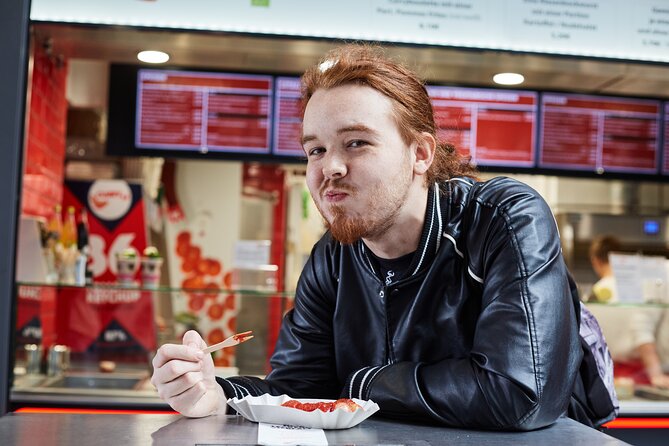
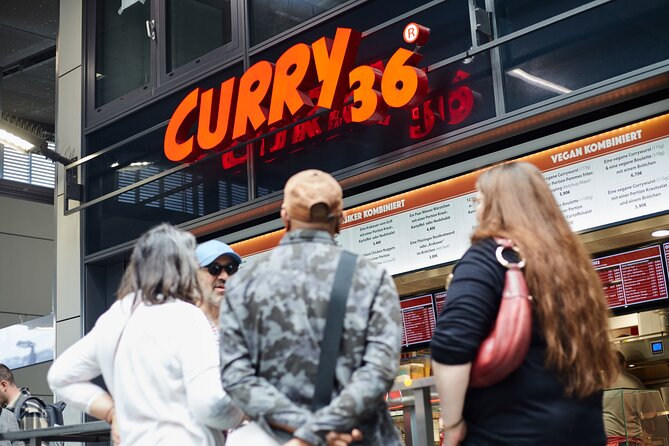
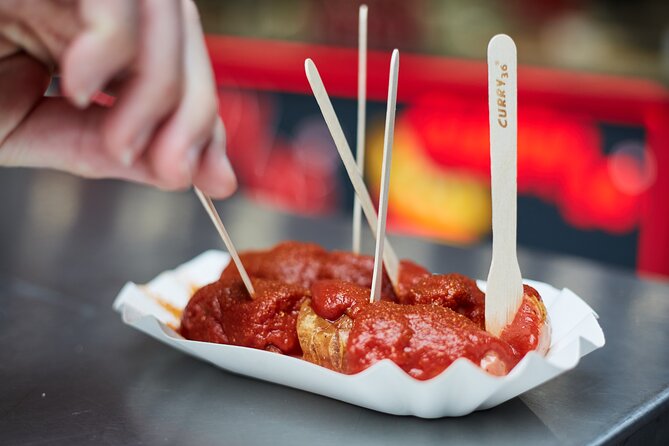
At Warschauer Straße, the tour pauses for currywurst, one of Berlin’s best-known street foods. The tasting takes place at a train station, which is exactly the sort of practical setting where the dish makes sense: fast, filling, inexpensive, and easy to eat on the move.
Your guide explains how currywurst was created and why it became such an important Berlin meal. This is the clearest traditional Berlin food stop on the route, though it is worth knowing that currywurst divides opinion. One person may find it essential, while another may prefer the döner, tacos, or Syrian food.
That variety is a strength. The tour does not pretend there is one correct Berlin cuisine. It shows you a city where local classics and immigrant foods sit side by side.
Schnitzel burger and the end of East Berlin
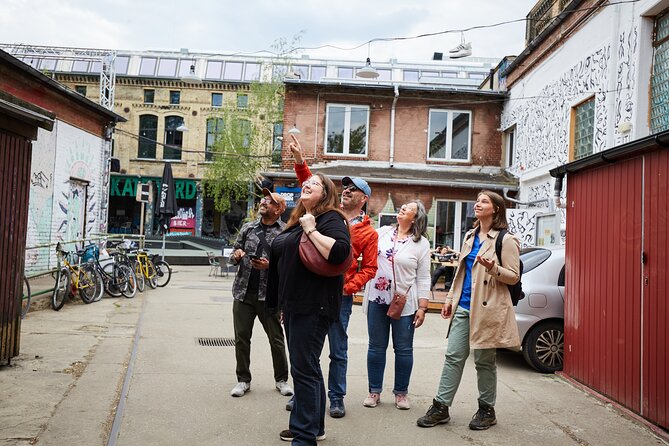
The next Warschauer Straße stop combines a schnitzel burger with Berliner Pilsner beer at a small schnitzel burger restaurant and club. Here, the conversation turns more directly to life near the end of East Berlin and the events that led to the fall of the Berlin Wall.
This pairing works because the location is informal. You are discussing major political change while eating a casual sandwich in a compact neighborhood venue. The tour’s history is not limited to monuments or museum labels. It is connected to ordinary life, food shortages, leisure, work, music, and the ways people spent time together.
The historical portion can be especially helpful if you know the major events but want a more personal sense of what life was like. Guides such as Benjamin and Clara have been praised for making complex history easier to follow and tying it to daily experiences in former East Berlin.
East Side Gallery and Berlin’s open-air wall
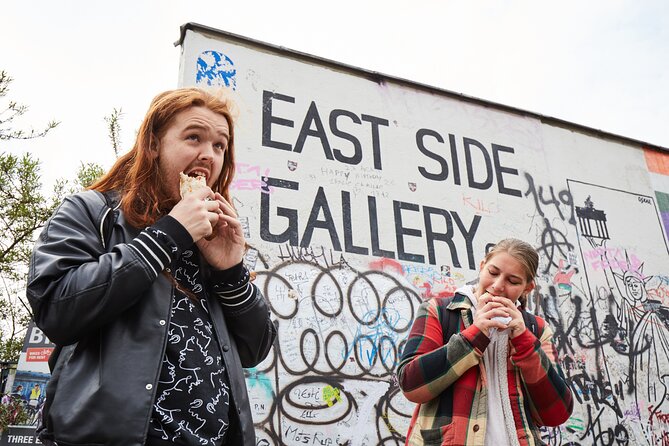
The walk then reaches East Side Gallery, the longest surviving stretch of the Berlin Wall. It extends for more than 1.3 miles and is covered with colorful, often political murals.
You only spend about ten minutes at this stop, so it is not a full art tour. Still, it provides an important visual counterpoint to the food stops. The wall once divided a city. Now, its surviving sections carry public art, political messages, and memories of the division.
The short visit is enough to see part of the gallery and hear why it matters, but you may want to return later if the murals interest you. The tour gives you an introduction, not time to inspect every painted panel.
Syrian mezze and Berlin’s newer food culture
At Aleppo Supper Club, you try a traditional mezze dish from Syrian and Levantine cuisine. This is a good closing food stop because it brings the immigrant-food theme into the present.
The mezze offers a different style of eating from the earlier street food. Instead of a handheld meal, you get a dish connected to shared plates and Levantine traditions. The guide explains how Syrian food has become part of Berlin’s wider dining scene and how newer communities continue to shape the city.
The included food may also feature a Turkish treat on some departures. Because the company changes dishes and locations by day or season, you should view the published menu as a sample rather than a fixed promise.
The route may also include one of Berlin’s remaining squat houses, a place that has hosted political and educational events as well as live concerts. This stop adds another piece of Berlin’s alternative culture and helps explain why certain parts of the former East remain associated with independent social spaces.
What the $107.68 price really covers
At $107.68 per person, this is not a cheap snack walk. It is also more than a simple restaurant crawl. You are paying for roughly 3.5 hours of guiding, several food tastings, beer, neighborhood history, and the convenience of having the stops arranged for you.
The value is strongest if you would otherwise spend money on lunch and dinner while trying to find these places yourself. The portions are spread across the route, and the combined tastings may replace a substantial part of two meals. You also receive local food and city tips that can help you choose restaurants later in your stay.
The price is less appealing if you want a large meal at one restaurant, several full beers, or only classic German dishes. Extra drinks cost more, gratuity is not included, and the tastings can change. Still, the small group and the range of locations make the cost reasonable for someone who wants both food and context.
Practical details that matter
The tour is offered in English and uses a mobile ticket. It begins at Haroun, Neue Bahnhofstraße 28, and ends at Mühlenstraße 78 near East Side Gallery. The route is close to public transportation, but the supplied details do not give a total walking distance.
Children under four can join without a ticket, but their food is not included. Paid tickets with food are available from age four. Service animals are allowed, and most people can take part.
Vegetarian and gluten-free requests can be sent by email or added when booking. The company says it will try to accommodate dietary needs, but the experience is not suitable for severe or life-threatening allergies involving ingredients used on the tour. If that applies to you, choose a different activity.
The tour needs at least two people to operate and accepts no more than 12. You can cancel for a full refund up to 24 hours before the start time. If the minimum is not met and the company cancels, you are offered another date or a full refund.
Who should book this experience?
I would choose this tour if you want to understand how Berlin became the food city it is today. It suits first-time visitors who want history without spending an entire afternoon indoors, and it works well for returning visitors who have already seen the major sights.
It is also a strong choice for people who enjoy trying several cuisines in one sitting. You should be comfortable with the fact that the food is a mix of Berlin classics and immigrant cooking, not a parade of sausages, pretzels, and schnitzel.
The experience may not suit you if you have severe allergies, dislike walking between stops, or want control over every dish. The exact stops can change, and currywurst or Syrian mezze may not appeal to every palate. That said, the variety gives you a better chance of finding several favorites.
Should you book the East Berlin Food and History Tour?
Yes, if you want a small-group walk that explains Berlin through food, migration, street art, and Cold War history. The strongest features are the guide-led storytelling, the range of cuisines, the included beer, and the chance to see places such as RAW-Gelände and East Side Gallery in one afternoon.
Come hungry, wear comfortable shoes, and tell the company about dietary needs before you arrive. If you want a traditional German meal, choose another tour. If you want to see how Turkish, Vietnamese, Syrian, and Berlin food traditions now share the same city, this is a smart and flavorful way to spend 3.5 hours.
FAQ
How long does the East Berlin Food and History Tour last?
The tour lasts approximately 3 hours and 30 minutes.
How much does the tour cost?
The listed price is $107.68 per person.
What language is the tour offered in?
The tour is offered in English.
Where does the tour start?
It starts at Haroun, Neue Bahnhofstraße 28, 10245 Berlin, Germany.
Where does the tour end?
It ends at Mühlenstraße 78, 10243 Berlin, Germany.
What food and drinks are included?
Included tastings can feature döner, Vietnamese tacos, currywurst, schnitzel burger, Syrian mezze, Turkish treats, and beer. Exact offerings can vary by day or season.
Are extra drinks included?
No. The included tastings and specified beer are covered, but extra drinks are not included.
How many people can join the tour?
The maximum group size is 12 people.
Can children join the tour?
Children under four can join free, but food is not included for them. Paid tickets with food are available for children aged four and up.
Can dietary requirements be accommodated?
Vegetarian, gluten-free, and other dietary requests can be sent by email or added at booking. Severe or life-threatening food allergies are not suitable for this experience.
Just added around Berlin
- Berlin Walking Tour★ 4.5 · 378 reviews
- East Meets West: Berlin Food Culture & Street Art★ 5.0 · 157 reviews
- Small Group Walking Tour of East Berlin with a French Guide★ 5.0 · 176 reviews
- Berlin Street Art Walking Tour – Off The Grid★ 5.0 · 270 reviews
- Berlin Highlights Private Guided Walking Tour★ 4.5 · 89 reviews
- Gruseltour Berlin Haunted Ghost Walk 90-minute at Berlin Mitte city center★ 5.0 · 75 reviews
- Berlin Private Complete History All Day Walking Tour★ 5.0 · 474 reviews
- Private Berlin: Iconic Sights and Hidden Gems Walking Tour★ 5.0 · 292 reviews
Berlin Walking Tours, compared.
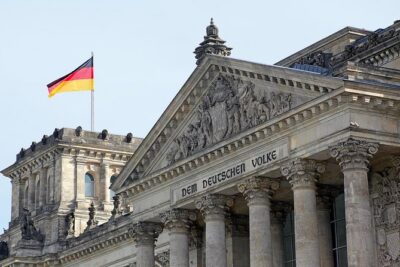
Berlin City walk Government District and Places of Democracy
Read our review →

Berlin’s Best: 2 Hour Walking Tour Third Reich and the Cold War
Read our review →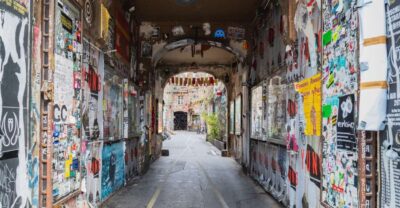

Explore Berlin: See All The Iconic Sights & Some Hidden Gems
Read our review →
Third Reich Berlin: Hitler and WWII Walking Tour
Read our review →Browse the lists this tour appears in