
REVIEW · SAVANNAH
Heart of Savannah History Walking Tour – 2hr
Savannah’s history is laid out in its streets, and this two-hour walk gives you a useful first look at the city’s grand squares, old homes, churches, and dramatic characters. You’ll follow an oak-lined route from Wright Square to Forsyth Park, with stops tied to the American Revolution, Civil War, Girl Scouts, and Forrest Gump.
I like the way the tour mixes major sights with small details, such as the fingerprints pressed into Savannah’s gray brick and the French catalog fountain in Forsyth Park. I also like the practical orientation: guides such as Rick, Mark, Rose, and Crystal explain where you are, what matters, and where to explore next. The main drawback is pace. There is a lot to cover in two hours, and some sections may feel rushed or leave little time for questions.
Key points
- A one-mile route through Savannah’s historic center: Start at Wright Square and finish at Forsyth Park Fountain.
- A useful first-day introduction: Learn how Savannah’s squares were planned and use the route to organize later sightseeing.
- Stories beyond architecture: Hear about Tomochichi, the Siege of Savannah, General Sherman, Juliette Gordon Low, and Jim Williams.
- A popular film stop: Visit Chippewa Square, where Forrest Gump sat waiting for the bus.
- Outdoor sightseeing only: The route passes the Juliette Gordon Low Birthplace and private homes, but does not include interior admission.
- Weather matters: Wear comfortable shoes, carry water in hot weather, and bring an umbrella because the walk operates in rain.
Starting at Wright Square and learning how Savannah was planned

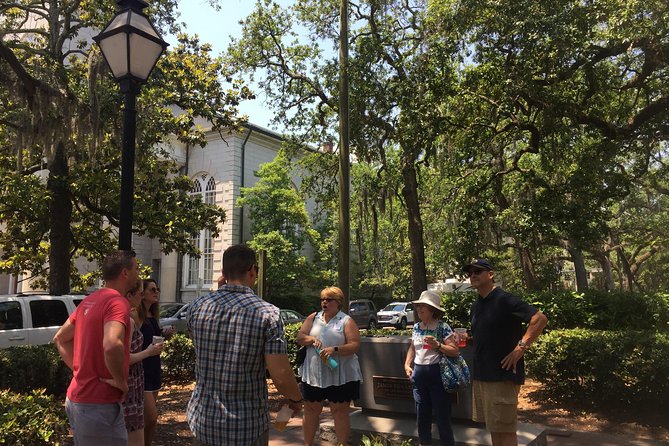
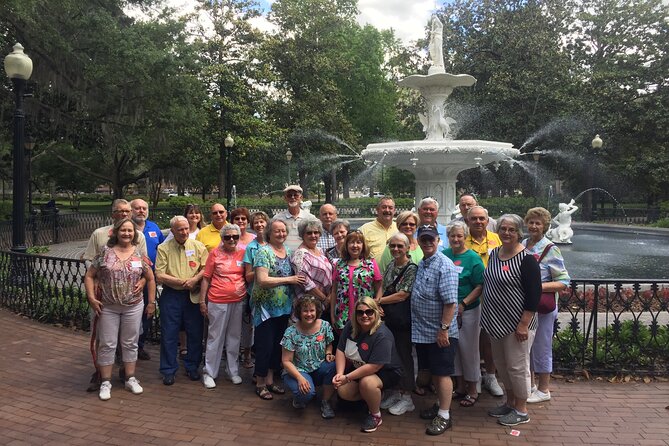
Meet your guide in the center of Wright Square, in front of the Gordon Monument. This is a sensible starting point because the square introduces the basic idea behind Savannah’s design before the walk moves into individual buildings and stories.
General James Oglethorpe established Savannah on a 40-foot bluff. The raised ground helped the new settlement, and the city’s planned squares gave residents open spaces within the growing town. Your guide explains how the square system works and why it remains one of Savannah’s defining features.
Wright Square also brings in Tomochichi, chief of the Yamacraw Indians. His connection to the early colony is central to Savannah’s founding story, and the monument in the square marks his burial place. The stop lasts about 15 minutes, long enough to set up the larger story without requiring an architectural lecture.
You’ll also hear about the Port of Savannah, described on the tour as the third-largest port in the nation. That detail helps connect the picturesque squares to the city’s practical importance. Savannah was not simply designed to look attractive. Its location and port helped make it an important center for trade.
More History Walking Tours in the USA
- Southern Flavors Food, Pub Crawl, and History Walking Tour
★ 4.5 · 1,623 reviews - Genteel and Bard’s Savannah History Walking Tour
★ 5.0 · 684 reviews - New Orleans Garden District History Walking Tour
★ 5.0 · 2,879 reviews
Juliette Gordon Low’s birthplace, seen from the street
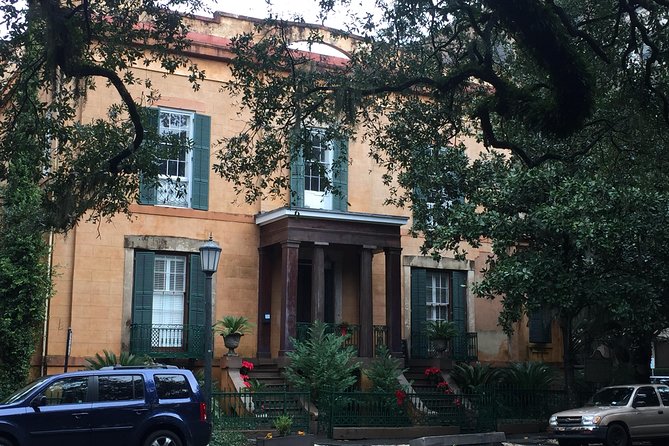
The next stop is the Juliette Gordon Low Birthplace, the home where the founder of the Girl Scouts was born on October 31, 1860. You admire the building from outside and hear about the Gordon family and the home’s present use.
This is a quick stop, about 10 minutes, and there is no interior visit included. That distinction matters if you want to tour the house itself. You can return later for the museum, but this walking tour keeps its attention on the larger district rather than adding admission visits.
I find this kind of exterior stop useful on a first walk. You get the address, the historical connection, and a reason to return, without spending a large part of a two-hour tour indoors.
A church with a complicated past
At Independent Presbyterian Church, the story shifts from private homes to Savannah’s religious and civic life. The church began in 1755 on Ellis Square, originally called Market Square, but fire destroyed the first building. A second location on Telfair Square met the same fate after a hurricane, and the current church was built in 1855 at Bull Street and Oglethorpe Avenue.
The stop lasts only about five minutes, so expect a quick explanation rather than a full architectural tour. Your guide points out the famous steeple and explains which United States president married in the church in 1885.
This is a good example of the tour’s approach. You are not stopping for long at any single building. Instead, you collect short stories that help explain why Savannah’s streets contain so many layers of rebuilding, public ceremony, and local memory.
Chippewa Square and the Forrest Gump connection
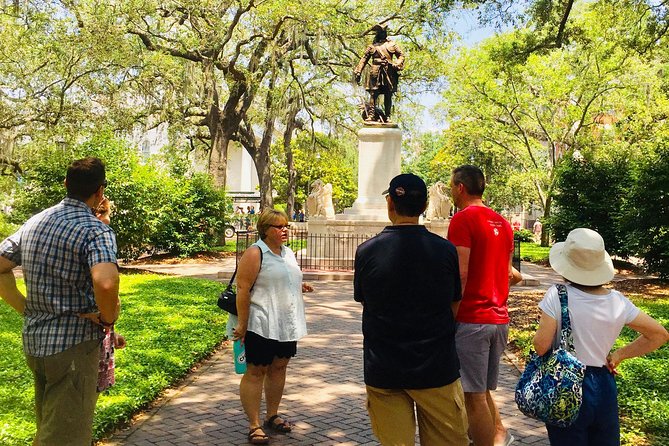
Chippewa Square is likely the most recognizable stop for film fans. This is where Forrest Gump sat with his box of chocolates while waiting for the bus.
The square also provides a chance to sort out a common mistake. The monument in the center honors General James Oglethorpe, not Captain Morgan. From a distance, the figure may suggest the famous rum-brand image, but the monument actually represents the man who founded Savannah’s colony.
That combination of movie trivia and local history keeps the stop light. You get the photograph opportunity, then move beyond the film to Oglethorpe’s role in Savannah’s beginnings. If Forrest Gump is important to your trip, this is a satisfying stop. If you are focused only on architecture, the film connection still takes just about 10 minutes.
More History Walking Tours in Savannah:
- Berlin: Third Reich & Cold War Guided Walking Tour
★ 4.9 · 8,378 reviews - Munich: Third Reich & WWII Walking Tour
★ 4.6 · 6,181 reviews - Berlin’s Best: 2 Hour Walking Tour Third Reich and the Cold War
★ 5.0 · 5,486 reviews - Third Reich Berlin: Hitler and WWII Walking Tour
★ 5.0 · 3,301 reviews
The Sorrel Weed House and Savannah’s gray brick
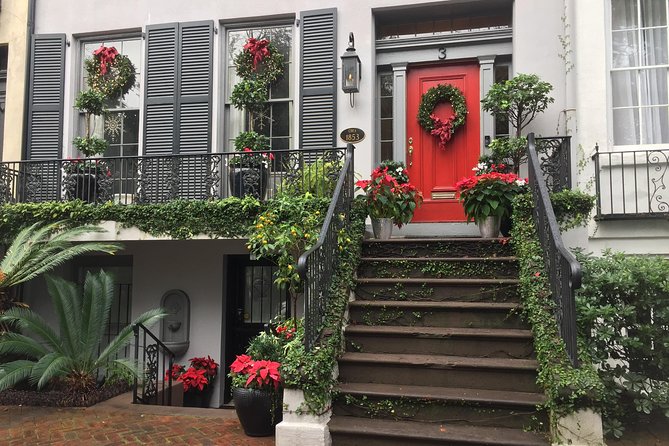
The walk passes the Old Sorrel Weed House, known as one of Savannah’s haunted homes. You do not go inside. Instead, the guide discusses the gray brick wall around the courtyard, including the fingerprints pressed into the brick and the source of the material.
At about two minutes, this is one of the briefest stops. It works as a quick visual detail rather than a full haunted-house experience. If you want ghost stories or an interior tour, you would need to make a separate plan.
That said, the stop adds texture to the walk. Savannah’s historic buildings are not only about grand facades. Walls, bricks, courtyards, and construction marks can reveal just as much about the city’s past.
Madison Square and the Siege of Savannah
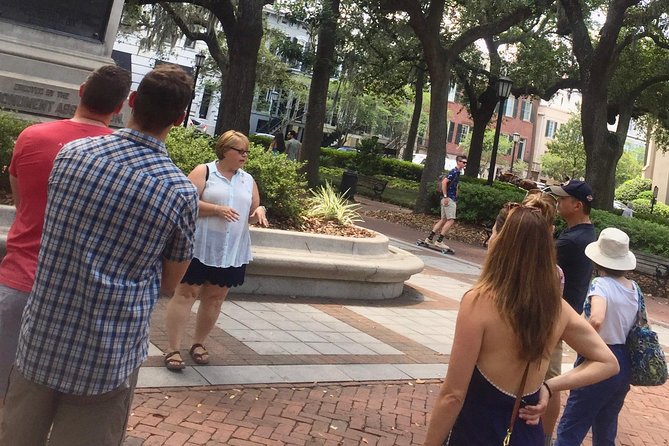
Madison Square carries some of the heaviest history on the route. The square occupies the site of one of the bloodiest battles of the American Revolution, the Siege of Savannah.
This stop lasts about 10 minutes. The value here is location. Instead of treating the Revolution as a distant event in a textbook, the guide places the conflict in a square where you are standing. The calm setting can make the story easier to picture, even if the park itself gives little visual sign of the battle.
If you enjoy military history, listen closely at this point. The tour does not promise a battlefield walk or a long tactical briefing, but it gives you a clear reason why this particular square matters.
Green-Meldrim House and Sherman’s Savannah headquarters
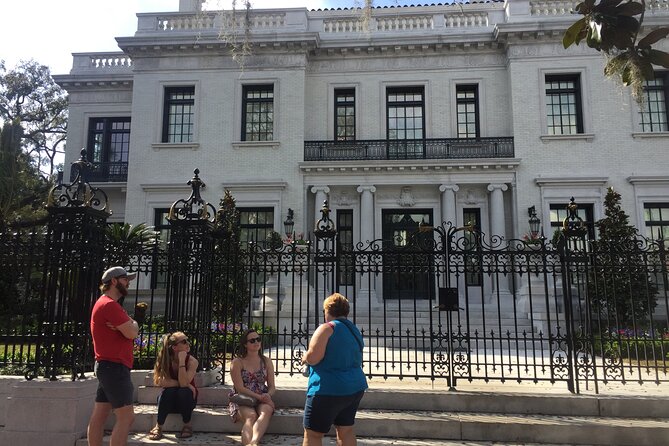
Green-Meldrim House is one of the route’s architectural highlights. Completed in 1853, it is presented as a leading example of Gothic architecture in the South. The home cost $93,000 at the time, equivalent to about $3.2 million today, making it Savannah’s most expensive home during the 1800s.
The house also links architecture to the Civil War. General William Tecumseh Sherman used it as his headquarters during the March to the Sea, when his forces occupied Savannah.
You see the building from outside, so this is not a house museum visit. Still, the stop makes good use of the facade. The combination of cost, design, and wartime history gives you three ways to read the building: as an expensive private residence, a Gothic landmark, and a military headquarters.
Passing the Savannah Volunteer Guard building
The route continues past a building originally built for the Savannah Volunteer Guard. It is now owned by the Savannah College of Art and Design, commonly called SCAD.
This is a pass-by rather than a formal stop, so do not expect a long presentation or interior access. It is useful as part of the broader pattern of the tour, where historic structures continue to serve new purposes.
The Gryphon Tea Room and an old apothecary
You also pass the building that houses the Gryphon Tea Room, known as the Shriner’s Building. Inside the tea room is what amounts to a small museum of its own. The space once served as Solomon’s Apothecary and retains original mahogany cabinetry and medicine cubbies.
The tour does not include a meal or tea service, but the guide points out why the building deserves attention. You may want to return for lunch, dinner, or tea if the schedule allows. It is a practical recommendation because the restaurant offers a chance to see more of the preserved interior than you can during the walk.
Mercer-Williams House and Savannah’s most famous scandal
The Mercer-Williams House is tied to John Berendt’s book Midnight in the Garden of Good and Evil. The story centers on Jim Williams, who bought the home in 1969, and the 1981 shooting of his assistant, Danny.
The book appeared in 1993 and remained on the New York bestseller list for 216 weeks. The later film helped put Savannah on the tourism map, and the house became one of the city’s best-known addresses.
You see the home from outside and hear the story rather than entering. If you have read the book or watched the film, this stop will carry more weight. If you have not, the guide still gives enough context to explain why one private residence became so closely tied to Savannah’s public image.
I recommend reading the book or watching the movie before you arrive if this part of Savannah interests you. It will give the house and the surrounding streets a stronger sense of place.
Armstrong-Kessler House, a private architectural showpiece
The Armstrong-Kessler House is another exterior stop, but it may be the most visually impressive home on the route. The house covers more than 26,000 square feet, and the guide explains its past and who lives there today.
This is a private home, not a museum, so you cannot tour the interior. That limitation is important. You are there to admire the scale and architecture from the street, not to explore the rooms.
The stop lasts around 10 minutes. For many people, that is enough time to take in the facade and hear the background. The house provides one of those moments when Savannah’s old wealth becomes immediately visible, even if the guide cannot show you how the building looks inside.
Ending at Forsyth Park Fountain
The walk ends at Forsyth Park, Savannah’s largest and most famous green space. The park began in 1848 with 10 acres and now covers 30 acres. The route finishes at the fountain, where you can continue exploring on your own.
The Forsyth Park Fountain arrived from France through a catalog order and was installed in 1858. That detail gives the park’s centerpiece an appealing mix of grand appearance and practical shopping history. You should plan on taking a photograph here, since the fountain is one of the city’s most recognizable sights.
Ending at Forsyth Park is useful for trip planning. You can linger in the park, walk back through the historic district, or use the tour’s orientation to choose your next stop. The finish also gives the walk a clear endpoint instead of leaving you somewhere in the middle of the old city.
What the two-hour format means for you
The tour takes about two hours and covers roughly one mile. Benches appear along the way, which helps, but you should still wear comfortable walking shoes. The route includes many stops, and the guide needs to keep moving to finish at Forsyth Park on time.
The stated maximum is 30 people. That is not a private walk, and a full group may make it harder to hear in noisy areas. One useful improvement would be ear microphones, especially when traffic or crowds make a guide’s voice harder to catch.
Morning and afternoon departures are available. I would choose based on weather and your wider schedule rather than assuming one time is always best. Savannah summers can be hot and humid, so carry water. Bring an umbrella, too, because the tour operates in rain.
The experience is offered in English and includes a professional local guide. It does not include entrance to the Juliette Gordon Low Birthplace, the Sorrel Weed House, or the private homes along the way.
Guide style and the value of local storytelling
The strongest part of this experience is the guide’s ability to connect facts to places. Rick is described as friendly, funny, and well prepared. Mark is noted for an informative, humorous style, while Rose and Crystal are praised for strong storytelling, local detail, and a willingness to answer questions.
Guides can vary, of course, so you should not book expecting one particular person unless the reservation specifically confirms that guide. The shared strength of the tour is its conversational approach. You hear about famous figures, local characters, movie locations, folklore, and architectural details in the same walk.
Some guides may spend extra time on ghost stories or side notes. That can add fun, but it may also reduce time for questions or make the route feel long in places. If you want a tightly timed survey of every square, this may feel less precise. If you like stories and are willing to pause for local color, the style should suit you well.
Who should book this Savannah walk
I would choose this tour for a first visit, especially if you want to understand Savannah before exploring on your own. It gives you a map in your head, identifies buildings worth a second look, and ends at a park where you can continue at your own pace.
It also suits history fans, architecture fans, film followers, and anyone who enjoys learning through stories rather than reading plaques. Families can take part, and most people can manage the walking distance, provided they are comfortable on foot.
You may want something else if you need wheelchair-specific route information, want extensive interior access, or prefer a small private group. You should also allow extra time if you hope to enter the museums or stop for tea at the Gryphon Tea Room.
The price is not provided here, so judge the value against what you pay at booking. A two-hour local introduction that covers major squares, famous homes, Revolutionary and Civil War history, and the route to Forsyth Park can be good value if it helps you plan the rest of your stay. The main return is not admission to attractions. It is the guide’s context and the time saved figuring out the historic district on your own.
Should you book it?
Book this walk if you want a lively introduction to Savannah’s historic core, with plenty of stories and a manageable route. I especially recommend it for your first morning or afternoon in town, before you return to the homes, museums, and squares that catch your interest.
Skip it if you want a deep interior tour, a quiet private experience, or a strictly chronological history lesson. For most people who enjoy walking, architecture, and a little well-told scandal, the route from Wright Square to Forsyth Park is a smart way to begin.
FAQ
Where does the Heart of Savannah History Walking Tour begin?
The tour begins in the center of Wright Square in front of the Gordon Monument in Savannah, Georgia.
Where does the tour end?
The walk ends at the fountain in Forsyth Park.
How long is the tour?
The tour lasts approximately two hours and covers about one mile, with benches along the route.
Are museum or house admissions included?
No. The tour views the Juliette Gordon Low Birthplace from outside and passes the Sorrel Weed House, Mercer-Williams House, and Armstrong-Kessler House. Admission to interiors is not included, and the Armstrong-Kessler House is private.
Does the tour operate in bad weather?
The tour operates rain or shine. In severe weather, you may be offered the option to reschedule. If the operator cancels because of poor weather, you can choose another date or receive a full refund.
What is the cancellation policy?
You can cancel at least 24 hours before the start time for a full refund. Cancellations or changes made within 24 hours are not accepted for a refund.
Just added around Savannah
- Savannah: Historic District Foodie Walking Tour★ 4.8 · 613 reviews
- Genteel and Bard’s Savannah History Walking Tour★ 5.0 · 684 reviews
- Savannah Haunted Pub Crawl Walking Tour★ 4.5 · 695 reviews
- Creepy Crawl Night-Time Haunted Pub Walking Tour of Savannah’s Historic District★ 4.5 · 802 reviews
- Haunted Savannah Booze and Boos Ghost Walking Tour★ 5.0 · 1,186 reviews
- 2-Hour Bonaventure Cemetery Walking Tour★ 5.0 · 1,270 reviews
- Bonaventure Cemetery Walking Tour with Transportation★ 5.0 · 1,467 reviews
- Genteel and Bard’s Savannah Dark History and Ghost Encounter Walking Tour★ 5.0 · 1,546 reviews
History Walking Tours, compared.



Berlin’s Best: 2 Hour Walking Tour Third Reich and the Cold War
Read our review →
Third Reich Berlin: Hitler and WWII Walking Tour
Read our review →
New Orleans Garden District History Walking Tour
Read our review →
Cartagena: Historic Center and Getsemaní Shared Walking Tour
Read our review →
Imperial Palace and Shogun Historical Walking Tour
Read our review →Browse the lists this tour appears in