
REVIEW · FLORENCE
Fascinating Florence: Guided Walking Tour
Florence’s greatest stories unfold outdoors on this tour: Medici power plays, artistic rivalries, religious drama, and the engineering puzzle behind Brunelleschi’s dome. You move from grand piazzas to narrower streets, with an English-speaking guide connecting the buildings to the people who shaped the city.
I like the small maximum group of 15 and the headsets, which help you hear even when the streets are noisy. I also like the practical advice about restaurants, bars, shops, and gelato. The main drawback is the price: $511.66 per person is a steep sum for roughly three hours, especially since entry to the Duomo interior and the dome climb are not included.
Key things to know before you book
- The best first-day orientation: The route links Florence’s central sights and helps you understand where everything sits.
- A guide-led history lesson: Expect stories about the Medici, Leonardo, Michelangelo, religious fanatics, and Florence’s rise as an art center.
- Headsets are provided: You can keep up with the guide without crowding around a single speaking point.
- The Duomo is mainly an exterior stop: The dome, Baptistery, bell tower, and cathedral are explained, but cathedral entry is omitted under the stated access rules.
- Santa Trinita is the church entry: Knees and shoulders must be covered, and services or closures can affect access.
- A costly short tour: The experience may suit someone who values a private-feeling introduction, but the listed price deserves careful thought.
Why this Florence walk works best on your first full day
I like guided walks in Florence because the historic center can feel easy to wander but hard to understand. A palace may look like another grand building until someone explains which family paid for it, which rival it challenged, or how its location reflects old political divisions.
This tour gives you that framework in three hours. You begin near Piazza della Repubblica and finish at Piazza del Duomo, passing major landmarks along the way. That makes the route useful for getting your bearings fast, then returning later to the places that deserve more time.
The strongest part is the storytelling. The tour asks questions that turn stone and marble into drama: who was buried alive near the Duomo, what Leonardo did that offended Michelangelo, and how the Medici used artists to strengthen their rule. Those details make the city easier to read after the walk ends.
The pace is not a museum crawl. Much of the experience takes place outside, with short stops of about 15 minutes. One person described it as less walking than expected, while others specifically advised good shoes for cobblestones and a long route. The fair reading is that you will walk steadily between sights, but much of the time is spent listening at fixed points.
More Guided Tours in Florence:
- Florence: Highlights Walking Tour with Expert Guide
★ 4.6 · 4,662 reviews - Florence: Duomo Complex with Tickets & City Walk Guided Tour
★ 4.7 · 2,057 reviews - David & Accademia Guided Tour with Time Entry Ticket
★ 4.5 · 1,705 reviews
Starting at Piazza della Repubblica
The meeting point is Via Roma, 1r, in central Florence. From there, the tour heads toward Piazza della Repubblica, one of the city’s most open and recognizable squares.
This is a useful place to begin because it gives the guide room to explain Florence’s long development before the group moves into tighter streets. You receive an introduction to the city, its medieval period, and the forces that later helped create the Renaissance.
The square is also a practical reference point. If Florence is new to you, the central location makes it easier to connect later walks to the Duomo, Palazzo Strozzi, Santa Trinita, and the Arno.
A small logistical warning: make sure you understand the meeting instructions before tour morning. One guest nearly missed the start after finding the office arrangement confusing, and another arrived early to find the office door locked. Arrive with enough time to locate Via Roma, 1r rather than assuming the guide will be waiting in the middle of the square.
Orsanmichele and the churches of central Florence
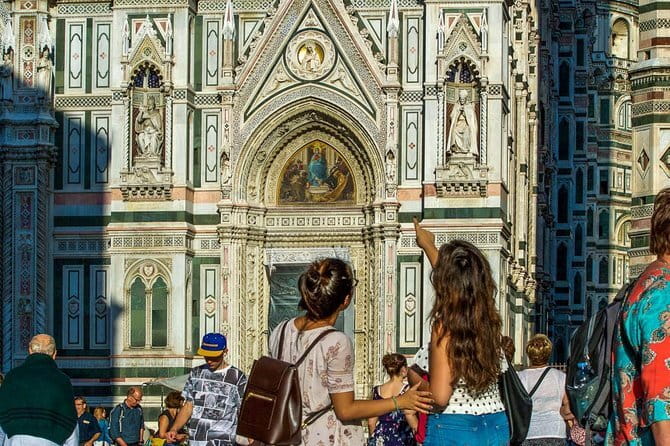
The route includes the Church and Museum of Orsanmichele, along with views or discussion of Santa Trinita and the cathedral area. These stops show how Florence blended religion, commerce, art, and civic power.
Orsanmichele is especially useful in that conversation. It began with a practical public function before becoming a church, and its decorated exterior reflects the influence of Florence’s trade guilds. You do not need a long lecture to appreciate the basic point: in Florence, wealthy working groups helped shape public art and religious spaces.
At Santa Trinita, the tour includes church entry when conditions allow. This is one of the few stated interior visits, so dress for it. Men and women must cover knees and shoulders, and sleeveless or backless tops are not permitted. A church may also be closed during Mass or another service, so access cannot be treated as guaranteed at every departure.
The guide’s commentary is the real value here. Past guides such as Mario, Angelo, Ismael, Hilde, Silvia, Riccardo, and Corina were praised for clear explanations, humor, and strong storytelling. The specific guide varies, but the experience depends heavily on who leads your group. That is normal on a walking tour, and it is worth expecting a human guide with a personal style rather than a fixed audio script.
Palazzo Strozzi and the power of wealthy families
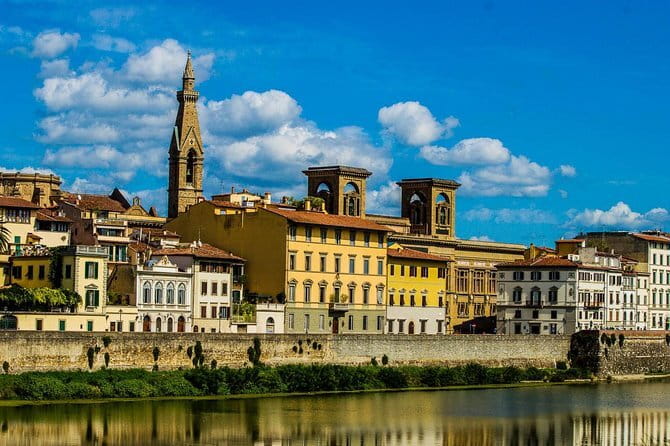
Palazzo Strozzi is viewed from outside, but it deserves its place on the route. Its massive stone exterior tells you plenty about the old rivalry between Florence’s leading families.
The Strozzi family had wealth, ambition, and a long-running conflict with the Medici. A palace like this was not just a comfortable home. It was a public declaration of status, influence, and confidence.
I like stops like this because they prevent the tour from becoming a parade of famous names. You see how politics appears in the architecture. The palace also gives your guide a chance to explain how merchant wealth helped finance art, churches, and public buildings.
Do not expect to go inside Palazzo Strozzi as part of this walk. The visit is from the outside, so the stop works best if you enjoy context and street-level architecture rather than a palace interior.
A few more walking tours around Florence worth a look
- Uffizi & Accademia Timed Entry: Small Group Duomo Walking Tour
★ 4.5 · 3,630 reviews - Florence: Guided Walking Tour
★ 4.6 · 1,602 reviews - Florence: Renaissance and Medici Tales Guided Walking Tour
★ 4.8 · 1,549 reviews - Florence: Uffizi & Accademia Small Group Walking Tour
★ 4.7 · 1,380 reviews
Ponte Vecchio and the crossing of the Arno

Ponte Vecchio is another exterior stop, with time devoted to its story and place in Florence. The bridge is one of the city’s essential sights, but it can be difficult to appreciate when you are simply trying to cross it among crowds.
A guide gives you a reason to pause. You hear how the bridge fits into Florence’s commercial and political life, then gain a better sense of its relationship to the surrounding streets and river.
The bridge stop also adds variety to the tour. After churches and palaces, you reach an open crossing with a different feel. It is a good point to take photographs, but keep your attention on the guide as well. The walk is not designed as a long photo break, and the group must keep moving to cover the remaining sights.
Piazza della Signoria and Florence’s public stage
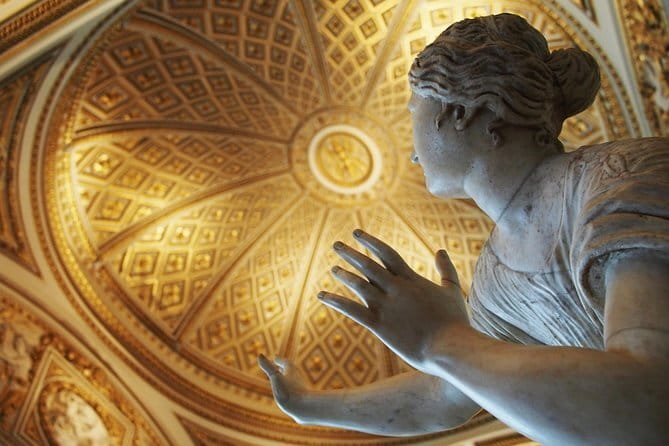
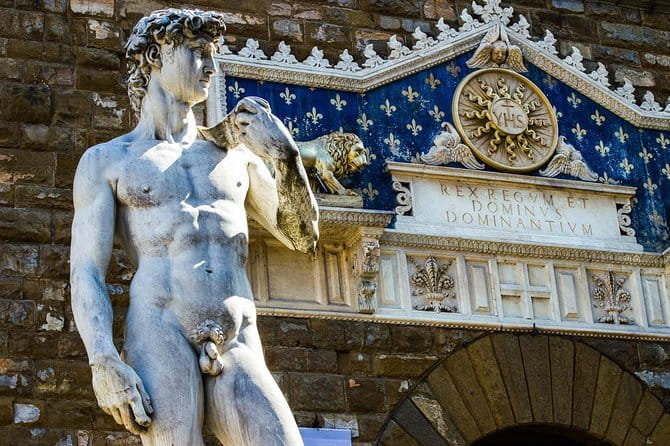
Piazza della Signoria is where Florence’s political story becomes especially visible. The square is surrounded by major buildings and sculpture, but the guide’s stories give the space its force.
This is where I would pay close attention to the discussion of Medici rule and Florence’s use of art. The city’s rulers did not treat paintings and sculpture as decoration alone. Public art could honor a family, intimidate opponents, express religious ideas, or promote civic pride.
The guide also connects the square to the feud between artists and the difficult personalities behind famous works. Questions about Leonardo and Michelangelo help make the period feel less like a list of dates and more like a contest among ambitious people.
Some tours rush through Piazza della Signoria because there is so much to see. Here, the planned stop gives the guide room to explain the political meaning behind the setting. The tradeoff is that you will not receive a full museum visit. You are learning how to read the square, not entering every building around it.
Piazza del Duomo and Brunelleschi’s great problem
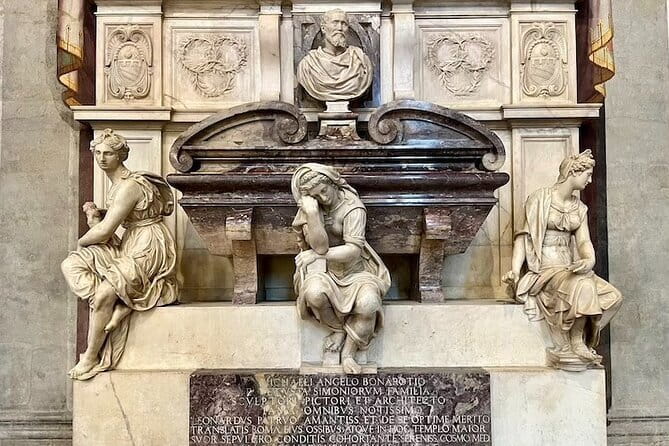
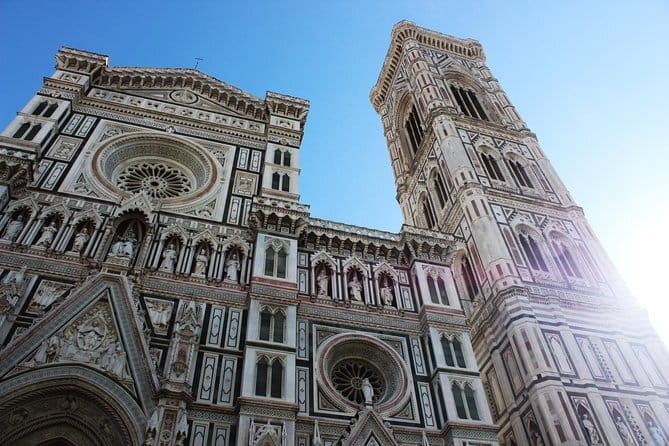
The tour ends at Piazza del Duomo, where you see the San Giovanni Baptistery, Giotto’s Bell Tower, the Gates of Paradise, and Brunelleschi’s famous dome.
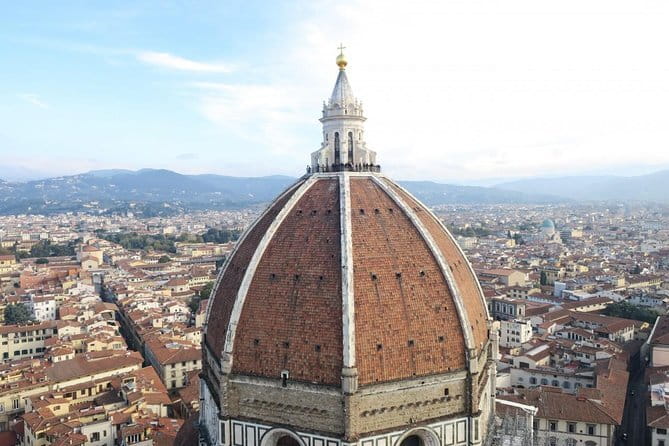
This is the grand finish, and it brings together the themes introduced earlier: money, faith, competition, technical skill, and civic pride. The guide explains how a goldsmith and untrained architect took on one of the most difficult building projects of the Renaissance.
The dome itself is worth careful attention. From the piazza, you can see its scale and unusual profile, while the guide explains the engineering challenge behind it. You also learn why the cathedral complex became such a powerful symbol for Florence.
Here is the important limitation: climbing the dome is not included. The current tour information also says that entry into the cathedral is omitted because of a required 30-minute video and changing priority-entry rules. The overview may suggest stepping inside Santa Maria del Fiore, but you should plan on an exterior Duomo experience unless the operator confirms otherwise for your date.
That distinction matters. If your main goal is the cathedral interior, dome climb, or Baptistery entry, you will need separate arrangements. If your goal is to understand the Duomo’s place in Florence’s story, the final stop still provides a strong introduction.
What the headsets and group size change

The supplied headsets are a real practical benefit. Florence’s center can be noisy, and a guide speaking to 15 people without audio equipment can be hard to follow. With a receiver, you can stand a little apart, look up at a building, and still hear the explanation.
The maximum group size is 15, which is smaller than many city walks. It does not make the tour private, but it should make questions and movement easier. The exact number may be lower. One past group had only seven people, creating a more personal feel.
The guide quality matters just as much as the equipment. Ismael was praised for being clear, friendly, and full of useful local facts. Angelo was described as funny and enthusiastic. Mario was noted for bringing Medici history and Florence’s secrets to life. Hilde, Silvia, Riccardo, Manoli, Laura, and Corina also received especially warm praise for their presentation.
You should not book on the assumption that one specific guide will lead your departure. Names show the range of guides used by the company, not a guaranteed roster for your date.
Food, shopping, and advice beyond the landmarks
The tour promises tips about restaurants, bars, shops, and gelato. This can be more useful than it sounds, especially on your first day, when every street seems to offer an attractive place to eat.
Ask specific questions. You might ask where to find a relaxed dinner near your hotel, which shopping streets fit your budget, or where to stop for gelato after the tour. The guide’s local perspective can help you avoid choosing a place simply because it is closest to the Duomo.
The food discussion also fits Florence’s history. Italian cuisine is part of the tour’s subject, not just an extra recommendation list. You hear how food and local custom fit into the city’s wider story, then can test that advice during the rest of your stay.
Price, value, and who should pay it
At $511.66 per person, this is expensive for a three-hour group walk. The price is easier to justify if the booking is for a small group, if the guide quality is excellent, and if you place a high value on a strong introduction to Florence.
It is harder to justify if you expect several paid admissions, a cathedral interior visit, or a dome climb. Those are not included. Most of the listed sights are seen from public spaces, and Santa Trinita is the main stated church entry.
For comparison within your own plans, ask what you want from a guide. If you mainly need directions and a list of sights, this price is too high. If you want a well-organized history lesson that helps you understand the Medici, Renaissance art, and central Florence before exploring alone, the value is better.
I would book it early in your stay, ideally on your first full day. That timing lets you use the restaurant advice, recognize the main squares, and return to the places that caught your attention. It also means you can spot any gaps, such as the Duomo interior, and arrange separate visits afterward.
Walking comfort, clothing, and weather
Wear comfortable shoes. Florence’s streets can be hard on your feet, and the walk includes several central stops connected by cobbled surfaces.
The tour operates in all weather. Bring suitable clothing rather than assuming the walk will be canceled for rain or heat. You may want water and sun protection in warm weather, though those specific items are not supplied.
Dress with church entry in mind from the start. Knees and shoulders must be covered for both men and women, and sleeveless or backless tops and shorts may lead to refused entry. One past comment suggested that rules were enforced loosely on a particular day, but you should follow the official requirement instead of counting on an exception.
Should you book Fascinating Florence?
Book this tour if you are visiting Florence for the first time, enjoy stories about people and power, and want a guide to organize the city before you explore it alone. The small group cap, headsets, central route, and strong record of engaging guides all work in its favor.
Think twice if you mainly want interior access to the Duomo, a dome climb, or a low-cost walking tour. The listed price is high, and much of the route is viewed from outside. For the right person, this is a lively history and orientation walk. For someone seeking a ticket-focused cathedral visit, it is the wrong tool.
FAQ
How long does the Fascinating Florence walking tour last?
The tour lasts approximately three hours.
Where does the tour start?
It starts at Via Roma, 1r, 50123 Firenze FI, Italy, in central Florence.
Where does the tour end?
The walk ends at Piazza del Duomo, and the tour information identifies the Duomo as the final location.
Is the tour conducted in English?
Yes. The experience is led by an English-speaking local professional guide.
Is entry to the Duomo included?
No dome climb is included. The stated access information says cathedral entry is omitted under the current priority-entry rules, so you should plan to see and discuss the Duomo from the outside.
What should I wear for the churches?
Your knees and shoulders must be covered. Shorts and sleeveless or backless tops are not allowed for entry into sacred sites.
How large is the group?
The group has a maximum of 15 participants. Headsets are provided so you can hear the guide clearly.
Can I cancel for a refund?
No. The experience is non-refundable and cannot be changed for any reason. If the operator cancels because the minimum number of participants is not reached, you will be offered another date or experience, or a full refund.
Just added around Florence
- Medici Legends & Renaissance Wonders: Florence Small Group Tour★ 5.0 · 205 reviews
- Tasty Florence Street Food with Guided Walking of the City★ 5.0 · 174 reviews
- Florence Food Tour of 10+ Authentic Tastings with Cheeses & Wines★ 5.0 · 155 reviews
- Florence Private Walking tour with Skip-the-line to Accademia★ 4.5 · 236 reviews
- Florence: Whispers of the Renaissance walking tour★ 4.5 · 78 reviews
- Private Florence Tour: 3-Hour Walking Tour with a Licenced Guide★ 5.0 · 233 reviews
- The Best of Florence Walking Tour in a Small Group★ 5.0 · 503 reviews
- Private Skip-the-Line Florence Highlights and David Walking Tour★ 4.5 · 78 reviews
Walking Tours, compared.

Magical London: Harry Potter Guided Walking Tour
Read our review →
Reykjavik Food Walk – Local Foodie Adventure in Iceland
Read our review →
History and Hauntings of Salem Guided Walking Tour
Read our review →
New Orleans Premier Ghost, Voodoo and Vampire Walking Tour
Read our review →
Amsterdam Anne Frank: Small-Group Walking Tour & Local Guide
Read our review →

Edinburgh Castle: Guided Walking Tour with Entry Ticket
Read our review →
Anne Frank’s Story – Guided Walking Tour through Amsterdam
Read our review →Browse the lists this tour appears in