
REVIEW · CHARLESTON
Behind the Scenes of Shem Creek Shrimp Walking Tour
Shem Creek’s shrimping story begins away from the restaurant patios, on old residential streets where fishing families lived and worked. Captain Bryan connects those houses, ferry routes, seafood businesses, and working trawlers into a clear story about how commercial shrimping shaped Mount Pleasant.
I like the small maximum of 15 people, which gives you room to ask questions, and I like the hands-on cast-net lesson at the end. The guide’s local ties also matter: Captain Bryan grew up in the area and has family connections to the shrimping industry. The main drawback is simple: this is not a food tour, and you should not expect shrimp to eat or a ride on a shrimp boat.
Key points at a glance
- A local history walk: Connects Mount Pleasant’s old homes and neighborhoods with Charleston Harbor, wartime events, storms, and the rise of commercial shrimping.
- Working waterfront access: You pass seafood facilities, shrimp shacks, and trawlers while learning how boats and nets operate.
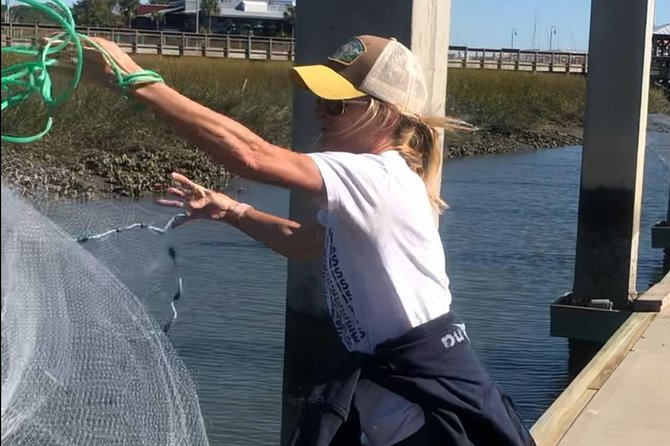
- Hands-on finale: The tour ends with a cast-net demonstration, with a chance to learn how shrimp are caught.
- Captain Bryan’s local connection: His family ties to the fishing trade add personal context to the story.
- A manageable but real walk: Plan on about 1.5 miles over 90 minutes, with little relief from summer heat.
- Good value for history fans: At $29, the tour offers a focused small-group experience, but the value depends on wanting history rather than a meal or boat ride.
Shem Creek begins with houses, not seafood restaurants
Many people first picture Shem Creek as a place for waterfront dining and sunset views. This tour takes a different route. It starts on Mary Street, then moves through old Mount Pleasant neighborhoods before reaching the creek and its working boats.
That order is important. You first learn how the community developed, then see how shrimping fit into local life. The tour does not treat the fishing industry as a stand-alone attraction. Instead, Captain Bryan explains how homes, ferries, seafood businesses, and commercial boats formed one connected community.
The walk covers roughly 1.5 miles and lasts about an hour and a half. At $29 per person, I consider it a fair price for a small-group local history tour, especially if you value personal storytelling and the chance to ask questions. It is less compelling if you are mainly paying for a boat encounter, seafood tasting, or a quick photo stop.
The tour begins at 10 a.m. at 111 Coleman Boulevard in Mount Pleasant. It ends at 1313 Shrimp Boat Lane, a short walk from the starting point, beside a public boardwalk along the creek. That finish gives you time to look around Shem Creek afterward, but the walk back to your car should be part of your plan.
A few more walking tours around Charleston worth a look
- Historic Charleston Guided Sightseeing Walking Tour
★ 5.0 · 6,216 reviews - Ghosts of Charleston Night-Time Walking Tour with Unitarian Church Graveyard
★ 4.5 · 2,835 reviews - Hidden Alleyways and Historic Sites Small-Group Walking Tour
★ 5.0 · 2,335 reviews
Mary Street sets the harbor story
The first stop takes about 15 minutes on Mary Street. From here, you get an overview of Charleston Harbor and the forces that changed this seaside community over time.
Captain Bryan discusses conflict, natural disasters, and insect infestations. Those subjects may seem far removed from shrimping, but they help explain why coastal communities do not develop in a straight line. War can interrupt trade. Storms can reshape waterfront life. Disease and insects can affect where people live and work.
I like this opening because it gives you a wider frame before the tour narrows its focus to shrimp. You are not simply looking at boats and hearing a few facts. You are learning why this particular shoreline became important and how outside events affected local families.
The stop is free, of course, but the real value is the guide’s ability to turn a view of the harbor into a story. If you prefer a tour that gets to the boats immediately, this slower start may test your patience.
Magwood Drive reveals the shrimpers’ old homes
On Magwood Drive, you pass the home of Shem Creek’s first commercial shrimper and see the small shrimp shacks where early shrimpers lived. This is one of the most useful stops for understanding the work as a way of life rather than a modern attraction.
The homes help put scale to the story. Commercial shrimping was not just an industry carried out by anonymous crews on the water. It was tied to families, modest houses, and a neighborhood built around the creek.
You will not be touring the inside of these homes, and this is not a museum visit. The interest comes from seeing the structures in their original setting while Captain Bryan explains their place in the community. Several tour comments praise his ability to connect local buildings with larger American and South Carolina history, including war-era events and the growth of Mount Pleasant.
For me, this stop is a good reason to bring children or older kids who like stories with visible landmarks. The houses give them something concrete to look at while the history unfolds.
The Captain Peter Lewis House and the lost ferry link
The Shem Creek stop includes the Captain Peter Lewis House, built in 1855. The discussion then turns to the ferry system that once operated on the creek.
A ferry may sound like a small detail, but it shows how people moved around the water before modern roads and bridges made travel easier. The creek was not merely scenery. It was a route, a workplace, and a barrier that local residents had to cross.
This part of the walk also begins to shift your attention from private homes to the water itself. You start to see the creek as working infrastructure. That change in viewpoint is one of the tour’s strengths.
The house is a stop viewed from the outside, so do not expect an interior tour. The reward comes from the explanation and the setting. Captain Bryan is repeatedly praised for mixing humor with historical detail, and that tone helps keep these architectural stops from becoming dry.
Same streets, a different route:
- Highlights of Charleston Guided Walking Tour
★ 5.0 · 2,206 reviews - Charleston French Quarter or Brunch Food Tour with 7+ Tastings
★ 5.0 · 1,853 reviews - Charleston Haunted Booze and Boos Ghost Walking Tour
★ 5.0 · 1,569 reviews - Charleston’s Pleasing Terrors Night-Time Walking Ghost Tour
★ 5.0 · 1,345 reviews
Hibben Street connects an old house to a new industry
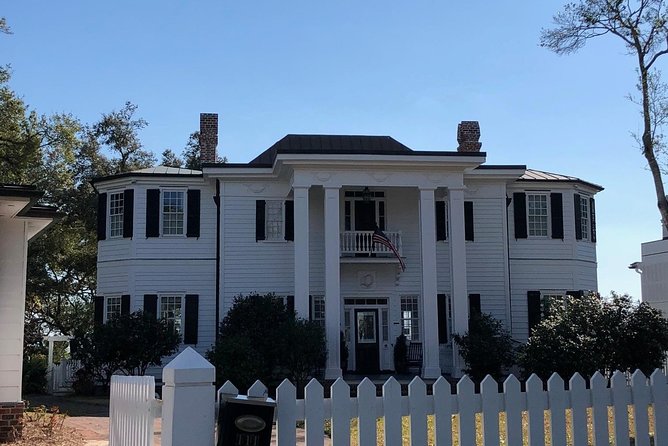
At Hibben Street, you see the Hibben House, the oldest standing structure in Mount Pleasant, dating to the mid-1700s. The house provides another piece of the area’s early settlement story.
Captain Bryan uses this older history to explain how commercial shrimping later began in the region. That connection is the heart of the tour. You are not being shown old buildings simply because they are old. You are being shown how a settled coastal community created the conditions for a fishing economy.
This is also where you should set your expectations carefully. The first half of the tour spends substantial time on homes, streets, and local history. If the word shrimp in the tour title makes you expect nonstop boat activity, you may find the balance surprising.
I see that balance as a benefit if you want context. A working trawler means more when you understand the community that built, staffed, and depended on it. But if your priority is machinery, catches, and time on the docks, this walking tour may feel too history-heavy.
Mt. Pleasant Seafood shows the industry today

The stop at Mt. Pleasant Seafood brings the story into the present. You see locally sourced seafood at a family-run facility and learn about the decline of commercial shrimping in the area.
The numbers make the change clear: Mount Pleasant once had nearly 100 trawlers, but that number fell to four by 1998. This gives the tour a strong sense of what has been lost. Shem Creek still has working boats and seafood businesses, but the industry is far smaller than it once was.
I value this stop because it avoids presenting shrimping as a frozen piece of folklore. You see a living trade facing pressure, and you learn why supporting local seafood businesses matters to the community.
You may see seafood being handled, but this is not a tasting stop. Do not arrive expecting a snack, lunch, or shrimp to take home. One part of the experience description has caused confusion on that point, so I would plan to eat before or after the walk. The guide can suggest local places for lunch, but a meal is not included.
Shem Creek Park brings you beside the trawlers
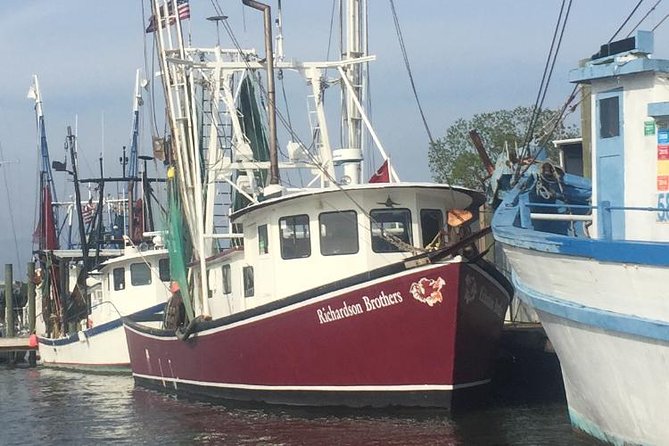
The final main stop is Shem Creek Park, where you walk along the boardwalk and see the shrimp trawlers. Here, the tour focuses on how the boats operate and how crews use nets to catch shrimp.
This is the closest the experience comes to a behind-the-scenes look at the working waterfront. You are not promised a trip aboard a boat, and the tour does not include a shrimping excursion. Instead, you get an explanation of the boats and their gear from the boardwalk.
That distinction matters. You can expect to see trawlers and learn how they work, but not to cruise the creek or handle commercial equipment. For many people, the shore-based format is enough. You can observe the boats without committing half a day to a cruise, and you remain close to Mount Pleasant’s public waterfront.
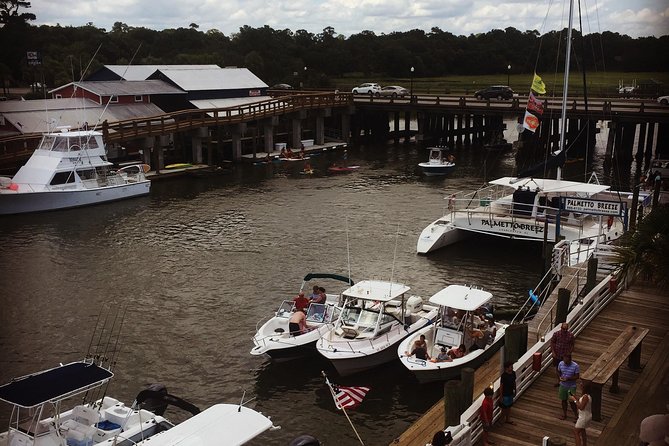
The boardwalk is also a pleasant place to finish. After the formal tour ends, you can continue exploring the creek on your own. The ending point is only a short walk from the start, so the route is practical for a morning outing.
The cast net lesson is the hands-on payoff
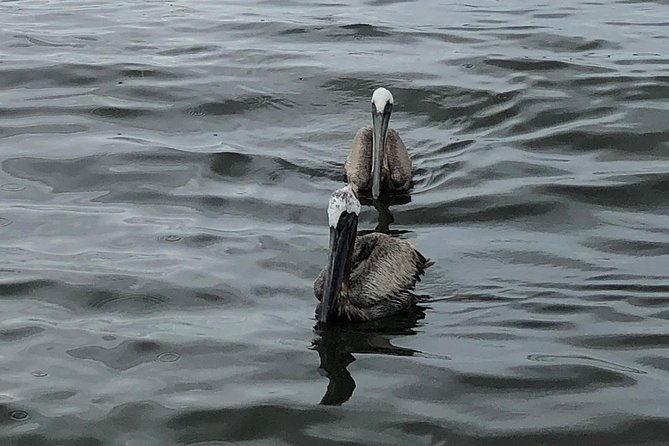
The tour finishes with a cast-net demonstration. You learn how to throw a net and how shrimp can be caught in shallow coastal waters.
This is the most interactive part of the walk, and it gives the morning a satisfying finish. Children especially have something active to do after listening to the historical sections. Adults get a better sense of the skill involved in a simple-looking fishing technique.
The cast-net lesson also keeps the tour from being only a sequence of buildings and explanations. You leave with a practical image of how people caught seafood, rather than just a list of dates and names.
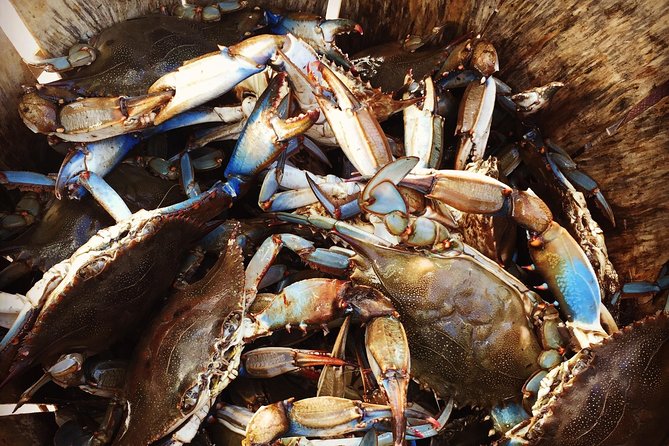
The experience can include other small surprises tied to the waterfront, such as seeing local aquatic life, but the promised hands-on feature is the net demonstration. The focus remains educational, not recreational fishing.
Captain Bryan is a major part of the value
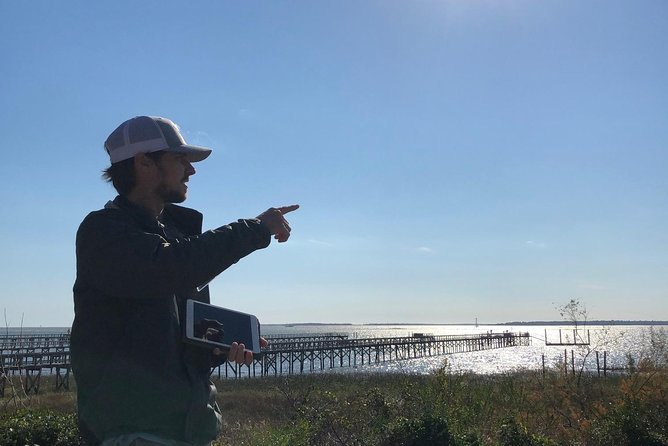
The guide makes a noticeable difference here. Captain Bryan is described as local to the area, connected by family to the shrimping trade, and comfortable discussing both broad history and small community details.
His approach appears to suit mixed groups. Families with children as young as two and four have found ways to stay involved, while adults get material on war history, architecture, sustainability, and the decline of the fishing industry. He is also praised for remembering names, answering questions, and treating children with patience.
That does not mean every minute will appeal to every person. A guide who tells long stories is a gift to someone who enjoys local history, but it can feel slow if you want a quick tour built around photographs. The best way to think about this experience is as a guided conversation while walking, not as a tightly timed attraction with constant movement.
The group maximum is 15 people. That is small enough for questions and personal attention without making the tour feel like a private booking. The tour is offered in English.
Walking conditions and planning tips
You should be able to walk about 1.5 miles at an easy pace. Most people can participate, and service animals are allowed, but summer heat deserves serious attention. Bring water, sunscreen, and comfortable walking shoes.
The route includes residential streets, creekside areas, and a boardwalk. Since the tour begins at 10 a.m., much of the walk may take place as the day warms up. If heat affects you quickly, plan ahead rather than treating the distance as trivial.
The tour requires good weather. If poor weather cancels it, you are offered another date or a full refund. If the minimum number of participants is not reached, the same options apply. You can cancel for a full refund up to 24 hours before the start time, but cancellations or changes inside that window are not refunded or accepted.
Who gets the most for $29
At $29, I see good value for several kinds of visitors:
- You want a local guide rather than a general Charleston overview.
- You enjoy old homes, neighborhood history, and working waterfronts.
- You are curious about where local shrimp comes from.
- You are traveling with children who like demonstrations and hands-on activities.
- You want to get away from the more crowded historic areas for a morning.
- You are interested in sustainability and the decline of a once-large local industry.
The price is harder to justify if you want food included, a boat ride, or access inside historic houses. You can walk parts of Shem Creek on your own for free, but you will not get the organized story linking the harbor, old homes, ferry system, seafood businesses, and trawlers.
The tour has a 5.0 rating from 171 reviews, with 99 percent recommending it. The repeated praise centers on Captain Bryan’s humor, local knowledge, family-friendly style, and ability to connect history with shrimping. The one clear warning is also important: expect history and a cast-net lesson, not lunch.
Should you book the Shem Creek Shrimp Walking Tour?
Book it if you want to understand Mount Pleasant through its people, houses, and fishing trade. The best parts are the personal stories, the connection to local shrimping families, the sharp decline from nearly 100 trawlers to four, and the chance to try a cast net.
Skip it if your main goal is eating shrimp, riding on a working boat, or spending most of the morning directly on the docks. For the right audience, $29 buys an engaging small-group walk with a strong local voice. Just eat beforehand, wear good shoes, carry water, and arrive ready for a history tour that ends at the creek.
FAQ
Where does the Shem Creek Shrimp Walking Tour begin?
The tour begins at 111 Coleman Boulevard, Mount Pleasant, South Carolina 29464.
Where does the tour end?
It ends at 1313 Shrimp Boat Lane, Mount Pleasant, beside a public boardwalk along the creek. The end point is a short walk from the starting location.
How long does the tour last?
The tour lasts approximately 1 hour and 30 minutes.
How far do you walk?
The walking distance is around 1.5 miles. You should be able to manage that distance, especially in warm summer weather.
What time does the tour start?
The stated start time is 10 a.m.
Is food included?
No. This is a historical walking tour about Shem Creek and the shrimping industry, not a food tour. No shrimp snack or meal is included.
Will I ride on a shrimp boat?
No boat ride is included. You walk by the shrimp trawlers at Shem Creek Park and learn how the boats and nets operate.
What happens if the weather is poor?
The experience requires good weather. If it is canceled because of poor weather, you can choose another date or receive a full refund.
Just added around Charleston
- Charleston Ghosts of Liberty Guided Walking Tour★ 4.5 · 473 reviews
- Private Charleston Walking Food Tour at the French Quarter★ 5.0 · 201 reviews
- Charleston Chicora 2 Hours Walking Tour★ 5.0 · 264 reviews
- Small-Group Tour: Charleston Old Walled City Historical Walking Tour★ 4.5 · 283 reviews
- Charleston’s Savor the Flavors of Upper King Street Walking Food Tour★ 4.5 · 130 reviews
- Lost Stories of Black Charleston Walking Tour★ 5.0 · 412 reviews
- Charleston History, Homes, and Architecture Guided Walking Tour★ 5.0 · 267 reviews
- Charleston History and Hops Tour: Bar and History Walk★ 5.0 · 316 reviews
Walking Tours, compared.

Magical London: Harry Potter Guided Walking Tour
Read our review →
Reykjavik Food Walk – Local Foodie Adventure in Iceland
Read our review →
History and Hauntings of Salem Guided Walking Tour
Read our review →
New Orleans Premier Ghost, Voodoo and Vampire Walking Tour
Read our review →
Amsterdam Anne Frank: Small-Group Walking Tour & Local Guide
Read our review →

Edinburgh Castle: Guided Walking Tour with Entry Ticket
Read our review →
Anne Frank’s Story – Guided Walking Tour through Amsterdam
Read our review →Browse the lists this tour appears in