
REVIEW · BOSTON
The Full Revolutionary Story Epic Small Group Boston Walking Tour
Boston’s revolutionary story makes more sense when you follow it in the order events happened, not simply from one end of the Freedom Trail to the other. This tour begins at City Hall Plaza and builds from Puritan Boston through protest, bloodshed, the Tea Party, Paul Revere’s ride, and the battles that followed.
I like the small group of no more than 15 and the way guides such as Tyler, Mike, Chris, and Tom use maps, cards, historic character badges, and even Lego soldiers to explain complicated events. I also like that the walk leaves the standard trail to show modern Boston, the North End, and the waterfront.
The catch is simple: this is a long outdoor walk, often three and a half hours, with little shelter from rain, cold, or wind. You need comfortable shoes and a moderate level of fitness. It is suitable for children, but it is a serious history lesson rather than a child-focused show.
Key points to know before booking
- The story follows historical order: You move from early Massachusetts Bay settlement through the events that led to independence.
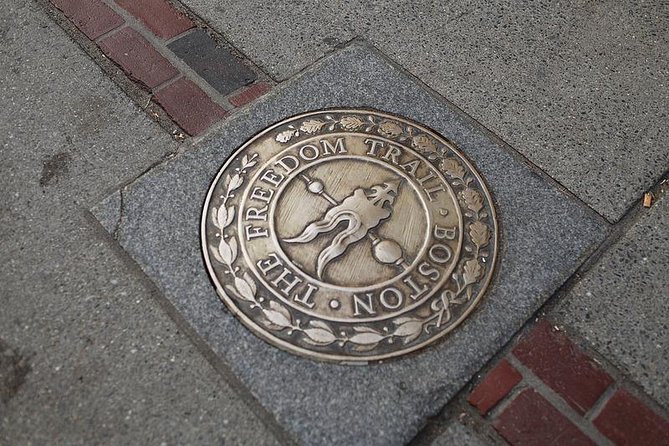
- The route goes beyond the red brick line: Expect the Freedom Trail, downtown streets, the Financial District, the North End, and Boston Harbor.
- The guides teach rather than perform: There are no costumes or staged re-enactments, but visual aids and audience participation help bring the material to life.
- The group stays small: A maximum of 15 people allows more room for questions and personal attention.
- The walk ends in Boston’s North End: You finish near Lewis Wharf, close to restaurants, public restrooms, public transportation, and the Aquarium stop.
- The price is $55: That is a fair rate for a three to three-and-a-half-hour guided walk, especially if you want context rather than quick facts.
Why the chronological route works so well
Many Boston walks treat the Freedom Trail as a line to follow. This one treats it as a story to assemble.
That difference matters. The Old State House means more after you understand the political pressure building around British authority. The Boston Massacre means more after you know who was arguing in the streets and why soldiers were stationed there. The Tea Party becomes more than a familiar schoolbook scene once you have seen the meeting places and burial grounds tied to the people involved.
The guides connect names, buildings, political ideas, and public anger. You are not simply told that Paul Revere was important. You learn how his work, neighborhood, and role in the resistance fit into the larger struggle.
The route also makes room for the present-day city. You pass office towers, the Financial District, public gardens, restaurants, and the waterfront. That keeps the experience from feeling like a museum visit stretched across three hours. Boston’s past is not isolated from its current life. It sits under the sidewalks, beside modern offices, and around restaurants serving lunch in the North End.
A few more walking tours around Boston worth a look
- Boston: Freedom Trail History Small Group Walking Tour
★ 5.0 · 6,450 reviews - Harvard University Campus Guided Walking Tour
★ 4.5 · 3,632 reviews - Boston Freedom Trail Walking Tour with Costumed Guide
★ 4.5 · 2,531 reviews
Starting at City Hall Plaza with a Boston sign
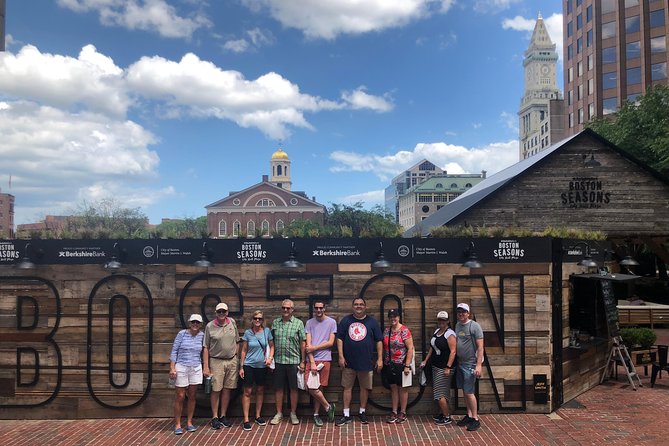
Meet your guide at City Hall Plaza, between Five Iron Golf and City Hall, near the seasonal beer garden and the large BOSTON sign. Faneuil Hall appears behind you, making this a handy place for an opening photograph.
The plaza is pedestrian-only and central, directly across from Faneuil Hall. That makes the meeting point easy to reach by public transportation and convenient if you are already exploring downtown.
The opening is more than a roll call and a quick orientation. You begin thinking about Boston as a working city with an older layer beneath it. Boston City Hall, famous for its stark architecture, provides an early reminder that the city has never been shy about making political and architectural statements.
King’s Chapel and Boston’s first settlers
At King’s Chapel Burying Ground, the focus shifts to the people who first settled Massachusetts Bay. This stop adds useful background before the Revolution begins.
The Puritans are presented as complicated people, not just stern figures from a history worksheet. Their beliefs, community rules, and conflicts helped shape the political culture that later produced arguments about authority and liberty.
You also pass Boston’s first Anglican church. That detail matters because it shows the religious and political tension within colonial Boston. The city was not built around a single point of view. Different groups competed for influence, and those disagreements helped create the conditions for later resistance.
Granary Burying Ground and the people behind the slogans
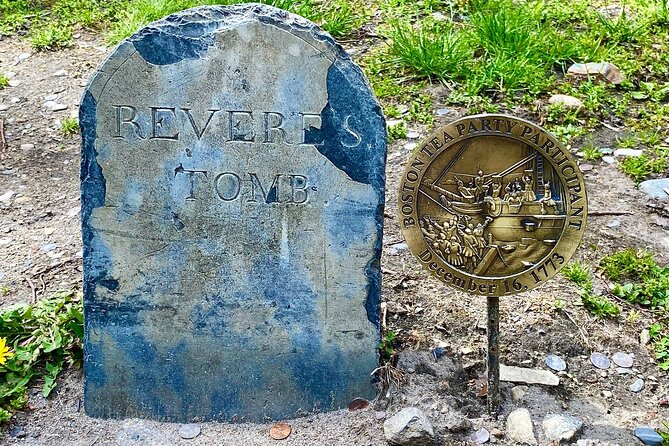
Granary Burying Ground is one of the strongest early stops. Here you see the graves of Paul Revere, John Hancock, and Samuel Adams.
The guide uses the cemetery to explain who the Sons of Liberty were and how their work turned public frustration into organized opposition. This is a good place for the tour’s people-first approach. Names that can blur together in a textbook begin to take on separate roles and personalities.
The walk also includes Brimstone Corner, known for fiery sermons and later connected with William Lloyd Garrison’s public opposition to slavery. That stop broadens the story beyond the Revolution itself. Boston’s public arguments did not end in 1776, and the city continued to use churches, meeting places, and streets as platforms for political debate.
Same streets, a different route:
- Boston’s Freedom Trail: A Revolutionary Walking Tour
★ 4.9 · 1,748 reviews - Boston: Freedom Trail History Small Group Walking Tour
★ 4.9 · 1,590 reviews - Boston North End Food Tour of 6+ Tastings, Cannoli, Lobster Roll
★ 5.0 · 1,404 reviews - Boston’s Freedom Trail: A Revolutionary Walking Tour
★ 5.0 · 1,343 reviews
Old City Hall, Benjamin Franklin, and the political center
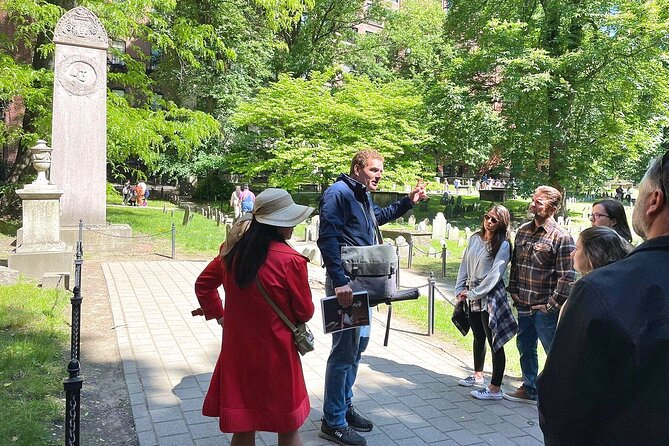
Old City Hall gives the group a chance to look closely at Boston architecture while discussing the difficulties built into democratic government. The point is not simply that the building is attractive. It is a prompt to consider who had political power, who was left out, and how public institutions worked.
At the Benjamin Franklin statue, you learn about America’s first public school and Franklin’s connection to it. Franklin’s place in the story is larger than his familiar image as printer, inventor, and statesman. This stop helps tie education, civic life, and self-made public influence together.
These shorter stops help break up the longer historical discussions. You are still walking, but the subject changes often enough to keep the route moving.
The Old State House and the Boston Massacre

The Old State House was the nerve center of Massachusetts politics and is described here as the oldest public building in the country. It is one of the best places to picture the clash between British authority and local political rights.
The Boston Massacre site follows naturally. The guide addresses soldiers, citizens, loyalists, and patriot leaders, showing how several groups were pulled into a fast-moving crisis.
This is where the tour’s effort to separate legend from evidence becomes useful. The goal is not to flatten the event into a simple story of heroes and villains. You hear about the competing pressures and the way political leaders used the incident to influence public opinion.
Nearby, the walk also points out a former publishing house associated with Ralph Waldo Emerson, Henry Wadsworth Longfellow, Nathaniel Hawthorne, and other literary figures. It is not a major Revolution stop, but it adds a later chapter to Boston’s cultural story.
Old South Meeting House and the start of the Tea Party
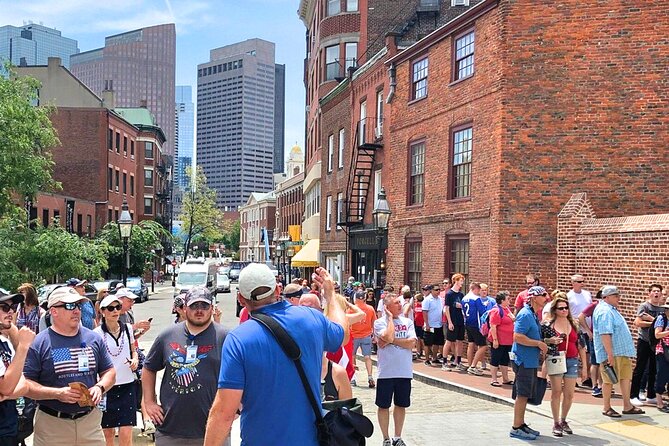
At Old South Meeting House, the story reaches one of its best-known turning points. This is where the large public gathering connected with the Boston Tea Party began.
The value of the stop is the buildup. You have already seen burial grounds, political offices, protest sites, and meeting places. Now you can understand how a public meeting moved toward direct action.
The tour does not treat the Tea Party as an isolated act of mischief. It places it within the wider argument over taxation, representation, British control, and colonial rights. You get the sense of a city where political debate was becoming harder to contain.
Post Office Square, the Financial District, and modern Boston
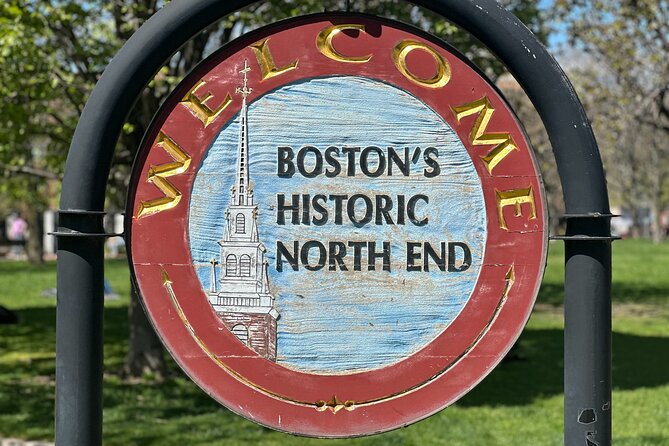
Post Office Square and the Financial District are where the tour makes its strongest connection to present-day Boston.
The walk passes through an area shaped by education, health care, finance, and business. Modern buildings surround the older sites, and the guide uses that contrast to show how much the city has changed.
I appreciate this part because it keeps the tour from turning Boston into a preserved colonial set. You see people going to work, office buildings, public spaces, and the daily rhythm of downtown. The Revolution happened in a compact city, but the city around those sites has grown dramatically.
Faneuil Hall and Quincy Market
Faneuil Hall is known as the Cradle of Liberty, and the tour explains how its roots reach into American political life. This is the point where a protest becomes a movement with wider force.
There is a built-in break around Faneuil Hall and Quincy Market. That gives you a chance to pause, use the market, and take in the setting without stopping the historical thread completely.
Quincy Market is also where the guide gives a practical warning: tourist traps abound. That is useful advice. The market is convenient and lively, but convenience does not guarantee the best meal in Boston. Save serious restaurant decisions for the North End, where the tour ends and the food choices become much stronger.
The Greenway and the road to Paul Revere
The Rose Fitzgerald Kennedy Greenway provides a welcome change of pace. This long public garden runs through the center of Boston and gives you open space after several dense downtown stops.
From there, the walk heads toward the North End and Paul Revere’s neighborhood. The Paul Revere House sits in one of the city’s oldest and most charming squares. You see the setting that shaped his daily life, rather than meeting him only as a figure on a midnight ride.
The walk does not turn Revere into a one-note hero. His work, neighborhood, and role in the resistance receive more attention than the famous ride alone. That wider view is one of the tour’s strengths.
North Square, Paul Revere’s statue, and Old North Church
North Square Park is described as the oldest residential square in America. It gives you a feel for the North End as a lived-in neighborhood, not just a collection of historic addresses and restaurants.
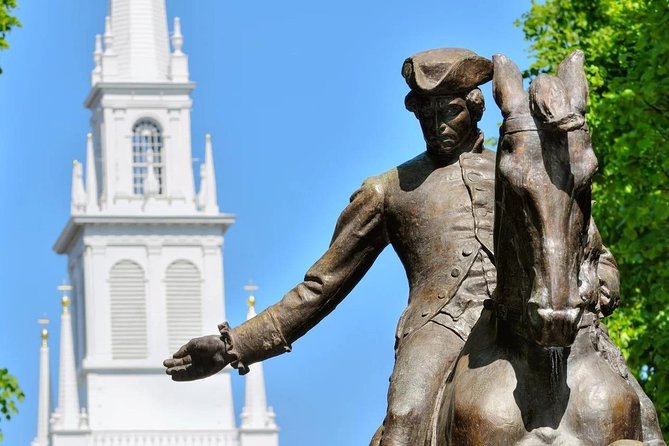
The Paul Revere statue provides the classic photograph. Then the route continues to Old North Church, where the guide explains the signal associated with Revere’s ride and the movement of information before the battles at Lexington and Concord.
This portion tends to be especially engaging for families with older children. The use of maps and small visual props helps show how signals, roads, riders, and military movements fit together. Children can follow the action, while adults get more context about the choices and risks involved.
Bunker Hill, Charlestown views, and Old Ironsides
The tour includes a complete account of the Battle of Bunker Hill, described as the largest battle of the American Revolution. A Lego soldier demonstration has been used to show troop positions and movement, and it is exactly the sort of simple aid that can make a confusing battle easier to picture.
You also get views toward Charlestown and Boston Harbor from a terrace near a second-oldest burial ground in Boston. The cemetery itself is viewed from outside, so do not expect an extended cemetery visit at every stop.
Across the harbor, you can see the oldest commissioned naval vessel in the world, USS Constitution, known as Old Ironsides. The ship was not part of the American Revolution, and this tour does not present it as though it were. Instead, the guide gives a short explanation and tips for seeing it properly on another visit.
That distinction is a good example of the tour’s larger approach. It adds nearby history without forcing every landmark into the Revolution story.
Finishing beside Boston Harbor in the North End
The final stretch passes through the North End, Boston’s oldest residential neighborhood. This is the place to talk about Italian food, seafood, pizza, cannoli, and the cultural life that developed long after the Revolution.
The walk continues along Boston Harbor and the Harborwalk, with views from piers, wharfs, and waterfront parks. Ocean air and open water provide a pleasant change after the narrow streets downtown.
The ending is at Lewis Wharf, close to public restrooms, parking, bicycles, public transportation, and the Aquarium stop. You are less than a ten-minute walk from the original meeting point, though the nearby North End restaurants are the better reason to linger.
The promised surprise tea party on Boston Harbor is part of the finish, but this is not a costume performance or full re-enactment. The activity is built around explanation, discussion, and the setting.
What $55 buys you
At $55 per person, this is not the cheapest way to see Boston’s landmarks. You can follow much of the Freedom Trail on your own for free.
The value comes from the organization and the time. A three to three-and-a-half-hour walk links 14 official landmarks with related sites, cemeteries, modern downtown, the North End, and the waterfront. A strong guide also saves you from reading disconnected plaques and trying to reconstruct the timeline yourself.
The small group matters here. A maximum of 15 people is far more manageable than a large crowd at busy downtown crossings. Guides can ask questions, demonstrate ideas, and respond to the group. Tyler, Mike, Chris, and Tom have been praised for strong storytelling, clear explanations, humor, and energy, with Tyler noted for his American history master’s degree and former curriculum work.
The price is easiest to justify if you want a serious introduction to Boston. If you only need quick photographs of the main landmarks, a self-guided walk may suit you better.
Practical advice for the three-and-a-half-hour walk
Wear walking shoes. The route covers a lot of ground, and several people who enjoyed it still described it as a long walk.
Dress for the forecast. The experience runs outdoors, and cold, rain, and strong wind can affect your comfort. The tour requires good weather and may be rescheduled or refunded if conditions are poor.
Bring water and plan your meal afterward. There is a short break around Faneuil Hall and Quincy Market, but the tour ends near some of Boston’s best-known food options in the North End.
Children are welcome when accompanied by an adult. The material is suitable for all ages, but it is not simplified into a children’s program. Older children and teenagers who enjoy stories, maps, and participation will likely get the most from it.
The experience is offered in English, uses a mobile ticket, and allows service animals. Free cancellation is available up to 24 hours before the start time. If the minimum group size is not met, you are offered another date or a full refund.
Who should book this Boston walk
Book it if you want the Revolution explained as a connected story, with the people, arguments, and locations tied together. It is a particularly good first activity in Boston because it gives you a framework for later visits to museums, ships, churches, and historic houses.
It also suits history fans who already know the basic names but want more substance. The guides go beyond the familiar Paul Revere and Tea Party material, using maps, props, and political context to explain how events unfolded.
You should think twice if long outdoor walks are difficult for you, if you prefer to enter every historic building, or if you want a short tour aimed at young children. Most stops are viewed from outside, and museum admission beyond the included Faneuil Hall and Quincy Market portion is not included.
For me, the best reason to book is the combination of story order and city coverage. You finish knowing not just where Boston’s famous sites are, but why they mattered and how the modern city grew around them.
FAQ
How long does the tour last?
The tour lasts approximately three to three and a half hours.
What is the price?
The cost is $55 per person.
Where does the tour begin?
It begins at City Hall Plaza, at 1 City Hall Square in Boston. The meeting area is near the large BOSTON sign, between Five Iron Golf and City Hall, beside the seasonal beer garden.
Where does the tour end?
The tour ends at Lewis Wharf in Boston’s North End, near Boston Harbor. The end point is close to public restrooms, parking, bicycles, public transportation, and the Aquarium stop.
How large is the group?
The maximum group size is 15 people.
Is transportation included?
No. This is a walking tour, and transportation is not included.
Are museum admissions included?
Museum entry is not included, except for the included portion at Faneuil Hall and Quincy Market. Most historic locations are viewed from outside.
Is the tour suitable for children?
Children are welcome when accompanied by an adult. The tour is suitable for all ages, but it is not designed as a children’s version of the events.
What happens if the weather is poor?
The experience requires good weather. If it is canceled because of poor weather, you are offered a different date or a full refund. You can also cancel for a full refund up to 24 hours before the start time.
Just added around Boston
- Boston: North End Pizza Walking Tour with 3 Slices & Cannoli★ 4.8 · 162 reviews
- Boston: Freedom Trail Guided Walking Tour in French★ 4.9 · 106 reviews
- Boston: Salem by Boat – Witch Trials & Walking Tour★ 4.3 · 263 reviews
- Boston: Full Revolution Story Epic Small Group Walking Tour★ 4.9 · 132 reviews
- Boston: 2-Hour Historic Walking Tour★ 4.7 · 88 reviews
- Self Guided Classic Freedom Trail Location Aware (GPS) Walking Audio Tour★ 4.5 · 258 reviews
- Boston History Tour: Scenic Walk Through Time & Landmarks★ 5.0 · 627 reviews
- Entire Freedom Trail Walking Tour: Includes Bunker Hill and USS Constitution★ 5.0 · 732 reviews
Walking Tours, compared.

Magical London: Harry Potter Guided Walking Tour
Read our review →
Reykjavik Food Walk – Local Foodie Adventure in Iceland
Read our review →
History and Hauntings of Salem Guided Walking Tour
Read our review →
New Orleans Premier Ghost, Voodoo and Vampire Walking Tour
Read our review →
Amsterdam Anne Frank: Small-Group Walking Tour & Local Guide
Read our review →
Edinburgh Castle: Guided Walking Tour with Entry Ticket
Read our review →
Anne Frank’s Story – Guided Walking Tour through Amsterdam
Read our review →Browse the lists this tour appears in